Category: Natural History Observations Page 29 of 34

Anoles Beaten at Their Own Game?

Both images from ganeshdhane's flickr page: http://www.flickr.com/photos/ganeshdhane/

Even though anoles aren’t the only lizards to have evolved dewlaps, their spectacular diversity of dewlap shapes and sizes certainly makes them leaders in the global arms race for dewlap dominance.  Nevertheless, I recently came across some photos of the spectacularly dewlapped-agamid Sitana ponticeriana doing something I don’t think anoles are capable of – displaying while standing on two hind limbs.  I’ve seen Australian agamids stand up for extended periods of time to display, dissipate heat, or scan the horizon, but I’ve never seen an anole do this for more than a few seconds while reaching for a new perch.  Sure, anoles can do lots of other stuff to get the message across – push-ups, full-ups, elaborate tail-wags, tongue protrusions, nuchal crest extensions, gapping, etc. – but I’m just not sure they’re built to stand.   My question to all the anoles lovers out there: has anybody ever seen one of our beloved creatures displaying while standing on its hind-limbs?

PS – Lots of other amazing photos of the dewlapped agamids are on Flickr

Anolis Cuvieri On The Prowl

Puerto Rican anole photographer extraordinaire, Father Alejandro Sanchez (you must see his webpage here) describes these photos of a female A. cuvieri: “In a karstic forest in north-western Puerto Rico, a female Puerto Rican giant anole (Anolis cuvieri) patrols its territory in search of prey. When doing so, members of this species usually move in a very deliberate way, reminiscent of chameleons to the point of moving their eyes independently as they scan the vegetation for food or danger.  Anolis cuvieri is usually very tame, and this individual hardly paid any attention to my movements or the camera’s flash. After I finished shooting, the lizard allowed me to stroke its tail for a few moments before jumping out of reach.” He also noted that “I saw a couple of A. cristatellus make themselves scarce as this female A. cuvieri approched.”

Zig First, Then Zag.

This female Anolis carolinensis has a tail that is kinked in a zig-zag fashion, starting from what seems to be the proximal autotomization point and continuing distally along the tail. The kinks are permanent. Running the tail between one’s fingers fails to smooth out the zig-zags. Have any anoleologists out there seen this growth pattern before? Any idea what might cause it? Additional photos and an x-ray are after the jump.

An Anole Murder Mystery?

Looking through old image files I found the above picture. At first glance, this may look like an unearthed fossil. No way. Try to earn some points by answering the questions below:

  1. Which species is this?
  2. What happened to it (cause of death)?
  3. Where (within the DR) or in which type of habitat did this take place (this is linked to #1 and #2)?
  4. What is the dark patch in the background/horizon, located in the upper right of picture (linked to #2 and #3).

Amazing Anole Fight Caught on Film

Fights between male anoles in nature can get pretty serious.  A few dramatic anole fight videos have already been posted on-line, including some mentioned previously on anole annals ([1], [2]).  Recently, I posted photos from a fight we saw this summer on a rock along the Rio Bani between two males of A. d. ravitergum.  This was the most dramatic anole fight I’ve ever seen, with the males tumbling head over heels down a boulder while locked in combat.  The fight ended with one male skulking off and the other proudly displaying from atop the boulder.  Now, Shea Lambert has posted his video of the fight on YouTube (Shea aptly added background music from the classic video game Mortal Kombat).  This video was taken with a point and shoot digital camera, so the quality isn’t the greatest, but Shea did a great job capturing all of the acrobatics!  To quote Shea immediately after the fight: “That dark anole is a straight-up ninja.”

Anolis Roquet Males Displaying On Exhibit

Acrobatic bushmaster says hello!

At the Nashville Zoo we have a large mixed species exhibit that contains two species of dart frog, a bushmaster, Gonatodes, and 2.3 Roquet’s anoles (Savannah anoles).  We are working on some new graphics where we hope to incorporate videos, and in that attempt we captured some great footage of our two male A. roquet displaying towards one another.  The two males are approximately a foot apart and right in front of the glass of the exhibit.  The females were watching anxiously as shortly after the video stops one male chases the other up a tree.  I hope you enjoy the clips.

http://www.flickr.com/photos/66876684@N04/6086156957/in/photostream

http://www.flickr.com/photos/66876684@N04/6086649388/in/photostream/

Anoles: They’re Just Like Us!

a juvenile Anolis orcesi, in the afternoon of an all-day recording

They wake up, but hit the snooze button before they really get moving.  They poop, grab something to eat, and then check out the neighborhood.  They take wrong turns, and have to turn around when they reach a dead end.  Young boys try to impress each other with their dewlaps.  They take naps in the afternoon, and yawn throughout the day. They even sleep in the same bed, most nights.

As Jonathan Losos hinted at in an earlier post, we observed 4 Anolis orcesi individuals from dawn to dusk (12 hours!), and several more individuals for 1 to 6 hours, in the vicinity of Baeza, Ecuador.  More to come after several months of video analysis!

Dominican anoles that bask together, stick together

I am irreparably fond of anoles, but I must admit that they are not the cuddliest of beasts. In fact, they can be downright unfriendly, especially with each other. The mere sight of another male sends anoles into spasms and, when not mating, males and females seem to barely tolerate each other, at best. It would seem that cuddling is best left to mammals and birds, but recent observations would indicate that even the ornery anole has a soft side.

Anolis shrevei mating pair cuddling in Valle Nuevo, Dominican Republic.

post by Kat Wollenberg on this blog documented two Anolis etheridgei sleeping with their tails intertwined. A follow-up  post by Melissa Woolley shows that Anolis gemmosus mating pairs sleep near each other, even if not touching.

But does an anole have to be asleep to show its softer side? In June 2011 I observed an Anolis shrevei mating pair in Valle Nuevo cuddle as they basked one afternoon. It is chilly at 2500 meters, even in the Dominican Republic. It had been a cold morning, and neither the sun nor the lizards had shown themselves until almost noon. But when the sun did peek out from behind the clouds, there was a mass exodus of anoles, which came out from under their rocks to take advantage of the day’s first rays. This little pair came out from under the same rock and sat together for close to an hour. They were touching each other, despite the fact that there seemed to be enough rock to go around. Whether this was coincidence or another mechanism of behavioral thermoregulation, the anoles of the chilly Cordillera Central know how to keep warm.

The Principle of Unsympathetic Magic Strikes (Yet) Again II

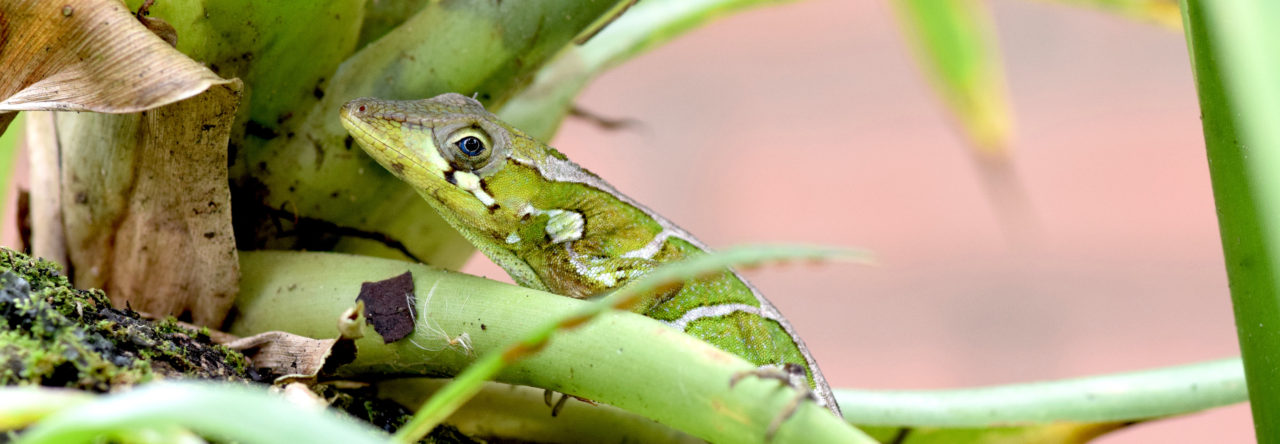
Phenacosaurus orcesi. Photo by Melissa Woolley.

As I prepared for our current trip to Ecuador to study the natural history of Phenacosaurus orcesi, I feared that we would not find any lizards. After all, until recently, the species was known from only two specimens. What if we simply couldn’t find them?

These fears were assuaged when I reviewed the literature—scant as it is—on phenacosaur ecology. In the most comprehensive study, Miyata found 77 P. heterodermus individuals in blackberry bushes in five afternoons of observations at a site near Bogota. On seeing the previous AA post, Vic Hutchison also recalled finding P. heterodermus in blackberry bushes in Colombia. George Gorman  mentioned to me that he  collected phenacs in a suburb of Bogota in the summer on 1968,  and he recalls that “it was a like Lesser Antillean experience…rather than a ‘mainland’ experience, in that the lizards were abundant, easily collected, and on fenceposts and hedges.” In addition, the original description of P. vanzolinii states that “the local people say that the ‘camaleon o camaleon’ is common in the fields of maize.”

From all of this information, I formed the hypothesis that finding phenacs would be easy, that we’d be awash with data and would finish so early that we could go traipsing off elsewhere in Ecuador. In other words, I set myself up for the Principle of Unsympathetic Magic to rear its ugly head, and it did so with a vengeance.

Hedges Team Rediscovers Anolis darlingtoni

Image of Anolis darlingtoni from http://www.philly.com/philly/blogs/evolution/A-Long-Lost-Lizard-is-Found-in-Haiti.html

Last week, Blair Hedges led a team of scientists, journalists and naturalists on a helicopter tour of some of the most remote forested habitats remaining on Haiti’s Tiburon Peninsula.  For anole enthusiasts, this expedition’s most remarkable find was the rediscovery of Anolis darlingtoni, an enigmatic species that hasn’t been seen since 1984.  As reported by Faye Flam at Philly.com, expedition member Miguel Landestoy spotted a single animal sleeping around 2m up in a tree fern.  This seems to have been the only darlingtoni recovered by the expedition, but full trip details are still filtering in.

Even with this rediscovery, Anolis darlingtoni remains the rarest anole on Hispaniola, and the one that is the most immediate danger of extinction.  Luke Mahler and I went to a great deal of trouble to search for A. darlingtoni in remnant forests at the western end of the Tiburon Peninsula a few years ago and came up empty, so I know that finding this species is no easy feat.  My congratulations to Blair, Miguel, and the rest of the team!

Page 29 of 34

Powered by WordPress & Theme by Anders Norén