Category: Natural History Observations Page 12 of 34

Sex and Battle in Puerto Rican Green Giants

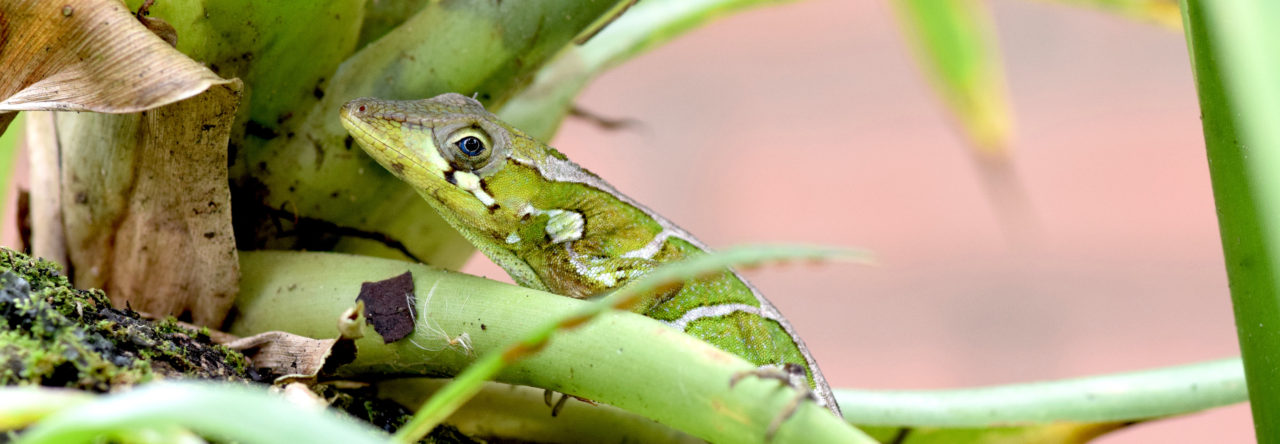
Anolis cuvieri. Photo by J. Losos.

Anolis cuvieri. Photo by J. Losos.

Several days ago, Manuel Leal, Liam Revell and I went to Cambalache State Forest in Puerto Rico, west of San Juan. We were there to search for anoles, particularly–the giant Puerto Rican anole, Anolis cuvieri—and other fauna and flora. The trip was a great success, culminating in an action-packed interaction between three—count ‘em, three!—A. cuvieri. Manuel has already posted some observations over on Chipojolab, but Rashomon-style, I’ll present my take on what went down.

At about 2 p.m., we were walking along when a female—our fourth cuvieri of the day—was spotted head down at a height of about six feet on a tree trunk. After observing it for a few minutes, we noticed that there was a male about four feet above her on the same trunk. We watched them do nothing for a while, the inactivity perhaps caused in part by our peering and approaching for photographs.

Manuel Leal photographing two Puerto Rican giant anoles.

Manuel Leal photographing two Puerto Rican giant anoles.

IMG_1416xAfter a while, the female walked across a narrow branch to the next tree, performing some small headbobs as she did so. After a while more, the male started displaying (see photo), but the female studiously ignored him. Finally, the male came over to the female, who immediately ran away, up the tree. The male ran after her and caught up with her. She seemed to be playing hard to get—if she’d really wanted to get away, why did she stop and let the male get to her? He then approached her from behind in typical male fashion and grabbed onto her by biting the back of her neck. She, however, would not allow him to mate, keeping her body pressed firmly to the branch.

Attempted mating, with female not being cooperative. Photo by Manuel Leal from Chipojolab

After this went on for a while, another male comes tearing over through the canopy from another tree and chases the first male down to the ground, where he runs to a nearby tree. The female takes off and disappears up the tree. The second male then goes back up the tree. After a while, the first male—who had turned very brown—moves over to a nearby tree, slowly resumes his green color, and starts nodding. The two males bob and look menacingly at each other, but they are separated by a distance too great to jump across. At the beginning, the second male flashed his dewlap a lot and presented an open mouth tongue display, but as time went on and the old male regained his greenness, these behaviors waned. Both males continually moved up their respective trees, neither seeming to want to let the other be higher. As the trees bent in opposite directions, moving up caused the males to become further and further apart. After a while, male #2 turned dark and seemed to adopt a submissive pose, whereas male #1, who had been chased off, had a victorious pose. How the two of them had decided that #1 had won is a mystery.

Males posturing at each other from a distance. Photo by M. Leal at Chipojolab

So, what went on? Was the female being unreceptive because #1 was an interloper and she was waiting for her guy to come by? Given that #2 started from another tree and eventually retreated back to it, that doesn’t seem to be the case. Was she mating publicly and prominently to attempt to attract other males, as Trivers suggested for the Jamaican giant A. garmani? Another point is that the interaction, although aggressive, involved little or no physical contact (couldn’t quite tell what happened when the second male rushed the first one at the outset); these two males may be old acquaintances and were simply reminding each other of where their territory boundaries lies. Notably, as well, when the two males were displaying back and forth, it seemed at times like one or the other was thinking about attacking, but the distance between the trees was too great to bridge in a jump. The only other avenue would have been to go to the ground and run over to the other tree, and then attack from below, which would seem to put that male at a disadvantage according to the laws of gravity.

I am unaware of any reports in the literature on A. cuvieri territorial or mating behavior, so these observations are interesting and perplexing. As Manuel states, this shows the importance of getting out and observing animals in their natural habitats—we’ve got a lot left to learn.

Snake Tries To Eat Lizard; Lizard Bites Back

Photo by Manuel Leal

Another anole bites the dust. Or does it? Over at Chipojolab,  Manuel Leal reports the observation of a Puerto Rico racer apparently in the process of ingesting an Anolis krugi. But if you look carefully, the krugi is giving as good as he gets. Or at least doing his darned best. Will it be enough to fend off his demise? Seems unlikely given the size difference, but in lab trials, Leal and Javier Rodríguez-Robles showed that Anolis cristatellus often bites attacking racers on the snout and can hang on for as long as 20 minutes; in 37% of the trials, the lizard actually escaped. Admittedly, cristatellus is bigger and beefier than krugi, but who knows–maybe this guy lived to see another day.

Lizards Licking Leaves: Why?

Manuel Leal recently observed this A. stratulus in Puerto Rico licking a leaf high in the forest at El Verde. He describes his observation over at Chipojolab, and suggests that they are not drinking water, and that the behavior is very focused.

Recently in the Bahamas, we observed a female A. sagrei licking a leaf. It hadn’t rained in several days and there wasn’t any dew on the leaves. However, close inspection of the leaf after the leaf left indicated that it was covered with a sticky substance. Perhaps aphid honeydew?

What Goes Around Comes Around: Who’s Eating Curly-Tailed Lizards?

A curly-tailed lizards, sans business end.

We’ve written much about the voracious depredations of curly-tailed lizards on smaller folks, so turnabout’s fair play. But who’s the culprit? Sean Giery provides all the gories over at The Abaco Scientist.

Green Anole Habitat Use When There Are No Brown Anoles

Wake up, green anoles. Spring is on the way.

We’ve had a lot of discussion of perch height in the green anole, A. carolinensis, and whether or not greens shift their habitat use downward in places where brown anoles, A. sagrei, don’t occur. AA’s man in Georgia, Janson Jones, reported last year that he often found greens very near to the ground, even on water plants. It’s a new year, things are warming up, and the greens are getting active. Janson has vowed to keep a close eye on all things anole this year, and a while back he just posted his first report over on Dust Tracks on the Web. Early reports are that the green anoles are messing with our minds again. Let’s see what happens as the summer progresses.

Information Wanted On Three-Legged Lizards

3 legged marsh harbour 2013 clinging dataPeriodically, AA has featured reports on finding three-legged lizards in nature (1,2). And here’s another one, briefly detained on a recent field trip to Abaco. Loss of her hindfoot doesn’t seem to be troubling her too much; heck, she’s even gravid!

Turns out that three-legged lizards pop up all the time. I’ve decided to put together a compilation of the little tricyclers. If you have any information on a three-legged lizard–a photo or more, such as measurements of mass, survival, or sprint performance–I’d love to know about it. Please contact me at jlosos@oeb.harvard.edu.

A Little Giant’s Dewlap… Why Do They Need One?

Anolis ricordii. Photo by Miguel Landestoy.

Anolis ricordii. Photo by Miguel Landestoy.

If a juvenile anole has a dewlap since birth, there must be a reason for it, but what is it?  Juvenile hispaniolan crown giants do have them and here is a video of one using it. This Anolis ricordii was only 52.10 mm in SVL and was showing his stuff while a colleague was taking photos of it. We placed it in the tree and left it for about 10 minutes without disturbing it, after which it started dewlapping and bobbing the head. At one point, the dewlap was fully extended, but by the time I got my “pocket” camera ready, this was all it gave.

httpv://www.youtube.com/watch?v=PZLAvF84Ob4

Later on, another individual, which was somewhat smaller, was found on the ground on a rainy day. There must be intraspecific spatial niche partitioning, when your parents are higher up and could eat you, it must be safer to stay away. Would a dewlap also be useful mainly for “pushing” away potential competitors/predators, as A. cybotes?

Northern House Gecko Eats Biscuit: Video Clips

httpv://www.youtube.com/watch?v=QsOmFYVhS9g

Northern House Gecko eats biscuit !

The Northern House Gecko (Hemidactylus flaviviridis) is a widespread species found in human-modified habitats throughout northern and eastern India. This is probably the most common house-dwelling gecko in Kolkata, the eastern capital of India. This species is primarily insectivorous and often observed to hunt on various insects like ants, mosquitoes or cockroaches. As an altered behavior, it is also not very uncommon to find this species extending it’s food items to available edible human food products! However, there have not been many reported incidents where Northern House Geckos specialized on a certain type of human food.

The video clips here show an individual gecko that ‘waits’ for biscuits everyday almost at the same time in the evening at my home in Kolkata. This individual shows extraordinary ‘pet’ behavior and sometimes eats from my hand. This has been happening since 2011 until very recently.Sometimes the gecko goes missing for a couple of months, but reappears again when we find it waiting for a biscuit near the TV-table, its usual refuge. Though not marked,I assume it to be the same individual as it has very distinctive behavior.

The Anole Bunch-Munch Frenzy

httpv://www.youtube.com/watch?v=R-y5r5kj87M

_MG_4001 copyAfter an early afternoon rain in western Cordillera Central of the Dominican Republic, a swarm of “flying ants” emerged from a nest on ground, most of them gathering at top of this antenna pole, attracting the attention of the neighboring community of anoles. Approximately a “platoon” of 2 dozen of A. chlorocyanus started climbing up the 7-8 meter tall pole, a few A. cybotes stayed low, and at least one A. distichus joined the feast. The lizards came from two small wooden buildings and used the wire (seen near top, at right side) and roof-to-nearest bushes jumps to access the pole. Many more came and went. Certainly, there were several males, and dewlap displays were made once in a while, but there was no time (or no real need?) for a fight this time. Some male chlorocyanus live very close to each other in those buildings (along with several females), and show notorious scars over their faces.

Editor’s Note: Here’s another video that Miguel mentioned in a comment (below):

httpv://www.youtube.com/watch?v=2dxAqySnAVM

Green Anole Creeping And Displaying:The Video

httpv://www.youtube.com/watch?v=R2RXWqiHjhA

Here’s a nice video clip of a green anole (A. carolinensis) creeping along a branch and displaying. To me, it’s a nice reminder that the different ecomorphs not only live in different places, but interact with their environment in very different ways. You’d rarely see a trunk-ground anole, such as A. sagrei, behaving in this manner, but it’s quite typical for trunk-crown anoles.

Page 12 of 34

Powered by WordPress & Theme by Anders Norén