Category: Natural History Observations Page 13 of 34

Invasive Lizards: The Fast Food Chain Connection

Yesterday, we heard a report about red-headed agamas sipping lattes at Starbucks; today, news reaches us that invasive brown anoles in Georgia are munching on Doritos Locos at Taco Bell. Read Janson Jones residential brown anole report at dust tracks on the web.

Another Bad Boy Anole-Eating Lizard Gaining Ground In Florida

Red headed agama in Florida. Photo by John Rahn.

Red headed agama in Florida. Photo by John Rahn.

Anole correspondent John Rahn, of Big Kahuna fame, reports that red-headed agamas are becoming established well beyond Miami. Here’s what he has to say after re-spotting an individual in a Starbucks parking lot that he had previously seen last fall: “I don’t know what he’s eating in that parking lot, but he is HUGE now. My girl at Starbucks says these are all over the place in Jupiter now. He’s survived the fairly cold weather we’ve had, this winter. He is a beauty! Saw another one, same shape, but smaller and very little color.”

AA recently discussed these guys at the Fairchild Botanical Gardens in Miami, and James Stroud suggested that they may have a big and negative effect on anoles, similar to that of curly-tailed lizards. Curlies are also in Jupiter and areas north of Miami–I wonder how these two sun-loving species get along.

Attempted Predation Of A “Yelping” Cuban Treefrog By A Knight Anolis

httpv://youtu.be/Du9oQr8PQC4

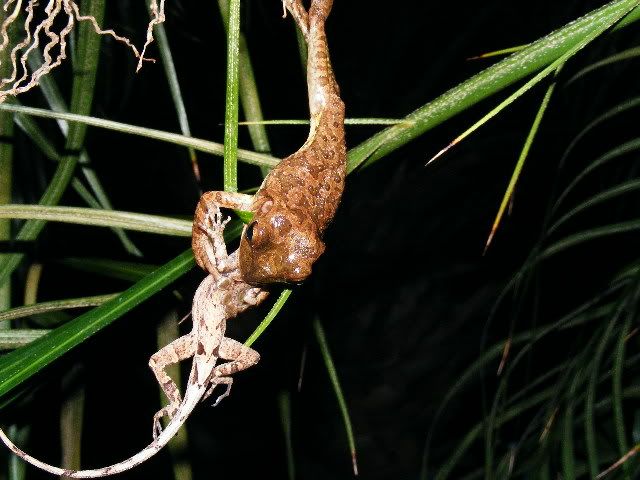
This occurred at 10:20 AM April 12, 2004 in South Miami Florida. I was working in my kitchen at my home in South Miami Florida with my back porch door open, when my attention was captured by a loud “yelp-yelp” sound in repetition. I also noticed that I heard the “distress” call of a cardinal – similar to what I would hear if there was a cat or snake in my backyard. I grabbed my Sony cybershot 3.2MP and ran out my back door. On an adjacent pony tail palm (Nolina recurvate) just below the crown, about 8’ off the ground I saw a large knight anole (Anolis equestris) in a head down position. The anole had in its mouth, the back legs (below the knees) of a Cuban treefrog (Osteopilus sepentrionalis). The frog was making a very loud repetitive “yelp-yelp” sound while trying to climb out/away from the lizard’s mouth using its front legs. There were a pair of cardinals and mockingbirds, and a blue jay that were attracted to the sound. The cardinal was calling, and the mockingbird was approaching and slowly opening and moving its wings in a “swimming fashion,” making it obvious as it walked across the ground. The birds’ focus seemed due to the frog’s call. I have never experienced any reaction of a bird to the many resident Knight anoles in my property or elsewhere. I managed to get a short clip (meaning to take an image) and a captured still is what you see attached. After a few more cycles of yelping, the frog managed to break free from the Anolis’ mouth and hopped away behind my AC unit. Having had some firsthand past experience with Osteopilus’s antipredatory compounds, I wondered if they had the same effect on lizard’s bucccal cavity as they did on this (at the time intoxicated) human. I had heard a very similar call from an unidentified tree frog in Costa Rica 1998. It had been captured by a parrot snake (Leptophis sp.) that fell to the ground in front of a friends horse while we were jungle riding in Guanacaste. To humans, the call does sound very much like a baby, or toddler’s wail. I would be interested in knowing if it serves to attract other predators giving the “crier” a possible distracting means of escape.

How Often Do Lizards Capture Enormous Prey? And How Often Are They Unable To Consume It?

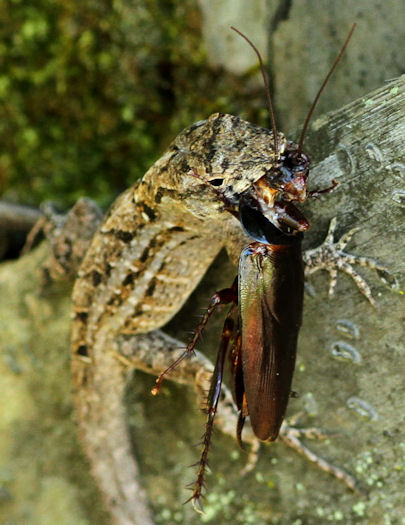
The photograph above from Daffodil’s Photo Blog shows a brown anole that has just caught a roach almost as big as itself. The lizard was actually able to run away with its prey, so we don’t know if it was consumed.

This, in turn, reminds us of a previous post of DFB in which a green anole again caught a really large prey item, in that case a moth, but again the outcome was unknown.

Imagine eating a Big Mac 80% of your body weight. Think how long you could run on that, and you’re warm-blooded–lizards have a much lower metabolic rate. How often do anoles get this bonanza? Certainly, most of their prey items are quite tiny in relative terms. And how often do they catch prey that they ultimately can’t ingest? There  is a lot of data on anole diets in the literature, but no one has every synthesized it to see what general messages can be extracted, what broader questions–such as this one–can be addressed. Would make for an interesting project.

Brown Anole – Green Anole Interactions

Periodically, we’ve discussed how green and brown anoles interact now that they’ve been thrown into  sympatry in the southeastern U.S. and elsewhere–do they fight, do they mate, do they just ignore each other? Perhaps, it seems, a little bit of each. In any case, the latest report comes from Janson Jones over at Dust tracks on the web, who presents a nice tryptich of observations and photos on a one-side green-brown interaction in southern Georgia. As always, the photos are sumptuous and the text entertaining.

Frog Eats Anole

Brown anole being eaten by a Cuban Treefrog. Photo by jwood10016.

Surely you remember the heart-warming story–the best post AA has ever had–about Gordon, the green anole that was almost eaten by a Cuban tree frog, but somehow escaped and lived to see many more days (if you haven’t, check it out now!). Well, apparently the story doesn’t always end so happily for anole-kind. Above is a photo from Orlando, Fl, of a brown anole going down the hatch, and there’s no reason to believe that it came back up. There’s a whole series of photos on planetisuzoo.

Anole Research In Colombia And Venezuela: Scientist At Work Blog Posts

Earlier this spring, I reported on a trip to Colombia and Venezuela to collect natural history data on several unknown anoles: A. heterodermus, A. onca, A. annectens and A. tigrinus. As part of the Scientist at Work: Notes from the Field blog on the Science webpage of the New York Times, I wrote a series of posts, which have now all been published. If you’re interested, links to them are provided below.

Losos, J.B. March 12, 2013. Quest for a little-known suburban lizard. link to article

Losos, J.B. March 14, 2013. Life of a Lizard Wrangler. link to article

Losos, J.B. March 19, 2013. Lizard Olympics. link to article

Losos, J.B. April 2, 2013. A Beach Vacation, Lizard Style. link to article

Losos, J.B. April 11, 2013. An Embarrassment of Anoles. link to article

Losos, J.B. April 25, 2013. A Night of Saurian Spotlighting. link to article

There Is Always Something New To Learn: Lizard Eggs Can Survive Flooding

A close-up of the hatchling, un-hatched egg, and the remains of the hatched egg, we recently reported on.

A close-up of the hatchling, un-hatched egg, and the remains of the hatched egg, we recently reported on.

It is interesting that even in fairly well-studied species, we can still find new information from chance observations and carefully planned empirical studies. Recent studies have found that brown anole (Anolis sagrei) females favor nest sites that are quite moist. Losos et al. (2003) also found that the eggs of this species can survive being inundated for up to six hours by seawater. Recently we reported on an observation of brown anole eggs that remained viable after being inundated by fresh water due to heavy rains. The difference between the two conditions is, since seawater is more saline than the content of the eggs, it can be expected that the eggs would lose water, while when exposed to excessive fresh water the water gains will exceed losses, and the eggs will swell.

The observations of other researchers and ours suggest that the eggs of A. sagrei are fairly tolerant to a wide variety of environmental conditions and can remain viable when exposed (for a few hours) to excessively wet conditions. Our observations in Taiwan also reveal that unless washed away or damaged, the eggs of A. sagrei can remain viable during the high rainfall (often as a result of typhoons) of this region.

As Aristotle (384 BC – 322 BC) said, “In all things of nature there is something of the marvelous.” And I would like to encourage everyone to look into their chance observations and to describe them, not only in chat forums, but also in journals as natural history notes. That way the information is not only disseminated, but may also be accessible to a greater audience and for generations to come.

More Surprises From Anolis Tigrinus

DSC_0054x

Anolis tigrinus. Photo by J. Losos.

I’ve previously posted on the surprising behavior of the Venezuelan A. tigrinus. We found them in astonishing abundance in the town of Colonia Tovar, in the mountains above Caracas. Despite their twig anole appearance and their twig anole habitat use–on twigs and other narrow surfaces–they don’t behave like twig anoles. Rather, they move rapidly and often, and seem to display a lot as well. Some Caribbean twig anoles move frequently, albeit slowly, and some display a lot, but none zip around like these guys. Moreover, we’ve seen a number of other mainland twig anoles, and they live life in the slow, slow, slow lane. So, our first day of tigrinus-watching was full of surprises. But that night, things got even more surprising, as I recently recounted in my most recent post in the Scientist at Work blog of the New York Times..

The tell-tale banded tail.

The tell-tale banded tail.

Anolis tigrinus sleeping on a stem. Photo by J. Losos.

Anolis tigrinus sleeping on a stem. Photo by J. Losos.

As we walked down to the local brewhaus to grab a pizza, we casually scanned our surroundings. And as we walked by a weed patch, there was the tell-tale white blob hanging on to the end of a grass blade. It could be only one thing–an anole. In the Caribbean, this would be primo grass-bush anole habitat, but there were no grass-bush anoles here. Quick examination confirmed that it was an A. tigrinus. That’s right, a twig anole in the grass. And then as we looked around, there were more and more of them–the lot was silly with twig anoles.

The next two days, I came back during the day to look for twig anoles. Unlike in the woods where we had found them initially, the twig anoles here were hard to find during the day, even though the place was full of them at night. The few I saw were deep in the vegetation–my conclusion is that this guys are moving through the vegetation, navigating along narrow branches, stems, and grass-blades.

Which leads, of course, to the question of why in the Caribbean, grass-bush anoles use low-lying narrow vegetation in grassy, bushy  areas, while twig anoles use narrow twigs and branches up in the trees. Perhaps A. tigrinus  is just being opportunistic, taking advantage of an unoccupied habitat and moving in? Certainly a plausible explanation, but I’ve never, ever heard of a twig anole in the grass in the Caribbean. Has anyone? Not even in Jamaica, where there are no grass-bush anoles.

This in turn reminds me of the trunk-crown anoles, A. allisoni, I observed in the grass in Roatan, Honduras. If nothing else, it’s important to remember that anoles are very behaviorally flexible and adaptable. Even though they’ve specialized to different microhabitats, they aren’t so specialized that they can’t use other microhabitats when they get the chance. Crown-giant anoles on the ground are one example, but that’s another story.

In any case, A. tigrinus is a very interesting anole, and it’s great abundance would make it an excellent choice for behavioral and ecological studies.

DSC_0059x

Sweet dreams, little tiger anole. Photo by J. Losos

There Is More To That Beach Anole

Norops-onca-male

Adult male Anolis onca from Isla de Margarita basking.

Continuing the recent interesting post on the Beach Anole Anolis onca, I decided to write something about my personal experiences with this amazing species and attempt to summarize some of what already exists in the literature. Famous by its lack of expanded, smooth, infradigital lamellae, there is a lot more to these beautiful lizard.

Coastal-thorn-scrubland

Typical habitat of Anolis onca on Isla de Margarita

This “beach” anole is basically endemic to Venezuela (it is also found on a narrow portion of adjacent Colombia). Within Venezuela, Anolis onca has a disjunct distribution (more on that below). It ranges continuously along the coast of the states of Zulia and Falcon in the West. It is also found on the islands of La Tortuga and Margarita, as well as along the coast of the state of Sucre in the East. Another, possibly disjunct population has surprisingly been recorded from dry savannas well inland in the state of Monagas! I have observed A. onca in western Venezuela, but I am most familiar with populations from Isla de Margarita. I have traveled countless times to the island and since I was a kid I always remember being fascinated by these fairly large, active anoles. On Isla de Margarita, A. onca is definitely ubiquitous. It is easily found on thorn scrubland, coastal sand-dune environments, and beaches. It is also common around human habitation.  I have always observed this anole in sites with constant and strong wind currents. Several authors have suggested that the windy conditions present in the habitats preferred by this lizard may have prevented it from being strictly arboreal like other anoles (Williams, 1974; Miyata, 1975; Kiester, 1977).

onca-dewlap

These guys have a really large, beautiful dewlap

Whatever the case, it is definitely more terrestrial than other anoles (even species that are commonly found on the ground, e.g. Anolis planiceps) and I have observed it numerous occasions on open ground. However, it often climbs up to about 1.5 m on shrubs, cacti, vines or rocks. Around human habitation it also perches on unfinished walls of buildings, cobble and fence posts (same places frequented by the larger Tropidurus hispidus on the island). I also have observed A. onca on open sand banks of beaches in close proximity to salt water (Ugueto and Rivas, 2010). Williams (1974) also mentioned finding this species near the seashore. Interestingly, light colored specimens are very well camouflaged amidst the sandy soil. I have noticed that when A. onca perches on low shrubbery it often just exposes its head above the leaves. I do not recall seeing such behavior in other anole species.

Most individuals remain motionless when first spotted. If you get too close for comfort, lizards invariably run towards and hide within nearby bushes, clumps of herbaceous vegetation or thorny shrubs. Occasionally they may hide beneath rocks or boulders. Collins (1971) reported that some specimens escape into Ocypode crab holes after lizards were pursued for long time, but I have never observed this behavior. Various types of small arthropods like grasshoppers, robber flies, beetles and spiders have been reported as prey (Roze, 1964; Kiester, 1977; Ugueto and Rivas, 2010). Kiester (1977) reported that the analysis of 38 stomachs revealed that a particular species of chrysomelid beetle constituted a large portion of the diet in western Venezuelan lizards. Saurophagy has also been reported in this species; Miyata (1975) and Kiester (1977) recorded a large individual preying on a female Cnemidophorus lizard in northwestern Venezuela. I observed this species preying on small flies that passed near the lizard on a beach on Isla de Margarita. Kiester (1977), however described a very interesting mode of predation in which the lizard stalked fast moving robber flies in a cat-like fashion using the irregularities of the terrain as cover and dashing towards prey when at close range. What is known about the reproduction of this species is fragmentary at best, but it appears it could be seasonal on northwestern Venezuela. Kiester (1977) reported females laid eggs after the rainy season so that hatchlings come out during January, February and probably March.

Anolis-onca-map

Distribution of Anolis onca and the closely allied Anolis annectens in Venezuela. Notice the disjunct distribution of onca.

As I mentioned earlier, the distribution of A. onca in Venezuela is disjunct and the western and eastern population are separated by a long stretch of apparently suitable habitat.

Page 13 of 34

Powered by WordPress & Theme by Anders Norén