Category: All Posts Page 78 of 153

ESA 2016: Top-Down Effects of Brown Anoles on Islands Following Hurricanes

Following up with summaries of anole talks at ESA 2016, Dave Spiller presented a broad summary of his and his colleague’s (Tom Schoener and Jonah Piovia-Scott) research investigating the effects of hurricanes on long term food web dynamics of small Bahamian islands, which has just recently been published in Ecology (see Spiller et al. 2016).

Picture1

Spiller opened by explaining some of the patterns of food web dynamics that have been learned from this research. Most notably, that the elimination of brown anoles – which act as top predators in these simple ecosystems – leads to increased levels of herbivory as arthropods experience a relaxation of predation pressure (Spiller and Schoener 1990).Specifically, the presence of a common moth (Achyra rantalis) on islands without brown anoles can lead to extreme levels of herbivory upon a common island plant, Sesuvium portulacastrum (below).

Picture3

Spiller and his colleagues began to notice that following hurricanes, one of the most extreme natural disturbance events in this region, islands with lizards experienced a much more rapid recovery of Sesuvium .

Picture4

In an attempt to understand how ecosystems may be stable despite experiencing extreme disturbance regimes, Spiller and colleagues measured the percent ground cover of Sesuvium and abundance of Achyra moths on 11 islands with lizards present and 21 islands without lizards annually for 10 years.

Overall abundance of Achyra was 4.6 times higher on no-lizard islands than on lizard islands. The percent cover of Sesuvium exhibited lower temporal variability on lizard islands when the study site was undisturbed by hurricanes, and higher recovery rate on lizard islands following hurricanes.

Picture5

Spiller concluded by suggesting that these stabilizing phenomena are linked to a trophic cascade in which predators (brown anoles) control herbivores (Achyra moths), and therefore enhance plant recovery following hurricanes.
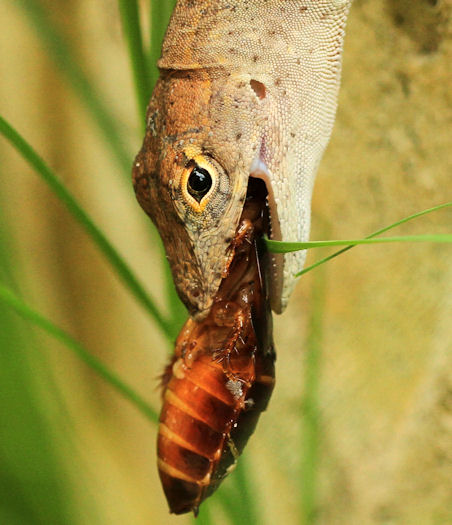
Brown Anole Mouthful

Photo by Karen Cusick

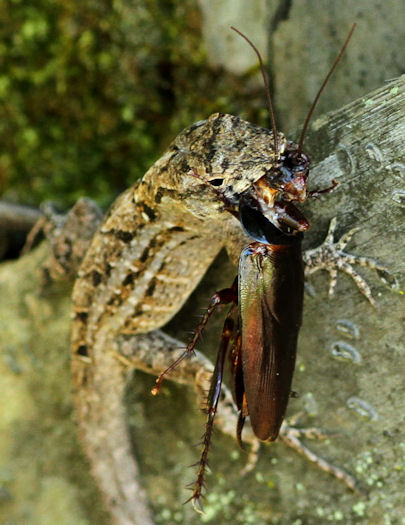
It’s amazing the size of prey that some anoles will try to get down their throats (and who could blame them?).  Here’s an example from Daffodil’s Photo Blog. And here’s another example from the same source.
Great Nickname for Jamaican Anole

Screen Shot 2016-08-08 at 10.29.04 AM

Anoles on Exhibit at the Milwaukee Public Museum


IMG_1463

AA stalwart Tony Gamble has provided these two photos from exhibits at the Milwaukee Public Museum. The one above is a knight anole, whereas below, an Archaeopteryx appears to be dining on a green anole, significantly increasing our understanding of the age of the anole radiation.

AA’s other Wisconsin stalward, Greg Mayer, provides the low-down: “The equestris  is from the Rain Forest exhibit. This is a fabulous exhibit based mostly on the Costa Rican rain forest, but including some other tropical/rain forest elements. I take my vert. zool. class there every year, and have used it as part of the pre-trip preparation for Costa Rican field classes. It was funded in part by the NSF, and involved lots of field work–they did latex casts of trees to get the bark right for life size models of them! The Milwaukee Public Museum was much involved in making Costa Rica the center of tropical studies for US-based scientists. The MPM was slightly independent of OTS. They had their own field station, La Tirimbina, which is very nice–I’ve taken students there 2 or 3 times.

Allen Young, the MPM lepidopterist, was the driving force for Milwaukee’s tropical studies. He wrote about his work at Tirimbina in Sarapiqui Chronicle (Smithsonian Institution Press, Wash. DC, 1991). Young first went to Costa Rica in 1968 with OTS, then focused his work at Tirimbina. (Bob Hunter, who owned Tirimbina at the time, also owned part of La Selva, and was involved in getting both places established as field stations.) MPM’s stake in Tirimbina was sold off by then Milwaukee county executive (now governor) Scott Walker, who couldn’t imagine why a natural history museum in Wisconsin could be interested in Costa Rica. Fortunately, another conservation organization bought MPM’s share.

Others were involved in the exhibit creation as well, and though I’ve never asked him, I’ve always thought the Anolis equestris behavior display in the rain forest exhibit may have been a contribution of Bob Henderson. There are several males and females (not sure if they’re freeze-dried, or some kind of model), showing various levels of agonistic display– fans, nuchal crests, open mouth, raised posture– set out on vines/branches. A question I ask vert. zool. students about this display case is how could they tell the lizards are arboreal, even if they were not posed on branches.”

And with regard to the photo below: “The other picture is from the Third Planet exhibit (I’m always tempted to write Third Rock!), from a section of that very good exhibit on the Hell Creek Formation and the end Cretaceous vertebrate extinctions. The MPM has two Archaeopteryx models made up with feathers, and the one in the pic has a dried or model Anolis carolinensis in its mouth, painted a fairly bright green. The other Archaeopteryx model is better done, and that one goes out on loan periodically to other museums (I think I’ve seen it at the Field Museum).

IMG_1466

Owls Eat a Lot of Anoles: Data from Dominica

An owl with a green anole.

A recent paper in the Caribbean Journal of Science on the diet of the Lesser Antillean barn owl on Dominica revealed that anoles, specifically the native species A. oculatus, are a very frequent prey item, constituting 193 of the 517 prey items. The authors note that owls are nocturnal and anoles are diurnal and proffer three explanations: 1. the predation occurs at dawn and dusk, when both species are normally active; 2. the anoles are active around lights at night; 3. the owls are catching the anoles while they sleep. We’ve discussed this topic before: owls are known to eat anoles in Cuba and many other places in the neotropics, and there’s the great photo re-posted below (original post here). As far as I’m aware, that’s the only direct observation of an anole being preyed upon by an owl (although a quick search on Google Images will yield many photos like the one at right). We’ve also discussed the parallel  issue of bat predation on anoles in these pages. Clearly, more data are needed!

Mystery Anole from Gulfo Dulce, Costa Rica

IMG_4901

I was recently doing some anole field work in the Gulfo Dulce area of Costa Rica, and I came across a lizard that has me stumped. Perhaps some more experienced AA readers have some insight – any idea what species this little guy is? To me, it looks a bit like A. limifrons and a bit like A. carpenteri, but not completely like either (and carpenteri isn’t supposed to occur in the Gulfo Dulce area). It was in an area of pretty thick primary forest, perched about 6 ft or so up a tree trunk, and it ran quite high when I pursued it. I’d appreciate any tips!

IMG_8631 (2) IMG_8638 (2) IMG_8645 (2) IMG_8655 (2)

Assistance Needed for Anole Identifications from Camera Trap Images from the Peruvian Amazon

4 Anolis sp. 4 cropped

Although camera traps have historically been used to study endotherms, particularly mammals, recent studies have found them to also be effective for reptile research, given proper conditions. Indeed, Welbourne and colleagues (2015) found them to be as effective as complementary methods for detecting reptiles.

We conducted a study in the Lower Urubamba Region of the Peruvian Amazon using camera traps to monitor mammal use of natural canopy bridges for crossing over a pipeline road between September 2012 and October 2013 (see Gregory et al. 2014 for further description). Unexpectedly, we ended up with numerous records of reptiles, including many of Uracentron flaviceps, which is easy to identify because if its large body size, and records of 17 individuals we have not been able to identify. We suspect many of them to be Anolis species, but they are very difficult to see. We would be grateful for identification assistance from the Anolis researcher community.  Below we show pairs of images for each individual: the full camera trap photo and then a cropped image of just the individual. Please e-mail me (GregoryT@si.edu) with the individual number (listed above each photo pair) and any thoughts you have about identifications. Thank you Anolis research community!

Gregory, T., Carrasco-Rueda, F., Deichmann, J.L., Kolowski, J., and Alonso, A. (2014). Arboreal camera trapping: taking a proven method to new heights. Methods in Ecology and Evolution 5:443-451.

Welbourne, D.J., MacGregor, C., Paull, D., and Lindenmayer, D.B. (2015). The effectiveness and cost of camera traps for surveying small reptiles and critical weight range mammals: A comparison with labour-intensive complementary methods. 42:414-425.

Unknown sp. 17

17 Unknown sp. 17 full17 Unknown sp. 17 cropped

Unknown sp. 16

16 Unknown sp. 16 full16 Unknown sp. 16 cropped

Unknown sp. 15

15 Unknown sp. 15 full 15 Unknown sp. 15 cropped

Unknown sp. 14

14 Unknown sp. 14 full14 Unknown sp. 14 cropped

Unknown sp. 13

13 Unknown sp. 13 full13 Unknown sp. 13 cropped

Unknown sp. 12

12 Unknown sp. 12 full 12 Unknown sp. 12 cropped

Unknown sp. 11

11 Unknown sp. 11 full 11 Unknown sp. 11 cropped

Anolis cf. punctatus (#10)

10 Anolis punctatus sp. 10 full10 Anolis punctatus sp. 10 cropped

Unknown sp. 9

9 Unknown sp. 9 full9 Unknown sp. 9 cropped

Unknown sp. 8

8 Unknown sp. 8 full8 Unknown sp. 8 cropped

Unknown sp. 7

7 Unknown sp. 7 full 7 Unknown sp. 7 cropped

Unknown sp. 6

6 Anolis sp. 6

Unknown sp. 5

5 Unknown sp. 5

Anolis sp. 4

4 Anolis sp. 4 full 4 Anolis sp. 4 cropped

Anolis sp. 3

3 Anolis sp. 3 full 3 Anolis sp. 3 cropped

Anolis sp. 2

2 Anolis sp. 2 full2 Anolis sp. 2 cropped

Anolis sp. 1

1 Anolis sp. 1 full 1 Anolis sp. 1 cropped


Using Sports Rankings to Understand Dominance in Anoles

ArenaTrial

Two male green anoles (Anolis carolinensis) competing in a staged arena trial.

As anole enthusiasts, most of you have probably seen anoles engage in lock-jawed fights, where two rival males grab onto each other’s jaws and try to throw their opponent off a contested perch. These encounters are extremely physical, often leaving one or both contestants injured. While these fights are exciting to watch, they are relatively rare in nature. Most contests between anoles are resolved without fighting using stereotypical display behaviors, where the two lizards head bob and dewlap at each other until one anole submits. In these cases, dominance is conveyed not through physical defeat, but from the animals’ perceptions of their opponents.

This of course begs the question, what criteria do anoles use to evaluate their rivals? How do they decide if they should keep pushing or if they should back down during a fight? A lot of research has attempted to answer this question. Many of these studies are performed in the lab using staged contests between two individuals, called arena trials. These studies generally look for differences between the “winners” and the “losers” of each trial to identify potential dominance signals.

When I was an undergraduate in Dr. Michele Johnson’s lab at Trinity University, we ran a lot of arena trials to understand how lizards interact. At the same time, I was part of a collaborative biomath team that included McKenzie Quinn (another undergrad) and me, and our advisors Michele and mathematician Dr. Cabral Balreira. We had been working together to develop a mathematical model of lizard energy use, and as that project was wrapping up, we were considering other directions our team might pursue. We came up with the exciting idea that we might be able to use those arena trials we’d been doing in combination with Cabral’s area of expertise –the development of ranking algorithms, usually applied in sports. In Cabral’s work with sports ranking algorithms, he summarizes the win-loss results of a sports tournament to identify the overall best and worst teams. These rankings allow you to incorporate how each team performed against teams of varying skill levels, providing a more holistic metric of their abilities than individual game results would. This led us to a “light bulb” moment. By applying a sports tournament framework to a lizard population, we could see how individuals compete against different opponents to determine what traits are associated with social dominance. This also allows us to evaluate lizard dominance using quantifiable metrics instead of qualitative metrics.

TrinityTeam

(From left) Michele Johnson, McKenzie Quinn, Jordan Bush, and E. Cabral Balreira at Palmetto State Park.

We first created a tournament in which each lizard in our population (n=18) competed in six arena trials. We then used sports ranking algorithms to generate a dominance hierarchy for the population and used stepwise linear regressions to compare rank (y variable) to morphological and behavioral traits (x variables) of each lizard. We found that rank was highly predicted by aggressive behavior, indicating that lizards that displayed more during the tournament tended to be more dominant (surprisingly, body size didn’t predict dominance in our trials!). We then applied this same logic to a natural system (studying the green anoles in Palmetto State Park in Gonzales, Texas) to see if “dominant” anoles in the wild had the same characteristics as “dominant” anoles in the lab. In the wild, male anoles fight over territories, because controlling a territory gives owners uncontested access to the food and potential mates within it. Therefore we can “rank” males based on the size (bigger = better) and quality (more females = better) of their territories. When we compared territory size and quality (y variables) to morphological and behavioral traits (x variables) as before, we found that traits related to fighting ability, such as head width (a proxy for bite strength), were the best predictors of dominance in the natural system (but again, body size was not predictive of territorial success).

Together, our results indicate that dominance cues in anole contests are often context specific. In brief arena trials between unknown males, signals that reveal immediate intentions (i.e., display behaviors) are especially important. In contrast, males in the wild have to back up their bluster, and thus actual fighting ability is more highly favored in the long run. If you are interested in this study, we hope that you check out our recent paper to view the details of our results and methods.

That’s a Mouthful: Dragonfly No Match for a Green Anole

Screen Shot 2016-08-07 at 10.40.34 AM

Global Warming and Lizards: an Article on Manuel Leal’s Trail-Blazing Research

The following appeared in the spring/summer 2016 issue of the University of Missouri publication Illumination.

Consider the Ectotherm: Can “Cold-Blooded” Creatures Survive in a Warming World?

By Melody Kroll

Photos by Manuel Leal

Illumination - Spring 2016

Even as the climate-driven suffering of polar bears tugs at the heartstrings of concerned citizens worldwide, thousands of less-visible species also face disastrous consequences from a warming planet.

These are the “cold-blooded” animals, the millions of amphibians, fish, insects and reptiles, collectively known to scientists as ectotherms. Together these species make up the vast majority of the world’s biodiversity.

Ectotherms are found all over the world, but most make their homes in the tropics, where, obviously, it is warm already. Being used to the heat, one might assume that an extra degree or two wouldn’t make much difference. Wrong. Scientists have recently determined that many tropical ectotherms are already surviving at their upper temperature limits. Even a modest rise may, in fact, be enough to push them into extinction. Consider the plight of tropical lizards, an animal that MU’s Manuel Leal, an evolutionary biologist and associate professor, has spent two decades observing. Studies have predicted that about 6 percent of tropical lizard species will be extinct by the year 2050. A full 20 percent of the world’s lizard species, one study predicts, could be gone by the year 2080.

Consider the plight of tropical lizards, an animal that MU’s Manuel Leal, an evolutionary biologist and associate professor, has spent two decades observing. Studies have predicted that about 6 percent of tropical lizard species will be extinct by the year 2050. A full 20 percent of the world’s lizard species, one study predicts, could be gone by the year 2080.

Like all ectotherms, lizards have an optimal temperature range over which they are able to successfully hunt, eat, move quickly, and reproduce. For most, that active range is between 81 and 84 degrees Fahrenheit.The fear is that, as global average temperatures inch upward, the thermal range available to them will begin to constrict, leaving lizards less and less time to be active.Leal specializes in documenting the behaviors of Anolis, a genus of the Iguanian sub-order of lizards living in habitats throughout the Caribbean, Central and South America. Anolis is an incredibly diverse group of creatures — some 400 species have been documented so far. Anolis lizards are striking in appearance, their bodies radiant in a neon-like glow of greens, yellows and blues.

Because many Anolis species, commonly known as anoles, have evolved over long periods of time in isolated island habitats, their study has become profoundly important in ecological and evolutionary scholarship.

Leal says there is little doubt that anoles are in trouble and that warming is the primary reason. But, despite all the attention they’ve received over the years, he argues that scientists have largely failed to grasp the complicated means by which climate change may be contributing to the lizards’ survival struggles, a failure that could make understanding their vulnerabilities much more difficult.

“We’ve done very well at saying climate change will have an impact on ectotherms, but we don’t know how,” says Leal. “We have painted with a broad brush already; now we have to take the pencil and try to say, ‘Ok, how is this going to happen?’”

With his former graduate student, Alex Gunderson, Leal recently proposed a new conceptual framework aimed at re-thinking how scientists model the effects of climate change on lizards specifically, and ectotherms in general.

The problem, Leal explains, is that previous studies have treated “optimal body temperature” as the primary or only driver of activity.

“Activity time is treated as an on-off switch — a lizard is either active or it isn’t. But, it’s not that way,” says Leal. “We have shown that the effect of temperature on activity is continuous. We have observed lizards engage in all types of activities – eating, mating, fighting — at temperatures outside their optimal body temperatures. Activity is more like a dimmer switch.”

The strength of the new framework, he says, is its organism-centered approach. “The framework nicely illustrates the importance of measuring variables at scales relevant to the species in question or, in other words, of doing natural history work in order to inform climate-change models.”

Leal believes obtaining lizard-level results is critical. “I tell my students that we are the boots on the ground,” he says. “Theoretical predictions need to be tested. In order to be tested, you need somebody that is willing to do the dirty work, somebody that wants to be working at the scale that really represents the organism and to ask, ‘okay, does this really matter?’”

For Leal’s team, this means hours of filming anoles in the field, coupled with even more hours re-watching and transcribing these videos back in the lab. A big chunk of time is also spent catching anoles and collecting morphological data such as body length, weight, and dewlap color (the characteristic fold of skin hanging from anoles’ throats). They also document aspects of the lizards’ subtropical habitats.

This last point is particularly attractive to Leal, because anoles are abundant in Puerto Rico, the place where Leal spent his childhood catching all sorts of critters, anoles among them.

“I just grew up catching everything that moves, from spiders to big things to little things,” says Leal.

His lizard-catching abilities paid off when his biology professor at the University of Puerto Rico one day invited students to help him collect blind snakes. Leal jumped at the chance. “I said, I’ll go! That’s what I like to do. Then I started working with him and eventually did my master’s degree with him.”

Leal started observing anole behavior in earnest while pursuing his master’s degree in Puerto Rico. His thesis involved looking at how anoles signal their physiological condition to lizard-eating snakes. He showed that the number of push-ups a lizard does is correlated with the lizard’s running endurance. “Basically, the lizard is saying, don’t waste your time attacking me because I’ll run away very fast and if you catch me I’ll bite you really hard,” says Leal.

His research provided one of the first demonstrations under natural conditions that prey can honestly advertise their escape abilities, that is, physiological conditions to predators. It has since become a staple study mentioned in the seminal animal behavior textbook.

While a master’s student, Leal met Jonathan B. Losos, a world leader in evolutionary ecology, who was in Puerto Rico on a collecting trip. Leal says, only half joking, that it was his unrivaled lizard-catching ability that impressed Losos to the point that the senior scientist invited him to join his lab and pursue a doctorate at Washington University in St. Louis. “He promised me that as long as I was able to catch more lizards than him, I would be successful at getting a Ph.D.,” Leal says with a laugh. “I had no idea you could make a living studying lizards. Even to this day, I often stop and think how amazing it is that someone pays me for being dirty and catching lizards. That’s cool.”

“That is not why I selected him,” says Losos, now a professor of organismic and evolutionary biology and Curator in Herpetology at Harvard University. “I took Manuel as a student because it was obvious that he really understood the biology of these animals at a very deep level. But, yes, it’s true that Manuel can walk up to a lizard and just catch it with his bare hands. I still don’t know how he does it.”

By way of example, Losos recalls a field trip they made shortly after Leal arrived in St. Louis. “We came across some local fence lizards. Manuel approached one, and it ran away. I said something like, ‘Hah! Manuel. Not so easy as in the tropics, is it?’ Well, he disappeared, and 10 minutes later, he came back holding two lizards in his hand. I have no idea how he does it. I’ve watched him do it. I tried to figure out what he’s doing that I’m not. I don’t know, but he can do it.”

At Washington University, Leal continued his investigation of anole signaling behavior. After earning his doctorate in 2000, he followed up on these behavioral studies with Leo J. Fleishman at Union College in New York. In 2003, he joined the faculty at Vanderbilt University, moving to Duke University three years later. He joined MU’s faculty in 2014. Over the years, his studies have appeared in top scientific journals, includingScience, Nature, Proceedings of the National Academy of Sciences, Proceedings of the Royal Society of London B, The American Naturalist, as well as commercial publications such as the New York Times, The Economist, National Geographic, El Pais and Der Spiegel.

Leal’s most recent work seeks to advance scientists’ understanding of how temperature affects anoles’ behaviors. Along with Gunderson, he has proposed that temperature differentially affects four elements of activity that the researchers define as thresholds, probabilities, modes and vigor.

Thresholds, they explain, are the temperatures below and above which animals are inactive. Probability involves evaluating whether an animal will engage in activity when its body temperature is between the lower and upper temperature ranges. Mode is about activity, for example feeding, mating, fighting. Mode of activity is important because different modes have their own temperature-dependent probabilities. Finally, the researchers seek to determine the vigor with which an animal engages in an activity.

“Each of these components has been studied to some extent previously, but it was always only one of them,” says Gunderson, who is currently completing his postdoctoral work at San Francisco State University’s Romberg Tiburon Center. “In order to get a comprehensive understanding of how temperature is going to influence activity, you really need to know how all of these components are interacting simultaneously.”

The authors have applied their framework to document the consequences of climate warming on Anolis cristatellus, a tree-dwelling lizard found in both dry and wet habitats on the island of Puerto Rico. In the case of A. cristatellus, they sought to learn how the lizards’ overall health affected crucial behavioral characteristics.

Their findings showed that behaviors such as eating and mating are extremely sensitive to thermal change, especially compared to sprinting speed, the physiological trait typically used to measure climate-change effects.

“For example, our analyses show that the physiological performance of A. cristatellus in dry habitats will decrease by about 25 percent under future warming, but their activity budgets will decrease by 50 percent. Furthermore, the habitat will become much less suitable for reproductive behaviors, which are, of course, critically important for the viability of populations,” says Leal.

In other words, adds Gunderson, physiological traits alone may not be the best way to estimate the consequences of climate change. What we really need, he says, is to integrate both the physiological and behavioral.

“Even though organisms might have relatively high physiological health, if they’re not eating or reproducing then there are going to be big population consequences,” Gunderson says.

“If anything,” Leal adds, “what we have done is taken all these data and put them at the scale of the lizard and asked, can we predict what the lizard will do when we have the interactions of the temperature of the environment, body temperature, and sprint speed, which is basically the curve on which behaviors will happen.”

“Previously, we could say, yes, they can live in place A or place B and that is true. Now, we can say, when they are in place A, they will not be able to mate as often as they would if they were in Place B or they will not be able to defend their territory as often if they were in this environment. So it’s more at the scale of the individual.”

Harvard’s Losos calls Leal’s conceptual framework “a major step forward” in our understanding of how global warming will affect all ectothermic animals.

“Previous work has recognized the importance of changing temperatures but hasn’t been very sophisticated in trying to evaluate how global warming might affect the biology of the species,” he says. “What Gunderson and Leal do is take a much more in-depth examination of the biology of the species and how temperature really affects what they do and when they do it or how much they do it to present a framework to understand whether species will be able to cope with changing climates.”

Such insights don’t come by accident, Losos says. They happen because scientists like Leal and his graduate students spend a “huge amount of time out in nature actually studying animals and what they do. There is simply no substitute for understanding the biology of animals in their natural environment. Nonetheless it takes a huge amount of effort to collect those sorts of data: time, money, and being out in uncomfortable situations often. Most scientists don’t do that. What Manuel has shown is that this sort of data, what we call natural history, is critical in understanding how animals interact with their environment, and how, as the environment changes, animals will be able to respond. What is really unusual about their approach is that they are not sitting in a lab and making a bunch of assumptions and running data through computers. They’re out in nature getting the data we really need to have.”

The hope, Gunderson says, is that these “natural history” data, coupled with the revised conceptual framework he and Leal developed, can help scientists develop strategies to better predict and, one day perhaps, mitigate the effects of climate change on these vulnerable animals.

“Everything we talk about in this paper is relatable to other cold-blooded animals. That was something we really wanted, to make sure that what we were presenting, even though we were using lizards as a model, was applicable to a wide range of animals.” The types of animals, Leal would hasten to add, that can best be understood by “thinking outside the lab.”

“While laboratory studies of the effect of temperature on the physiology and behavior have provided significant insights into thermal ecology of ectotherms,” says Leal, “the time is ripe to take this knowledge outside the lab to further develop climate-change models.”

Page 78 of 153

Powered by WordPress & Theme by Anders Norén