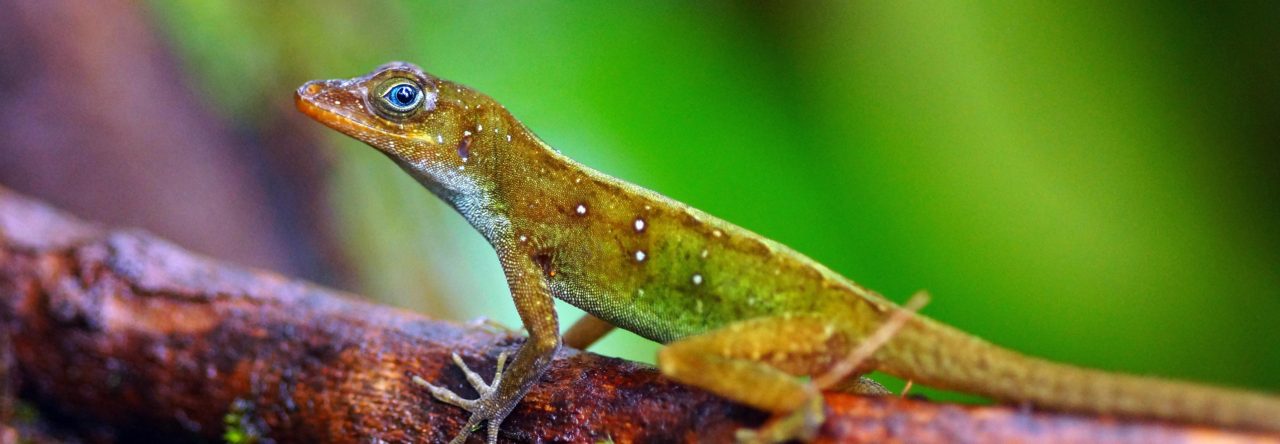
Like all ectotherms, lizards have an optimal temperature range over which they are able to successfully hunt, eat, move quickly, and reproduce. For most, that active range is between 81 and 84 degrees Fahrenheit.The fear is that, as global average temperatures inch upward, the thermal range available to them will begin to constrict, leaving lizards less and less time to be active.Leal specializes in documenting the behaviors of Anolis, a genus of the Iguanian sub-order of lizards living in habitats throughout the Caribbean, Central and South America. Anolis is an incredibly diverse group of creatures — some 400 species have been documented so far. Anolis lizards are striking in appearance, their bodies radiant in a neon-like glow of greens, yellows and blues.
Because many Anolis species, commonly known as anoles, have evolved over long periods of time in isolated island habitats, their study has become profoundly important in ecological and evolutionary scholarship.
Leal says there is little doubt that anoles are in trouble and that warming is the primary reason. But, despite all the attention they’ve received over the years, he argues that scientists have largely failed to grasp the complicated means by which climate change may be contributing to the lizards’ survival struggles, a failure that could make understanding their vulnerabilities much more difficult.
“We’ve done very well at saying climate change will have an impact on ectotherms, but we don’t know how,” says Leal. “We have painted with a broad brush already; now we have to take the pencil and try to say, ‘Ok, how is this going to happen?’”

An A. acutus observed in Saint Croix, U.S. Virgin Islands.
With his former graduate student, Alex Gunderson, Leal recently proposed a new conceptual framework aimed at re-thinking how scientists model the effects of climate change on lizards specifically, and ectotherms in general.
The problem, Leal explains, is that previous studies have treated “optimal body temperature” as the primary or only driver of activity.
“Activity time is treated as an on-off switch — a lizard is either active or it isn’t. But, it’s not that way,” says Leal. “We have shown that the effect of temperature on activity is continuous. We have observed lizards engage in all types of activities – eating, mating, fighting — at temperatures outside their optimal body temperatures. Activity is more like a dimmer switch.”
The strength of the new framework, he says, is its organism-centered approach. “The framework nicely illustrates the importance of measuring variables at scales relevant to the species in question or, in other words, of doing natural history work in order to inform climate-change models.”
Leal believes obtaining lizard-level results is critical. “I tell my students that we are the boots on the ground,” he says. “Theoretical predictions need to be tested. In order to be tested, you need somebody that is willing to do the dirty work, somebody that wants to be working at the scale that really represents the organism and to ask, ‘okay, does this really matter?’”
For Leal’s team, this means hours of filming anoles in the field, coupled with even more hours re-watching and transcribing these videos back in the lab. A big chunk of time is also spent catching anoles and collecting morphological data such as body length, weight, and dewlap color (the characteristic fold of skin hanging from anoles’ throats). They also document aspects of the lizards’ subtropical habitats.
This last point is particularly attractive to Leal, because anoles are abundant in Puerto Rico, the place where Leal spent his childhood catching all sorts of critters, anoles among them.
“I just grew up catching everything that moves, from spiders to big things to little things,” says Leal.

Manuel Leal collects data on light levels in a wooded area near Barahona, Dominican Republic.
His lizard-catching abilities paid off when his biology professor at the University of Puerto Rico one day invited students to help him collect blind snakes. Leal jumped at the chance. “I said, I’ll go! That’s what I like to do. Then I started working with him and eventually did my master’s degree with him.”
Leal started observing anole behavior in earnest while pursuing his master’s degree in Puerto Rico. His thesis involved looking at how anoles signal their physiological condition to lizard-eating snakes. He showed that the number of push-ups a lizard does is correlated with the lizard’s running endurance. “Basically, the lizard is saying, don’t waste your time attacking me because I’ll run away very fast and if you catch me I’ll bite you really hard,” says Leal.
His research provided one of the first demonstrations under natural conditions that prey can honestly advertise their escape abilities, that is, physiological conditions to predators. It has since become a staple study mentioned in the seminal animal behavior textbook.
While a master’s student, Leal met Jonathan B. Losos, a world leader in evolutionary ecology, who was in Puerto Rico on a collecting trip. Leal says, only half joking, that it was his unrivaled lizard-catching ability that impressed Losos to the point that the senior scientist invited him to join his lab and pursue a doctorate at Washington University in St. Louis. “He promised me that as long as I was able to catch more lizards than him, I would be successful at getting a Ph.D.,” Leal says with a laugh. “I had no idea you could make a living studying lizards. Even to this day, I often stop and think how amazing it is that someone pays me for being dirty and catching lizards. That’s cool.”
“That is not why I selected him,” says Losos, now a professor of organismic and evolutionary biology and Curator in Herpetology at Harvard University. “I took Manuel as a student because it was obvious that he really understood the biology of these animals at a very deep level. But, yes, it’s true that Manuel can walk up to a lizard and just catch it with his bare hands. I still don’t know how he does it.”

Leal with one of his many lab lizards.
By way of example, Losos recalls a field trip they made shortly after Leal arrived in St. Louis. “We came across some local fence lizards. Manuel approached one, and it ran away. I said something like, ‘Hah! Manuel. Not so easy as in the tropics, is it?’ Well, he disappeared, and 10 minutes later, he came back holding two lizards in his hand. I have no idea how he does it. I’ve watched him do it. I tried to figure out what he’s doing that I’m not. I don’t know, but he can do it.”
At Washington University, Leal continued his investigation of anole signaling behavior. After earning his doctorate in 2000, he followed up on these behavioral studies with Leo J. Fleishman at Union College in New York. In 2003, he joined the faculty at Vanderbilt University, moving to Duke University three years later. He joined MU’s faculty in 2014. Over the years, his studies have appeared in top scientific journals, includingScience, Nature, Proceedings of the National Academy of Sciences, Proceedings of the Royal Society of London B, The American Naturalist, as well as commercial publications such as the New York Times, The Economist, National Geographic, El Pais and Der Spiegel.
Leal’s most recent work seeks to advance scientists’ understanding of how temperature affects anoles’ behaviors. Along with Gunderson, he has proposed that temperature differentially affects four elements of activity that the researchers define as thresholds, probabilities, modes and vigor.
Thresholds, they explain, are the temperatures below and above which animals are inactive. Probability involves evaluating whether an animal will engage in activity when its body temperature is between the lower and upper temperature ranges. Mode is about activity, for example feeding, mating, fighting. Mode of activity is important because different modes have their own temperature-dependent probabilities. Finally, the researchers seek to determine the vigor with which an animal engages in an activity.
“Each of these components has been studied to some extent previously, but it was always only one of them,” says Gunderson, who is currently completing his postdoctoral work at San Francisco State University’s Romberg Tiburon Center. “In order to get a comprehensive understanding of how temperature is going to influence activity, you really need to know how all of these components are interacting simultaneously.”

A. bahorucoensis is of one of almost 400 lizard species from the genus Anolis.
The authors have applied their framework to document the consequences of climate warming on Anolis cristatellus, a tree-dwelling lizard found in both dry and wet habitats on the island of Puerto Rico. In the case of A. cristatellus, they sought to learn how the lizards’ overall health affected crucial behavioral characteristics.
Their findings showed that behaviors such as eating and mating are extremely sensitive to thermal change, especially compared to sprinting speed, the physiological trait typically used to measure climate-change effects.
“For example, our analyses show that the physiological performance of A. cristatellus in dry habitats will decrease by about 25 percent under future warming, but their activity budgets will decrease by 50 percent. Furthermore, the habitat will become much less suitable for reproductive behaviors, which are, of course, critically important for the viability of populations,” says Leal.
In other words, adds Gunderson, physiological traits alone may not be the best way to estimate the consequences of climate change. What we really need, he says, is to integrate both the physiological and behavioral.
“Even though organisms might have relatively high physiological health, if they’re not eating or reproducing then there are going to be big population consequences,” Gunderson says.
“If anything,” Leal adds, “what we have done is taken all these data and put them at the scale of the lizard and asked, can we predict what the lizard will do when we have the interactions of the temperature of the environment, body temperature, and sprint speed, which is basically the curve on which behaviors will happen.”
‘The habitat will become much less suitable for reproductive behaviors, which are, of course, critically important for the viability of populations.’
“Previously, we could say, yes, they can live in place A or place B and that is true. Now, we can say, when they are in place A, they will not be able to mate as often as they would if they were in Place B or they will not be able to defend their territory as often if they were in this environment. So it’s more at the scale of the individual.”
Harvard’s Losos calls Leal’s conceptual framework “a major step forward” in our understanding of how global warming will affect all ectothermic animals.
“Previous work has recognized the importance of changing temperatures but hasn’t been very sophisticated in trying to evaluate how global warming might affect the biology of the species,” he says. “What Gunderson and Leal do is take a much more in-depth examination of the biology of the species and how temperature really affects what they do and when they do it or how much they do it to present a framework to understand whether species will be able to cope with changing climates.”

A. cristatellus asserting his dominance, with “dewlap” flared.
Such insights don’t come by accident, Losos says. They happen because scientists like Leal and his graduate students spend a “huge amount of time out in nature actually studying animals and what they do. There is simply no substitute for understanding the biology of animals in their natural environment. Nonetheless it takes a huge amount of effort to collect those sorts of data: time, money, and being out in uncomfortable situations often. Most scientists don’t do that. What Manuel has shown is that this sort of data, what we call natural history, is critical in understanding how animals interact with their environment, and how, as the environment changes, animals will be able to respond. What is really unusual about their approach is that they are not sitting in a lab and making a bunch of assumptions and running data through computers. They’re out in nature getting the data we really need to have.”
The hope, Gunderson says, is that these “natural history” data, coupled with the revised conceptual framework he and Leal developed, can help scientists develop strategies to better predict and, one day perhaps, mitigate the effects of climate change on these vulnerable animals.
“Everything we talk about in this paper is relatable to other cold-blooded animals. That was something we really wanted, to make sure that what we were presenting, even though we were using lizards as a model, was applicable to a wide range of animals.” The types of animals, Leal would hasten to add, that can best be understood by “thinking outside the lab.”
“While laboratory studies of the effect of temperature on the physiology and behavior have provided significant insights into thermal ecology of ectotherms,” says Leal, “the time is ripe to take this knowledge outside the lab to further develop climate-change models.”