
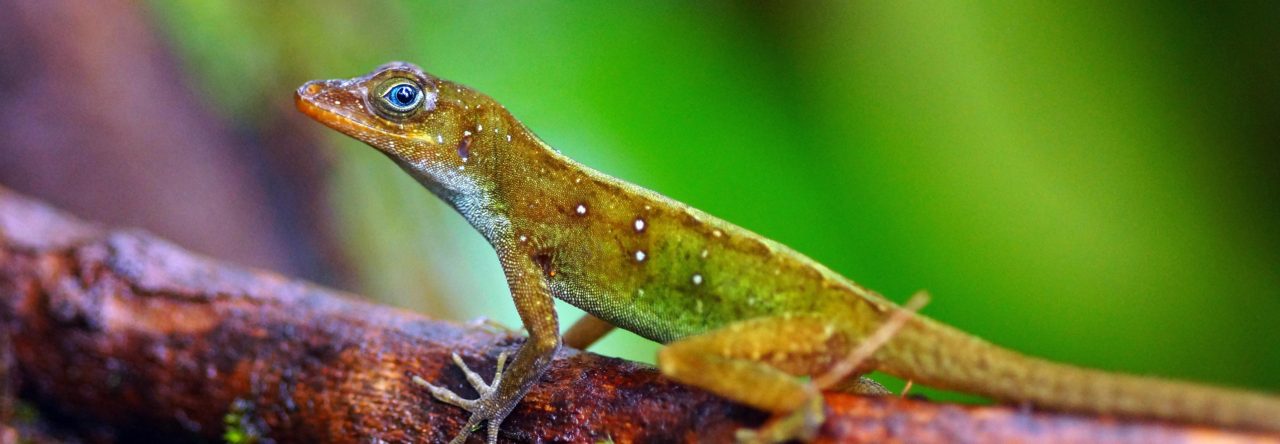
 A while back, we noted that “apparently no one has posted a picture of an anole sitting on an orchid on the internet.” Recently, alert reader Tsjok De Clercq has discovered that this is no longer true. He has pointed us to an image on The Orchid Source that shows a festive anole (A. sagrei) on what appears to be a houseplant. Of greater interest is the post on Ricardo’s Blog, Orchids, Parrots, Fish and People describing a Puerto Rican crested anole found in nature on a red orchid, which seemed to be a complete fail in the remaining cryptic department. Thanks for the tip, Tsjok!
Category: All Posts Page 129 of 154
 The tweet-o-sphere is full of news that there was some sort of anole question on Jeopardy late last week, and that apparently none of the contestants got the answer. But I can’t find any specific online. Does anyone have the inside skinny?
Though we now understand that post-copulatory sexual selection (such as sperm competition and cryptic female choice) can be as important in determining variance in reproductive success as pre-copulatory sexual selection, and though we recognize that the expression of traits subject to pre-copulatory sexual selection is often condition-dependent, it turns out that we know almost nothing about the condition-dependence of traits under post-copulatory sexual selection.

Sperm of Anolis sagrei. Picture by Ariel Kahrl.
In a session devoted to post-copulatory sexual selection, University of Virginia graduate student Ariel Kahrl described her research on the condition-dependence of sperm characteristics in Anolis sagrei. By feeding size-matched male lizards differentially for a period of four months, Kahrl not only generated differences in the body condition of these males, but also ensured that their sperm had developed under her imposed dietary regime. Kahrl predicted that male body condition would affect sperm morphology and sperm count. Pairs of males reared under different dietary conditions were also mated to a single female (making sure to control for mating order by using a reciprocal mating design), thus putting the sperm of two males with different body conditions into direct competition. Kahrl predicted that the fertilization success of males would depend on sperm morphology and count.
Not surprisingly, males with higher body condition had higher fertilization success. It turns out that variation in fertilization success may be influenced by a tradeoff between sperm mid-piece size and sperm number. This situation is interesting, because one can reasonably predict that males on either end of the tradeoff could have high reproductive success—having many sperm per ejaculate could increase the odds of fertilization, akin to purchasing multiple lottery tickets, but having sperm with larger mid-pieces, and thus potentially more mitochondria, perhaps might provide sperm with the burst of energy necessary to win the fertilization race.
In fact, Kahrl found that males with high sperm counts but small midpieces achieve high reproductive success. Intriguingly, she also found that high-condition males had sperm with less variable morphology than low-condition males, and hypothesizes that the dimensions of these uniform sperm match the dimensions of the tubules in females where sperm is stored. Kahrl’s results link pre-copulatory to post-copulatory sexual selection through condition-dependence, and represent a sizeable piece in the puzzle of how sexual selection works in Anolis lizards.

Anolis carolinensis from Miami. Photo by J. Losos.
I’m often a little skeptical of studies that suggest how lab results can have implications for natural systems without actually examining the problem in nature, and studies that address the same question in both lab and field are still rare. That it investigated the same broad question in the lab, in enclosure-style experiments, and in the field is what made Trinity University student Jordan Bush’s poster remarkable.
Bush was interested in the traits associated with dominance, and began by running a tournament of agonistic interactions between a set of male Anolis carolinensis. She used a number of different Markov Chain Monte Carlo algorithms, widely used in predicting winners of sports tournaments, to convert pairwise fight outcomes into individual ranks of “fight-winning ability.” Bush found that rank could be predicted by size-corrected head length, as well as the propensity for aggressive behaviours such as push-upping and crest-raising.
But do these same traits predict dominance in nature? Not exactly. Bush took the question to the field, and found that none of the traits that predict dominance rank in the lab are correlated with territory size in the wild. In the final piece of the puzzle, Bush constructed experimental enclosures to measure the territory sizes of males with known ranks (by conducting another dominance tournament). As predicted by the first two parts of the study, territory size was not correlated with rank.
By harnessing the power of both lab and field experiments to observations made in nature, Bush’s study will change the way behavioural ecologists think about territory formation. I’ve always assumed that winning agonistic encounters is the means by which anoles increase the sizes of their territory, but like everything in nature, it’s more complicated than that!
 Modifying behaviour is often an animal’s first line of defence against a changing environment. We know from Martha Muñoz’s research that high elevation relatives of Anolis cybotes—A. shrevei and A. armouri–modify their perch use to better thermoregulate in colder climates. In a talk entitled “Behavioural divergence along an altitudinal gradient in a clade of tropical lizards,” graduate student Katie Boronow investigated a number of other behavioural traits, asking whether shifting to high altitudes necessitates a suite of behavioural modifications in the cybotoid anoles.
Boronow measured basking, display, escape, and locomotor behaviour in four anole populations–a high-elevation and a low-elevation site in each of two mountain chains in the Dominican Republic. Sites differed substantially in habitat openness–high-elevation sites had a higher proportion of exposed substrate and lower canopy cover than low-elevation sites.
In both mountain chains, individuals basked more and fled more readily at high-elevation sites than at low-elevation sites. The first result is easily attributed to variation with altitude in thermoregulation–it’s not surprising that lizards bask in direct sunshine more when it’s cold. While the differences in escape behaviour might also be driven by high-altitude lizards being thermally disadvantaged, Boronow found no differences in lizard body temperature between high- and low-elevation sites. Predation risk (as measured by attacks on clay models) also did not differ between sites at high and low elevations, so this variation in escape behaviour remains a mystery.
Given that locomotor behaviour is thought to be tied closely to ecomorph and that both high- and low-elevation cybotoids are still trunk-ground anoles, it is also unsurprising that rates of locomotion (measured by movements per minute, a common metric of foraging behaviour) did not vary by elevation. Patterns of display rates were interesting–while there was no altitudinal effect on display rate, the variation in display rate among populations of cybotoid anoles was comparable to the extent of variation seen across ecomorphs in previous studies. Boronow’s results suggest that differences in macrohabitat can be an important driver of intra-ecomorph behavioural diversification in anoles.
Readers of the Anole Annals know that the Caribbean radiation of Anolis is a classic example of evolutionary convergence: different ecomorphs have evolved repeatedly on islands in the Greater Antilles and show convergent microhabitat use and morphology. Thus, anoles are a great candidate with which to test a different type of evolutionary convergence: convergence in the physiological mechanisms underlying behavior. If anoles do show convergence in these traits, then there should be a common relationship between physiology and behavior across distantly related species. If not, then different species are using different mechanisms to achieve similar functional outcomes. Michele Johnson of Trinity University addressed this question using a comparative approach in her talk, “The Evolution of Muscle Physiology and Social Behavior in Caribbean Anolis Lizards.”

Species of Anolis that copulate more frequently tend to have a larger RPM muscle.
Johnson’s study focused on two different behaviors: copulation rate and dewlap rate. To quantify these rates, she first collected over 1,000 hours of behavioral observations on adult males across nine different species of anole. To address the mechanistic basis of copulation behavior, she then measured the sizes of the seminiferous tubules, renal sex segments, hemipenes, and retractor penis magnus (RPM, the muscle controlling hemipene retraction). Using phylogenetically independent contrasts, she found a significant positive correlation between the mean species rate of copulation and the mean species size of the RPM, but not with any other trait. Thus, species that copulate more frequently tend to have a larger muscle controlling hemipene retraction. This result supports the hypothesis that the size of a structure is related to how frequently it’s used.
To quantify the mechanistic basis of dewlap extension, she next measured the size and muscle fiber composition of the ceratohyoid muscle (which controls dewlap extension) and androgen receptor expression. There was no correlation between ceratohyoid muscle size or fiber composition and dewlap rate. However, there is preliminary support from four species for an association between androgen receptor expression and dewlap rate. This supports the hypothesis that higher sensitivity to the sex hormone testosterone increases dewlap rate. As the project proceeds, there are plans to add a fourth measure, size of the neuromuscular junction to the study, as well as increase the number of species included.
In conclusion, there appear to be some common physiological mechanisms underlying behavior across the Anolis radiation; however, there are also many physiological traits that may be employed differently among species in the production of behavior.
While we all know that the dewlap of Anolis lizards must provide some information about the signalling liz ard to receiver lizards or predators, we remain uncertain about the exact nature of this information. By measuring aspects of dewlap design as well as myriad features of Anolis sagrei locomotor, immune, and behavioural performance, Tess Driessens of the University of Antwerp has begun to unravel the web of information conveyed by the dewlap.
Driessens’ results are complex, to say the least. Different features of the male dewlap relate in un-intuitive ways to various aspects of performance. For example, dewlap brightness was inversely proportional to jumping ability as well as immunocompetence, but directly proportional to haematocrit levels. Most surprisingly, given contrary results from previous work in A. carolinensis, size-corrected bite force in males was not related to any dewlap design variable in A. sagrei. In contrast to the male dewlap, no features of the female dewlap were found to relate to any measure of performance.
Though not unique to anoles, dewlaps are a defining feature of the genus, and I’ve always been amazed at how little we actually know about what dewlaps can say about the individual lizards that bear them. Driessens’ study is an important step towards answering that question.
 A majority of biomechanical studies focus on eliciting maximal performance from animals in laboratory conditions, an approach that can make it difficult to apply results from the lab towards understanding performance in nature. Jerry Husak addressed this issue in his talk entitled “Maximal locomotor performance and sprint sensitivity in green anole lizards (Anolis carolinensis).”
By measuring sprint performance on a variety of perches (two different dowel widths, as well as a broad perch with pegs functioning as obstacles) and comparing these performances to sprint performance on a broad, flat surface, Husak showed that green anoles are substantially worse at running on narrow perches and through obstacles than at running on broad, flat surfaces. This confirms that animals moving through their natural habitats are almost certainly sprinting sub-maximally–in nature, green anoles are found most often on perches even narrower than those tested.
Crucially, the morphological correlates of performance varied by perch, suggesting that fine-scale studies of selection on limb and muscle morphology in the wild will require knowledge of how often and in what circumstances lizards navigate different microhabitats and move on different substrates. Coupled with behavioural observations in the wild, this study can pave the way for a more nuanced understanding of body shape evolution in our favourite lizards.

A figure from Quinn’s poster, showing alternative possible energy budgets in green anoles (click for a better view).
Animals allocate energy that they acquire to a variety of bodily functions and activities. Some of the more important allocations are those toward metabolism and growth, though the relative allocations to these is unclear. McKenzie Quinn, an undergraduate student working with Michele Johnson at Trinity University, presented her work in the third poster session on the dynamic energy budget of green anole lizards. She quantified food intake, excretion, growth, and resting metabolic rate (RMR, the energy required for basic maintenance) of individual lizards over 40 days to create a predictive model to describe how they allocate energy. If metabolism receives a large allocation, then RMR and/or body mass are expected to be significant predictors of energy use. On the other hand, if growth is more important, then aspects of body length (snout-vent length, SVL) are expected to be better predictors.
Interestingly, she found that RMR and body mass were not included in the best model of energy use. Instead, their model building (with AIC criteria, if you’re interested) showed that a decreasing nonlinear function of SVL was the best model. This suggests that metabolic functions are a small, non-significant part of these lizards’ dynamic energy budget. This work was conducted on adult males, so it will of course be interesting to see how this approach might apply to younger individuals or females. However, this is useful information to know for those who wonder how anoles allocate energy in their daily lives.

 Arginine vasotocin, the reptilian homolog to vasopressin is a potent modulator of social behavior. (photos from Wikipedia)
For many of us, hearing about arginine vasotocin (AVT), or its mammalian homolog vasopressin, conjures up memories from a physiology class about water balance and the antidiuretic effects of the vasopressin system. However, AVT is also a potent neuromodulator and neurotransmitter in the brain that has strong effects on social behavior, such as parental care and pair bonding. Although most of this behavioral research has been done in mammals and birds, it appears that AVT might have similar behavioral functions in anoles! Leslie Dunham, a graduate student at Georgia State University, experimentally assessed the effects of AVT on male and female green anole behavior. By comparing lizards injected with either AVT or a control solution, Dunham was able to examine the effects of AVT on aggression and courtship in males. The behavior of individuals in the two experimental groups was then assessed in the following contexts: aggression toward a mirror, aggression toward another male, and courtship toward a female. She found:
- Decreased aggression toward a mirror.
- No difference in aggression toward a size-matched male.
- No difference in courtship behavior directed at a female.
AVT decreases aggression in other vertebrates, but the lack of an effect on courtship in anoles suggests that AVT may modulate behavior differently in male anoles compared to fish and birds.
But wait, there’s more! Not to be outdone by other types of vertebrates, females in the courtship trials showed some very interesting behavior. Although Dunham focused on the effects of AVT on male behavior, she also measured female behavior during the trials. She found that females displayed more toward males treated with AVT compared to control males. This was despite any detectable behavioral difference between the male treatment groups. Why is this? Although the answer is still unknown, Dunham proposed some plausible and testable hypotheses for what might be happening. First, there may be subtle changes in behavior brought about by AVT that weren’t detected. Second, there may be a role for chemical communication between the sexes during courtship that wasn’t measured. Anoles, and iguanian lizards in general, aren’t known for their reliance on chemical communication, so this possibility is sure to spark some interesting future research.