
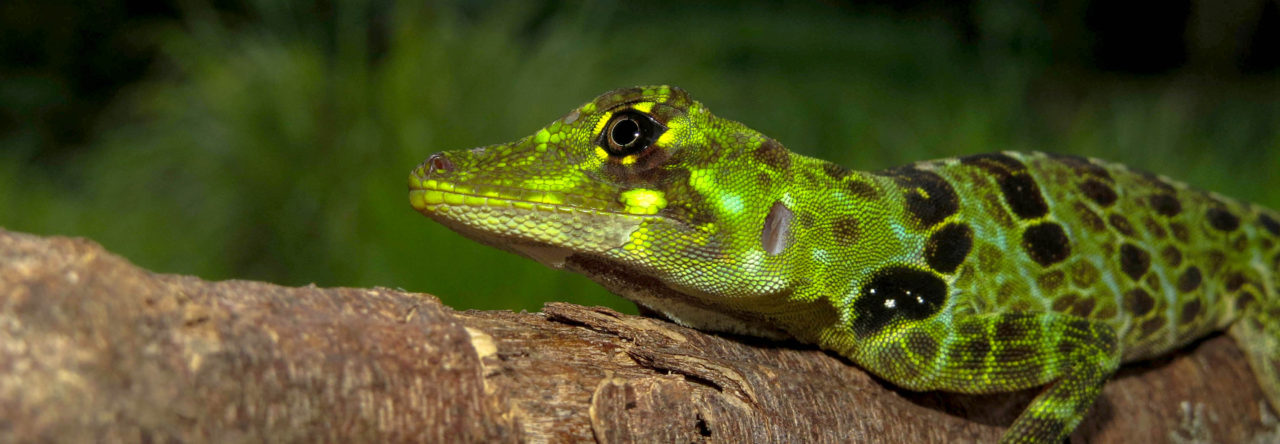
 What better adornment for an arm than a lovely knight anole? Thanks to Chuck Horne, the proud bearer of this lovely crown giant. We’ve featured anole tattoos before, but there must be others out there? Anyone want to share?
Category: All Posts Page 127 of 154
Community ecology is a confusing field, confounded by the interchangeable use of many fundamental terms.
Recently, a group of graduate students and I discussed this strange paradigm and thought we would see what people’s own interpretations were.
If you have a spare 5 minutes while drinking your morning coffee, please could you fill out this short (4 question!) poll asking you to give your definition for; ‘community’, ‘assemblage’, ‘guild’ and ‘ensemble’. It will be cool to see how people’s opinions differ!
Many thanks
James


Lyriocephalus scutatus. Photograph by Ruchira Somaweera, National Geographic
We at Anole Annals love horned lizards, and so were delighted to read about new research on Sri Lankan hornies, reported on the National Geographic Society’s webpage. Check out the article, which details recent research by Ruchira Somaweera of Sydney University.

Certatophora stoddartii. Photograph by Ruchira Somaweera, National Geographic
There was a lot of discussion last month about the fabulous anole goings-on at the SICB meetings. However, there were other conferences sporting important anole work over the holidays. One of them was International Plant and Animal Genome XXII, described as “the largest AG-genomics meeting in the world” and held in San Diego in early January. Perhaps not a venue at which you’d expect anole work to be discussed, but there was Poster #720:
Mining the Most Species-Rich Amniote Genus: de novo Sequencing of Three Anole Lizards for Comparative Genomic Analysis #P720
Date: Monday, January 13
10:00 am – 11:30 am
Description:
Presenters: Marc Tollis Arizona State University, Elizabeth D. Hutchins Arizona State University, Walter L. Eckalbar Arizona State University, Michael R. Crusoe Arizona State University, Catherine M. May Arizona State University, Jessica Stapley Smithsonian Tropical Research Institute, Elise Kulik Arizona State University, Matt J. Huentelman Translational Genomics Research Institute, Rebecca E. Fisher University of Arizona, Kenro Kusumi Arizona State University
P720 – Mining the Most Species-Rich Amniote Genus: de novo Sequencing of Three Anole Lizards for Comparative Genomic Analysis
The repeated evolution of morphological adaptations to specific ecological niches makes Anolis lizards a spectacular example of adaptive radiation in vertebrates, and an ideal model for comparative genomics. The complete genome of the green anole (A. carolinensis) has already provided insights to the evolution of genomic and phenotypic variation in vertebrates. A multi-species comparison within the Anolis genus would increase the power of studies seeking to understand the genomic bases of species diversification. We carried out de novo whole genome sequencing and draft assembly of three species, the grass anole (A. auratus), the bridled anole (A. frenatus), and the slender anole (A. apletophallus). Here we report some of our preliminary comparative genomic findings. Analysis of the abundance and diversity of transposable elements within these genomes has revealed repetitive landscapes typical of non-mammalian vertebrates, yet variation between Anolis species is greater than what is observed across most mammals. This may have provided a genomic environment amenable to key adaptations during the Anolis radiation. Using well-defined models such as mouse and chicken, we identified orthologous genes integral to myogenesis and limb development, and are beginning to catalogue interspecific variation in protein-coding genes and cis-regulatory motifs. Functional anatomical and histological studies are being performed to quantify the tail and hindlimb muscle groups of these species compared to A. carolinensis. Our ultimate goal is to identify the divergent alleles associated with ecological speciation, thus bridging the genotype-phenotype gap.
A recent trip to the Everglades with Palm botanist Sara Edelman was meant to provide a welcome break from studying for qualifying exams, and give her the opportunity to further educate me on all things palm (which was previously limited to determining which lizards in Miami appear to live on them).
After spending the morning locating individuals of her study species, the native and state-threatened Paurotis palm (Acoelorrhaphe wrightii), we had received very little wildlife luck (which was the true reason for me volunteering to ‘help’). From past visits, I had found brown anoles (Anolis sagrei) at every car park along the Everglades National Park road down to Flamingo, likely hitch-hiking unwittingly on visitors cars, but to my knowledge they had yet to disperse convincingly out from these. On our second to last survey of the day, to this tree island off the main road just south of Mahogany Hammock, while searching for native green anoles (Anolis carolinensis) which I had yet to see, I heard some rustling in the bushes – lo and behold, sitting there as bold as day signalling straight at me was a male brown anole!

Everglades tree island characterised by Paurotis palm (Acoelorrhaphe wrightii), Saw palmetto (Serenoa repens), Buttonwood (Conocarpus sp.) and Pine (Pinus sp.), with [inset] brown anole (Anolis sagrei) observed inside
So ruling out human-mediated release or dropping by a clumsy predator, we could assume that this chap arrived there all by himself. This would suggest that brown anoles have no problems in traversing through sawgrass, although temporal factors may be important (i.e. dispersing during the dry season when water levels are low or absent).
The implications for the expansion of this species through the Everglades remain unclear, although their relationship with green anoles leads to a predictable outcome (discussed extensively on AA [1, 2, 3). Just how much effect is a highly fecund, hyper-dense, extremely competitive and resilient insectivore going to have on these small ‘island’ ecosystems?

Read all about it in this post on Deadspin.
Update March 13, 2014: Here’s a less happy story on the same theme.

All’s well that ends well
A couple of days ago, we had a post about a poor anole frozen to death in wintry Texas. Today comes a report on Dust Tracks on the Web of another green anole incapacitated by unseasonable chill, but with a happier ending.

Male and female A. sagrei at the famous Soroa, Cuba locality.
Anole displays consist of conspicuous behaviors that are known to be used in multiple contexts, such as exhibiting territory ownership and territory defense, mate attraction and female receptivity, species recognition, and even predator deterrence. As most of you know, the display repertoire typically involves three major signal types: “dewlap extensions” (DE, pulsing of the throat fan or dewlap), “push-ups” (PU, up and down movement of the body and tail), and “head-nods” (HN, up and down movement of the head only). Although the visual display behavior in anoles has been extensively studied, the function of these three major signal types (DE, PU and HN) remains highly equivocal, and especially in the brown anole. Therefore, we decided to set up a behavioral experiment addressing DE, PU and HN signaling rates across diverse contexts, using the brown anole as study species.
Our study differed from previous ones in two main aspects. Whereas most other studies have focused on male signaling only, we looked to the three separate signal types in both male and female lizards. Secondly, our study is the first one to compare display rates across a wide range of contexts using the same individuals over again (repeated-measures design). This design could, however, only work under fully-controlled laboratory testing conditions. The diverse contexts we tested included predator, non-predator and several social interactions (i.e., mirror, male-male, male-female and female-male). For the predator and non-predator interactions, we used a living curly-tailed and equally-sized ocellated spiny-tailed lizard, respectively; the social context involved only conspecific interactions. Rather than examining display structure, we focused on the frequency with which each individual signal type was performed.
What did our results show? We found that brown anoles of both sexes exhibited higher display rates in the presence of conspecifics than when confronted with a predator or non-predator. DE, PU, and HN seem to be of main importance during brown anole social interactions, and thus not in predator deterrence. Whereas the females did not significantly raise display rates in response to a mirror or during intersexual interactions compared to a control situation, males did. The PU signal type only appears to play a major role for brown anole males during aggressive encounters. On the other hand, increased frequencies of all signal types during male-female interactions suggest that DE, PU, and HN are all essential for male courtship.

Staged intersexual interactions in the brown anole
Finally, we suggest that intersexual selection is probably a driving force for frequency-related dewlap use in both sexes (we found a very strong, but not significant, trend that females increased their DE frequency only during female-male interactions). In contrast, pronounced intersexual differences were detected for PU and HN rates within a social context. I would like to mention once more that all our behavioral experiments were conducted under controlled laboratory conditions and that caution is needed on the general interpretation of our findings.
To end, I would like to say that we did experience some difficulties in comparing our PU and HN results with results from previous studies on brown anole display behavior, due to an inconsistent terminology found in the literature. Authors have variously used the terms “nod,” “headnod,” “bob,” “headbob” and “pushup” to refer to the stereotyped bobbing display and it is not always clear which movements correspond exactly to which terms (e.g., only head movement, only front legs, whole body movement including/excluding tail). Partan et al. (2011) did a very nice job by discussing several bobbing display terms in her paper, but still we think there is need for a more consistent and defined “bobbing” terminology. In this way, pooling display datasets and comparing display results will become more efficient and accurate, which in turn may lead to better “anole science”!
Driessens, T., Vanhooydonck, B., Van Damme, R. 2014. Deterring predators, daunting opponents or drawing partners? Signaling rates across diverse contexts in the lizard Anolis sagrei. Behav Ecol Sociobiol 68:173–184.
This weekend I recently saw an adult male Cuban brown anole (Anolis sagrei) perching higher than I have ever observed – roughly 4m high!

Adult male Cuban brown anole (Anolis sagrei) perching uncharacteristically high
So anole aficionados, what dizzying heights have you observed trunk-ground anoles up to?
*My apologies for the poor quality of the zoomed in sections.