A while back, we reported on a monograph Hedges and Conn that described an enormous number of new skink species (35) from the Caribbean. Now efforts are being made to prevent some of these species from going extinct. The Center for Biological Diversity has just filed a petition with the U.S. Fish and Wildlife Service asking that nine Caribbean skink species be placed on the Endangered Species List. Those species are: Culebra Skink (Spondylurus culebrae), Mona Skink (Spondylurus monae), Monito Skink (Spondylurus monitae), Lesser Virgin Islands Skink (Spondylurus semitaeniatus), Virgin Islands Bronze Skink (Spondylurus sloanii), Puerto Rican Skink (Spondylurus nitidus), Greater Saint Croix Skink (Spondylurus magnacruzae), Greater Virgin Islands Skink (Spondylurus spilonotus) and Lesser Saint Croix Skink (Capitellum parvicruzae).
A press release from the CBD explains all:
“The Center for Biological Diversity filed a formal petition today seeking Endangered Species Act protection for nine newly identified species of skinks found only in Puerto Rico and the Virgin Islands. These rare lizards with smooth skins are on the knife’s edge of extinction due to introduced predators and habitat destruction. Reptiles around the globe are in the midst of an extinction crisis with roughly 1 in 5 species considered endangered or at risk of disappearing.
“Time is running out for these lizards,” said Collette Adkins Giese, a Center biologist and lawyer focused on protecting reptiles and amphibians. “The Caribbean is home to extremely rare animals found nowhere else in the world, but too many have already gone extinct. To save these skinks, we need to get them protected under the Endangered Species Act.”
Scientists recently recognized the nine petitioned skinks, along with dozens of others on Caribbean islands. The scientists initiated their study after finding unusually large genetic differences among populations of these skinks on different islands in the Caribbean. All of the newly identified endemic Caribbean skinks are near extinction (or already extinct) due to introduced predators like mongooses and cats, as well as large-scale habitat destruction for development and agriculture.
This loss is alarming because reptiles play important roles as predators and prey in their ecosystems and they’re valuable indicators of environmental health. The animals in today’s petition will reap life-saving benefits from the Endangered Species Act, which has a 99 percent success rate at staving off extinction for species under its care.
“Skinks have a slow-moving curiosity and are not adapted to fast predators such as the mongoose, introduced by humans,” said Dr. Blair Hedges of Pennsylvania State University, the lead author of the 2012 study that recognized the petitioned species. “The survival of these skinks depends on the special measures of protection that only the Endangered Species Act can provide.”
Although reptiles have been around for hundreds of millions of years and survived every major extinction period, now, due largely to human impacts, they’re dying off at up to 10,000 times the historic extinction rate. About 20 percent of reptiles in the world are endangered or vulnerable to extinction. Within the Caribbean, scientists estimate that reptiles have levels of endangerment that are at or near the highest levels worldwide.
The Center was joined in its petition for these nine skinks by Dr. Renata Platenberg, an ecologist specializing in Caribbean reptiles.
Background
The petitioned-for Caribbean skinks, which can grow to be about 8 inches long, are unique among reptiles in having reproductive systems most like humans, including a placenta and live birth. They have cylindrical bodies, and most have ill-defined necks that, together with their sinuous movements and smooth, bronze-colored skin, make them look like stubby snakes.
Four of the species for which we petitioned are found within the territory of Puerto Rico: the Culebra skink (Culebra and the adjacent islet of Culebrita), Mona skink (Mona Island), Monito skink (Monito Island) and Puerto Rican skink (Puerto Rico and several of its satellite islands). The remaining five are found in the Virgin Islands: the Greater St. Croix skink (St. Croix and its satellite Green Cay), Lesser St. Croix skink (St. Croix), Greater Virgin Islands skink (St. John and St. Thomas), Lesser Virgin Islands skinks (St. Thomas and two adjacent islets, several British Virgin Islands) and Virgin Islands bronze skink (St. Thomas and several of its islets, several British Virgin Islands).
Eight of the nine petitioned-for species fall within the genus Spondylurus, and one falls within the genus Capitellum. The genus Spondylurusincludes what are now known as the Antillean four-lined skinks because of the four major dark stripes on their back and sides. Skinks in the genus Capitellum are called the Antillean small-headed skinks and have small feet and short heads, lacking dark dorsolateral stripes.”
The entire petition can be downloaded from the CBD’s website.

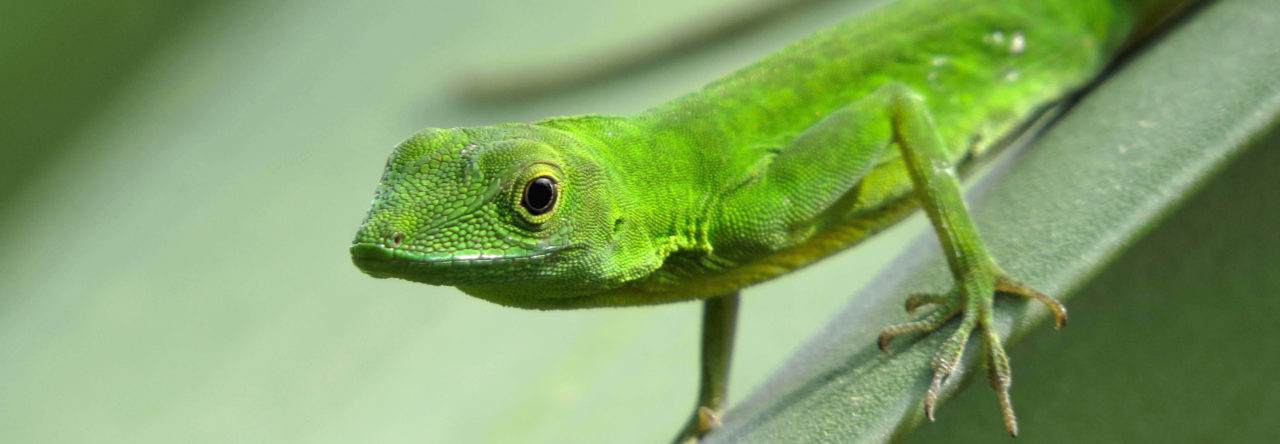

 What better way to celebrate moving your clock forward than getting that anole watch–available in five ecomorphs–that you’ve been coveting. Pop on over to


 Small in size, but a global giant in biodiversity, Ecuador is awash in all manner of fauna and flora. Birds, butterflies, trees—the country is a hotspot for just about everything. But no group of organisms is more beautiful, more charismatic, more scientifically captivating than Ecuador’s reptiles and amphibians. The Amazon rainforest dominates the attention of the public, but other parts of the country, especially the mountainous regions, are just as biologically rich. One such area is the small parish of Mindo in Pichincha Province, home to 102 species of creepy crawlies. And what an ensemble! Brilliant colors, toxic skin and venom, sweet serenades, menacing looks, gorgeous displays—this region is an encyclopedia of herpetology in just 268 square kilometers.

