Category: All Posts Page 123 of 154

Indian Robin chasing a Sitana

I’ve been re-watching some of my Sitana videos from 2012, and was reminded of an odd interaction between an Indian robin and a male fan-throated lizard (Sitana ponticeriana), from a population in Kutch, Gujarat, in western India. Usually, Indian robins and fan-throated lizards don’t pay much attention to each other. Here’s a video in which a lizard displays when a pair of robins pass by. His dewlap remains extended for a while, which is uncharacteristic, but the interaction doesn’t escalate:

But in the same population, an Indian robin chases after a male fan-throated lizard, after the lizard first ran in the direction of the robin. He starts perched on the rock in the centre of the screen. Here’s a video, slowed down to half-speed. When filming,  I had no idea what was happening, or even where the lizard was, which explains why the camera deviates from the lizard for a while (apologies). 

I’m not sure what’s going on. I didn’t think robins eat lizards–do they? Maybe it thinks the lizard’s tail is a worm? Maybe it’s just playing? Any further ideas?

Spotlight on Cuban Anoles III: Anolis vermiculatus

_1060024

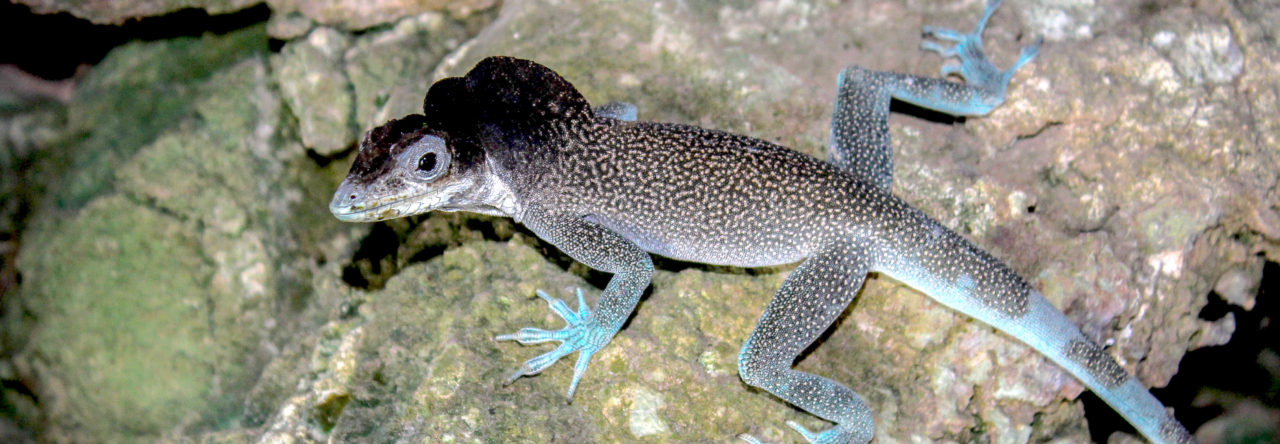
I don’t think I’ll run into any disagreements by claiming that Anolis vermiculatus is hands-down one of the coolest anoles in existence. First of all, it’s huge – up to 123mm SVL for males. They have blue eyes. They are capable of eating fish and amphibians. They can run across water, and are “truly aquatic” (Schwartz & Henderson 1991). The males in particular seem more like crested water dragons than anoles. A. vermiculatus is sometimes called “lagarto caiman” in Cuba. Although this might bring to mind Dracaena for some, Anolis vermiculatus is quite a different animal. Nevertheless, the name seems appropriate after meeting the creature.

We got our first chance to see A. vermiculatus while staying in Viñales, a lovely, foggy town surrounded by towering limestone mogotes home to Anolis bartschi. We had originally expected to see them only in Soroa, a legendary locality for Anolis in Cuba and a short drive from Viñales. However, we discovered them in abundance along the densely vegetated banks of the mud-brown stream running between our hotel and the road.

A blue eyed male Anolis vermiculatus

A blue eyed Anolis vermiculatus

I generally found A. vermiculatus to be the hardest lizard to get a decent picture of that we encountered (with nods to A. equestris and A. vanidicus). Their preferred habitat is full of shade, and A. vermiculatus is quick to retreat there, often spotting clumsy humans from long distance. If molested further, they leap into the water and apparently remain submerged for some time.

_1060153

The next day, we were scheduled to have an hour in Soroa, but a bus breakdown allowed us two entire hours. We found more A. vermiculatus, a bit more light, and much clearer water, but the lizards remained a wary bunch. Below are females and a juvenile rafting in what looks like a coconut husk. Sexual dimorphism in this species is significant for size (123mm max SVL for males, 83mm for females, Schwartz & Henderson 1991), and coloration.

_1060197

_1060181

_1060167-2

I did get the chance to photograph two large males. This individual appears to have some sort of parasite (notice the swelling on the side of the neck). Anyone have any ideas what it could be? My guess would be a nematode. I’m unsure if the deformity of the jaw is another of these parasites or perhaps a different injury.

_1060256

Although A. vermiculatus is able to run across the surface of water, we did not observe this behavior in our short time with the species. However, it was quite surprising to learn that these lizards do this without the assistance of toe fringes as in Basiliscus.

Here’s the best shot of the bunch:

_1060208-2

Next up: a blue lizard that wears yellow pants!

New Film on Snake Research: Do the Lizard Cameos Steal the Show?

httpv://www.youtube.com/watch?v=zDtDtn5n8-A

A new movie on snake research, an Alex Pyron production, features not only great snake footage, but cameo appearances by anoles and Frank Burbrink explaining how he got out of prison and into herpetology (see disclaimer below), as well as wildfires in the Brazilian Cerrado, and plenty of other frogs, lizards, and rock and roll music.

Alex explains: “Most people think of science as being fairly boring most of the time. They are probably right. However, readers of this page are more likely familiar with another side of the story. Those of us who do field work are lucky enough to get paid to flip rocks for a living, chasing after the most exciting creatures on the planet. Books like Snakes and Snake Hunting and The Snake Charmer captured some of this adventure, and gave many of us an early glimpse into the future careers that awaited us. Bringing this magic to the silver screen is snakehandlers: these signs shall follow them, the new documentary about field herpetology that you never knew you needed (or wanted).

Shot across one year, snakehandlers follows Alex Pyron and a rotating band of pirate misfits across the U.S., Panama, Ecuador, and Brazil in search of tissue samples from the rarest (and commonest) herps around, to fuel the fires of our phylogenetic frenzy. Along the way, a wildfire rips across the Brazilian Cerrado, the clouds boil in the Northern Andes, Frank Burbrink shares his hard-luck tale of crime and punishment on the road to redemption from state prison to evolutionary biology*, famous herpetologists from the past speak to us across time, and new species are discovered left and right.

At its core, snakehandlers tries to answer the question of why we work with snakes to begin with. Herpetologists from every corner share their stories about the interests and experiences that brought them into the field. On the whole, though, the question remains unanswered; how could it be? Why do we do something as crazy and absurd as handle snakes or chase anoles? Watch snakehandlers and see if you can figure that out for yourself, in a movie that does for snakes what Plan 9 did for Outer Space.

As a plus (or a main attraction) for readers of Anole Annals, have fun spotting at least six species of Anolis from North, Central, and South America! Happy herping…

*The producers of snakehandlers were unable to verify the accuracy of all participant interviews.”

Whose Tail Crest Is That?

Which species owns this lovely tail crest?

Which species owns this lovely tail crest?

Some anoles sport fancy dorsal tail crests. It would be interesting to survey the distribution of tail crests–they are only found in some areas, and species of some sizes and not others, and those in particular microhabitats. Quick–can you think of a mainland anole with a tail crest?

But I’m guessing the species above is not one that comes to mind when you think of tail-crest bearing species. Whose is it? The answer’s below the fold.

Draco Shares the Anole Limb Length–Perch Size Relationship

A recent study in Oecologica by Terry Ord and myself found striking parallels in habitat use and morphology between the phylogenetically distinct Anolis and Draco genera.  Draco (family: Agamidae), for those who don’t know, is a genus of gliding lizards found throughout southeast Asia that are similar to anoles in that they communicate with conspecifics using bright and diversely coloured dewlaps (see picture).

IMG_2234  anole

(L: Draco sumatranus; R: anole)

A defining characteristics of anole ecology is their ecomorphology – a description of the species microhabitat and its morphological adaptions for thriving there. Anole species living sympatrically avoid interspecific competition by partitioning their habitats and resources, and consequently develop morphological adaptations that are suited to their slice of the habitat. As Draco species are also often found in sympatry, we tested whether competition pressures had resulted in similar habitat partitioning and corresponding morphological characters (or ecomorphs). Whilst it’s perhaps a bit early to suggest that Draco have  evolved the full complement of anole ecomorph classes, the Draco taxa studied largely clustered into two groups that shared characteristics with the Greater Antillean anoles. The figure below (panel b) shows a combined Draco/anole phenogram, based on morphology and ecobehaviour (the anoles are labelled only by ecomorph). The Draco species fall out largely in line with groups of ‘trunk-ground’ anoles towards the top of the phenogram, and ‘trunk-crown’ anole towards the bottom. Phenogram ecomorph

One of the better diagnostic features of the Greater Antillean anole ecomorphs are the differences in perch use and subsequent differences in limb length. The plot below shows total hindlimb length (size-free residuals) of adult males of Draco species and Greater Antillean anoles, as a function of perch circumference.  The relationship between limb length and perch size is nearly identical between the groups, with a very similar slope, and only a difference in y-intercept owing to differences in body length (Draco bodies are elongated to accommodate gliding membranes).  The same unit increase in perch size results in the same unit increase in limb length for both genera.

These results are surprising considering that this relationship has not been found in species that are more closely related to the Greater Antillean Anolis (see study for references) and because Draco and Anolis have very different ‘key innovations’ for locomotion in their respective habitats (toe pads for Anolis and gliding membranes for Draco). This implies that Draco species have experienced interspecific competition over resources in similar ways to the anoles, resulting in homologous character displacement. 

Evolutionary History of the Green Anole in the United States

tollis1It’s an old story: a Cuban émigré arrives in Florida, thrives and then sends out roots, in the process becoming completely Americanized. I refer, of course, to the green anole, Anolis carolinensis, derived from grand-daddy porcatus in Cuba. But the exact story of carolinensis‘s spread–when, by what routes, where–is still unclear. Two years ago, a pair of papers reported interpretations based on sequences of mitochondrial DNA, revealing a somewhat complicated history of green anole diaspora. Now, in a recent paper in Genetica, Tollis and Boissinot revisit this question, bringing to bear the power of a multi-locus, nuclear gene sequencing effort. Their results lead to a simpler, more satisfying story, and suggest that we need to be wary of placing too much faith in phylogeographic/evolutionary scenarios derived from mitochondrial DNA.

Here’s the tail end of their abstract:

“We find that all demographic events occurred during or after the Upper Pliocene and suggest that green anole diversification was driven by population divergence on interglacial island refugia in Florida during the Lower Pleistocene, while the region was often separated from continental North America. When Florida reconnected to the mainland, two separate dispersal events led to the expansion of green anole populations across the Atlantic Seaboard and Gulf Coastal Plain.”

Their inferred evolutionary relationships are portrayed above, and their biogeographic scenario below.

tollis2


Does the Gender of an Observer Affect Lizard Behavior?

Hard at work studying lizards (from a previous AA post on best practices in lizard videotaping in the field)

The New York Times reported today on a recent paper in Nature Methods that indicated that stress levels of lab rats varied depending on whether the scientist in the room with them was a man or a woman. This effect existed even in response to t-shirts worn by a man or a woman.

This got me thinking: could the same factor effect lizard behavior studies? In many cases, anoles are studied by an observer quietly watching or recording lizards from a distance of a few meters. Many anole species seem unperturbed by the presence of observers and go about their activities in a seemingly natural way. But does the presence of an observer have an effect? Are they warier? Do they display less? And, more to the point, does the identity of the observer have an effect? Men are, on average, bigger than women, so might that matter? Some people are more fidgetty than others. Clothes? Facial hair? I am aware of a few studies on observer effects on lizard behavior (such as this one on the brown anole), but not many.


Anolis carolinensis in Alabama–What Do Green Anoles Do When Browns Aren’t Around?

carolinensis on pine alabamax

Something you don’t see every day: a green anole on a pine tree.

Through the years here at AA, we’ve had discussion of the habitat use of the common green anole. In particular, there is a persistent belief that before the brown anole emigrated from Cuba, green anoles used all manner of anole habitat, from the bottom of trees to the very top of the canopy. Once the browns arrived, however, greens seem to have repeated back up the tree, ceding the low perches to the browns.

This is a very nice story, and probably true, but it’s surprising how little documentation we have of the habitat use of green anoles in places where browns don’t occur. In fact, more generally, it is quite surprising just how little we know about the natural history of green anoles throughout their natural range. For such a common species, you’d think its biology would be extremely well-known, but that is far from the case.

A while back, Janson Jones referred to the green anoles in his then-neighborhood (he’s since moved) in Georgia as low-riders, a possible example of green anole habitat use in the absence of browns. With this in mind, I was delighted to get a chance to see what the greens are up to in Alabama, a state that is still mostly–at least for now–mostly brown anole free.

Across the street from Pi Kappa Kappa.

Across the street from Pi Kappa Kappa.

On the campus of the University of Alabam in Tuscaloosa, greens were moderately abundant when the sun was out. The fellow to the right was strutting his stuff on sorority row, but his comrades elsewhere were in similar habitats on trees, moving up to into the canopy when harassed by an old dude with an iPhone.

But then I had the good fortune to get taken to a nearby pine forest by whiptail lizard geneticist turned turtle biologist Peter Scott, a grad student at UA. Peter told me that he often saw (or, rather, heard) green anoles scurrying through the leaf litter when he approached, running to the nearest tree which it then ascended. It seemed unlikely, but sure enough, that’s where the greens we found were, down low, in very un-green anole-like habitat.

carolinensis in the litter Alabama

Alabama low-ridin’ green anole

Of course, these were just a few observations made over the course of a short hike one afternoon. But clearly there’s a lot to learn about green anoles–what they do in places without competitors, and how that changes when brown anoles arrive. Seems like a great project out there, just waiting for someone to do it.

 

More Orange-Headed Brown Anoles

sagrei orange headed heather stewart

We’ve had a series of posts on orangey brown anoles in Florida, but this most recent example is a stunner. Thanks to Heather Stewart for providing this photo of a fine male from Boca Raton, FL, photographed this past January. Heather pointed out that other brown anoles in the populations were quite normal looking.

Rampaging Wrens Chow Down on Green Anoles

Wrens seem like such harmless, friendly little birds. And with such a dainty little beak, how much damage could they do? Imagine our surprise, then, to learn that they may be voracious predators on our beloved anoles. Thanks to the observations of Roger Birkhead and Mark Benny, reported in the most recent issue of Herpetological Review, we now know the true nature of these little beasts. Here’s what they saw (Herpetological Review 45(1):123-124, 2014):

wren“On 14 August 2013 around 0730 h MCB was observing the birdfeeders and birdhouses at his residence (Harrison Co., Mississippi, USA; 30.387325°N, 89.021624°W, datum WGS84/NAD83) when he noticed a commotion near the potted plants on his front porch. An adult Carolina Wren (Thryothorus ludovicianus) was observed smacking and shaking something large and elongated. When the wren flew up to the nearby birdhouse it became apparent that it had a juvenile Anolis carolinenis in its beak which it quickly fed to its chicks. This behavior was observed for a second time at approximately 1130 h. A third anole was observed being fed to the chicks at 1619 h (Fig. 1). There were at least two exchanges of food missed while leaving the point of observation to retrieve and set up a camera, but were evidenced by long green tails protruding from the entrance hole of the birdhouse that were longer than the lizard in Fig. 1. Adult wrens were also seen bringing larger unidentifiable pieces of flesh assumed be the remains of a larger dismembered A. carolinensis. Similar behavior has been noted for vireos feeding on A. carolinenis (Sykes et al. 2007. Wilson J. Ornithol. 119:508–510). Additional observations were made on 15 August and 16 August of both whole lizards and parts being brought in by the adult wrens. Lizards are identified in the diet of the Carolina Wren as far back as 1916 (Beal et al. 1916. Common Birds of the Southeastern United States in Relation to Agriculture. Farmers Bulletin 755, 40 pp.), but no species identifications were provided. Generally, predation of vertebrates by passerine birds is considered uncommon (Lopes et al. 2005. Lundiana 6:57–66). This observation is the first documented record of A. carolinensis being consumed by Carolina Wrens and judging by the frequency of captures noted here this wren species may be a significant predator of anoles at least during the bird’s nesting season.”

Page 123 of 154

Powered by WordPress & Theme by Anders Norén