Category: All Posts Page 100 of 153

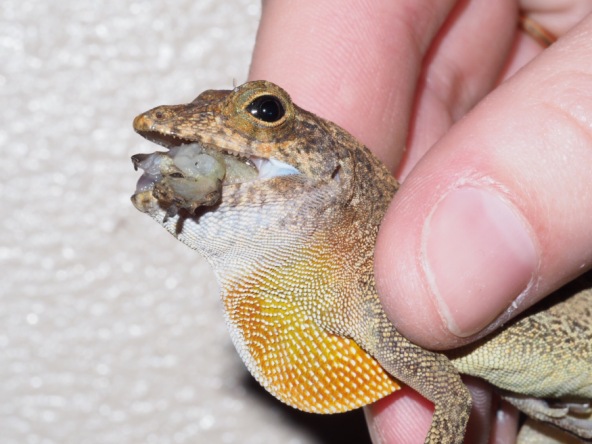
Anolis gundlachi and Sustainable Forestry in Puerto Rico

A little over two weeks ago, I had a paper focusing on Anolis gundlachi published in Herpetology Notes. I had known since I was a child that I wanted to be a herpetologist, but when I graduated in 2003 with a Bachelor’s in Environmental Studies, there weren’t many opportunities in my area; I fell into environmental consulting, where I stayed for five years.

Eventually, I came to realize that my life’s journey would never change if I didn’t force it to.  In addition to my love of herpetology, I had always wanted to live in the tropics, so when my lease in Atlanta was up in 2008, I sold most of my belongings and went to live and volunteer at Las Casas de la Selva, an approximately 1,000 acre sustainable forestry project in Patillas, Puerto Rico.

Started on the remnants of an old, abandoned coffee plantation, in the early 1980’s the founders of the project planted the introduced timber tree “Blue mahoe” (Talipariti elatum) on approximately 300 acres, allowing the rest of the property to undergo secondary succession.  Now, the T. elatum is being extracted, and younger native trees that have grown beneath the plantation canopy are left behind. The project is staffed entirely by volunteers, and scientific research is carried out with help from the Earthwatch Institute.  For those not aware, Earthwatch is a non-profit organization that provides a unique form of ecotourism mixed with research. Potential travelers fill out an application, and if approved, join a group for an expedition to one of the dozens of projects Earthwatch partners with, for the sole purpose of assisting with scientific research.  I was given permission to design a study and use Earthwatch volunteers to gather data.Anolis gundlachi

My research idea was simple enough, to set up plots in areas with and without Talipariti elatum and see if the presence of the tree made a difference in anole abundance.  With four to six Earthwatch groups per year, I was well on my way to collecting large amounts of data. Meanwhile, as this was my first field survey ever, I was teaching myself “on the fly” through trial and error, as well as spending nights in my casita reading books on research design, ecology, and Puerto Rican herpetofauna.

One of the most disheartening moments during my research was when I had gained enough experience to realize…that I needed to start over.  After reading numerous articles and books dealing with anoles and general ecology, after accumulating almost two years in the field, I decided that I couldn’t in good faith rely on the data I had gathered at the start of my project. I was too inexperienced when I had first started the study, and I felt that I simply couldn’t be certain of the identifications I had made during previous counts; such are the hazards of self-teaching. I was also convinced that in my attempts to survey as large an area as possible, I had included far too many plots in my study, preventing me from gathering useful data; even if the anole identifications were accurate in each plot, I had so many that I had ended up with few anole counts that allowed me to compare the seasonal abundance of one plot to another.  I reduced the size of my study area to one “control” area (without mahoe) and one “plantation” area (with mahoe), with each area containing six plots.  It was a hard lesson to learn, and even harder to admit my mistakes to myself in the first place.

I also learned a lesson in regard to “citizen science,” of which I am still a huge advocate. I now know that in order to get reliable data, it is up to the researcher to set aside an adequate amount of time for training, as well as to implement a research design that is appropriate for the level of experience your volunteers have.

I restarted my research; and although at first I was decidedly taciturn at going back to the starting line, as I conducted more and more counts, I realized I was getting good, usable data. After I felt I had enough counts, I brought my survey to a close, wrote the paper manuscript, reached out to more experienced colleagues to review it, and eventually submitted it to Herpetology Notes, and received feedback and requests for revisions.  Now, that paper has been published, and to me, it means so much more than just the results showing that the null hypothesis couldn’t be rejected–my paper is proof-positive that I can do this. I can be a herpetologist. I can learn the proper methods and protocols of research design. As someone who is largely self-taught and is getting a late start, completing this study make me certain that my best is yet to come, and I can make useful contributions to the discipline.

The paper‘s abstract:

The island of Puerto Rico has one of the highest rates of regrowth of secondary forests largely due to abandonment of previously agricultural land. The study was aimed at determining the impact of the presence of Talipariti elatum, a timber species planted for forest enrichment, on the abundance of anoles at Las Casas de la Selva, a sustainable forestry project located in Patillas, Puerto Rico. The trees planted around 25 years ago are fast-growing and now dominate canopies where they were planted. Two areas, a control area of second-growth forest without T. elatum and an area within the T. elatum plantation, were surveyed over an 18 month period.  The null hypothesis that anole abundance within the study areas is independent of the presence of T. elatum could not be rejected. The findings of this study may have implications when designing forest management practices where maintaining biodiversity is a goal.

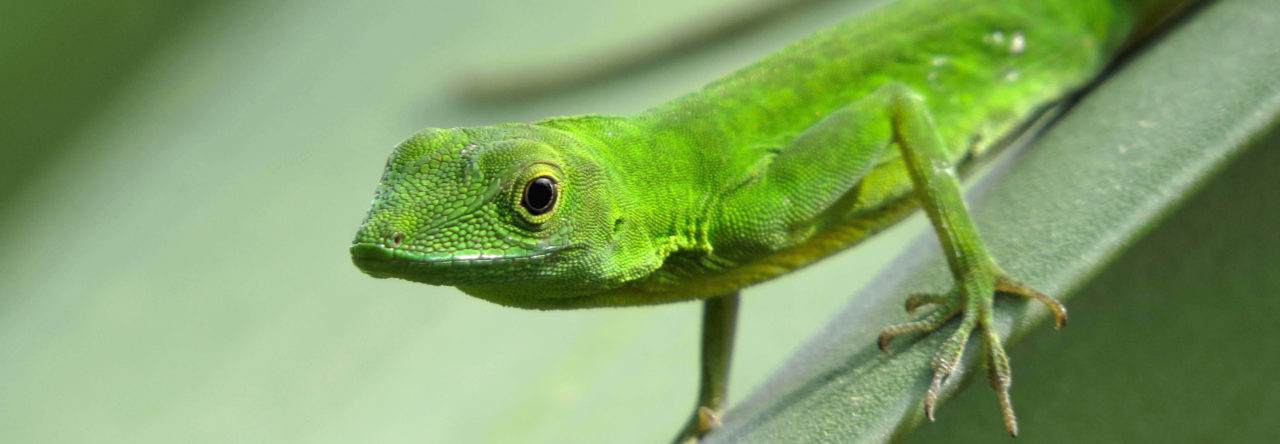
Green Anole Window Decals

We once discussed what the appropriate term would be for a group of anoles, but what about a family of anoles? Is there such a thing? If not, there is now.

Just in case stick figures aren’t an appropriate representation for your family group, look no further than the green anole window clings made personally by herp. lover Andrew. These aren’t yet available on the web, but Andrew may knock a few out for you if you write him directly. I did and now I have one of the most stylish minivans in Florida!Anole family

Anolis cristatellus Exploits in Puerto Rico

Photo by Kristin Winchell

Cannibalism and a three-and-a-half legged lizard–field trips don’t start any better than that! Read all about it on Kristin Winchell’s website, Adaptability.

What You Can Learn from Watching a Lizard for a Long Time

Photo by Ambika Kamath

Behavioral research is often reduced to a large set of data points, necessary of course for statistical analysis. But sometimes what gets lost is actual knowledge of what animals do in their natural habitats. There’s no substitute for just watching an animal over the course of a day or  a week. Often what you’ll see is that animals are not little automatons, repetitively undertaking particular actions in accord (or not) with our theories. Rather, they have lives where they do all kinds of idiosyncratic behaviors, the sort of quirky detail that often get lost in high-falutin’ analyses of behavior. Ambika Kamath demonstrated just this in her recent post, “A Week in the Life of U131.” Here’s the first paragraph. You’ll have to go to her website to read the rest:

When you’re collecting data on the behaviour of individual animals over time, as I am this summer, your observations sometimes feel less like a collection of numbers and more like a collection of personal narratives. Of course, the data are both numbers and narratives, and when it comes time to analyze this collection of datapoints and understand the patterns that emerge from it, the numbers will be all that matter. But in the meanwhile, before I can look the bigger picture, I enjoy considering the individual narratives. And this week, I encountered a lizard whose story illustrates why it’s worth considering these narratives at all.

Anole Annals Wants You…to Write a Post!

The goal of Anole Annals is to be the clearinghouse for all things Anolis, the place that the anole community turns to for the exchange of information or ideas. To do so, we welcome–no, heartily encourage–contributions from anyone and everyone.

Who can post? Anyone who has something to say about the biology, natural history, or amazing-ness of anoles (well, within reason–we leave anole husbandry and sales issues to other websites). And fear not–you’ll have an audience. Anole Annals is now routinely visited by 600-1000 readers a day. That sounds like a broader impact to me!

Anole Annals is a good place to let the anole community know what you’re working on, like Ambika Kamath’s recent overview of her fascinating work on anole social behavior. And, it’s a great way to spread word of your recently published work–why not provide a short precis or tell the backstory of how the paper came to be, like Liam Revell recently did? It’s a great way of giving people the short story of what you’ve done and get them interested in reading the whole paper.

If you are fortunate to live in an anole-inhabited region, tell us about your local species, like David Alfonso’s recent post on the anoles of Colombia. And if you’ve observed something unusual, here’s a good place to report it, like Graham Reynolds note on twig anoles using mangroves.

And it’s just a great place to ask a question, post a photo, or report an observation. Plus, announcements of relevant conferences or personal milestones, such as newly-minted Ph.D.s, are always appropriate.

Posting is easy, and really doesn’t take much time. More than 100 scientists and anole enthusiasts have written posts–you should too! And if you’ve done so before, you’re overdue for another one. Don’t overthink it–just post today!

Anole Research Cakes!

It’s been an eventful year in the Losos Lab–three members of the lab have successfully defended their Ph.D.s in 2014-2015! To celebrate their defences, lab member Talia Moore designed and made three wonderful cakes, each tailored to the research of the newly-minted Ph.D.

For Dr. Martha Muñoz, who studied the shift of high-altitude anoles’ perches from trees to rocks, we had this beauty:

photo 1


For Dr. Alexis Harrison, who studied the Anolis dewlap, primarily in A. sagrei:photo 2

And for Dr. Shane Campbell-Staton, who studies geographic variation in cold tolerance in the North American Anolis carolinensisa map with sampling locations rendered in sprinkles, and lizard popsicles!

shane cake


Shane Campbell-Staton, Ph.D.

SCS,PhD

Congratulations!!!

Clay Models with Dewlaps Are Attacked More than Clay Models Without Them

modelIn recent years, biologists have put out clay model lizards to measure attack rates by birds and other predators. In a recent study published in Herpetology Notes, Vazquez and Hilje put a twist into this approach, by ornamenting some faux lizards with a colorful dewlap-like structure. Sure enough, those models were attacked more. Here’s their abstract:

We investigated how predatory attacks on Norops lizards occur in old-growth and secondary pre-montane wet forests in Costa Rica using clay models. Using models with secondary sexual characteristics also permitted comparison of attack rates between males and females, as well as the specific site of the attack (head, body, or tail). Birds were found to account for the bulk of predation attempts on the lizard models in both forest types, and there was no significant difference in attack frequency between forests. Attempts were more frequently made on males, indicating that colorful, bright dewlaps used to attract females and for territorial displays might also function in attracting predators. Male models received more attacks on the head, suggesting that birds may preferentially target areas of brighter coloration, whereas female models received more attacks on their tail, indicating that birds may not have adopted any avoidance of a potentially less profitable region from which tails can be autotomized.

Predation of a Gymnophthalmid Lizard by an Andean Motmot (Momotus aequatorialis) in the Canyon of Combeima, Central Andes of Colombia.

The canyon of Combeima is located in the Central Andes in Colombia, in corregimiento of Juntas, municipality of Ibagué (Tolima). This life zone is approximately at 1700 masl (pre-montane forest). The Canyon is known for its biological diversity in birds, anole lizards and some snakes.

In this canyon, the abundance of Andean Motmot (Momotus aequatorialis) is high allowing them to be readily observed. The Andean Motmot, M. aequatorialis was separated as a distinct species from the rest of the complex Momotus momota according to (Stiles 2009). The distribution of M. aequatorialis is reported in mountain regions of the Andes between 1500 and 3200 masl (Hilty and Brown 1986, Stiles 2009).

Andean motmots feed mainly arthropods and fruits (Remsen et al. 1993), and it has been documented that they may also feed of various vertebrates such as frogs (Master 1999), snakes (Stiles & Skutch 1989), hummingbirds (García-C & Zahawi 2006) and mammals such as mice, bats, shrews (Delgado-V. & Brooks 2003, Chacón-Madrigal & Barrantes 2004, Greeney et al. 2006, Sandoval et al . 2008) as well as marsupials of the genus Micoureus (Acevedo-Q 2012).

Here I report predation by M. aequatorialis on a lizard of the family Gymnophthalmidae. The bird was holding the lizard in its beak, lacking a part of its tail (Fig. 1). The observation was conducted for the period in which the bird remained perched on the tree.

IMG_0530

Figure 1. Andean motmot (M. aequatorialis) capturing a Gymnophthalmidae Lizard

I also observed that the M. aequatorialis had an ectoparasite on the blue stain (Fig 2), another example of the various interactions that can be found in this ecosystem.

Motmot_Ecto

 Figure 2. M. aequatorialis with an ectoparasite (Red circle)

Lizard Systematics: Morphology and Molecules Redux

Closely related to snakes after all?

Two years ago, I wrote an AA post on lizard phylogenetics, summarizing the results of a paper by Gauthier et al. that claimed that analyses based on morphological and molecular data produced very different phylogenies. Moreover, Gauthier et al. argued that the morphological data provided absolutely no support for the phylogeny suggested by the molecular data.

The issue has now been further considered in a recent paper by Reeder et al. in PLoS One. These authors provide some new morphological data and add a tad of previously unutilized molecular data; with these data sets, they recover essentially the same disagreement in phylogenies. However, what is new in this paper is that they perform a combined analysis that analyzes morphological and molecular data together. The results of this analysis are firmly in agreement with the molecular data. To address the possibility that this is simply a result of the much greater quantity of molecular characters, the authors also conducted analyses that essentially weighted the molecular and morphological data equally. Still, the result was the tree produced by the molecular data alone.

Perhaps the most striking point in the Gauthier et al. paper was the claim that the morphological data gave absolutely no support for the molecular tree. This suggested, in turn, that if the molecular tree is correct, then morphological evolution has been extraordinarily homoplasious. However, Reeder et al. dispute this claim, finding that a number of morphological characters support the molecular phylogeny.

Reeder et al. also broke the morphological characters into six subsets: cranial characters; characters related to the jaws, teeth, and hyobranchial apparatus; characters related to the vertebral column; other postcranial osteological characters, mostly related to the limbs and limb girdles; miscellaneous morphological characters, including morphology of the osteoderms, scleral ossicles and tongue; and characters of squamation and external morphology. Their analysis found that only the cranial characters were incongruent with the molecular phylogeny, and they suggested that these were the characters in which homoplasy was rampant, leading to false signal in the morphological analyses.

Overall, the authors make a strong case that the molecular phylogeny is likely to be the correct one and that morphological data, particularly cranial characters, are misleading due to homoplasy. It will be interesting to see whether and Gauthier et al. respond to these analyses.

Here is the take home message from the discussion of Reeder et al.’s paper:

Our combined analyses strongly suggest that the phylogenetic hypothesis for living squamates based on the molecular data is correct. Specifically, our results support the hypothesis that Iguania is placed with snakes and anguimorphs, and not at the squamate root (as suggested by morphological data alone). Our conclusions are based on several lines of evidence, including:

(a) combined analyses of the relevant molecular and morphological data supports the molecular placement of Iguania, even when the molecular dataset is reduced to only 63 characters, less than one tenth the size of the morphological dataset,

(b) mapping morphological characters on the combined-data tree shows that there is actually hidden support for the molecular hypothesis in the morphological data (similar to the number of characters supporting the morphological

hypothesis),

(c) the morphological dataset is dominated by misleading phylogenetic signal associated with convergent evolution of a burrowing lifestyle and associated traits, and a similar problem associated with feeding modes may explain the morphological placement of Iguania, and

(d) the morphological hypothesis is unambiguously supported by only one of six subsets of the morphological data. Conversely, we find no evidence for hidden signal supporting the morphological hypothesis among the 46 genes in the molecular dataset; no genes support this hypothesis. Further, the failure of some genes to fully support the molecular placement of iguanians in Toxicofera seems to be associated with sampling error (i.e. shorter genes).

Page 100 of 153

Powered by WordPress & Theme by Anders Norén