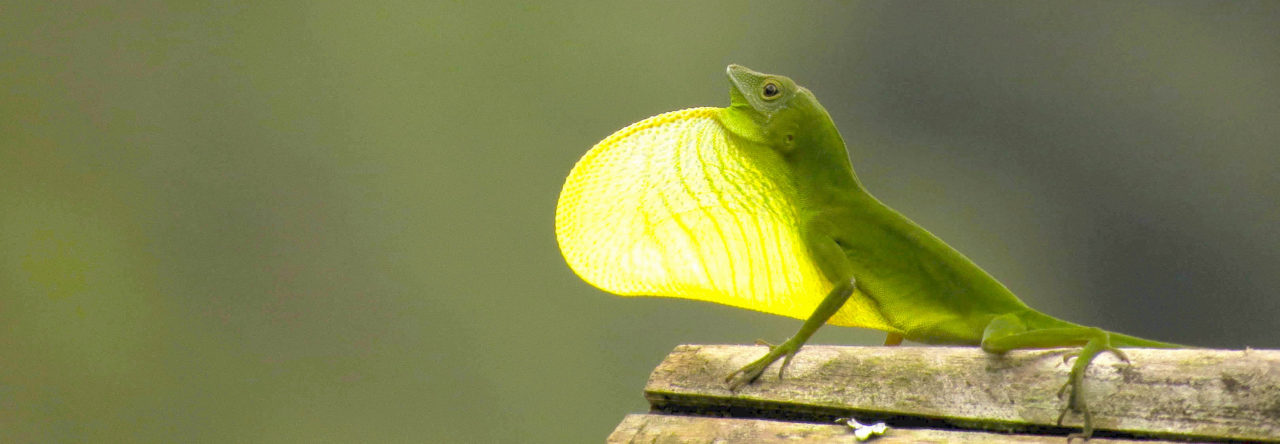
Tell almost anyone in Florida that you’re doing research on brown anoles (Anolis sagrei), and they’ll express some distaste for your study organism. “I don’t like them,” they’ll say, “they’re invasive. Aren’t they driving the native green anoles extinct?” Everyone—literally everyone who has lived in Florida for a while—will tell you how their backyards used to be full of green anoles (Anolis carolinensis). Today, they report, these green anoles have disappeared and been replaced by the invading browns.

Green anoles, increasingly elusive in Florida
These backyard tales are supported by some scientific evidence for shrinking populations of green anoles . On spoil islands in Mosquito Lagoon, Dr. Todd Campbell documented precipitous declines in green anole densities following the experimental introduction of brown anoles [1]. In southwest Florida, Cassani et al. repeated surveys of reptile and amphibian abundance fifteen years apart, using identical methods in exactly the same locations [2]. They found a drop in green anole numbers and a sharp rise in brown anole numbers between 1995 and 2011. Based on their results, both Campbell and Cassani et al. suggest that the persistence of green anoles in Florida has been jeopardized by the invasion and spread of brown anoles.
But both Campbell and Cassani et al. acknowledge a second possible explanation for the apparent disappearance of the green anoles: the lizards may simply have shifted upwards, out of sight.* As Cassani et al. put it, “the hope remains that these lizards persist in the face of competition and predation from A. sagrei by shifting habitat use.” We already know that green anoles shift upwards at least a bit in the presence of brown anoles, and have evolved morphological features that likely help them survive at these higher perches [3]. Could green anoles have shifted so high as to be nearly invisible to us, from our vantage points near the ground?

A bead-tagged brown anole
When I started studying brown anoles in Gainesville, FL, in 2014, I was convinced that the green anoles were all gone. But as we spent many hours marking individual brown anoles and repeatedly surveying their habitat to re-spot them, we began to spot a few green anoles too. I guessed that these green anoles were the last few holdouts against the invaders, and that we were seeing the same individuals again and again. To prove this, all we needed to do was catch and individually mark these green anoles using permanent bead-tags, in exactly the same way that we were catching and marking the brown anoles. It didn’t seem like too much extra work, so once I realised that my 2015 fieldsite was also home to quite a few green anoles, we began catching and tagging them as well.
In two months of sampling, we either caught or re-spotted green anoles a mere 52 times. In the same period and location, we caught or re-spotted brown anoles 4369 times, which certainly seems to suggest more brown anoles than green anoles in this site. But to compare the population sizes of brown and green anoles, you need to compare how often you see new, unmarked individuals relative to how often you see already-marked individuals for each species**. In the graphs below, I’ve plotted the total number of observations against the total number of marked individuals for both A. carolinensis and A. sagrei***, and then zoomed in to just the first 52 observations for both.

Zoomed in, you notice that the curves for the brown and green anoles look quite similar. If anything, we see more new individuals per observation for green anoles than for brown anoles. Neither of these curves has begun to plateau (i.e. we’re still seeing lots of new individuals), so we cannot quantify the difference in total population size of these two species. But these limited data suggest that this population of green anoles is not doing that badly.

The taller tree was home to at least three different green anoles
But if the population is doing okay, then why weren’t we spotting green anoles all that often? The most logical explanation is that the green anoles have shifted up to very high perches, and only rarely descend to heights at which we can observe and catch them easily. Moving a bit beyond the numbers, we find another piece of evidence that supports the idea of a perch height shift—of the 40 green anoles we caught, only eight were males!
We know that male anoles usually perch higher than female anoles [4], that female anoles will often search for and feed on insects on the ground, and that females must descend to the ground to lay their eggs. Males, on the other hand, often move to higher perches to display, seem to feed more opportunistically than females, and are not necessarily compelled to return to the ground after they hatch. Though sex ratios can deviate quite a bit from 1:1 in natural populations of anoles [5], it seems unlikely that a population of green anoles could be comprised of one male for every four females. Taking the sex differences in perch height into account, it makes sense that for every female green anole we spotted, there’s a male green anole perching really high up whom we simply did not see.

None of this means that green anole densities aren’t declining due to the presence of brown anoles in some habitats. In particular, because brown anoles can perch as high as 4 m off the ground, there may be many places in which green anoles previously thrived but where there is simply no “up” for them to escape to once the brown anoles arrive. I suspect that many backyards are exactly such places, and that some reports of local declines in green anole population sizes may in fact be well-founded.
But it’s also certainly possible that, in habitats with sufficiently tall trees, brown anoles are not driving green anoles to extinction. Instead, brown anoles may simply have precipitated a substantial upward shift in the perch height of green anoles towards their ancestral trunk-crown niche. It’s therefore possible that green anoles are thriving, just out of our sight. If that’s the case, then brown anoles don’t deserve quite so much of our animosity after all!

A brown anole perching pretty high.
References:
[1] CAMPBELL, T.S. 2000. Analyses of the effects of an exotic lizard (Anolis sagrei) on a native lizard (Anolis carolinensis) in Florida, using islands as experimental units. Unpublished Ph.D. Thesis. Knoxville, USA, University of Tennessee
[2] CASSANI, J.R., D.A. CROSHAW, J. BOZZO, B. BROOKS, E.M. EVERHAM, D.W. CEILLEY, AND D. HANSON. 2015. Herpetofaunal community change in multiple habitats after fifteen years in a southwest Florida preserve, USA. PLoS One 10(5): e0125845.
[3] STUART, Y.E., T.S. CAMPBELL. P.A. HOHENLOHE, R.G. REYNOLDS, L.J. REVELL, AND J.B. LOSOS. 2014. Rapid evolution of a native species following invasion by a congener. Science 346: 463-466.
[4] SCHOENER, T.W. 1968. The Anolis lizards of Bimini: resource partitioning in a complex fauna. Ecology 49: 704-726
[5] SCHOENER, T.W., AND A. SCHOENER. 1980. Densities, sex ratios, and population structure in four species of Bahamian Anolis lizards. Journal of Animal Ecology 49: 19-53.
*Cassani et al., in particular, trapped reptiles and amphibians in ground-level traps, and very likely missed many anoles. Campbell, however, did sample in arboreal habitats, and did not find this explanation compelling in the context of his study. Trees on the islands he sampled were relatively short (~6 m), “allowing the vertical habitat to be searched thoroughly with small binoculars and some healthy tree climbing.”
**The logic is this: once you’ve marked every individual in a population, you will only re-spot marked individuals and not see new individuals, and the size of your population will be equal to the number of individuals you’ve marked. In reality, you’ll almost never mark every individual, but the rate at which you spot new individuals relative to the total number of individuals you observe (new and marked) can still be revealing. Say you have two populations, A and B. If population A is much smaller than population B, then you will reach the point of mostly re-spotting marked individuals and not seeing new individuals more quickly in population A than in population B.
We obviously could not catch every lizard, and we were better at catching brown anoles than green anoles, so don’t use these data for any serious estimates of population size. But, if anything, our relative inability to catch green anoles means that there are more green anoles in this site than we document.
***Sampling for A. sagrei began about a month before sampling for A. carolinensis, explaining the mismatch in numbers between graph and text.