
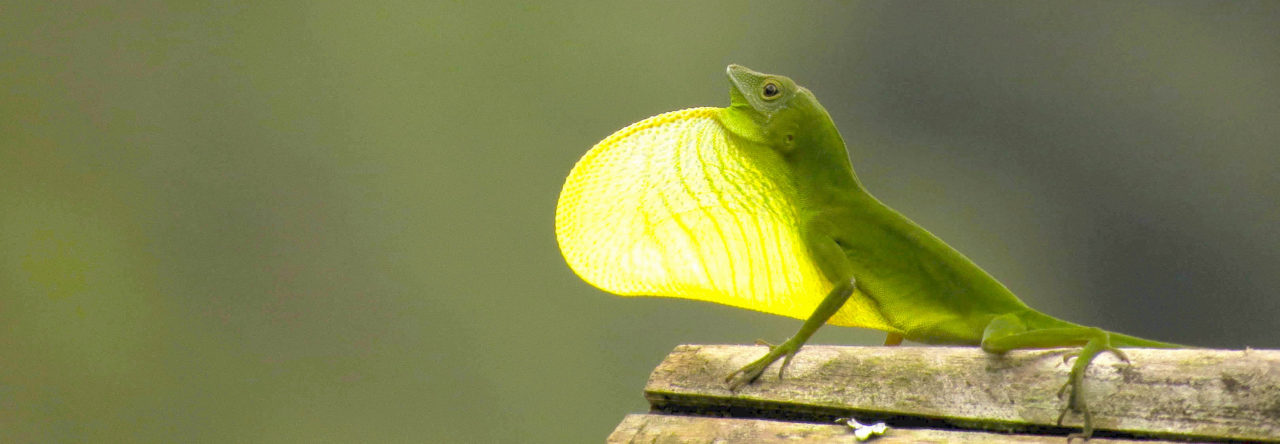
The title of the paper says it all: “It is time for a new classification of anoles (Squamata: Dactyloidae).” No doubt, AA contributors will have something to say about this before long, but comments–or posts–are welcome now. The paper–by Nicholson, Crother, Guyer, and Savage–is a 108 page monograph in Zootaxa (text runs to page 69). Anolis is proposed to be split into the following genera: Dactyloa, Deiroptyx, Xiphosurus, Chamaelinorops, Audantia, Anolis, Ctenonotus, and Norops. In addition to presenting a phylogeny and a new classification, the paper also has sections on biogeography, dating, ancestor reconstruction and–most intriguingly–“Evolution of ecomodes in the family Dactyloidae.” Stay tuned!
Author: Jonathan Losos Page 94 of 133
Professor of Biology and Director of the Living Earth Collaborative at Washington University in Saint Louis. I've spent my entire professional career studying anoles and have discovered that the more I learn about anoles, the more I realize I don't know.

Photo by Piotr Naskrecki from thesmaller majority.com
World class photographer Piotr Naskrecki has a blog, The Smaller Majority, in which he writes about little beasties. Recently he featured the aquatic anoles of Costa Rica. Most notably, he includes some excellent photos of an aquatic anole eating a freshly caught aquatic insect, slightly surprising as some reports are that Central American aquatic anoles only use the water to escape predators. Here’s his description of what he observed:

Photo by Piotr Naskrecki
“The actual capture of the insect happened under water, and thus I did not see the very moment of the catch. These roaches (a still undescribed species) live in the sand and under submerged rocks of fast flowing streams, and dive and stay under water at the slightest disturbance. The anole gave several chases to the insects, in all cases running after them underwater on submerged sides of boulders or logs, but in only one case I was able to photograph it as it emerged with an insect in its mouth (attached [editor’s note: to the left] is a photo of the lizard taken a second or two after it emerged from under water).
The location was a stream nr. Est. Pitilla in Guanacaste, CR (photo of the habitat attached), the coordinates are 10°59’26”N, 85°25’40”W; the observations were made May 27th, 2007.”

High school students conducting anole research. Read all about it in the author’s post on the paper.
Everyone knows that anoles, like most reptiles, are not good parents. They just drop off the eggs, and that’s that. If they come across their offspring, they might even eat them! Not a paragon of parenthood. But does that mean the anole moms don’t do anything to help their kids? If nothing else, perhaps they could lay their eggs in places that would lead to maximally healthy offspring.
To test this idea, Aaron Reedy and a cast of dozens conducted an experiment in which they gave female brown anoles a choice of nest substrates varying in moisture content to see if they preferentially put eggs in some places over others. Then, they raised the eggs in the different environments to see if it matters.
 The results were clearcut: females prefer to lay eggs in the soil with the highest moisture levels available. And, in turn, it matters: eggs put in such soils (the placement of eggs was randomized after the females laid them) had high hatching success, produced large offspring, and led to an overall increase in offspring survival.
These results are interesting and in agreement with a variety of studies on other reptiles. What is particularly notable about this research is that it was conducted in a low-income neighborhood city high school science classroom. The first author, Aaron Reedy, was a science teacher (he’s now in grad school at the University of Virginia), and the project was conducted by him and a large number of his high school students. Now, that’s remarkable! Reedy provides an interesting account of how the experiment came to be and what the students thought of it in a post at Scientific American’s website.
This paper also brought to our attention another paper published earlier this year that had eluded AA‘s notice.
 AA reader, anole scientist, and anole breeder Veronika Holáňová has written a beautiful book on anole husbandry. I can attest that the photos are exquisite, and here’s what she has to say about it: “It is a book for all Anolis lovers who would like to try to keep them in captivity. In that book I have my experiences with keeping different anole species after many years :-).” The only catch is that it is in Czech, though Veronika says that “maybe one day it could be in English too.” Let’s hope! The book has a nice webpage from which it can be ordered.

Karen Cusick, author of Lizards on the Fence, writes Daffodil’s Photo Blog, on which she daily chronicles in photographs the nature goings-on in her backyard. And these goings on often feature green and brown anoles, which go about their business and interact with each other on her back fence. Included are some lovely shots of displaying, eating, fighting, and more. Worth a look.
The post from a week ago Friday, August 24th, reports an encounter between a female A. carolinensis and a small A. sagrei. We’ve had a number of previous posts on AA about carolinensis-sagrei interactions and I think it’s still an open question how often the two species are actively aggressive to each other. In this light, Karen’s observations were interesting, and she has provided some photos. Here’s her report:

Figure from Leal and Powell paper showing that members of the same ecomorph category are not convergent in brain structure.
The Caribbean anole radiation is famous for its convergence. First detected in features related to habitat use and locomotion, such as limb length and toepad size, we now know that the Greater Antillean ecomorphs are convergent in many other attributes such as sexual dimorphism, territory structure and head shape. One might wonder what other features are convergent as well. For example, brains. The anole ecomorphs differ in the complexity of the environments in which they live, which might lead to selection for different brain configurations in different habitats. Brian Powell set out to examine anole brains for his just completed doctoral dissertation at Duke University, and he has now published the results. The short story: the anole ecomorphs are not convergent in brain structure! You can read more details in Chipojolab’s first-hand account of this paper, or check out the paper’s abstract here:
 A while back, we had discussion of a photo of a beautiful turquoise Anolis grahami. Here’s a much better photo that just popped up on Instagram. I’d love to see one of these in life. Joe Burgess says they’re from the Hellshire Hills area of south central Jamaica.
This, of course, is not the only time that blue color has evolved in anoles. I wonder what drives it. I’m told that the shockingly blue A. gorgonae on Gorgona Island is surprisingly cryptic in the shaded canopy.
And while we’re on the topic of beautifully blue A. grahami, it turns out that this species has just been featured on The Featured Creature (thanks to AA reader and Duke University anole wrangler Maria Campano for pointing this out). Enjoy the lovely photo below and check out the full story over there.

More photos and story at http://www.thefeaturedcreature.com/2012/08/mystery-solved-most-beautiful-anole.html?showComment=1346442604552#c1991819277006706898

Photo by Karen Cusick.
That’s how big. This little gal is probably just out of the egg. Thanks to Karen Cusick, author of Lizards on a Fence, for the photo.
Or, for another take on the same topic, check out Dust Tracks on the Web‘s latest offering.

From Dust Tracks on the Web

The New York Times covered the story, too. http://graphics8.nytimes.com/images/2012/08/08/blogs/cat/cat-blog480.jpg
We reported earlier this month on the talk at the Ecological Society of America where a University of Georgia researcher put kitty cams on housecats to see where they went and what they did. And one finding: they caught a lot of anoles! USA Today ran an article on the front page, and included a video online that has some grisly (ok, not that grisly) footage of this, as well as other cool stuff (encounters with other animals, secret lives of housecats). Check it out!
The guys at Day’s Edge Productions have wrapped up their expedition to Spanish Islands in quest of colorful and highly variable lacertid lizards. They’ve posted their swan song of a video, which reveals extraordinary differences in color in populations literally right next to each other. As always with this team, worth watching.
And while we’re on the topic of great lizard videos by Day’s Edge, here’s a wonderful one on the introduced anoles of Miami and Neil Losin’s doctoral work. Though made more than a year ago, for some reason, it seems to have just made it’s way to Youtube, which is reason enough to pop it up here.
httpv://www.youtube.com/watch?v=HsLDPwdX748&feature=g-high-lik