Author: Jonathan Losos Page 93 of 133

Professor of Biology and Director of the Living Earth Collaborative at Washington University in Saint Louis. I've spent my entire professional career studying anoles and have discovered that the more I learn about anoles, the more I realize I don't know.

Lacertid Pays The Price For Being Mistaken For A Gecko; Thanks Geico

We’ve previously discussed cases of anoles being mistaken for geckos, as well as the very  negative effects that cats can have on green anoles. Turns out that anoles aren’t the only lizards that serve as gecko doppelgangers. And you might think that people wouldn’t mistake lacertids for anoles, but apparently that happens, too.

The Proposal To Split Anolis Into Eight Genera: Time To Discuss

ResearchBlogging.orgWe’ve had a week now to let the proposed reclassification of Anolis sink it, so it’s time to start discussing it. A revolutionary new view of the scientific review process suggests that in the future, all papers will be published open access online (as this one is–thanks Nicholson et al.), the journal in which it appears (if any) will not matter, and peer review and evaluation will be conducted post-publication on internet discussion sites. Realistic? Who knows, but why not give it a try?

The paper by Nicholson et al. is undoubtedly the most important paper on anoles to be published in the last several years. Not only does it propose to split Anolis into eight genera, but it also presents provocative findings about the ecological evolution of anoles (including throwing out the ecomorph concept), anole biogeography, and the dating of evolutionary events in anole history.

Anole Annals’ goal is to be the meeting place for discussion of all things Anolis, so let’s take this post-publication review and commentary idea out for a spin. Anole Annals invites members of the anole community to post their thoughts on any aspect of the Nicholson et al. paper. We hope to get a conversation going on the merits of splitting the genus, as well as the other issues raised in the paper. In fact, this has already begun, as evidenced by the comments by Mssrs. Crother, Hillis and Duellman, among others.

To get the ball rolling, here’s a short précis of the paper:

1. Phylogenetic analysis based on previously published data of all sorts (genetic, morphological, karyological), with a smidgeon of new molecular data, reveals a phylogeny with eight strongly supported clades in a Bayesian analysis. These clades are recognized as distinct genera.

2. The ecomorph concept does not apply to mainland anoles because species similar in habitat use are not similar in morphology. Hence the term “ecomode” is coined for species similar in habitat use. Phylogenetic analysis of ecomode evolution on the phylogeny suggests that the crown-giant ecomode is ancestral for Anolis. The ecomorph concept is argued to not work for Greater Antillean anoles and should be discarded.

3. Biogeography is reconstructed on the phylogeny. Using the phylogeny, the authors argue that the eight clades differentiated about the time that the proto-antillean islands were passing between what is now North and South America. The Norops clade differentiated on several of these blocks (both island and mainland), explaining why Norops is nested within Caribbean non-Norops taxa without requiring the island-to-mainland colonization of Norops proposed by a number of previous papers.

4. Molecular clock dating reveals that anoles are surprisingly ancient, originating in South America approximately 130 million years ago.

Nicholson, K. E., B. I. Crother, C. Guyer, J. M. Savage (2012). It is time for a new classification of anoles (Squamata: Dactyloidae) Zootaxa, 3477, 1-108

Anolis Aequatorialis Information

Photo by Jonathan Losos

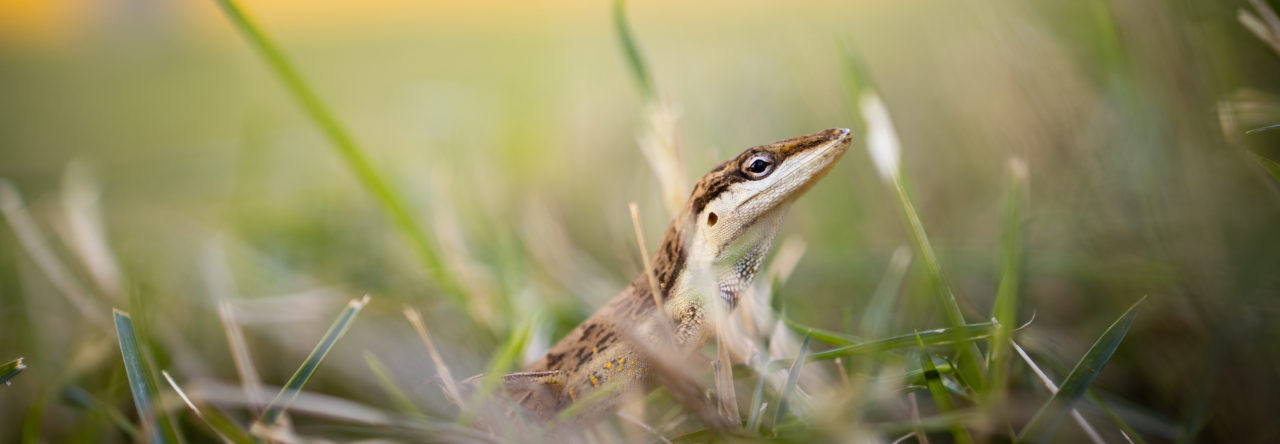
I’ve just learned of a website called Atyourservices. I don’t understand the point of this site, which seems to have a disparate range of topics, but one of the posts today is a nice compilation of sources of photos and information on Anolis aequatorialis.

The Amazing Social Life Of The Green Iguana

From http://blogs.scientificamerican.com/tetrapod-zoology/2012/09/17/amazing-social-life-of-green-iguana/

Here at Anole Annals, we occasionally digress to post on interesting topics in anole relatives. In that vein, I wish to call attention to a fascinating summary of the social complexity of Anolis‘s big green cousin, Iguana Iguana. Tetrapod Zoologya fascinating source of information on all thing Tetrapodan, has a very interesting article which I highly recommend.

Explain What’s Going On Here

I’ll give one hint: it started something like this.

Anolis Gemmosus

Those guys at Tropical Herping have done it again. Check out their new post with information and lovely photos of Anolis gemmosus, truly a gem of a lizard.

Anolis Tropidogaster Sundered

Squares are A. gaigei; circles are A. tropidogaster; triangles are locations of members of the species complex for which specimens were not examined and thus determination to species has not yet been accomplished.

Gunther Köhler’s at it again! This time with a merry band of colleagues he’s split Anolis tropidogaster, a little brownjob of an anole widespread in southern Central America and Colombia, into two species, A. tropidogaster in Colombia and eastern Panama and A. gaigei sandwiching it in western panama and the Santa Clara Mountains of Colombia.

Like a number of recently differentiated mainland anoles, the species differ markedly in the shape of their hemipenes. However, in contrast to some other cases, they also differ in dewlap color and a number of scale characters. Further, a limited genetic analysis suggests that the two forms may be substantially differentiated genetically.

News Flash: New Study Proposes Splitting Anolis Into Eight Genera

The title of the paper says it all: “It is time for a new classification of anoles (Squamata: Dactyloidae).” No doubt, AA contributors will have something to say about this before long, but comments–or posts–are welcome now. The paper–by Nicholson, Crother, Guyer, and Savage–is a 108 page monograph in Zootaxa (text runs to page 69). Anolis is proposed to be split into the following genera: Dactyloa, Deiroptyx, Xiphosurus, Chamaelinorops, Audantia, Anolis, Ctenonotus, and Norops. In addition to presenting a phylogeny and a new classification, the paper also has sections on biogeography, dating, ancestor reconstruction and–most intriguingly–“Evolution of ecomodes in the family Dactyloidae.” Stay tuned!

Aquatic Anole Foraging

Photo by Piotr Naskrecki from thesmaller majority.com

World class photographer Piotr Naskrecki has a blog, The Smaller Majority, in which he writes about little beasties. Recently he featured the aquatic anoles of Costa Rica. Most notably, he includes some excellent photos of an aquatic anole eating a freshly caught aquatic insect, slightly surprising as some reports are that Central American aquatic anoles only use the water to escape predators. Here’s his description of what he observed:

Photo by Piotr Naskrecki

“The actual capture of the insect happened under water, and thus I did not see the very moment of the catch. These roaches (a still undescribed species) live in the sand and under submerged rocks of fast flowing streams, and dive and stay under water at the slightest disturbance. The anole gave several chases to the insects, in all cases running after them underwater on submerged sides of boulders or logs, but in only one case I was able to photograph it as it emerged with an insect in its mouth (attached [editor’s note: to the left] is a photo of the lizard taken a second or two after it emerged from under water).

The location was a stream nr. Est. Pitilla in Guanacaste, CR (photo of the habitat attached), the coordinates are 10°59’26”N, 85°25’40”W; the observations were made May 27th, 2007.”


Does Where A Lizard Mom Lay Her Eggs Matter? Results Of A Study Conducted By High School Students

High school students conducting anole research. Read all about it in the author’s post on the paper.

Everyone knows that anoles, like most reptiles, are not good parents. They just drop off the eggs, and that’s that. If they come across their offspring, they might even eat them! Not a paragon of parenthood. But does that mean the anole moms don’t do anything to help their kids? If nothing else, perhaps they could lay their eggs in places that would lead to maximally healthy offspring.

To test this idea, Aaron Reedy and a cast of dozens conducted an experiment in which they gave female brown anoles a choice of nest substrates varying in moisture content to see if they preferentially put eggs in some places over others. Then, they raised the eggs in the different environments to see if it matters.

ResearchBlogging.orgThe results were clearcut: females prefer to lay eggs in the soil with the highest moisture levels available. And, in turn, it matters: eggs put in such soils (the placement of eggs was randomized after the females laid them) had high hatching success, produced large offspring, and led to an overall increase in offspring survival.

These results are interesting and in agreement with a variety of studies on other reptiles. What is particularly notable about this research is that it was conducted in a low-income neighborhood city high school science classroom. The first author, Aaron Reedy, was a science teacher (he’s now in grad school at the University of Virginia), and the project was conducted by him and a large number of his high school students. Now, that’s remarkable! Reedy provides an interesting account of how the experiment came to be and what the students thought of it in a post at Scientific American’s website.

This paper also brought to our attention another paper published earlier this year that had eluded AA‘s notice.

Page 93 of 133

Powered by WordPress & Theme by Anders Norén