Professor of Biology and Director of the Living Earth Collaborative at Washington University in Saint Louis. I've spent my entire professional career studying anoles and have discovered that the more I learn about anoles, the more I realize I don't know.
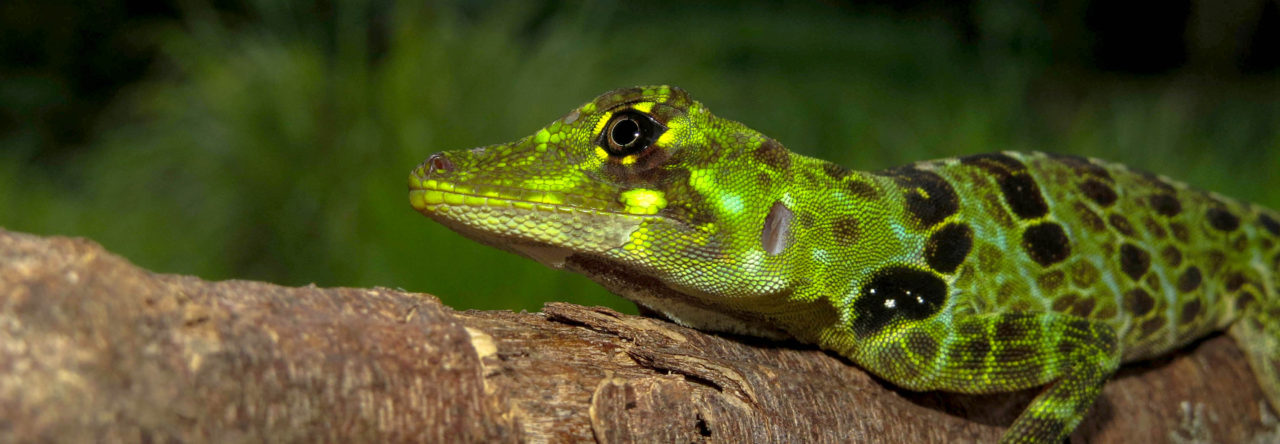
Reader Gary Dick tells us: I encountered the hatchling pictured about 10 years ago on my patio. Part of a small population in my specific area. Best I can tell, it was achromic Green anole. What do you think?
A little additional info about this lizard: it’s from a population I established in my yard about 25 years ago north of Dallas Texas over a period of ten or so years. Individuals (mostly adult) from southeast Louisiana, northwest Louisiana, and northeastern Texas, plus the very occasional one I encountered in this general area. My guess is the population has experienced founder colony effects from the multiple but low number introductions, leading to the genetic magnification of a few recessive traits. From my limited knowledge of genetics and some interesting AI discussions, I’m leaning toward a triple recessive condition that includes amelanistic, xanthic, and iridiophore-limited traits ( hence my probable inaccurate use of the term “achromatic”). Or, a single or double recessive condition maybe accounts for all three traits. The most interesting thing, perhaps, is that I observed this in the individual photographed as well as two other individuals with the same traits over a six week period.
From the same population, I am now seeing a few individuals with “patchy” coloration…splotches of dull when the animal is brown. The same areas appear brownish when the animal is green.
“We may never acquire the gift evidenced by this anole I saw on our retaining wall last weekend: the ability to regenerate large portions of one’s own body after an accident or an encounter with a predator.
I was grilling dinner when I saw it, and had to raise my glass in admiration. Long live the new flesh. May your descendants grow large, and lord over the rewilded ruins we leave behind.”
I’ve seen anoles like this before. Is skin regeneration the explanation?
Some green anoles sometimes temporarily develop a black spot behind their eyes. We had a great post on why this happens in 2011. Spoiler: it’s a sign of stress.
Photo by Seth Whaland
Reader Seth Whaland has provided interesting observations: In August of this year, I was on the Butler Hike & Bike Trail along Lady Bird Lake in Austin, TX. I was walking along the trail with a new point-and-shoot 35mm camera when I spotted two anoles. I watched them for a while and knew I wouldn’t be able to get close enough with my camera to get a decent photo without disturbing them, so I used my phone. The two lizards circled each other, both extending their dewlaps, doing “push ups” and opening their mouths (biting?) until one of them pushed the other one off of the branch. It happened quickly so I’m not totally clear on what it did to cause the other to fall. I believe it was in a live oak tree.
Tulane researchers found brown anole lizards in New Orleans have record-high blood-lead levels, yet tests of balance, speed and endurance revealed no impairments typically caused by lead exposure. (Photo by Wayne Wang)New research from Tulane University found that brown anole lizards in New Orleans carry the highest blood-lead levels ever recorded in a vertebrate — amounts that would be lethal to most other animals — yet they appear unaffected.
The study, published this month in Environmental Research, found that the lizards’ blood lead levels exceeded all previously reported values for fish, amphibians, birds, reptiles and mammals.
“What’s astonishing is that these lizards aren’t just surviving, they’re thriving with lead burden that would be catastrophic for most other animals,” said study author Alex Gunderson, assistant professor of ecology and evolutionary biology in Tulane’s School of Science and Engineering.
“What’s astonishing is that these lizards aren’t just surviving, they’re thriving with lead burden that would be catastrophic for most other animals.”
Alex Gunderson, School of Science and Engineering
Lead is a pervasive environmental pollutant with severe health impacts, especially in urban settings. The research underscores the lingering legacy of lead contamination in New Orleans and the complex ways organisms adapt — or fail to adapt — to polluted environments.
The brown anoles are an invasive species originally from the Caribbean. They’ve been in New Orleans since at least the 1990s, but their population has increased over the last 20 years, and they are now more common than the green anole, which is a native species.
PhD student Annelise Blanchette and Gunderson led the study and discovered that the lizards could withstand lead levels about 10 times higher than the already extreme concentrations found in the field before showing any decline in performance.
Tests measured traits such as balance, sprint speed and endurance — abilities commonly impaired by lead exposure.
“These animals are performing at full capacity despite record-setting lead levels, making them one of the most, if not the most, lead-tolerant animals known to science,” Blanchette said.
Transcriptomic analyses of the animals’ brain and liver tissue showed only minor effects from lead exposure, although several altered genes were linked to metal ion regulation and oxygen transport.
The findings raise new questions about how the reptiles survive such toxic exposure and whether those mechanisms could someday inform treatments for humans and other wildlife.
“We need to reevaluate what we know about toxicity thresholds in vertebrates,” Gunderson said. “If we can figure out what’s protecting them, we might uncover strategies that could help mitigate heavy metal poisoning in people and other species.”
While this study does not suggest humans can develop the same resistance as these lizards, the discovery of such extreme lead levels in a vertebrate highlights the persistent presence of lead in the environment and the urgent need to reduce exposure in people, particularly in communities where contamination remains widespread.
Anole Annals has featured a series of posts on three-legged lizards over the years (e.g., here and here). Now we need help. Some time around 2017, April Brown contributed a photo of a brown anole missing both of its forelegs. The photo was taken in Winter Park, FL. We’d like to contact April, but can’t locate her. Can anyone solve the mystery?
Anolis winstoni from https://commons.wikimedia.org/wiki/File:Anolis_oculatus_at_Coulibistrie-b01.jpg
Peter Mudde writes:
I am chairman of Lacerta, the Dutch Herpetological society. I also am a regular contributor to the magazine Lacerta. Lacerta recently made an “Anolis special.” We are preparing a printed English version and we have an internal discussion about the matter below.
In 1962 the late Skip Lazell, a regular contributor to Anole Annals described Anolisoculatus winstoni, stating: “This subspecies is named for Charles A. Winston, Manager of Woodford Hill Estate, and his family.” In recent years, the epithet “winstoni” has been changed to “winstonorum” as that would be he proper grammatical form if the subspecies was indeed named after Winston and his family (Michels and Bauer, 2004). This was critisized by Dubois (2007).
Now I am not familiar with the latest in zoological taxonomy, but I was under the impression that a name once given could not be corrected afterwards. That’s why the American alligator still misses a character in it’s scientific name.
Indeed, the combination Anolis occulatus winstonorum has emerged several times, mainly in non-scientific literature. Now my question is: how do those working with anole taxonomy refer to this subspecies? Your verdicts please.
NParks monitoring whether brown anole, greenhouse frog pose threat to native species
Nparks said that it is aware of the presence of the brown anole (left) and greenhouse frog in Singapore and is monitoring the situation.PHOTO: DESMOND WEE, COURTESY OF ROBBIN TAN
SINGAPORE – In many areas across Singapore, one may find small, slender lizards – sometimes displaying a yellow or reddish orange flap under their throats – if one looks intently enough.
These lizards, which can be found on the ground or trees, are called brown anoles (Anolis sagrei), and they have been spotted at an increasing frequency across the island.
The catch is: They are not supposed to be here.
The brown anole is found naturally in the Bahamas, Cuba and the Swan Islands.
It is one of two introduced species – the other being the greenhouse frog (Eleutherodactylus planirostris) –that have been seen here more often, and in more places.
The greenhouse frog is native to the Bahamas, Cuba and the Cayman Islands.
In March, two brown anoles were spotted on the balcony of a residential unit in Sembawang.
Introduced species are plants or animals that are not naturally found in Singapore.
They can be considered invasive when their presence causes harmful impacts on the local environment. This could happen if, for instance, they outcompete native species due to a lack of natural predators, high reproductive rates and adaptability to different environmental conditions.
The National Parks Board (NParks) told The Straits Times that it is aware of the presence of the brown anole and greenhouse frog in Singapore, and that it is monitoring the situation.
Dr Karenne Tun, group director for NParks’ National Biodiversity Centre, said the brown anole has outcompeted the native green anole in the US state of Florida, and in Taiwan it has impacted local arthropod – invertebrate animals with an exoskeleton – communities in betelnut palm plantations. In Hawaii and other parts of the US, the greenhouse frog has also been documented as invasive, she added.
However, there is no evidence that these species have significantly impacted local ecosystems so far, said Dr Tun.
Observers believe the two Caribbean species came into Singapore by “piggybacking” on exotic plants that were brought in by the horticultural sector.
A brown anole displaying its dewlap, found under its throat.PHOTO: SHANYL ONG
Dr Alex Figueroa, executive secretary of the International Commission on Zoological Nomenclature based at Lee Kong Chian Natural History Museum at NUS, said brown anoles continue to be introduced throughout the island, via plants imported by nurseries.
“At this moment, brown anoles do not appear to be invasive in Singapore,” said the reptile and amphibian researcher.
He said that most of the lizards found here are bigger than the brown anole – which is usually about 12cm to 21cm long – and either live on the ground or high in the trees. Meanwhile, brown anoles prefer warm, open grassy areas and the lower parts of trees and shrubs.
According to a report by Nature in Singapore, an online journal of the Lee Kong Chian Natural History Museum, brown anoles were observed and recorded in Singapore for the first time in 2012, when they were sighted at Gardens by the Bay.
“The many individuals, hatchlings and courtship activities observed at the Gardens by the Bay strongly suggest that the brown anole has already established a population in Singapore, at least within Marina Bay,” said the report, adding that it is the first reptile from the Americas that has done so there.
Brown anoles were observed and recorded in Singapore for the first time in 2012 when they were sighted at Gardens by the Bay.ST PHOTO: DESMOND WEE
Years later, they continue to be spotted in different parts of the island, such as in Bishan in 2015, Jurong Lake Gardens in 2020 and Chua Chu Kang in 2022.
When The Straits Times visited Gardens by the Bay in March, a brown anole was spotted perched on a tree trunk near the Bayfront MRT station. Subsequently, 11 more were spotted in less than 1½ hours.
As for the greenhouse frog, the first sighting of the small amphibian – its length ranges from about 12mm to 30mm – was recorded in Sembawang in 2015. These creatures were also spotted in Clementi Woods and Dairy Farm Nature Park in 2017.
While a population study has yet to be done on the greenhouse frog in Singapore, Mr Robbin Tan, a scientific officer at the Herpetological Society of Singapore (HSS), said: “Today, the greenhouse frog is widespread across Singapore, including within our Central Catchment Nature Reserve… We can ascertain that there are plenty of breeding populations established in Singapore.”
Mr Tan said the greenhouse frog has successfully established populations throughout Hawaii, Hong Kong and the Philippines. Its global spread has been primarily driven by the plant trade, he added.
Dr Figueroa said that while it is hard to estimate their population without properly studying the frog, it is “safe to say” that they can be found throughout Singapore, and in some areas, they can be found in large numbers, although this is difficult to tell given how tiny they are.
While the frog can be found widely across the island, it remains to be seen if they are harmful to the native species due to lack of evidence, experts said.
However, Associate Professor Darren Yeo, head of the Lee Kong Chian Natural History Museum at NUS, said they may be considered potentially invasive, as they are already widespread in Singapore, and can spread rapidly.
Greenhouse frogs skip the tadpole stage entirely, and their eggs develop into frogs. This also means that, unlike other frogs, they do not need water bodies to breed, which enhances their ability to spread, he said.
The sighting of the greenhouse frog – its length ranges from about 12mm to 30mm – in Sembawang was first recorded in 2015.PHOTO: COURTESY OF ROBBIN TAN
HSS’ Mr Tan added that due to its small size, habitat and diet, the greenhouse frog may also compete with native chorus frog species, especially since both can be found in similar places, like secondary forests and leaf litter.
Ms Tricia Cho, a research assistant at Lee Kong Chian Natural History Museum at NUS, who has done research on greenhouse frogs, said more research and monitoring could be done to assess their population status and quantify any negative effects they might bring to the local ecosystem.
HSS’ Mr Tan said that public education campaigns and citizen science programmes encourage people to report sightings, avoid releasing non-native pets, and support conservation efforts.
Besides regular monitoring and early detection, he said that restoring native habitats and reducing human disturbances strengthen ecosystem resilience, making it harder for non-native and invasive species to establish.
Prof Yeo said that most invasive and non-native species in Singapore tend to be found in more urban or artificial habitat areas and less in more forested and natural habitat areas.
“This could reflect a preference for urban or artificial systems or a resistance by the native communities in natural systems,” he said. “If it’s the latter, we can help prevent invasive species from affecting the ecosystems by keeping as much of the ecosystems and their faunal and floral communities as intact as possible.”
Chin Hui Shan is a journalist covering the environment beat at The Straits Times.
What the secret lives of lizards tell us about evolution
Scientists are studying natural selection in real time on a small Florida island.
March 23, 2025 at 7:00 a.m. EDTToday at 7:00 a.m. EDT
Researcher James T. Stroud studies an anole that was captured with a small lizard lasso. The anole blends in well with the tree. (Neil Losin/Stroud Research Miami)
By James T. Stroud
Every morning in Miami, our fieldwork begins the same way. Fresh Cuban coffee and pastelitos — delicious Latin American pastries — fuel our team for another day of evolutionary detective work. In this case, we are tracking evolution in real time, measuring natural selection as it happens in a community of Caribbean lizards.
Our research takes place on a South Florida island roughly the size of an American football field — assuming we are successful in sidestepping the American crocodiles that bask in the surrounding lake. We call it Lizard Island, and it’s a special place.
Since 2015, we have been conducting evolutionary research here on five species of remarkable lizards called anoles. Our team is working to understand one of biology’s most fundamental questions: How does natural selection drive evolution in real time?
Each May, coinciding with the start of the breeding season, we visit Lizard Island to capture, study and release all adult anoles — a population that fluctuates between 600 to 1,000. Through the summer, female anoles lay a single egg every seven to 10 days. By October, a whole new generation has emerged.
Anoles aren’t early risers, so we don’t expect much activity until the sun strengthens about 9:30 a.m., giving us time to prepare our equipment. Our team catches anoles with telescopic fishing poles fitted with little lassos, which we use to gently pluck the lizards off branches and tree trunks.
Picture yourself as an anole on Lizard Island. Your life is short — typically one year — and filled with daily challenges. You need to warm up in the sun, find enough food to survive, search for a mate, guard your favorite branch from other lizards and avoid being eaten by a predator.
An identification code lets researchers track the lizard’s growth and survival. (Neil Losin/Stroud Research Miami)
Like human beings, each lizard is unique. Some have longer legs, others stronger jaws, and all behave slightly differently. These differences could determine who survives and who doesn’t, as well as who has the most babies and who doesn’t.
These outcomes drive evolution by natural selection, the process in which organisms with traits better suited to their environment tend to survive and reproduce more. These advantageous traits are then passed on to future generations, gradually changing the species over time. However, scientists have an incomplete understanding of exactly how each of these features predicts life’s winners and losers in the wild.
To understand how species evolve, researchers need to crack open this black box of evolution and investigate natural selection in wild populations. My colleagues and I are doing this by studying the anoles in exquisite detail. Last year was especially exciting: We ran what we called the Lizard Olympics.
Tiny fishing poles
As the morning heat builds, we spot our first lizards: Cuban brown anoles near to the ground, and the mottled scales of Hispaniolan bark anoles just above them. Farther up, in the leafy tree canopies, are American green anoles and the largest species, the Cuban knight anole, about the size of a newborn kitten.
In 2018, a new challenger entered the arena — the Puerto Rican crested anole, a species present in Miami that hadn’t yet made it to Lizard Island. Its arrival provided us with an unexpected opportunity to study how species may evolve in real time in response to a new neighbor.
Catching these agile athletes requires patience and precision. With our modified fishing poles, we carefully loop dental floss over their heads. Each capture site is marked with bright pink tape and a unique ID number; all lizards are then transported to our field laboratory a short walk away.
In the laboratory, Stroud weighs a green anole. (Neil Losin/Stroud Research Miami)
The Lizard Olympics
Here, the real Olympic trials begin. Every athlete goes through a comprehensive evaluation. Our portable X-ray machine reveals their skeletal structure, and high-resolution scans capture the intricate details of their feet. This is particularly critical: Like their gecko cousins, anoles possess sticky toes that allow them to cling to smooth surfaces such as leaves and maybe even to survive hurricanes.
We also measure the shape and sharpness of their claws, as both features are crucial for these tree climbers. DNA samples provide a genetic fingerprint for each individual, allowing us to map family relationships across the island and see which is the most reproductively successful.
The performance trials are where things get interesting. Imagine a tiny track meet for lizards. Using high-speed video cameras, we test how fast each lizard runs, and using specialist equipment, we measure how hard it bites and how strong it grips rough branches and smooth leaves.
These aren’t arbitrary measurements — each represents a potential evolutionary advantage. Fast lizards might better escape predators. Strong bites might determine winners in territorial disputes. Excellent grip is crucial for tree canopy acrobatics.
Each measurement helps us answer fundamental questions about evolution: Do faster lizards live longer? Do stronger biters produce more offspring? These are the essential metrics of evolution by natural selection.
As afternoon approaches, the team relocates each piece of bright pink tape and returns the corresponding lizard to the exact branch on which it was caught. The anoles now sport two 3-millimeter tags with a unique code that lets us identify it when we recapture it in future research trips, along with a small dot of white nail polish so we know not to catch it immediately after we let it go.
At 8:30 p.m., with the Lizard Olympics done for the day, we return to the island with headlamps. Night brings a different perspective. Some of the most wily lizards are difficult to catch when fully charged by the midday sun, so our nocturnal jaunts allow us to find them while they sleep. However, it’s often a race against time. Lizard-eating corn snakes are also out hunting, trying to find the anoles before we do. As we wrap up another 16-hour day at about 11:30 p.m., the team shares stories of the night.
Evolution on the island
Now spanning 10 years, 10 generations and five species, our Lizard Island dataset represents one of the longest-running active studies of its kind in evolutionary biology. Such long-term studies are fundamental to our understanding of evolution. By tracking which individuals survive and reproduce, and linking their success to specific physical traits and performance abilities, we are documenting natural selection with unprecedented detail.
So far we have uncovered two fascinating patterns. Initially, it did not pay to be different on Lizard Island. Anoles with very average shapes and sizes lived longer than those with features that are slightly different. But when the crested anoles arrived, everything changed: Suddenly, brown anoles with longer legs had a survival advantage.
The Lizard Olympics is helping us understand why. The larger, more aggressive crested anoles are forcing brown anoles to spend more time on the ground, where those with longer legs might run faster to escape predators — allowing them to better survive and pass on their long-leg genes, while shorter-legged anoles might be eaten before they can reproduce.
By watching natural selection unfold in response to environmental changes, rather than inferring it from fossil records, we are providing cutting-edge evidence for evolutionary processes about which Charles Darwin could only theorize.
These long days of observation are slowly revealing one of biology’s most fundamental processes. Every lizard we catch, every measurement we take adds another piece to our understanding of how species adapt and evolve in an ever-changing world.
James T. Stroud is an assistant professor of ecology and evolution at the Georgia Institute of Technology.
Turns out that for anoles, predation by spiders is a very real threat. What a horrible way to go! We’ve reported on this phenomenon many times in the past. Here’s another example.