Author: Jonathan Losos Page 132 of 133

Professor of Biology and Director of the Living Earth Collaborative at Washington University in Saint Louis. I've spent my entire professional career studying anoles and have discovered that the more I learn about anoles, the more I realize I don't know.

Why Larger Islands Have More Anole Species

Anolis takes its rightful place on the cover of PNAS. Photo of A. distichus vinosus by R. Glor.

            Larger islands have more species.  Why?  MacArthur and Wilson’s theory explains island species richness as an equilibrium between the input of new species (a function of island isolation) and extinction (inversely related to island area).  Although certainly one of the most influential ideas in biology in the 20th century, the theory had its limitations, most specifically, that it relied solely on ecological phenomena—colonization and extinction—to explain species richness.  Yet, that can’t be the whole story, because islands are renowned for their evolutionary exuberance—witness the adaptive flowering of lemurs on Madagascar, finches in the Galápagos, honeycreepers on Hawaii and so on.  MacArthur and Wilson were, of course, well aware of the evolutionary component of island diversity and discussed the need to incorporate evolutionary issues into their theory at the end of their monograph.

Scaredy Lizards: Differences in Escape Behavior in Two Jamaican Anoles

Anolis grahami and A. lineatopus

Research on the escape behavior of lizards has become somewhat of a cottage industry in the last two decades, with scores, if not hundreds, of papers examining the effect of factors such as temperature, concealment, and crypticity.  Probably the most important early paper in this area (and perhaps the first period) was Stan Rand’s study of the effect of body temperature on flight initiation distance of Anolis lineatopus.  This work—conducted on the grounds of the University of the West Indies in Mona (a suburb of Kingston), Jamaica—reported that lizards with lower body temperatures fled at greater distances from an approaching predator.  Rand speculated that this pattern resulted because warmer lizards could run faster, setting the stage for the pioneering work on the effect of temperature on sprint locomotion by Ray Huey, Al Bennett, and others.

More than four decades later, Bill Cooper returned to the scene of Rand’s work to further study the escape behavior of A. lineatopus and its relative A. grahami.  Following the method used by Rand and many since, Cooper walked directly toward lizards at a constant pace and noted how far away he was when they fled, as well as the manner in which they escaped.  Although the two species differ in habitat use, A. grahami being more arboreal, escape behavior was very similar.  In both species, lizards tended to escape by running up trees, often by moving to the far side of the tree (termed “squirreling” by many anole aficionados); lizards initially perched lower in the vegetation tended to initiate escape at greater distances; and lizards in areas with greater human activity appeared to be habituated to the presence of people and delayed escape until the faux predator was relatively close.

None of these results is surprising; rather, they agree quite closely with work on other anoles and other types of lizards.  Cooper makes an interesting observation that anoles that flee to the ground, such as grass-bush anoles, show an opposite pattern, fleeing at greater distances when they are perched higher in the vegetation.  This, of course, makes sense because the higher they are, the further they are from safety, the opposite of the relationship that occurs in species that flee upward.  As Cooper notes, more comparative work on other species, both more types of ecomorphs and species from other islands, could prove instructive.  In addition, studies using non-human predators would also be welcome to establish the extent to which behavior elicited in response to approaching humans is representative of how anoles respond to their natural predators.  Other studies have used snake or bird models to study anole escape behavior.  In this paper, Cooper explains why he and others use humans for these tests—ease and repeatability of methods are certainly major advantages.  Nonetheless, research on other types of predators would be an interesting avenue for future work. 

Finally, Anole Annals awards a booby prize to the copy editor of this journal for the unique distinction of having a typo in the first line of the abstract (“fight” instead of “flight”) and what appears to be a sentence fragment that was supposed to have been deleted as the first words of the article itself.

Darwin’s Finches vs. Anoles

Darwin’s finches are the iconic example of adaptive radiation.  Some researchers, including me, have had the temerity to suggest that the diversification of Caribbean anoles may join the finches as an exemplar case study.  But just how similar are these two radiations, in terms of evolutionary pattern and process?  And can we learn anything from a two-clade comparison?  I explore these questions in a chapter in a recently released book that resulted from a symposium held two years ago to honor Peter and Rosemary Grant.  My chapter concludes:

“Overall, adaptive radiation in Darwin’s finches and Greater Antillean anoles has occurred in very much the same way. Interspecific competition appears to have been the driving force leading to resource partitioning and subsequently adaptation to different niches, and speciation is probably primarily allopatric and may be promoted as an incidental consequence of adaptation to different environments. Differences exist as well, such as the extent of hybridization and of independent evolution on different islands; many of these differences probably result because the radiations differ in age and aspects of natural history.”

If you want to read the whole thing, it’s available here

Incidentally, the book, In Search of the Causes of Evolution: From Field Observations to Mechanisms, presents a nice overview of the breadth of evolutionary biology, with chapters by workers as diverse as Dolph Schluter, Andy Knoll, Cliff Tabin, David Jablonski, Scott Edwards, David Wake and Hopi Hoekstra, among others.

E-Book Readers Beware

Not in a Digital World! (photo from http://www.livingwisdomschoolseattle.org/pages/kindergarten.html)

Lizards in an Evolutionary Tree can be bought as an e-book from its publisher, the University of California Press.  Naively, I would have thought that a virtual book would be substantially cheaper than its ink and paper counterpart, but not so; UCP charges nearly as much for the e-book as for the hardback.  The e-book does have some advantages, though: it weighs less and can be easily searched for keywords, for example.  There are disadvantages, too: you’re not supposed to make copies, or even lend it to someone else.  Further, according to infibeam.com, which sells the e-book, you’re not even allowed to read it out loud!  So, if you’re planning to host a LIAET party for Christmas, or would like to use it for nighttime stories for the kids, or even were hoping to quote from it for dramatic moments in your classroom lectures, you’d better not go digital.  Incidentally, the paperback version is due out in February, and Amazon is currently selling it for 1/3 off.

Google Announces New Initiative to Track Study of Anoles

Well, more or less.  The New York Times, and many other newspapers, reported today (link 1) on a new project involving Google’s database of 5.2 million digitized books.  From this massive compendium of 500 billion words, it is possible to chart the use of words, and even combinations of words, through time.  Naturally, that immediately leads to the question of how usage of “anole” and “Anolis” has changed through time.  The results are presented in the graphs above.  The most obvious surprise is the peak in the mid-1950’s.  Why this should be, I don’t know, but my guess is that it has something to do with the actual books that have been digitized.   You can check this out for yourself by going to the Google Books website and rummaging around.  For example, here’s my search for “Anolis” in the 1950’s (link 2).  My guess based on this is that Google was only able to digitize many old journals, and perhaps those journals willing to be involved in projects like the Biodiversity Heritage Library, but that they do not have much of the recent scientific literature in their data base.   Compare, for example, the hits that come up for the 50’s versus those for the same search for the 1990’s (link 3).  Just a hunch, though—might make an interesting interdisciplinary undergraduate project.

The y-axis reveals that, shockingly, “anole” and “Anolis” are used in only a small minority of all books, surely something that will change in the future as knowledge of and interest in anoles continues to expand.  Note, too, that “anole” is used an order of magnitude more often than “Anolis,” not surprisingly given that most of these books are not scientific.  It is also possible to search for combinations of words, such as “anole” and “fabulous,” but we have not yet undertaken this exercise.

Evolutionary Reinforcement in Anolis brevirostris

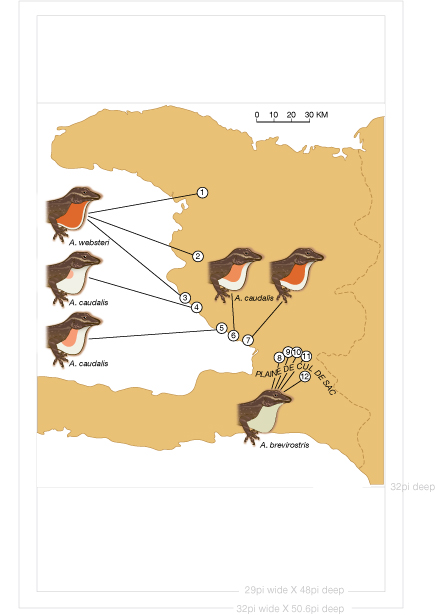
Figure from Lizards in an Evolutionary Tree, based on Webster and Burns (1973).

In a recent Anole Annals post, Luke Mahler mentioned the pioneering work of Webster and Burns on variation in the Hispaniolan trunk anole, A. brevirostris.  This paper presents one of the most compelling cases for the occurrence of reinforcement—the phenomenon in which natural selection leads to the evolution of increased reproductive isolation when two hybridizing species come into sympatry.  Surprisingly, however, this example is not well known; indeed, Google Scholar reports only 29 citations, only two of these post-1991.  This is too bad, because it is a wonderful example and deserves to be more widely known.  For this reason, I present a slightly modified description of variation in these lizards taken from Lizards in an Evolutionary Tree:

Three members of the A. brevirostris species complex, nearly indistinguishable in appearance, occur contiguously along the western coast of Haiti.  The southernmost of these species is A. brevirostris itself, which has a light-colored, pale dewlap.  By contrast, the northernmost species, A. websteri, has a vivid, orange dewlap.  Most interesting, however, is the species sandwiched in between the other two, A. caudalis, whose dewlap color varies geographically: at the southern border of its range, near A. brevirostris, its dewlap is bright orange, and at the northern edge of its range, where it comes into contact with A. websteri, its dewlap is white.  Interior populations exhibit variability in dewlap color with change occurring at least somewhat clinally from one end of the range to the other.  Display behavior also differs among all three species, with the behavior of A. caudalis being the most distinct from the other two species.  The most parsimonious explanation for these differences—particularly the geographic variation in dewlap color in A. caudalis—is that they evolved to prevent hybridization between closely related species.  Indeed, electrophoretic analyses by Webster and Burns confirm that levels of gene flow are high among populations within each species, but extremely low or non-existent between species, including adjacent heterospecific populations.

Lizards on a Plane: Transporting Anoles the Old-Fashioned Way

In the good old days, back when grad students weren’t afraid to push the boundaries and TSA didn’t exist, we used to transport lizards in the passenger cabin of airplanes.  We’d simply put them, one to a plastic bag, in a backpack or duffle bag and bring them onboard as carry-on luggage.  Rarely was this a problem.

Lizard guys weren’t the only ones to do this.  I remember a frog biologist telling me of the time he brought a bunch of coquis back to his lab from Puerto Rico.  They were snuggled into their individual little containers, dark and moist, and apparently quite content, because midflight they started calling as only a coqui can.  Of course, this attracted the attention of other passengers.  As they looked around, up and down and sideways, speculating about what was causing the ruckus, my colleague simply buried his nose in his book and kept quiet.

I only twice had trouble carrying anoles onboard.  The first time was in Gainesville, Florida, in 1987.  I was just starting out on my anole research and had flown to Miami to collect a sample of the superbly diverse, if non-native, anole fauna of that fine city.  I collected five species, including A. carolinensis (the only native species of the lot), A. sagrei, A. distichus, A. cristatellus, and several magnificent knight anoles, A. equestris, the largest anole species.  I then flew to Gainesville to meet with anole expert Alan Pounds, anoles in tow.  No problem.  However, on the way back, things did not go smoothly.  The Gainesville Airport, at that time, was a small, rinky-dink affair.  When I got to security, I put my duffle bag full of lizards onto the conveyor belt and through the x-ray machine it went (as an aside, as far as I could tell, no lizard suffered any harm from being x-rayed).  The inspector, a small, round, white-haired and cranky woman, took one look at her monitor and barked, “You’ve got an alligator in there.”  I pulled out a small A. carolinensis and tried to convince her otherwise, but to no avail.  It was the only time I had to check my bag o’ anoles.

The second problem trip was a year later in Jamaica.  In our travels, we would put the lizards in gallon-sized plastic bags, inflated with air (this was pre-Ziploc days—such bags are hard to find now).  Every two days, we would change the bags, and this worked fine.  Except on this particular trip, I failed to bring enough Baggies® with me, so we had to scour local shops for Jamaican made bags, which we eventually found.  However, unbeknownst to us, these bags were not well made.  On the day we were to fly out of Montego Bay en route back to California, we checked in and passed through security without incident.  I thought the coast was clear.  But then, as they called the flight, I realized that the security staff—all female, all dressed in elaborate red uniforms, including ornate hats—were hand-searching each piece of carry-on luggage.  My heart sank.  When I got to the front of the line, the woman unzipped my duffel bag, reached in, and started rummaging around with her hands, but without looking down.  Saved!  Or so I thought.  Unfortunately, several plastic bags had split open at the seams, freeing their captives, and a beautiful male Anolis grahami jumped out of the duffel and onto the table.  This the inspector did see.  She immediately let out a scream and—I kid not—stood on a chair.  I thought all was lost, but from her lofty perch, she yelled at me to catch the lizard and get on the plane, which I quickly did, returning to the lab without further trouble.

So, when talking to a fellow from Transport Executive’s Man and a Van Plymouth, I reminisced on how we used to do it in the old days.  No packaging lizards in coolers for transport in air cargo or checked luggage, no elaborate containers, no fuss, no muss.  It was a simpler, easier time, and usually it worked quite well.  I always suggest to travelers these days that they consider taking a duffel bag and try hand carrying their lizards, but then again, we can only guess how TSA would react (and the x-rays are probably now a lot stronger).

Note added June 2, 2013: Since this post was published in December 2010, a number of commenters have asked about the consequences of transporting lizards on airplanes. There are two issues for doing so. First, capturing a lizard and taking it somewhere else almost always requires a collecting and/or export permit from the state or country of origin. Failing to do so is breaking the law. Moreover, the United States’ Lacey Act makes it a felony to import into the United States any animal illegally (i.e., without permission) collected in or exported from another country. Let me reiterate: this is a felony. If you get caught doing this, you are in big trouble.

Second, can one bring lizards onto airplanes. As far as I am aware–though I may be wrong, so you should check yourself–there are no laws against doing so. However, airlines have regulations about what you can bring onto their airplanes and how you can do so, so you’ll need to check with the airline. In addition, there is the question about how to get the animals through security if you are transporting them with you. As always, the internet is a good place to start in trying to figure out what is allowed and how to proceed. Here’s one article I found in a quick Google.

Ecuadorian Anole Advice Needed

My name is Frederik Sachser and I am studying Biology at the Heinrich-Heine-University of Düsseldorf, Germany and at the moment I am about to start writing my Bachelor thesis. I want to study the influences of the eyespots of Caligo on Anoles at “Un poco del Choco” in Ecuador next March. I heard that there is a wet season at this time and I am wondering if the anoles are showing less activity because of this.  Can anyone advise me?  My email is Frederik.Sachser@uni-duesseldorf.de.

Quantifying Attack Rates on Anoles in the Wild

The green thing on the left doesn’t look like a real anole to me.  But apparently it’s convincing enough to both predators and other anoles, because both attack them, as evident by the bite marks they leave on these clay doppellizards.  McMillan and Irschick deployed these faux lizards in trees in two areas in New Orleans, on the Tulane campus and in a wilder area outside of town.  In the wild area, the models had bites marks clearly identifiable as belonging to lizard jaws (photo on right), and others that were from birds or other presumed predators.  By contrast, perhaps not surprisingly, on the lovely grounds of Tulane, models were bitten by anoles, but not by predators.  Also not surprisingly, there were no bites of any kind in either locality in the winter, and many more in the spring and fall.  You might say to yourself: maybe lizards and predators just like to bite clay or anything new that shows up in their environment.  How do we know that they actually thought they were attacking a lizard?  Well, we don’t, of course, but the researchers did put out cubes made of the same material, and none of these were attacked, which lends some credence to the possibility that these models, cartoonish as they seem, may have passed for the real thing.  McMillan and Irschick, following others, suggest that these models may serve as a proxy for levels of predation and intraspecific aggression.

The Burden of Motherhood: Effect of Gravidity on Female Anole Behavior

Anoles only lay one egg at a time.  This penurious habit has been speculated to result from their arboreal lifestyle—because they spend so much time running around on vertical surfaces, they can’t afford to be weighed down by a big clutch of eggs.  Reasonable enough, but is there any evidence that carrying eggs has any cost to female anoles?  In a recent study in Ethology, Johnson et al. find that in A. carolinensis, as the mass of the egg increased, display behavior and movement rates decreased, suggesting that females are less active as they become more gravid.  Whether this is inactivity results because females are more vulnerable to predators or for other reasons is not known.

Page 132 of 133

Powered by WordPress & Theme by Anders Norén