
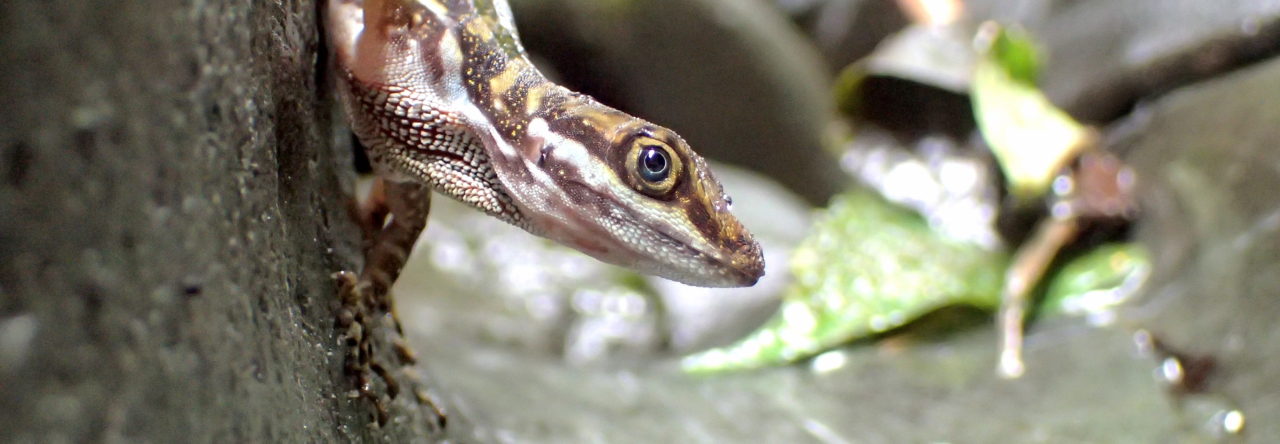
My name is Frederik Sachser and I am studying Biology at the Heinrich-Heine-University of Düsseldorf, Germany and at the moment I am about to start writing my Bachelor thesis. I want to study the influences of the eyespots of Caligo on Anoles at “Un poco del Choco” in Ecuador next March. I heard that there is a wet season at this time and I am wondering if the anoles are showing less activity because of this. Can anyone advise me? My email is Frederik.Sachser@uni-duesseldorf.de.
Author: Jonathan Losos
Professor of Biology and Director of the Living Earth Collaborative at Washington University in Saint Louis. I've spent my entire professional career studying anoles and have discovered that the more I learn about anoles, the more I realize I don't know.

The green thing on the left doesn’t look like a real anole to me. But apparently it’s convincing enough to both predators and other anoles, because both attack them, as evident by the bite marks they leave on these clay doppellizards. McMillan and Irschick deployed these faux lizards in trees in two areas in New Orleans, on the Tulane campus and in a wilder area outside of town. In the wild area, the models had bites marks clearly identifiable as belonging to lizard jaws (photo on right), and others that were from birds or other presumed predators. By contrast, perhaps not surprisingly, on the lovely grounds of Tulane, models were bitten by anoles, but not by predators. Also not surprisingly, there were no bites of any kind in either locality in the winter, and many more in the spring and fall. You might say to yourself: maybe lizards and predators just like to bite clay or anything new that shows up in their environment. How do we know that they actually thought they were attacking a lizard? Well, we don’t, of course, but the researchers did put out cubes made of the same material, and none of these were attacked, which lends some credence to the possibility that these models, cartoonish as they seem, may have passed for the real thing. McMillan and Irschick, following others, suggest that these models may serve as a proxy for levels of predation and intraspecific aggression.
Anoles only lay one egg at a time. This penurious habit has been speculated to result from their arboreal lifestyle—because they spend so much time running around on vertical surfaces, they can’t afford to be weighed down by a big clutch of eggs. Reasonable enough, but is there any evidence that carrying eggs has any cost to female anoles? In a recent study in Ethology, Johnson et al. find that in A. carolinensis, as the mass of the egg increased, display behavior and movement rates decreased, suggesting that females are less active as they become more gravid. Whether this is inactivity results because females are more vulnerable to predators or for other reasons is not known.

Can someone explain this to me? Have anoles gotten commercially big when I wasn’t looking?

check out the lizard comic book super hero, Anole here

Poe named an anole
williamsmittermeieror’m:
Ponder, weak, weary.
Perched on a warm day,
Dewlap dewlap dewlap dew –
Blackbird predation.
Dewlap and Toepad.
Adaptive Radiation.
Key Innovations?
Did you like it? Or… maybe you think it’s not that easy to follow. Let me know at Printsy if you can.