Professor of Biology and Director of the Living Earth Collaborative at Washington University in Saint Louis. I've spent my entire professional career studying anoles and have discovered that the more I learn about anoles, the more I realize I don't know.
S.A.’s Common Critters: Nothing common about the green anole, San Antonio’s most common lizard
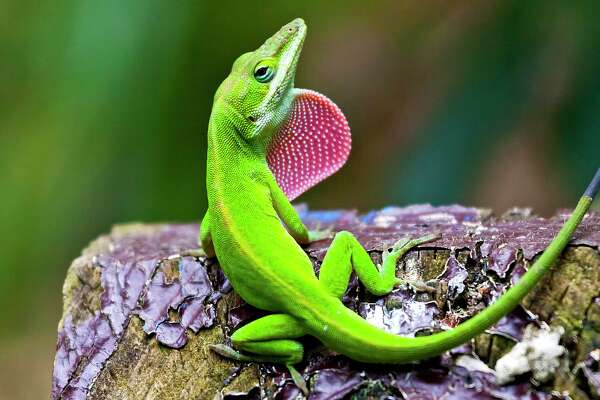
The male green anole has a throat fan called a dewlap that’s much larger than the one on females.Photo: Tongho58 /Getty Images
The Marvel comic book character Anole, who is named after the lizard.Photo: Marvel Entertainment
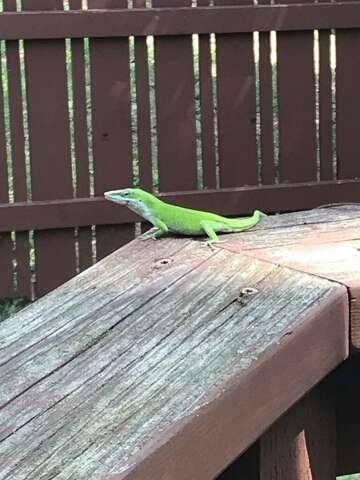
San Antonio audiologist Sarah Baade takes photos of the green anole lizards around her home gardens.Photo: Sarah Baade
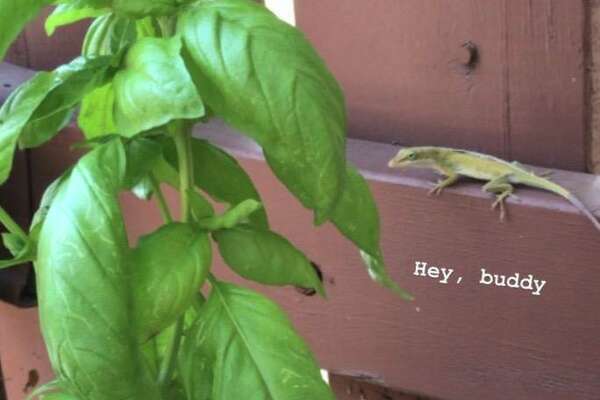
San Antonio audiologist Sarah Baade takes photos of the green anole lizards around her home gardens. This is a closeup of one of her Instagram posts.Photo: Sarah Baade
Sarah Baade practically considers anole lizards her personal gardeners. The green little reptiles have a knack for keeping her company at her San Antonio home while she tends to her front yard tomatoes and backyard squash, poking out their slender heads from under her plants to stare at her.
She calls it a mutually beneficial relationship. The anoles eat any pesky bugs, and Baade rewards them with a free drink whenever she waters her gardens.
But there’s something else these simpatico green thumbs share: The joy of silence.
“It’s kind of my peaceful quiet time,” said Baade, who works as an audiologist. “They are my peaceful, quiet companions when I’m gardening.”
Anole lizards, the most common lizards in and around San Antonio, may not make much noise, but they sure make an impression — especially now as we see them more often while we spend more time in and around the house. And take it from another anole fan, one who’s studied them for nearly 20 years, there’s nothing common about this so-called common lizard.
“I think they’re incredibly charismatic,” said Michele Johnson, a biology professor at Trinity University who runs the kid-friendly website, lizardsandfriends.org. “I think that they’re a really interesting lizard because they seem so familiar, and yet there’s still things about them that we haven’t figured out yet.”
Here are some familiar and not so familiar facts about the anole.
Tomato, tomato. Anole, anole. San Antonio is home to the Carolina anole (Anolis carolinensis), sometimes just referred to as the green anole.
Anole is pronounced “ah-NOH-lee”, though Johnson noted most scientists say anole like “ah-NOLE.” She doesn’t think there’s one right way to say the name.
Anoles range beyond the Carolinas. The Carolina anole is native to North America and ranges across the southeastern United States, from around the middle of Texas east and up through the Carolinas. The lizard prefers warm and moist environments with trees, though you’re sure to spot them just about anywhere else there’s foliage, from forests and roadsides to lawns and doorsteps.
It’s easy being green. The Carolina anole also is known as the green anole for its bright, verdant color. The anole can change color into shades of brown, but that doesn’t make it a chameleon. Chameleons are not found in the Americas. Rather, anoles belong to the iguana family of reptiles.
Hey, baby, do you like my camo? Yes, an anole’s ability to change color can help it blend in with its surroundings, which is great for hunting insects and avoiding predators. But most anoles change color as a sign of dominance or sexual attraction, rather than trying to blend in.
“We know for sure it’s not camouflage,” Johnson said. “There’s been several studies.”
Little green men and women. Male and female anoles look almost exactly alike save for two distinguishing features. The female often sports a white dorsal stripe along her back, while the male displays a larger throat fan, or dewlap, that’s bright red and three times the size of the female’s fan.
Long tails, short bodies, short life spans. Anoles range in size from 5 to 8 inches long, and more than half of that is tail. Anoles live only around two to three years in the wild. The lizards are popular pets though, and can live up to seven years in captivity.
Days spent in the trees. Anoles are diurnal, meaning they’re active in the daytime. They’re also arboreal, meaning they live in trees.
They really toe the line. Johnson noted anoles have big toe pads that allow them to cling to surfaces.
They also cut and run. An anole will shed its tail to escape a predator. The twitching limb serves as a distraction for the lizard’s escape. A new tail will grow back, though not as long or as colorful as the original.
A bug’s life for breakfast, lunch and dinner. Anoles eat all sorts of insects, including moths, crickets, ants and spiders.
Keep off the dudes’ turf. Male anoles are extremely territorial and will fight other males to preserve their areas for themselves.
Self-reliant hatchlings. A few weeks after mating, a female anole will lay her first egg, then lay another every other week until she reaches around 10 eggs. The hatchlings then emerge 30 to 45 days later. The babies must fend for themselves without mother or father to care for them.
“I know that they had babies in my front garden because I’ve seen the babies,” Baade said. “It’s cool to see them scurry around.”
The anole is one of the X-Men. The Marvel comic book character Anole is one of the lesser-known mutants to join the heroic X-Men. The openly gay young hero exhibits lizardlike traits and abilities, including green scaly skin and the power to grow back lost limbs.
A first in genome sequencing. As part of scientists’ efforts to better understand the evolution of various animals, the green anole was the first reptile to have its entire genome sequenced. Johnson said the lizard was chosen because it has a small body and a fast reproduction time — and it’s way easier to keep in a lab than, say, a crocodile or snapping turtle.
She noted that sequencing the green anole has since led to a better understanding of such processes as forming eggs and regenerating tails. Take that, GEICO Gecko.
From a press release from the Smithsonian Tropical Research Institute:
When the U.S. flooded Panama’s Chagres River valley in 1910, Gatun Lake held the record as the world’s biggest reservoir. This record was surpassed, but researchers at the Smithsonian Tropical Research Institute (STRI), who are now studying invading lizards on the tiny islands that dot the lake, discovered that islands with native lizards act as another kind of reservoir, harboring the parasites that control invaders. The study, published in the journal Biology Letters, is valuable experimental evidence that biodiversity is better, making ecosystems more resistant to invasion.
As part of another study to find out how many generations it takes for slender anole lizards (Anolis apletophallus) to adapt to climate change, a research team led by Christian Cox, a visiting scientist at STRI from Florida International University, and Mike Logan from the University of Nevada, Reno, transplanted lizards from the tropical forest on the mainland to the islands, which tend to be hotter and drier. Before the transplant, they did a general health check of the lizards that included counting the number of parasites (mites) on their bodies.
When they came back several times during the next two years to see how the lizards were doing in their new habitats, they recounted the number of mites.
“We found that on the islands with no resident species of anole lizard, the slender anole lizards that were transplanted to the islands lost their mites within a single generation, and the mites are still gone several generations later (up until the present),” Cox said. “Indeed, individual founding lizards that had mites during the initial transplant had no mites when they were later recaptured. In contrast, anole lizards that were transplanted to an island with another resident (native) species of anole lizard kept their mites for three generations, and some of the founders on the two-species island never lost their mites.”
“Our study turned out to be a large-scale experimental test of the enemy release hypothesis,” said Logan, who did this work as a three-year STRI/Tupper postdoctoral fellow. “Often, when an invasive animal shows up in a new place, all of its pathogens and parasites are left behind or do not survive, giving it an extra survival advantage in the new place: thus the term enemy release.”
The team also found that the two-species island had lower density and lower biomass per unit area of the invasive lizard species, indicating that the continued presence of the mites may be keeping their populations under control.
“Our study is a clear example of something that conservationists have been trying to communicate to the public for some time,” Logan said. “Diverse native communities sometimes function as ‘enemy reservoirs’ for parasites and diseases the keep down the numbers of invaders.”
Funding for this study was provided by the Smithsonian Institution, Georgia Southern University, the Theodore Roosevelt Memorial Foundation and the American Museum of Natural History.
Adaptation and speciation are largely responsible for the origin and maintenance of biological diversity but despite this central role in evolution, many fundamental questions about these interrelated processes remain. The adaptive radiation of Anolis lizards (anoles) is ideally suited for testing hypotheses about speciation and adaptation because they represent a replicated natural experiment. Anole species on the Greater Antilles that occupy similar ecological niches have independently evolved strikingly similar morphologies and behaviors. These ecomorphs have been the focus of decades of detailed analyses which strongly support the adaptive nature of this convergence. Nevertheless, we lack a clear understanding of how morphological adaptation contributes to speciation and we know virtually nothing about the genetic basis of these convergent traits.
In this webinar, Dr. Geneva presents ongoing research in his lab using anole genomes to investigate the processes of adaptation and speciation. He will detail the development of genomic resources for anoles including nine highly complete and contiguous reference genome assemblies and discuss NSF-funded plans to understand the genetic basis of morphological convergence in this group.
Read all about it in this new paper, available online: Víctor Vásquez-Cruz. 2020. New prey records for the Atlantic Central American Milksnake Lampropeltis polyzona (Serpentes: Colubridae). Phyllomedusa 19(1):107–111.
Freddie is my dog, a 27 lb mixed breed, and this photo was taken in my back yard. Freddie’s quite the little hunter – fascinated by cockroaches at night and Anolis sagrei by day. The latter have become extremely abundant here in Houston in the last decade or so, out-competing/displacing the native green anole. There are dozens (hundreds?) in my yard. They tend to stay on or near the ground, unlike the green anole, which seems to prefer (especially now) to be higher up in the vegetation (so not of interest to Freddie, fortunately). Male A. sagrei can get quite large and as you can see here, pretty feisty! The standoff lasted several minutes, and was repeated several times. But I’m afraid Freddie got the better of the plucky fellow in the end.
Paleobiologist Melissa Kemp spends a lot of time overturning assumptions. Her excavations don’t involve digging bleached bones out of windswept deserts, but looking for partially preserved lizard fossils in dark, dank jungle caves. Last month, she published a study tracking human-driven species introduction in the Caribbean through the region’s 7,000 years of human habitation—challenging the idea that “restoring” Caribbean biodiversity means taking it back to where it was before Christopher Columbus arrived in the so-called New World around 530 years ago.
Kemp, who runs a lab and teaches integrative biology at the University of Texas at Austin, opened up on Twitter last week about her experience as a Black scientist and outdoorswoman, under the hashtag #BlackInNature—as part of continuing conversations about race in America following the killings of Ahmaud Arbery, Breonna Taylor, and George Floyd, and the harassment of Black birder Christian Cooper. She spoke with NOVA about decolonizing environmental restoration, tropical fossil quirks, and the joys of time outside.
Alissa Greenberg: Let’s start with the hashtag #BlackInNature, which you’ve used in tweeting about your love of spending time outside. What’s important about that time in nature for you? What do you feel like it does for you physically and emotionally?
Melissa Kemp: I love spending time in nature. I live in Austin now, in a much more urban environment than I was raised in. But it’s still very rejuvenating just to go outside and look at the sky, look at the plants, find animals on the property and just see that there’s life there. Even when I’m doing my field research, there’s bursts of active work where we’re hiking through the rainforest trying to get to our site. But then when we get there, it can be very slow. The work that we’re doing is very meditative. So nature is very therapeutic for me. It’s played a very important role for me personally and professionally.
Particularly thinking about the COVID crisis, so many people are trying to find solace in nature during this time. And I think, now more than ever, it really needs to be accessible to everyone, with everything that’s going on—not only to make discoveries in and learn about, but just to enjoy and to feel comfortable enjoying it.
The hashtag #BlackInNature was used to celebrate Black nature enthusiasts on May 31, the first day of #BlackBirdersWeek.
AG: Youmentioned in a tweet that you grew up exploring outside on land your great-great-great-grandfather bought after emancipation. So your family has been there ever since?
MK: Yes. I grew up in Maryland, outside of Baltimore. Not really that far from any city, but very, very rural and situated near a state park. And because of that, I had a lot of nature at my disposal. I grew up listening to stories. My mom and my aunts and uncles would tell stories about how they would go out in the woods and explore. So I always had a connection to nature. I never questioned that connection because I felt like I lived in it—even just knowing that my family had been there for so long. The church cemetery was across the road, so I could go in the woods and see the graves of my ancestors.
AG: You also mentioned in that same tweet that your grandmother taught you to mark recapture, the biology technique to help estimate animal populations.
MK: Especially during the summers when my cousins would be there, and my grandmother had all these kids to deal with, we would go around looking for animals. We always found turtles, eastern box turtles. We would write our initials on them in nail polish, which we really probably shouldn’t have been doing, and take care of them for a night, then release them. She would always tell us, “Look for your turtles,” and we would find them again. Sometimes years later, we would find a turtle and be like, “Wait, that’s MK, that’s my turtle!” She really encouraged us to just go out there and explore. I think it really rubbed off on me.
A painting by Melissa Kemp of part of her family’s property. Image courtesy of Melissa Kemp
AG: How did you end up working in integrative biology? And why did you choose to focus on islands?
MK: I didn’t come into science in the most traditional way. When I was growing up, I always thought I was going to be an artist. I went to art magnet schools as a kid and trained at a really high level, mostly painting and drawing. I still approach science in a way that is similar to how I approach art. This diligence of working on something for a very long time and also being open to feedback from others to make the work better. Art is a very iterative process. It can take years before a piece is done, and it’s not a sprint, it’s a marathon. I think a lot of the same concepts apply to science as well. And my eye for detail maybe helps me find nuances in materials I look at. When I’m working with fossils I’m constantly looking at different shapes and looking for differences in structures of the different fossils I’m handling.
I study how biodiversity in tropical regions originates both through processes of extinction and diversification, as well as colonization. Particularly, I’m interested in how changes in the environment then impact the different communities of organisms that we have. I’m interested in these past instances of change that we can see through the fossil record, because it’s the key to really understanding the biodiversity that we have today, but also helps us understand how biodiversity might change in the future.
Islands in particular are really interesting biologically, and there’s been a wealth of study of diverse life-forms of islands, particularly lizards. But we don’t really have as much literature on fossil occurrences of lizards. That’s why I started focusing on islands, because we really don’t have a thorough understanding of how we got to present day biodiversity.
Human-driven biodiversity change in the Caribbean did not start in 1492. There is a 7,000-year legacy of change.
AG: You recently published a paper that delves pretty deeply into that topic. Can you summarize what you were looking for and what you found?
MK: We were really interested in investigating how humans have modified the biota of the Caribbean, particularly through which species they’ve introduced. This paper is really thinking about what we are adding to the islands—and what are the impacts of what we’re adding? How do those introductions scale across time? We developed a database of species introductions by going through the archaeological literature, as well as the paleontological literature, to get a sense of what we know about species introductions, and then also what we don’t know.
I think one of the biggest takeaways is the fact that humans have been engineering the landscape for millennia, particularly these places that we think of as recently perturbed. Human-driven biodiversity change in the Caribbean did not start in 1492. There is a 7,000-year legacy of change. We have these terms that I don’t think are representative of the biodiversity of the Caribbean, like “New World.” They’re really terms steeped in European colonization, referring back to the Caribbean as something being “new” to Europeans, when people had been living there for a very, very long time.
When we think about what the Caribbean used to look like, if you ask somebody on the street that question, they’re probably going to think about before Columbus and Europeans came. And we are definitely interested in that period, very much so. But we’re also interested in what it looked like before any humans arrived. And we really want to acknowledge how Indigenous groups in the Caribbean moved around, what species they were bringing, how they were using species, and how their manipulation of the landscape changed biodiversity in the Caribbean.
AG: Why is it important to ask those questions? Not just culturally but also scientifically?
MK: We have to be realistic about what’s actually feasible. The ideal restoration target probably in the head of a lot of people in the public would be what the environment was like before we came and messed it all up. But it’s not a realistic target, in part because we’ve lost so many species that were in the landscape before humans arrived.
What we see in a lot of systems after an extinction of one animal is that you have an extinction cascade where other things go extinct because organisms are interconnected with one another. They don’t exist in silos in the landscape. So, if we remove a pollinator, the plants that were pollinated by it might also undergo decline. They might also go extinct. And that might affect soil erosion, for example. Maybe their roots provided important structure for soil. And if you’re eroding soil, maybe you’re interrupting something else’s habitat. So we would want to restore this system so that that plant is there, and so that that plant is pollinated by an organism in the system—but it might not be possible to do all of those things. So, we have to think about, what is it that we are hoping to accomplish through restoration?
Melissa Kemp excavating a cave site on the island of Marie-Galante, Guadeloupe. Image courtesty of Melissa Kemp
Maybe another takeaway from our research would be thinking about introductions of species and what they mean biologically. There’s a lot of different terminologies that we use for introduced species—I think one of the most common one is “invasive,” because we often think about the negative impacts of species introductions. Certainly there were instances where species had very, very negative impacts, but then there are also instances where species don’t seem to be having a negative impact on the environment and maybe are actually doing good things for those ecosystems.
The Caribbean had a lot of endemic mammals prior to human colonization. There were monkeys and a lot of really unique mammals—like these animals called Nesophontes, which are these shrewlike insectivores that are no longer there. We think that a lot of them were really important pollinators in the ecosystem that were then lost. But with the introduction of new birds to the Caribbean, for example, it’s possible that some of that loss of pollinators, that ecological service, may have been restored.
AG: I’ve read that paleontology in the tropics is particularly difficult. What makes it so hard?
MK: The environment of the tropics is not really conducive to fossilization processes. You need stable temperatures, ideally, cold temperatures and dry weather, to get good fossilization—and things covered up really quickly. The tropics are very hot and very humid. It’s just so hot, it’s so wet, that it’s going to erode away very quickly compared to something that’s in the Arctic, for example. There’s much more rapid disintegration when it’s hot and humid. Microbes breaking things down is certainly part of it. Also exposure to UV light—there’s physical damage being done to the material as well as biological damage.
So we don’t have a lot of fossilization in the tropics, but we do have some, particularly in environments where the material is somewhat shielded. Almost all of the work that I conduct is done in caves. We’re going through often heavily forested areas, in limestone landscapes where the humidity and precipitation cuts through the limestone and creates cavities. Usually materials get in there through water flow—when, let’s say, there’s a hurricane.
A lot of it is very fragmented bones. We’re not getting a full lizard, with the skin removed and the bones in perfect position. Some of them have features that are identifiable, some of them do not. I think that’s one of the reasons people have been turned off studying them in the past. A lot you can look at with the naked eye and figure out what part of the skeleton it is, but some of them you need to look at under a microscope.
A fossilized piece of the upper jaw of a lizard, retrieved from cave sediments on the island of Marie-Galante, Guadeloupe. Image courtesy of Melissa Kemp
AG: So what techniques have you used to sort of get around those challenges?
MK: The biggest thing is just not to disregard the data that do exist and brush it aside. If you want to get material from the tropics, it’s not necessarily going to be very, very flashy in the same way that maybe a T. rex skull would be, but there are valuable data out there. Another thing that we do to get around some of the challenges is we just keep on looking. It requires us to interface with people in that area, talking to people about where caves are, if they’ve ever seen fossils.
So it’s very much a community effort, in terms of the work that we do. Finding sites with the help of local people. So local people who are out there exploring the caves for fun often have been a real godsend for us, very helpful in orienting us on the land. They’re almost always happy to show us and then interact with us when we tell them more about what we’re doing. And that’s always really fun.
I think it’s a function of where I do fieldwork that I have always felt safe in the field. I work in spaces where there are very diverse cultures that are not my own, often cultures where Black people are dominant or brown people are dominant. When I worked in Guadeloupe, for example—a French-speaking island in the Lesser Antilles where the majority of people are Black and Creole—if I kept my mouth shut, people just assumed I was from Guadeloupe. Being an outsider hasn’t been a source of fear in those landscapes.
Just seeing my grandmother as a Black property owner in a small town where there were not many other Black property owners was very inspiring. I don’t know if it’s the right word for it, but I felt that the outdoors belonged to me and that it was my right to be there.
AG: To that end, what’s important about the conversations we’re having now, around the incident with Christian Cooper and the #BlackInNature and #BlackBirdersWeek hashtags? What would you hope might come out of them?
MK: It’s important because it reinforces, particularly for us as Black people, that we belong here, that this country is ours. We had a very, very instrumental part in creating what we have today in this country, even as we continue to be oppressed. I think it’s also important for non-Black people to hear that as well, that they recognize those contributions. I feel very privileged to have had a very positive association with the outdoors all my life. Just seeing my grandmother as a Black property owner in a small town where there were not many other Black property owners was very inspiring. I don’t know if it’s the right word for it, but I felt that the outdoors belonged to me and that it was my right to be there.
I heard messages going through school from other people like, “Oh, nature is more of a white space.” But I really rejected those messages because I had this pride in my family history, and my connection to the land, and my family’s connection to the land. I just felt like everyone else had it all wrong, that they just didn’t know the history of this country well enough—how tied, for better or for worse, African Americans are to the land. It’s a very painful history, sometimes, to think about how many Black Americans got to this country, why we were brought to this country in the first place, to work the land that white people didn’t want to work.
For me, at least, learning that history has really made me feel more grounded in the space that I occupy. I’ve always felt grounded because of my very strong family history. But I know a lot of Black Americans don’t have that. Talking to distant cousins that I share lineage with further back, helping them learn about the history of enslavement of our family, has really helped ground them as well.
Whenever people may have made snide comments—“I’m afraid of the woods,” or, “The woods is a white space”—I’m very comfortable with my story and being like, “Well, I’m here. My family’s here. They’ve been on this land for six generations. You can’t tell me it doesn’t belong to me.”
According to no less authoritative a source than Coin World, the most fabulous new currency for 2019 is the 100-florin bill (about $56 US) from the island of Aruba. You can read all about it in CW‘s article below, but let me highlight the important point that our very own Anolis lineatus is featured prominently on the bill (as well it should be). Clearly, the message here is that if you (you being a country) want to gain accolades for your currency, putting an anole on the note is a wise move. Perhaps some of our more artistically gifted readers can mock up some examples?
Aruba 100-florin note named Banknote of the Year for 2019
By Arthur L. Friedberg , Special to Coin World
Published: Apr 20, 2020, 8 AM
Aruba’s new 100-florin note was named Banknote of the Year for 2019 by the voting membership of the International Bank Note Society. The winner bested 21 other contenders selected from among the over 100 new notes issued last year. The finalists were the only ones considered new enough in design to be considered for the award.
The IBNS said that Aruba’s entry led almost from the start of balloting. While every nominee received at least some votes, immediately behind Aruba were the Eastern Caribbean States $10 bank note with multiple motifs, the Ulster Bank of Northern Ireland’s £5 note showing flying geese with people on the shoreline, and Switzerland’s 1,000-franc bank note with human hands in the main design. Norway’s 1,000-kroner note with a cascading wave design was in fifth place.
The IBNS competition began in 2004, but this was Aruba’s first entry.
Canada’s $10 bank note won for 2018, breaking a two-year run by Switzerland with its 10- and 50-franc notes.
Aruba issued a new five-note series of 1-, 5-, 10-, 25-, 100- and 200-florin notes at one time on June 30, 2019. (The florin is pegged to the U.S. dollar at a rate of 1.79:1.)
The series, called the “Stars of Aruba,” was the first redesign in 30 years. Their vertical format draws on artistic elements from Aruba’s culture, flora, and fauna. They were jointly developed with Crane Currency, who also did the printing. Given Aruba’s small population of 120,000, the central bank needed to balance anti-counterfeit technology with production costs, and did so utilizing high-relief printing, watermarks, color-changing ink, the Omron Rings, and Motion Surface, Crane’s 3D moving stripe with miniaturized micro-optics.
The face of the 100-florin note is predominantly emerald green in color with a large iguana in its center and an indigenous lizard, the striped anole (Anolis lineatus) on the left. The green and blue back features women in native dress dancing and leaves from the aloe plant, an economic mainstay.
Jane Semeleer, president of the Central Bank of Aruba, said, “It is very clear that we have managed to create a beautiful family of bank notes. We have one of the most innovative and modern banknote series in the world. And we’re very proud that our vision — to make Arubans proud of their country and to show the world the rich life of Aruba — has led to an award winning 100 florin banknote.”
Semeleer added, “We had to present a better product that the public could fall in love with — and we succeeded. The reactions since the launch have been very positive. Shortly after the co-circulation started, 80 percent of the old banknotes where exchanged.”
About the award
Among the criteria for the nominated notes, according to the IBNS, “Banknotes nominated must have been issued to the public (specimens and non-circulating currencies are inelligble) for the first time during the year of the award, and must have artistic merit and/or innovative security features, and be in general circulation.”
Notes were judged and “the winner [was] decided by a vote of the IBNS, who will consider the artistic merit, design, use of colour, contrast, balance, and security features of each nomination,” according to the IBNS.
“The IBNS Banknote of the Year award is an initiative of the IBNS to recognize an exceptional banknote issued each year,” according to the organization.