
Author: Jonathan Losos Page 11 of 133

Professor of Biology and Director of the Living Earth Collaborative at Washington University in Saint Louis. I've spent my entire professional career studying anoles and have discovered that the more I learn about anoles, the more I realize I don't know.

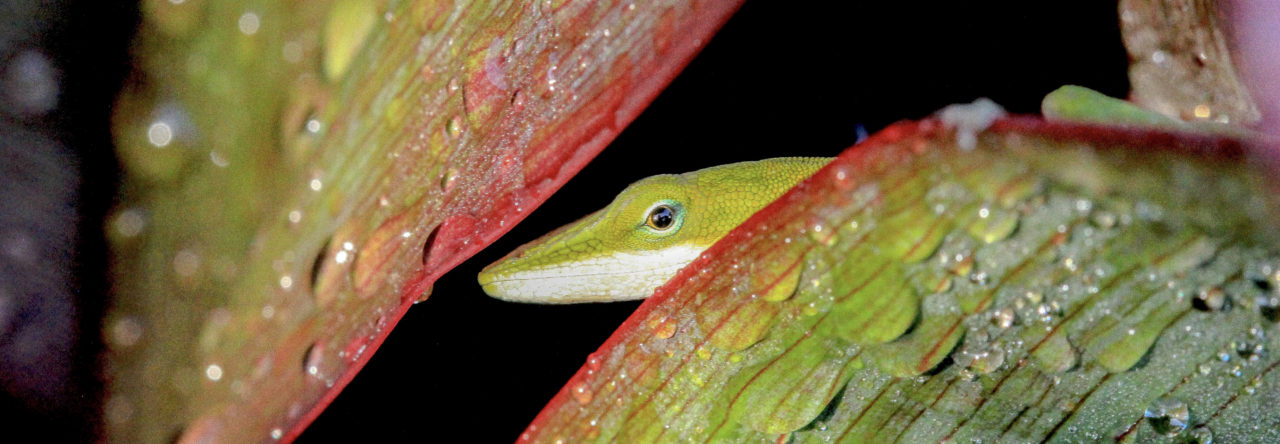
Wacky Looking Green Anole from Gainesville

Matt R. Whiles, Chair and Professor in the Soil and Water Sciences Department at the University of Florida provides these details:

Specimen was not captured, just photographed by my wife Lindsay Hsieh, who is familiar with Anolis and recognized that it was different looking.  Observed in Alachua county FL, west of Gainesville in a horse barn facility – coordinates: 29O 41’08”N 82O 30’18”W;  date was November 10 2020.  A. carolinensis are common on the barn, but none we’ve seen look like this.  The owners of the facility routinely haul horses back and forth from Gainesville to south Florida, so could be a transplant.”

He then asks: “I’ve seen thousands of A. carolinensis, and never one like this.  Do you think this is just a color/pattern display, or would this individual always look like this?  We are keeping an eye out for it again and will try to collect it if you want the specimen.”

Thoughts, anyone (including interest in the specimen should it be seen again)? My guess is that these are not  permanent markings; the block spot on the head and the hint of an erected nuchal (neck) crest suggests a stress response; perhaps the lizard had just been fighting. Indeed, Dr. Whiles clarified in a subsequent email: “I’ve certainly seen the black spot form on stressed individuals, but never the full patterning.  To add to your hypothesis, my wife indicated it was interacting with another Anolis when she saw it (you can actually see the tail of the other individual in the pic).”

Flashy Lizards Are More Attractive to Mates and Predators

 A water anole with a colorful dewlap. Image Credit: J. Montemarano.

In the lizard world, flashy colors attract the interest of females looking for mates. But they can make colorful males desirable to other eyes, too — as lunch.

Assistant Research Professor of Biological Sciences Lindsey Swierk is the first author of an article in the journal Evolutionary Ecology on the topic. Called “Intrasexual variability of a conspicuous social signal influences attach rate of lizard models in an experimental test,” the article details an experiment involving clay models of water anoles (Anolis aquaticus), a species of lizard only found in Costa Rica and a small slice of Panama. The researchers conducted the experiment at the Las Cruces Biological Station in Costa Rica, which is one of the Organization for Tropical Studies’ field stations.

To attract females’ notice, male anoles have dewlaps: colorful extendable flaps of skin under their chins. In most species of anole, dewlaps evolved to be as noticeable as possible within the environment, given an environment’s predominant colors and lighting conditions.

“Even so, we see a lot of variation within a species in just how bright dewlaps are,” Swierk said.

While some water anoles have dramatic red-orange flaps, others have more muted colors, more of a dull brownish-red. Researchers wanted to determine the effect these color variations had on their risk of predation.

While it’s widely assumed that flashier males will attract more attention from predators, few studies actually test this assumption. Logistics may be a factor: Researchers have to separate the effects of sexual colors from other aspects of a creature’s body and behavior, a difficult task when using real animals. As a result, many studies show correlation but not causation.

To prove that flashier males face greater risks of being attacked, the researchers created clay models with colored dewlaps — some bright, some more muted. Many visual predators use a stereotyped “search image” to identify prey, so the models only had to approximate anoles’ general size, color and shape. The dewlap color, however, required special attention.


“Because different animals have different visual sensitivities than we do as humans, getting the colors right was an important consideration in our model design,” Swierk explained. “We ran some pilot trials before this experiment to make sure our models were convincing as ‘lizards’ — and they certainly seemed to be, as many birds and other lizards took bites out of them!” 

Researchers were able to identity predators from bite marks in the clay models. They included many species of bird, including the strikingly beautiful motmot with its serrated beak. Basilisks and whiptail lizards were also among the likely attackers. The results proved that flashier lizards really do end up as lunch more often.

If bright colors have deadly consequences, why do female anoles prefer them? One answer is that brighter males have either high-quality genetic material or resources that allow them to handle the risk of getting eaten, Swierk explained.

“Because every individual’s evolutionary ‘mission’ in life is to pass on as many copies of its genes as it can, conspicuous traits like these can evolve if they give an individual a high level of reproductive success — even if the flashy trait ends up killing them in the end,” Swierk said.

Frog-Eating Bats Eat Anoles

Back in 2013, AA featured a number of posts discussing whether and how often bats eat anoles. The discussion ended with a report of a paper documenting extensive anole hunting by the big-eared bat in Panama (see photo above). That paper described how the bats captured their prey: “M. microtis hunts on the wing, checking leaf by leaf in the forest while hovering up and down the understory vegetation.”

Now, a new study has used DNA metabarcoding of fecal samples from the frog-eating bat, Trachops cirrhosus, and has discovered that the bat needs a new common name: the frog-and-lizard-eating bat. That’s right: although DNA from a variety of frog genera was found in the bat poop, the second most common taxon (inhabiting 22% of the turds) after Pristimantis frogs was anoles!

The study did some other clever things as well in an attempt to figure out how the bats found their prey. Here’s what they say in the discussion:

“We found DNA from Anolis lizards in almost a quarter of our bat samples, but bats showed a fairly low response to the rustling sounds of anoles moving through leaf-litter. A previous anecdotal report from Honduras described finding a dead anole in the mistnet pocket with a female T. cirrhosus (Valdez and LaVal 1971). Anoles do make alarm sounds, but do not call, therefore we anticipate that the rustling sounds made by anoles moving through leaf-litter is the most obvious cue they present to T. cirrhosus. We had hypothesized that we would find greater responses to anole rustling sounds in dry season conditions (lizards moving through dry leaves) than wet because movement through dry leaves produces louder, more conspicuous rustling sounds. While we did find anoles in the diet of more T. cirrhosus in the dry season than in the wet season, and we did find higher response to the sounds of anoles moving through dry versus wet leaf litter, these differences were not significant. Why bats did not show more response in general to anole rustles is unclear. One possibility is that since the speaker was in a fixed location, the rustling sound does not move in space as a real moving animal would. Additionally, rustles are relatively low amplitude compared to the mating calls we presented to the bats, which could account for the lower responses. Also, anoles are diurnal, therefore we might not predict them to be moving around at night, and rustling sounds could be indicative of many different potential prey, some more palatable than others. Bats may thus be locating anole prey by some other mechanism than rustling sounds, and one bat did attack a silent, motionless plastic anole model, indicating that T. cirrhosus may be able to locate sleeping lizards using echolocation alone. Anoles are diurnal, so unless one was scared off of its perch, they are unlikely to be moving through the leaf litter at night.”

And just because it’s so cool, I have to add the beginning of the next paragraph:

“Diet samples indicated some predation events that appear to be rare, including predation on the hummingbird F. mellivora, and on the bats Glossophaga soricina, C. perspicillata, and Micronycteris microtis.

Festive Anoles Expanding Range in Singapore

Festive anole in the Gardens by the Bay in Singapore

We’ve reported previously on the introduction of festive anoles (a.k.a., brown anoles) to Singapore. Now, a new report reveals that they are, indeed, spreading far and wide in the island state. How long before they make it to Malaysia (if not already)?

From Hongxia and Zhiyuan. 2020

Captive Breeding for Orange-Red Anolis sagrei

Photos by James Lindros

After my recent post on another observation of a bright orange–some might call it red–brown anole, Annals reader Nathan writes: “I saw the post of the Orange sagrei from Sarasota on Anolis Annals. My friend James Lindros has been breeding an Orange/Red Line in captivity, and I asked if it was ok to forward this photo. James is a true expert on keeping and breeding Anolis and lives in West Palm Beach, FL.” James gave permission to use the photos and added that “they’re second generation captive bred from full red parents.” Spectacular!

A brown anole from Sarasota. Photo by Rick Greenspun.

Orange Anolis sagrei

A brown anole from Sarasota. Photo by Rick Greenspun.

One of the most popular topics on Anole Annals are posts (such as this one) on orange- or even red-colored brown anoles. We regularly get comments on old posts on this topic, as well as people reporting new sightings. The most recent is shown above, sent to us by Rick Greenspun from Sarasota, who says this is the first such anole seen there in the 47 years he has lived there.

Are Anoles Smarter than a Fifth Grader?

This post is reprinted from the pages of Chipojo Lab.


Lagartijos más listos


Are lizards smarter than we give them credit for? Check out Manuel & Levi’s feature in the magazine Ciencia about foraging and problem solving in Anolis sagrei! The study was designed and conducted entirely in the lizards’ natural environment— in aims of understanding lizard behavior in an ecologically-relevant context. In the field of animal cognition, the majority of experiments are done in the lab, and field-based work is comparatively rare. We are in great need of more studies out in nature.


Adopt a Reptile to Help Publish a Fabulous New Reptiles of Ecuador Book


The ace photographic herpetologists at Tropical Herping are at it again! After publishing several beautiful and extremely useful guides–The Amphibians and Reptiles of Mindo and Reptiles of Galápagos–they’re now taking on the entire herpetofauna of Ecuador. If you have any doubts about their photographic chops, check out this page on Ecuadorian anoles.

And you can help make this book a reality! I’ve already done my part by sponsoring a species, but you have to guess which one.

Now you can play a major role in the publication of the 🐍 Reptiles of Ecuador 🇪🇨 book. Choose one of Ecuador’s 483 species of reptiles and your name will be displayed as its official protector or guardian in the species’ online data sheet. Your donation will help fund the last four remaining expeditions needed to find the most elusive reptiles in the country as well as cover the majority of the editing and printing costs. Every little donation helps. Click here to find out more about how can you adopt a reptile.

Invasive Green Anole on Japanese Island Implicated in Butterfly Extinction

We’ve previously had posts about green anoles, Anolis carolinensis, introduced to the Ogasawara Islands, and the efforts to eradicate them. Now a report has implicated the anoles in the possible extinction of a butterfly species. Here’s an article from the japan times:

Blue Japanese butterfly endemic to Ogasawara Islands feared extinct

The Environment Ministry said Thursday that a species of small butterfly endemic to Japan’s southern islands is feared to have gone extinct because all artificially bred butterflies and worms of its type have died.

In the butterfly’s natural habitats, in the Ogasawara Islands some 1,000 km south of Tokyo, no individuals from the species have been confirmed since 2018, the ministry said.

Unless the blue butterfly measuring just over 1 cm long is found in the wild, it will be the first butterfly species native to Japan to go extinct.

The ministry believes that a decline in the butterfly population is at least partially attributable to foreign lizards on the remote islands.

Efforts to preserve the species, known as Celastrina ogasawaraensis, had been under way since 2005 by Tama Zoological Park in western Tokyo and also at a facility in Shinjuku Gyoen National Garden in the capital since last October.

But all of the butterflies and worms raised at these facilities died in July and earlier this month, the ministry said, adding that repeated inbreeding might have led to an accumulation of hazardous genes, ultimately causing death.

The small butterfly is currently categorized as endangered on the Environment Ministry’s Red List. The ministry is expected to decide whether the species should now be listed as extinct.

The Ogasawara Islands are known as the Galapagos Islands of Asia due to their unique flora and fauna after eons of separation from any continent.

While the remote islands are growing popular as a tourist spot for beautiful subtropical scenery and whale watching, limited access via a 24-hour ship voyage available only once once per week helps to preserve the wildlife and natural ecosystems.

The volcanic islands, now administered by the Tokyo Metropolitan Government, belonged to the United States after World War II before being returned to Japan in 1968.

Green Anole Eats Brown Anole

Four-year-old Dany Leffler noticed the goings-on in his backyard in Houston just minutes from downtown.

Down the hatch!

Page 11 of 133

Powered by WordPress & Theme by Anders Norén