

Read all about Project Noah, a citizen science initiative, and their recent good judgment in featuring Anolis.
Professor of Biology and Director of the Living Earth Collaborative at Washington University in Saint Louis. I've spent my entire professional career studying anoles and have discovered that the more I learn about anoles, the more I realize I don't know.
Read all about Project Noah, a citizen science initiative, and their recent good judgment in featuring Anolis.

A year ago, I posted on 20 years of research on anoles in the Bahamas, discussing our current projects: 1. the effects of brown anoles on the ecosystem, and how those effects are altered by the presence of the anole-eating curly-tailed lizard; 2. whether and how brown anoles will adapt to the presence of the terrestrial predators, which forces them to move up into the vegetation, where they must cavort on narrow diameter vegetation; and 3. the effects of an experimental founder effect in which we seeded each of seven islands with a pair of anoles and followed how the populations evolved for a number of years. The first two projects–as well as the methods we use–were discussed here, in one of my finest AA posts, if I do say so myself. The third project led to a paper on founder-effect evolution that appeared two months ago; you can get up to speed on that one here.
Every year we arduously return to the Bahamas to see how the population numbers have risen or fallen, to assess the state of the ecosystem, and to examine whether the morphology and genetics of the populations have changed. And so, we head south and east again. But the 800 pound gorilla in the boat concerns what happened last August. Hurricane Irene, which at its peak was a Category IV storm and which gained fame by wreaking havoc all the way to Vermont, scored a direct hit on our study site on Great Abaco Island (also on our newly established study in Staniel Cay, to the south).
We’ve got a history with hurricanes, and it’s not a happy one.
 Bermuda has only one native lizard, a skink, but is blessed with three introduced anoles: A. grahami, A. leachii, and A. extremus. Or is that now four? Joe Macedonia is on the ground in Bermuda as I write, and his team of intrepid lizard watchers have snapped this beauty. To me, it looks like a male A. sagrei. Anybody got another idea? Any chance it’s A. grahami, found everywhere in Bermuda?

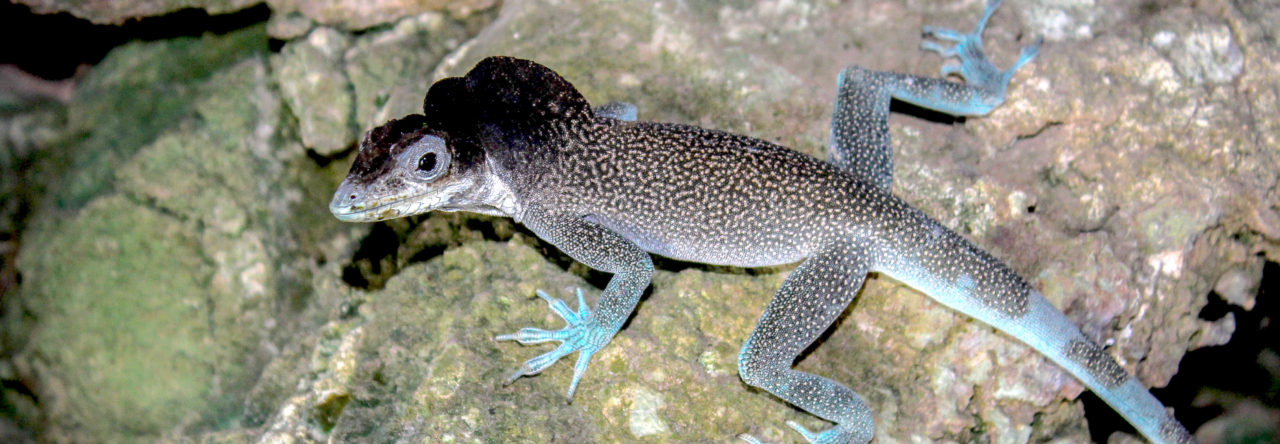
Anolis grahami on Bermuda. Photo by J. Losos.
If it is A. sagrei, and if this colonizer extraordinaire is firmly established, then how the population expands will be interesting to watch. As documented in detail, A. grahami spread rapidly throughout the island after its introduction in 1905, but the next two invaders expanded much more slowly, the last one to arrive, A. extremus, still having a limited distribution on one end of the island. All of these species are arboreal, however, so it is very possible that the presence of A. grahami inhibited the other two. Anolis sagrei, on the other hand, is much more terrestrial. My prediction is that if a population is established, it will quickly spread throughout the Bermudian archipelago. In turn, for someone moving quickly, this might make a great opportunity to study the ecological and evolutionary consequences of invasion. Will A. grahami populations decline? Will the species shift its habitat use, perhaps with selection to alter its morphology?
 Although devoted to all things Anolis, Anole Annals strives to keep its readers updated on relevant findings concerning other lizards. In that vein, we’ve just learned of a newly completed thesis on lacertid lizards on European islands by Anna Runemark at Lunds University, under the supervision of Erik Svensson. Here’s the English summary of her thesis, from this page, and some remarks from Erik here. Her defense is on May 25th. Good luck, Anna!
“Islands are cradles for new biodiversity and provide natural laboratories for the study of population divergence. In my thesis, I investigated the role of different evolutionary processes in the population divergence in the Skyros wall lizard (Podarcis gaigeae), a species where islet populations have strongly diverged morphologies. I used replicate islet populations and their respective most proximate mainland populations to investigate how divergence has proceeded following the isolation of the islets. First, I combined bathymetric maps with sea level curves and molecular inferences based on Bayesian statistics to investigate the biogeographical history of populations. I found that islet populations have become isolated by vicariance following sea level rises during the last thousands of years, and no significant gene flow between populations. To investigate which processes are affecting population divergence, I studied patterns of divergence in coding genetic variation, traits assumed to be under simple Mendelian inheritance, morphological and behavioral traits. A clear pattern of parallel adaptive divergence in the islet environment emerged for traits mainly subjected to natural selection. Islet lizards were larger, greener and less prone to escape. Islet lizards were also less cryptic in their environments than were mainland lizards. Moreover, between-population variation in size and color was larger for islet- than for mainland populations. These patterns are indicative of a predation release. I also found that islet lizards have relatively wider and differently shaped heads as well as a stronger bite force in relation to mainland populations. Data on available food and realized diet suggest that these changes are adaptations to harder island diet. Together these data suggest that predation release and selection for a diet change have interacted and jointly driven the evolution of larger body sizes on islands.
No general pattern of parallel divergence was found for traits subjected primarily to sexual selection. Instead, divergence in throat color morph frequency and sex pheromone composition were significantly correlated with neutral genetic divergence. This indicates that stochastic processes such as genetic drift have contributed to divergence of these traits. I also investigated if mate preferences for pheromones, throat color and body size could be driving population divergence. I found no population differences in preferences for throat color and body size, suggesting that mate choice does not drive divergence in these characters. Islet populations did, however, prefer scent from islet lizards, whereas mainland lizards were less discriminatory. This implies that there could be some mate discrimination against mainland lizards that disperse to islets.

Read all about it here.

IRCF Reptiles & Amphibians lives on in the digital realm, and just published its latest issue
IRCF Reptiles & Amphibians: Conservation and Natural History may no longer be publishing in the paper realm, but it’s still coming out electronically, and the latest issue has just hit the digital street. Amidst the customary excellent photography and interesting articles are two new reports of introduced anoles.
First is the interception in Dominica of two Anolis bimaculatus hitch-hiking on a container shipment from St. Kitts. This species has previously been reported there, but is not established.
Second is the report by an all-star cast of AA contributors of additional populations of A. porcatus in the Dominican Republic, presumably the result of dispersal from Santo Domingo, where they have been established for some time.

Flossless in Saint Louis. What has become of Reach (non-mint) waxed floss?
There’s been a lot of talk recently about the inability to get top-of-the-line noosing poles, but another lizard catching crisis hasn’t yet received attention. Right-thinking anolologists agree that dental floss is the preferred lasso-making material, but not all floss is the same. As discussed in a previous post, there are definite differences in quality, at least with regard to lizard-catching potential.
In particular, Johnson & Johnson’s Reach © brand waxed floss is the premium lariat string, yet in my experience, it has become harder and harder to find as many stores (e.g., CVS, Walgreens) are stocking inferior store brands and, for some reason, mint-flavored products.
This situation hit its nadir just this weekend, when I was unable to find Reach waxed floss in numerous St. Louis apothecaries and groceries, nor in an outlet in DC. Where the heck is it? Are other herpetologists hoarding it in fear of another Cabela’s-style debacle? I don’t know, but I’ve been forced to pack Walgreens brand stock on my upcoming expedition. I guess it’s only fair to give the little guy’s a chance, but you can bet I’ll be cursing Wallie’s finest every time a lizard flips out of my noose.

Only $4.99, available from Amazon.

Ok, not a parasitic worm of anoles, but it got your attention! Photo from http://childhealthproblems.com/images/head-of-helminth.jpg
In a gargantuan recent paper in Comparative Parasitology, Bursey, Goldberg, Telford and Vitt report new data for 13 Central American anoles and summarize what is known about helminths through all of anoledom. Before getting into the details, though, it may help some of our readers to explain what a helminth is. In short, helminths are parasitic worms, such as nematodes, flukes, and tapeworms; anoles—and many other animals—are commonly infested with them.
Prior to this study, helminths had only been reported in 10 Central American anoles. However, taking advantage of the collections of Telford and Vitt, dating back to late 1950’s, the researchers examined 426 anoles of 13 species, basically opening up museum specimens to see what surprises awaited. The result was 1026 parasites found in 173 of the specimens.
 Reader Mona G writes: “I like to watch anoles in my garden in the Florida Keys where they are ubiquitous. I also take photos of them. I wanted to tell a funny story about one of my photo shoots. This took place a few years before digital cameras were invented. The days of using film! I had a very large, long and heavy zoom lens. It was summertime and very hot. I sat in one spot observing a large anole doing what they do when another anole comes into their territory. He used his dewlap often and the sunlight was lighting it up making it so beautiful. It appeared to be all shades of red,yellow, orange and hot pink. It is not easy to catch that dewlap moment. So I sat sweating profusely and eventually aching from being tensed up into certain postures to get certain angles. I was so excited about the photos I was sure I would have at least 3 or 4 perfect pix out of my roll of 36. I prepared to take them directly to be processed. As I started to rewind the film back into it’s canister… something didn’t feel right. I thought “oh no. The film has gone too far and has detached from the can.” NO that was not the problem..the problem was that there was NO FILM in my %&^^&*&^%#!!! camera…I LOVE DIGITAL!! Anyone have any stories like this to share? Also about this chameleon pix..is this a pet? Or is it in nature? I hope someone enjoyed my story. I STILL take anole pix very often. They are always interesting to observe. I often leave a banana peel on a table and they come to eat the fruit flies. They seem to be familiar with me. Not tame but more relaxed in my presence as time goes by. I have also become familiar with certain lizards who live in a certain area. They definitely have there own home turf. Thanks for reading. I am attaching a recent night shot. This anole sleeps in the same area every night. I woke him up and you can see he is not very happy about it!
Powered by WordPress & Theme by Anders Norén