
Author: Jonathan Losos Page 104 of 133

Professor of Biology and Director of the Living Earth Collaborative at Washington University in Saint Louis. I've spent my entire professional career studying anoles and have discovered that the more I learn about anoles, the more I realize I don't know.

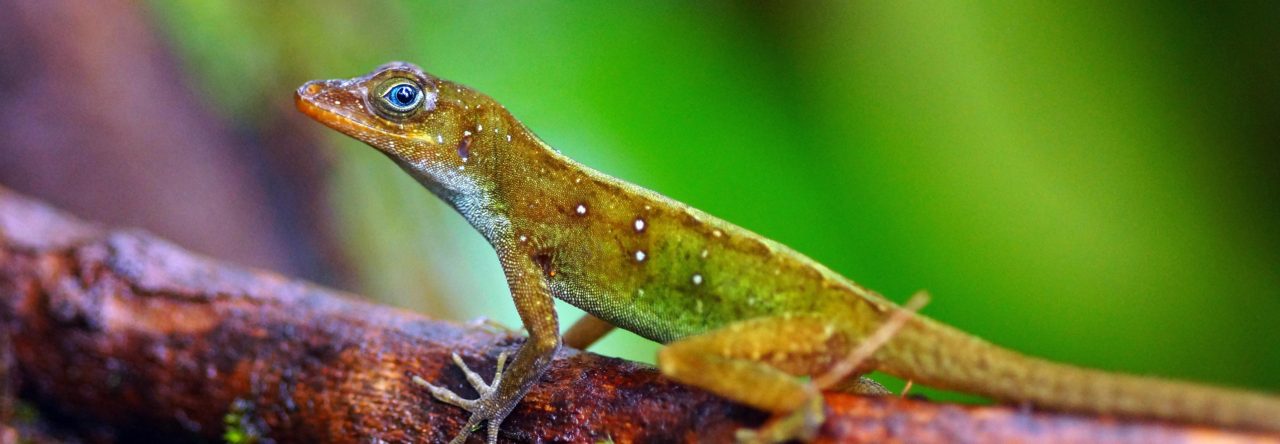
Anolis Capito Eats A Frog

Anolis capito, ranivore. From http://biogeodb.stri.si.edu/bioinformatics/dfm/metas/view/45332


The pug-nosed anole, as it is known, is a pretty weird species. First is its funny-looking face, hence it’s name. Second, it is very unusual among anoles in being relatively large, yet found almost invariably near the ground–most larger anoles are found higher up in the tree. Finally, it’s long legs are ungainly and seemingly awkward. Relatively little is known about its natural history, and there is some indication that in some places, it may have become less common.

Our knowledge of natural history knowledge was expanded ever so slightly by the recent report by Mora et al. in the most recent Herpetological Review of an observation of a male eating a pygmy rain frog (Pristimantis ridens). 

More On Horned Agamids: Reports From Sri Lanka On Cerataphora

Ceratophora tennenttii from The Lizard Lab website

We’ve had a continuing series of posts on anole wannabees (most recent here), those lizards other than Anolis that sport dewlaps. Many of the best faux anoles are Asian agamid lizards. Some of these lizards are anole-like in other ways. For example, the fascinating Sri Lankan Ceratophora, though lacking a dewlap, parallels some anoles (well, two in particular), by sporting an appendage on its nose. Read more about these fascinating lizards at Martin Whiting’s Lizard Lab website.

A Shiny New Example Of Caribbean Lizard Diversity

The Caribbean skink radiation. Islands identified by name have (or had) mabuyine skinks; others--notably Cuba--do (or did) not.

Think Caribbean lizard diversity and you think of anoles, dwarf geckos, perhaps curly tailed lizards and whiptails. But skinks don’t generally come to mind. Heck, I almost never see skinks in the Caribbean and, anyway, their diversity is very low, with only six Caribbean species.

Previously considered conspecific

Until now. In a recently published monograph, Hedges and Conn have scrutinized the genus Mabuya, using both molecular and morphological characters, and have more than doubled the number of species, from 26 to 61, which they have broken into 16 genera (and, as a sidenote, they also split the family Scincidae into seven families). That so many species went undetected is perhaps not surprising, in that Mabuya, like most skinks, all look alike, with very few characters available to distinguish them. Moreover, a trend of species lumping has occurred historically, obscuring sometimes great differences among taxa, as illustrated in the photo to the left.

Of the 61 species, 39—in six genera—occur on Caribbean islands. Most occur on a single island, and most islands only have one species, though as many as three occur on Hispaniola and St. Thomas, and two on a number of islands. Oddly, Cuba has none. Like anoles, to which they no doubt aspire,

Farmville Anole

From http://farmvillefreak.com/farmville-animals/farmville-glitch-green-anole-farm-coins?utm_medium=twitter

I have absolutely no idea what this means, but it seems to be a big development in the Farmville world.

Brown Anole Invasion In Georgia

They’ve finally arrived in Valdosta, Georgia. Janson Jones reports from the invasion front.

Anoles Are Organisms Of The Day Down Under

Over at “Catalogue of Organisms: inordinate fondness for systematics,” an Australian site dedicated to biodiversity, anoles are the clade du jour. Maitre d’ Christopher Taylor overcomes his entomological proclivities to write an extensive and insightful overview of anole diversity. Fair dinkum!

If You Want A Lizard To Run Fast, Yell At It

Lizards have become a staple of laboratory studies of locomotion. A standard approach, honed to perfection over 30 years of such work, is to get a lizard to run down a narrow trackway or on a dowel to determine how fast it can run and, in recent years via high speed video, to see exactly how the different limb elements move. Questions that one might ask include whether long-legged lizards run faster than their short-legged compatriots, whether species can run faster on broad surfaces as compared to on narrower supports, or whether the loss of a tail affects sprint speed. In fact, the sort of questions one might ask about lizard locomotion are virtually endless.

These studies have one Achilles heel, however, Most such studies focus on examining maximum speed of the lizard, but how can one ensure that lizards are actually running full tilt? The nagging fear has always been that differences in speed might result not for different capabilities, but rather as a result of differential motivation–some lizards just want it more than others.

But how can one elicit maximal speed or investigate whether a lizard is holding back? One approach to this question was revealed in a recent paper in J. Herp. Jones and Jayne tested whether a loud noise might cause a lizard to run faster and the answer is: yes, when subjected to repeated loud noises, lizards in experimental race tracks do, in fact, run faster.

And just what kind of loud noise? Let’s let junior author Bruce Jayne explain the genesis of the study:

Anoles Featured On Project Noah


Read all about Project Noah, a citizen science initiative, and their recent good judgment in featuring Anolis.

Back To The Bahamas Again: What Hath Hurricane Irene Wrought?

A year ago, I posted on 20 years of research on anoles in the Bahamas, discussing our current projects: 1. the effects of brown anoles on the ecosystem, and how those effects are altered by the presence of the anole-eating curly-tailed lizard; 2. whether and how brown anoles will adapt to the presence of the terrestrial predators, which forces them to move up into the vegetation, where they must cavort on narrow diameter vegetation; and 3. the effects of an experimental founder effect in which we seeded each of seven islands with a pair of anoles and followed how the populations evolved for a number of years. The first two projects–as well as the methods we use–were discussed here, in one of my finest AA posts, if I do say so myself. The third project led to a paper on founder-effect evolution that appeared two months ago; you can get up to speed on that one here.

Every year we arduously return to the Bahamas to see how the population numbers have risen or fallen, to assess the state of the  ecosystem, and to examine whether the morphology and genetics of the populations have changed.  And so, we head south and east again. But the 800 pound gorilla in the boat concerns what happened last August. Hurricane Irene, which at its peak was a Category IV storm and which gained fame by wreaking havoc all the way to Vermont, scored a direct hit on our study site on Great Abaco Island (also on our newly established study in Staniel Cay, to the south).

We’ve got a history with hurricanes, and it’s not a happy one.

Bermuda Mystery Anole


Bermuda has only one native lizard, a skink, but is blessed with three introduced anoles: A. grahami, A. leachii, and A. extremus. Or is that now four? Joe Macedonia is on the ground in Bermuda as I write, and his team of intrepid lizard watchers have snapped this beauty. To me, it looks like a male A. sagrei. Anybody got another idea? Any chance it’s A. grahami, found everywhere in Bermuda?

Anolis grahami on Bermuda. Photo by J. Losos.

If it is A. sagrei, and if this colonizer extraordinaire is firmly established, then how the population expands will be interesting to watch. As documented in detail, A. grahami spread rapidly throughout the island after its introduction in 1905, but the next two invaders expanded much more slowly, the last one to arrive, A. extremus, still having a limited distribution on one end of the island. All of these species are arboreal, however, so it is very possible that the presence of A. grahami inhibited the other two. Anolis sagrei, on the other hand, is much more terrestrial. My prediction is that if a population is established, it will quickly spread throughout the Bermudian archipelago. In turn, for someone moving quickly, this might make a great opportunity to study the ecological and evolutionary consequences of invasion. Will A. grahami populations decline? Will the species shift its habitat use, perhaps with selection to alter its morphology?

Page 104 of 133

Powered by WordPress & Theme by Anders Norén