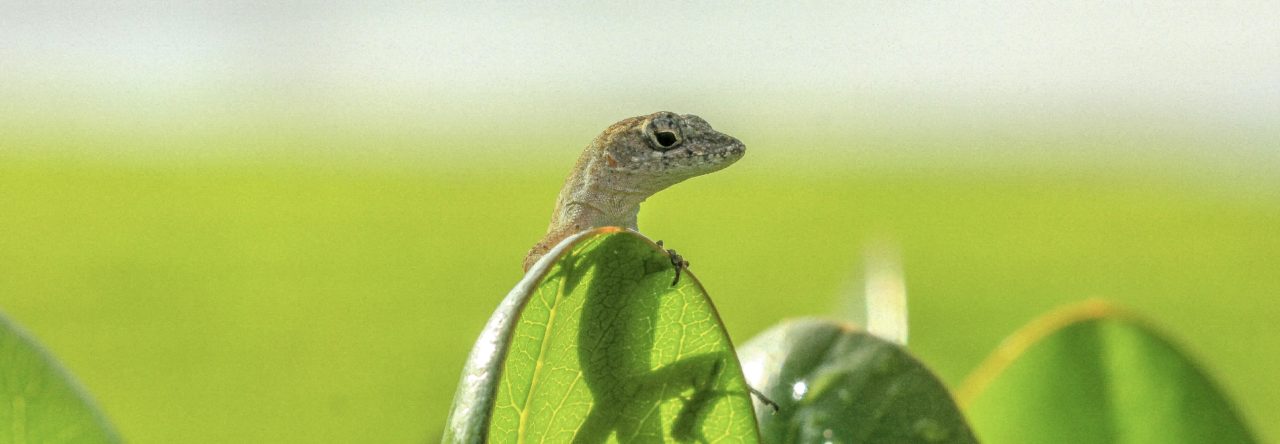
We’ve had previous posts on new anole entries to the Encyclopedia of Life, the project that is attempting to create a webpage for every species of life on earth. Recently Rosario Castañeda, whose work on anole phylogeny has been discussed previously, was appointed as an EOL Rubenstein Fellow with the goal of creating pages for the entire genus–a challenging endeavor for sure, and you can hear Rosario talk all about it, as well as about her research, on this newly released EOL podcast.
Author: Jonathan Losos Page 101 of 133
Professor of Biology and Director of the Living Earth Collaborative at Washington University in Saint Louis. I've spent my entire professional career studying anoles and have discovered that the more I learn about anoles, the more I realize I don't know.

Who knew that anoles were porn stars?
Actress Isabella Rosselini has become even more famous in recent years for a series of short films about animal sex, entitled Green Porno. The films are wacky and educational, and in them she acts out the mating behavior of various creatures, often in graphic, albeit artistic, detail. The award-winning series has gone through three seasons and airs on the Sundance channel (for more details, see the Wikipedia entry or the Green Porno website link above).
Along with the films, a book has been produced and, most importantly to us, a website is mantained. And yesterday, June 13th, that site has seen fit to feature anoles getting it on for the second time in their last five posts (see also May 13th). Be forewarned–the site is not PG-rated!
With Richard Branson blogging on anoles two weeks ago and now Isabella delving into their private lives, it’s clear that anoles have become the lizard of choice for the rich and famous.

Anolis gadovi, taylori or something else?
We’ve discussed iNaturalist before. It’s an on-line community for naturalists where you can “record what you see in nature, meet other nature lovers, and learn about the natural world.” In fact, if you go to AA‘s Citizen Science page, you can see recent iNaturalist anole observations, and you can add your own observations there as well. Get to it!
This photograph was uploaded to iNaturalist today, snapped at Jardín Botánico de Acapulco Esther Pliego de Salinas in Acapulco. Speculation abounds that it’s either A. taylori or A. gadovi. Can anyone out there confirm the identity of this beauty?
There was some talk a while back about the fabled gray-dewlapped anole of Florida (and, according to the comments, elsewhere). Amidst this discussion, one commenter referred to it as Anolis carolinensis seminolus. Many of us, even experienced anole hands, were unaware that A. carolinensis had subspecies. After a little bit of poking around, we’ve discovered the answer. Indeed, there are described subspecies. Thomas Vance, in a paper in the Bulletin of the Maryland Herpetological Society in 1991 described the gray-dewlapped form as A. c. seminolus, relegating the rest of the species to A. c. carolinensis. The paper, which can be downloaded here, is not as overwhelming as its 47-page length might imply. There’s a nice discussion of the history of the species name A. carolinensis (turns out that it’s quite a confusing trail of names), followed by a detailed comparison of morphological variation, focusing primarily on scale characters and based on the examination of nearly a thousand specimens. There’s a lot of molecular phylogeographic work on carolinensis in the works right now, and it’ll be interesting to see how the genetic data square with Vance’s taxonomy (my guess: not so well). More generally, it’s surprising how little work on variation in this species has been conducted. For anyone interested in this fascinating and underappreciated lizard, this paper is worth a look.

Anoland has a name-that-anole quiz. Here are the instructions, translated from French by an internet website: “Salvation to all, this is a new quiz. For each species a photo of the male as well as of the female (interesting to see the fanon and the difference of the latter as a function of sex) some very simple, others quite harsh.”
Veronika Holáňová of Charles University in Prague not only studies anoles, but she breeds them in great quantities, including these wonderful Chamaeleolis. The “false chameleons” as they are called are renowned for specializing on eating snails as adults, and here are some of Veronika’s photos of them in the act.
Most community ecology studies involving anoles focus on interactions between anole species. This is not surprising, because in the Caribbean, anoles are extraordinarily abundant and most of their ecological interactions are, indeed, with other anoles. Less studied are interactions with other taxa, the exception being predator-prey interactions, such as those with curly-tailed lizards (discussed many times in these pages, most recently here).
One widespread group of lizards are skinks, the most species rich family of lizards. There are few reports of anole-skink interactions, probably in large part due to the fact that skink diversity in the Caribbean is relatively low, and many species have been extirpated by human agents. However, anoles have been introduced to places around the world where skinks are more abundant, and some reports of interactions have been made. For example, in the Ogasawara Islands of Japan, A. carolinensis has reached high population densities and has been implicated in the decline of the native skink.
Gerrut Norval has been studying the introduced populations of A. sagrei in Taiwan. He now reports an observation of a somewhat odd interaction between a brown anole and a skink in which the anole fell to the ground from a utility pole and then was quickly chased back up the pole by an elegant skink, Plesiodon elegans. Given the relative size of the two lizards, attempted predation was probably not the cause. Gerrut speculates that this is an example of interspecific territoriality, transcending lizard family lines.
In Taiwan, A. sagrei reaches high population densities (as it does just about everywhere it occurs)–possibly cause for alarm for the native herpetofauna. Norval also mentions some intriguing preliminary observations: A. sagrei seems to attain smaller sizes at sites where it co-occurs with other lizard species. Interesting! Hopefully, we’ll hear more from Gerrut soon on this provocative possibility.

Says Cabela’s: “the merchandise is out of stock and we will not be getting it in till the spring of next year.”
What is up with these guys? Has every reader of Anole Annals recently ordered 100?
How else can you explain the fact that no one from either place has ever successfully logged onto Anole Annals? Surely, the populace there has tried, so clearly the governments are blocking us. Don’t know what I’m talking about? Check out the Map App on the right side of the page, which shows every location where someone has logged in (and don’t miss the real time rotating globe version–click on the “3D” link at the top of the page!).
It’s a pretty impressive map. Basically, just about the whole world has logged in. Regularly from the Gulf of Guinea. India, the Middle East, the far North, the Azores, Iceland, four different Hawaiian islands. You name it. Except New Guinea and the Galapagos. Even Madagascar logged on for the first time two days ago (I think they knew they were about to be singled-out). So I implore you, dear AA readers. Get on a plane, fly to those places, and log on. Please.

Cheap Tommy Bahama Cohen V Neck Tee Shirt (Color: Blue Anole, Size L)
I kid you not. Check it out here. The color is “blue anole.” Just what does that mean? For one thing, it doesn’t look like the blue anoles I know.
Your intrepid reporter contacted Tommy Bahama to get to the bottom of this. To my amazement, they responded in about 3 minutes! Here’s what they said:
“Thank you for contacting Tommy Bahama. A Blue Anole is a type of lizard that is known for its distinctive blue color. Our design team determined that this particular shade of blue for the Cohen V-Neck T-Shirt (#TD2753) was similar enough to the shade of the lizard to be a color choice. Please let us know if we can be of any further assistance regarding this matter.
We appreciate your patronage & continued interest in Tommy Bahama!
Kind Regards,
Tommy Bahama
Guest Services
Relax in Style”
The good news, though, is that even though TB sells it for this fine quality T for $48, you can find it for as low as $45 by doing a little googling.