Three in The Bed: a Curious Case of a Shared Sleeping Perch in a Neotropical Anole

Opposite views of a communal sleeping event (1 male, 2 females) of Anolis cusuco at Parque Nacional Cusuco, Departamento Cortes, Honduras (Brown & Arrivillaga, 2018)

Let’s be honest: anoles are fascinating! These charismatic and well-adapted lizards are always a pleasure to watch and document. Better yet, no matter how well you think you know a species, they’re still always full of surprises.

The sleeping behavior of anoline lizards is a fascinating aspect of their natural history, and a growing amount of literature has detailed species-specific sleeping activities.  Typically, anoles are considered solitary sleepers owing to their territorial nature,  but ‘behind closed doors,’ this may not always be the case!

For those curious,  a recent  ‘behavioral oddity’ published in Mesoamerican Herpetology  by Brown & Arrivillaga (2018), reported an example of three individual Anolis (Norops) cusuco sleeping together on a perch! The individuals were so close that portions of their bodies overlapped! Strange, indeed; this observation contrasts the typical view of anole sleeping ecology, territoriality and indeed that what is known for this species (Clause & Brown, 2017).  In over 5 years of visiting Cusuco NP (observing countless solitary sleeping A. cusuco), imagine the surprise in finding these anoles having a sneaky snuggle!!

As we wrote: “Although a conclusive explanation is not available, we suggest that because the sleeping group consisted of one male and two females, that the shared perch might have been breeding-related. This situation might be associated with the overlap of male and female territories, or by the anoles awakening close to necessary resources. Conceivably, however, courtship might have been interrupted by nightfall, and the orientation of the sleeping male ensured that courting would continue the following morning.”


From Trash to Art: Anole Conservation Through Community Engagement


(Top) A recycle themed community workshop resulted in this amazing anole artwork, designed to spur the recognition and conservation of Utila’s endemic Bica Anole – Anolis (Norops) bicaorum (photographed bottom).

Community engagement and local acknowledgment of important species is essential for effective conservation. On Utila Island, researchers at Kanahau Utila Research & Conservation Facility have been working hard to not only research and document populations of the endemic Anolis (Norops) bicaorum, but also increase community awareness and recognition towards this local lizards conservation plight.

An excellent example and interactive method found to raise awareness is through the creation of art!

Prior to a community based ‘recycle themed’ workshop held on Utila Island, Honduras, staff and volunteers at Kanahau (and other collaborators- Utila Beach Clean-Up Whale Shark & Oceanic Research Center (WSORC), the Bay Islands Conservation Association (BICA) and Utila Handmade Co-Op) performed beach cleans with the intention of sourcing suitable washed up plastic materials (i.e. bottle caps, polystyrene, etc), from which to re-purpose and use in our conservation-themed art!

With the kind inspiration, help and guidance of abstract artist Yioula Koutsoubou, we created some conservation-themed murals from the collected plastic materials, inviting children from the local schools to be involved. The event was held and artwork assembled throughout the day at the public park (a prominent location in Utila town), and so many people stopped to watch the artwork progress and ask questions. Overall, it was fantastic to see collaboration between the island NGO’s, as well as children,  locals, tourists (people of many ages) attending, all being involved, helping and importantly learning about the conservation issues surrounding Utila’s biodiversity.  In addition to the Anole art, a Sea Turtle mural was also created; which is currently positioned for all to see above a small recycle area in town (promoting the importance of limiting disposable plastics/sorting and recycling domestic waste). The Anole Artwork now hangs ‘pride of place’ on the front of the Kanahau Facility (located adjacent to Pumpkin Hill – the site observed with the highest anole abundance). Here (visible to all who pass by on their scenic route up the hill) it serves to honor the populations of Utila’s endemic anoles, whilst spreading appreciation and recognition for the species!

Why make Anole art on Utila? – Preliminary observations and research from the Kanahau facility (funded by MBZ) suggest that populations of Utila’s endemic anoles are substantially threatened owing to the unsustainable expansion and development of agriculture, infrastructure and the tourism industry (see N . bicaorum – Brown et al. 2017;  and Nutilensis – Brown et al. 2017). The greatest threat to these species is considered the loss of their primary hardwood forest habitats, of which less and less sadly remains. Environmental education and engagement of the local community with key issues (such as biodiversity decline and the importance of protecting island resources/habitats) is considered essential for successful conservation of these anoles.

* Many thanks to Yioula Koutsoubou, Andrea Albergoni, Daisy Maryon and the many others who assisted with the event that day!  A big thanks to all the islands NGOs and workshop collaborators (Kanahau, WSORC, BICA, Utila Beach Clean & Utila Handmade Co-Op ) for organizing and supporting the event!

The Dreaded Sand Fly: Not Even Anoles Can Escape Lutzomyia!

Blook sucking Sand Flies present on Anolis bicaorum; a species endemic to Utila Island, Honduras.

Sand Flies (Lutzomyia)! For those of you fortunate enough to have worked in the Neotropics, you may well remember these relentless, miniature biting definitions of annoyance and discomfort! Well, it seems it isn’t just biologists that fall victim to torment, but unfortunately our anole friends, too!

While in the field conducting ‘Anole Patrol’ (Visual Encounter Surveys) at Kanahau Utila Research & Conservation Facility  on Utila Island, Honduras,  we often encounter individuals of Anolis (Norops) bicaorum tolerating ectoparasitism by Sand flies (Lutzomyia).  Regretfully, we have yet to extensively research into anole ectoparasitic/host relationships, though a quick online search brings up a surprising pool of prior literature.

While my knowledge on this topic is still somewhat lacking, I figured that this little observation proves interesting and its documentation may spur a discussion of such!


A male Anolis bicaorum encountered in-situ with numerous ectoparasitic Sand Flies (Lutzomyia) on its body.

Extra species information:

Anolis (Norops) bicaorum is endemic to Utila Island, Honduras; a small  (41km sq)  Caribbean island part of the Isla de la Bahia/ Bay Island group.  Research in 2017 (funded by the Mohammed bin Zayed Species Conservation Fund (MBZ) , resulted in the publication of new information regarding Anolis (Norops) bicaorum distribution, natural history and ecology, as well as the first records of sympatric  occurrence with its endemic congener Anolis (Norops) utilensis The presented results also suggested that both endemic anole species are substantially threatened owing to loss of their core primary habitats.

An additional future threat includes the unfortunate establishment and spread of the admirably successful, yet deplorably invasive, Anolis sagrei , an adaptable, competitive and ironically ‘loathsome lizard’ previously associated with declines of native herpetofauna (a species that i am sure requires little introduction on Anole Annals!!).


Anole Outpost: The Cay Sal Bank, Part III

This is the final of a three-part post on our work on the anoles of Cay Sal Bank, Bahamas. In this post, I will visit the Brown Anoles (Anolis sagrei). Like many, many places in the Caribbean, Anolis sagrei occurs across the Cay Sal Bank. This species has the widest range of any Caribbean anole, having colonized a huge range of regions from ancestral origins in Cuba- from the northern Bahamas, throughout the northern Caribbean, all the way to the Atlantic versant of Mesoamerica.

(Mostly) native range of Anolis sagrei.

Our ongoing work on this species has resolved the evolutionary history of A. sagrei across this great range, but one hole that had lingered was the status of the populations on the Cay Sal Bank. Prior to our cruise to the region in 2015, A. sagrei was known from the following islands: Cay Sal Island, the Anguilla Cays (including Cotton Cay), and Elbow Cay (Buckner et al. 2012). Further, these populations were considered to be the subspecies A. sagrei ordinatus, or, the Bahamian Brown Anole (Buden and Schwartz 1968; Buckner et al. 2012).  This subspecies was originally described owing to having supraorbital scales in contact and a different dewlap color. We know now that dewlaps are highly variable both among and within populations of brown anoles on the Bahamas banks (e.g., Vanhooydonck et l. 2008). Populations proximal to the Cay Sal Bank- that is- populations on the Bimini islands, have a very distinct dewlap comprised of a light orange background streaked with dark red. Brown anoles on Cay Sal do not share this dewlap color; instead, they have a more classic sagrei pattern of darker red with a light distal border. This is not a smoking gun for considering Cay Sal anoles something other than A. s. ordinatus, of course, given the range of dewlaps we see to the east.

Cay Sal (left), South Bimini (right). Photos by R. Graham Reynolds.

If Cay Sal browns were indeed A. s. ordinatus, that would imply a (likely) westward colonization across the Santaren Channel–not an implausible scenario. During periods of lower sea level, the Cay Sal Bank would have been a big ‘ol target for lizards involuntarily leaving the Great Bahamas Bank. Of course, an alternative would be the reverse: an initial colonization of Cay Sal, followed by dispersal to the east across the Channel. Of relevance, during the course of the work I’m presently describing, we also found a snake: Tropidophis. We determined, using the same molecular phylogenetic techniques, that this snake is most likely T. curtus, and thus a population conspecific with Tropidophis over on the Great Bahamas Bank, evidence for a likely westward colonization.

Map of the Cay Sal Bank, from Reynolds et al. (2018). Note that Cotton Cay is part of the Anguilla Cays.

Of course, Cay Sal browns could also be Cuban in the sense that they might have colonized the bank directly from Cuba across the Nicholas Channel. To parse these alternative origin stories, we collected samples of the species from across the Cay Sal Bank and generated a coalescent gene tree paired with all our sampling from other brown anole populations across the region. We find that Cay Sal A. sagrei are actually much more closely related to western Cuba A. sagrei, rather than Bahamas A. s. ordinatus. Combining this finding with our analysis of A. fairchildi, we find that this particular Anole Outpost was colonized from Western Cuba by at least two species–and likely at different times.

Phylogeny of A. sagrei, showing Cay Sal Bank lineagers in blue (and a Cay Sal specimen in the inset). From Reynolds et al. 2018.

New Records

In addition to these findings, we also documented some novel populations of A. sagrei on the Cay Sal Bank. We added East Doubled Headed Shot Cay, Elephant Rocks, Great Dog Rock to the list of known populations on the bank. What is particularly interesting about these new records is the range of habitat types that they support. Cay Sal Island and the Anguilla Cays are by far the most lush, with lots of vegetation. To the north, the cays become increasingly xeric and barren. East Double Headed Shot Cay is the most vegetated of the northern islands, and has a thick, but low, covering of coastal shrub plant community. Anolis sagrei is not abundant on this island, and we only saw a few dozen during several hours of searching.

East Doubled Headed Shot Cay. Photo by R. Graham Reynolds.

In stark contrast, the Elephant Rocks to the west are tall, jagged, steep, and rocky islets with almost no vegetation at all. We had low expectations as we jumped into the sea from the dingy to start our ascent of these islands at dawn. But, to our surprise, we found some anoles happily living among the rocks. Not at high densities, but here they were, a saxicolous population of A. sagrei.

Elephant Rocks, Cay Sal Bank. Photo by R. Graham Reynolds.

Naturally, Alberto and I would love to follow up on some of this, but Cay Sal is a tough place to work. Maybe someday we’ll get back there, in the meantime, we can reflect on what a special opportunity we had to visit this Anole Outpost.

Sunrise on the Cay Sal Bank. Photo by R. Graham Reynolds.


References

Buckner, S. D., R. Franz, and R. G. Reynolds. 2011. Bahama Islands and Turks & Caicos Islands. In R. Powell and R. W. Henderson, editors. Island Lists of West Indian Amphibians and Reptiles. Bulletin of the Florida Museum of Natural History 51: 85–166.

Buden, D. W., and A. Schwartz. 1968. Reptiles and birds of the Cay Sal Bank, Bahama Islands. Quarterly Journal of the Florida Academy of Sciences 31: 290–320.

Vanhooydonck, B., A. Herrel, J. J. Meyers, and D. J. Irschick. 2009. What determines dewlap diversity in Anolis lizards? An among-island comparison. Journal of Evolutionary Biology 22: 293–305.

What’s New in Anole Literature?

Anolis biporcatus. Photo by Jessica Pita Aquino.

Anole biologists and enthusiasts, stay updated on the latest anole research and find out about these fascinating creatures as scientists continue to make amazing discoveries! Here’s what’s been published in the last year and a half (2017-2018): nearly 150 papers in just a year and a half!

Anole Annals welcomes posts on new anole literature. Our goal is to try to keep the anole community up-to-date with regard to new publications, but we need help! So, if you’d like to try your hand at some science communication (or need something to list as a Broader Impact), please consider writing a post summarizing or discussing a recent paper.

And authors: there’s nothing more interesting than to get the insider’s view of a recent paper. Tell us the backstory: how a paper came to be and why you conducted the study in the first place. Provide the fascinating details that you can’t find in a published paper. It’s a great way to disseminate your work, and looks good on grant proposals.

We invite anyone interested to write posts! If you’d like to be a contributor, please write anoleannals@gmail.com.

2017

Alibardi, L. 2017. Review: Biological and Molecular Differences between Tail Regeneration and Limb Scarring in Lizard: An Inspiring Model Addressing Limb Regeneration in Amniotes. Journal of Experimental Zoology Part B: Molecular and Developmental Evolution 328:493–514.

Armstead, J. V., F. Ayala-Varela, O. Torres-Carvajal, M. J. Ryan, and S. Poe. 2017. Systematics and Ecology of Anolis biporcatus (Squamata: Iguanidae). Salamandra 53:285–293.

Birke, L. L., A. M. Cespedes, E. R. Schachner, and S. P. Lailvaux. 2017. Cystic Calculus in a Laboratory-housed Green Anole (Anolis carolinensis). Comparative Medicine 67:112–115.

Bochaton, C., S. Bailon, A. Herrel, S. Grouard, I. Ineich, A. Tresset, and R. Cornette. 2017. Human Impacts Reduce Morphological Diversity in an Insular Species of Lizard. Proceedings of the Royal Society B: Biological Sciences 284.

Bonneaud, C., I. Sepil, L. Wilfert, and R. Calsbeek. 2017. Plasmodium Infections in Natural Populations of Anolis sagrei Reflect Tolerance Rather Than Susceptibility. Integrative and Comparative Biology 57:352–361.

Boyer, J. F. F., and L. Swierk. 2017. Rapid Body Color Brightening is Associated with Exposure to a Stressor in an Anolis Lizard. Canadian Journal of Zoology 95:213–219.

Anole Outpost: The Cay Sal Bank, Part II

Anolis fairchildi from Cay Sal Island, Bahamas. Photo by R. Graham Reynolds.

In a previous post, I introduced some results from our attempts to understand the evolutionary history of anoles on Cay Sal Bank, Bahamas (more results in a future post). We found that the only endemic reptile on the Bank, Anolis fairchildi (the Cay Sal Anole), is a lineage relatively recently derived from western Cuban A. porcatus progenitors. OK, fair enough, but what is this creature we list in our checklists and museum collections with the epithet fairchildi? A comment by James Stroud on a previous post of mine suggested that we visit this species directly here on AA, so off we go!

The anole specimens leading to the description were collected by Paul Bartsch in 1930, a malacologist who spent a week on the bank  (Buden 1987). Bartsch found specimens on both Cotton Cay and Cay Sal (more on distribution below). In this manuscript (Barbour and Shreve 1935), Thomas Barbour offers a narrative of an Utowana expedition in 1934 during which time the explorers, including Barbour and J.C. Greenway–another name that lingers after several Latin generic names (e.g. Leiocephalus greenwayi)–sought herpetological novelties. It is worth noting that Barbour and his team secured a “rich booty” of land mollusks (Barbour and Shreve 1935); in other words, they weren’t always just after reptiles and were likely offering tit-for-tat with Paul Bartsh (my opinion). This narrative is followed by his description of some new reptiles, including the Bahamian green anoles A. fairchildi and A. smaragdinus.

Barbour and Shreve gave these Cay Sal individuals the name fairchildi to honor the individual David Fairchild, the prolific botanist whose name also graces the wonderful Fairchild Tropical Botanic Garden (where the recent 7th Anolis Symposium was held!). Let’s pause briefly to consider the man who lends his name to this handsome lizard species. David Fairchild (1869-1954) was a well-known botanical collector, explorer, cultivator, and traveler. Indeed, Pauly (2007) considered him “one of the most important plant explorers in the history of the United States of America.” Like Thomas Barbour of the MCZ, Fairchild was a friend of Allison Armour, and what a great friend for a Caribbean biologist to have. Armour outfitted his 1315-ton steamer Utowana as a research vessel, providing it as a platform for numerous important cruises around the Caribbean and beyond (a “floating palace” according to Fairchild). Wonderful narratives of Barbour (Henderson and Powell 2004) and Fairchild (Francisco-Ortega et al. 2014) aboard the Utowana are definitely worth a read. I particularly love Fig. 2 in the former and consider THAT to have been the good-ol’-days of Caribbean herpetology! As a side note, a name given to Caymanian Anolis conspersus was A. utowanae by Barbour (1932)! You can read more about that interesting story from Steve Poe here or on AA here. Fairchild sailed (well, steamed, really) through the Bahamas at least three times on the Utowana, accumulating a significant amount of botanical knowledge and material. For this reason, and because he was an acquaintance, Barbour named his new anole species after David.

Anolis fairchildi. Photo by Alberto R. Puente-Rolon.

How many people have seen A. fairchildi? Probably not many, and even fewer who appreciated what they were looking at. Cay Sal is a hard place to get to, particularly if one goes via the legal route that necessitates a stopover in Alice Town, Bimini to clear customs (as opposed to running directly, and illegally, from the Florida Keys). Few photos of this species exist, and even fewer narratives of trips in which the species was seen are available.

Anolis fairchildi habitat on Cay Sal Island. Photo by R. Graham Reynolds.

Description

Anolis fairchildi is considered a relatively large green anole, with an SVL of 67–74 mm in males. Barbour and Shreve (1935) suggest it is “allied to” A. smaragdinus and A. porcatus–a natural supposition and borne out in examination–but differing in having “larger dorsal and temporal scales” and also a different coloration. This supposedly diagnostic coloration is a series of white or light blue flecks (comprised of small groups of differently colored scales). James Stroud recently posted a photo of A. carolinensis from Fairchild Tropical Botanic Garden that closely resembles the description of A. fairchildi, a humorous and fitting example of the variation present in the former species. A photo of A. fairchildi in Francisco-Ortega et al. (2014) also shows this coloration. Alberto Puente-Rolon and I did not find such distinct spotting in the specimens we examined from Cay Sal Island in 2015. Thus, it seems likely that A. fairchildi does frequently have light spotting, but that this is not a unique phenotype to Cay Sal.

Distribution

This species is considered endemic to the Cay Sal Bank. Historical records place them on  the following islands: Cotton Cay, the eponymous Cay Sal, Elbow Cay, and Double Headed Shot Cays (Buckner et al. 2012). In our cruise to the islands, we did not visit Cotton Cay (=South Anguilla Cay) or North Anguilla Cay, but we did visit the others where the species is thought to occur. We found A. fairchildi on Cay Sal Island only, and observed no individuals on Elbow Cay nor Double-headed Shot Cay.
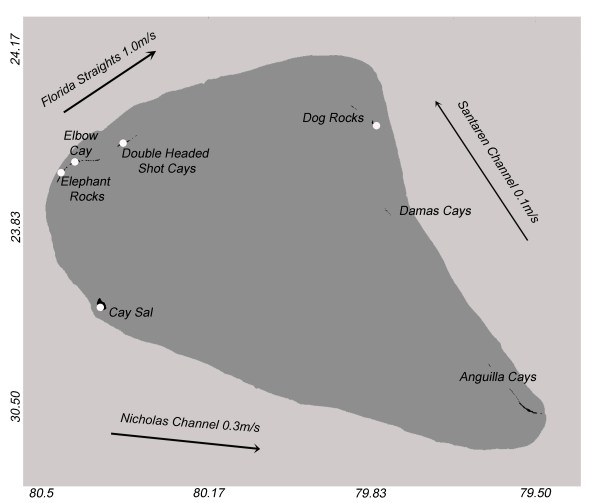
Map of the Cay Sal Bank, from Reynolds et al. (2018). Note that cotton Cay is part of the Anguilla Cays.

For more, check out our recent publication describing our work on Cay Sal Bank.

A Footnote: how to pronounce this island bank…

Most of us Caribbean ambulators pronounce the word “cay” (=small islands) with a hard k and e sound, like “key.” This apparently is the anglicized version of the Spanish “cayo,” itself possibly cribbed from the Arawak “cairi.” Cay Sal, on the other hand, is frequently pronounced with a hard k and a, as in “cake,” similar to the Spanish. Additional confusion is lent by the historical use of the French word “quay” in the region (originally from the Gaulish “caio”) to refer to docks or gangways present on islands (indeed, small islands would have been dominated by these constructions). An interesting read on all this is González Rodríguez (2016). Any toponomastics buffs have opinions on how Cay Sal should be pronounced?


References

Barbour, T. 1932. On a new Anolis from Western Mexico. Copeia 1932: 11–12.

Barbour, T., and B. Shreve. 1935. Concerning some Bahamian reptiles, with notes on the fauna. Proceedings of the Boston Society of Natural History 5: 347–365.

Buckner, S.D., Franz, R. & Reynolds, R.G. 2012. Bahama Islands and Turks & Caicos Islands. In: Powell, R. & Henderson, R.W. (Eds.), Island Lists of West Indian Amphibians and Reptiles. Florida Museum of Natural History Bulletin, 51, pp. 93–110.

Buden, D.W. 1987. Birds of the Cay Sal Bank and Ragged Islands, Bahamas. Florida Scientist 50: 2133.

Francisco-Ortega, J., et al. 2014. Plant hunting expeditions of David Fairchild to the Bahamas. Botanical Review 80: 164-183

González Rodríguez, A. 2016. El Muelle del Cay of Santander City (Spain) and the Two Big European Maritime Traditions in the Late Middle and Modern Ages. A Lexicological Study of the Words Cay and Muelle. 171-178. Names and Their Environment. Proceedings of the 25th International Congress of Onomastic Sciences, Glasgow, 25-29 August 2014. Vol. 1. Keynote Lectures. Toponomastics I. Carole Hough and Daria Izdebska (eds). University of Glasgow.

Henderson, R.W., and R. Powell. 2004. Thomas Barbour and the Utowana voyages (1929–1934) in the West Indies. Bonner zoologische Beitrage 52: 297–309.

Pauly, P. J. 2007. Fruits and plains. The horticultural transformation of America. Harvard University Press, Cambridge, MA.
Are Anoles Less Abundant in North Carolina after Last Year’s Cold Winter?

Anolis carolinensis from North Carolina. Photo by Graham Reynolds.

In response to a previous post on North Carolina anoles, AA reader John Philips asks:

Anyone notice a significant reduction in the population of anoles in SE NC? I live on Bradley Creek in Wilmington, NC and I have noticed very few this year. Used to see 3-5 per day sitting on various surfaces in the sun while walking my dogs, especially because my shihpoo is always “hunting” them. However, this year I probably only see 1 per week.

I assume this could be due to the cold winter? Any other predators that might have reduced the population? We have seen an increase in brown thrashers in the area and thought since they forage on the ground they might be a predator?

Anole Outpost: The Cay Sal Bank, Part I

What determines species composition on remote Caribbean islands? Geographic proximity to source populations? The vicissitudes of dispersal and colonization? Propagule pressure and prevailing biotic and abiotic environmental conditions? The study of biogeography addresses such questions, and is concerned with understanding the geography of biodiversity- where do species occur and why?

We perhaps often think of species groups accumulating from colonists arriving from the same place, that is, we identify a likely natal source for island colonists. But might species groups be chimeric, in that they contain groups of diasporic species from different natal lands? This is certainly a plausible scenario and could potentially lead to some interesting evolutionary outcomes.

The Cay Sal Bank is a remote island bank, or shallow carbonate platform, on which rests a line of small islands strung out along its margins. This region, as well as our recent expedition, has been mentioned in a previous AA post. Here I am returning to discuss the anoles and the results from our recently published work describing the evolutionary relationships of the terrestrial squamate fauna. Fundamentally, we ask a question that has circulated for the better part of a century: where do the anoles on Cay Sal come from?

Six terrestrial squamates are found on this bank:
Anolis fairchildi (endemic)
Anolis sagrei
Tropidophis curtus
Sphaerodactylus nigropunctatus
Cubophis cantherigerus
Typhlops biminiensis

Dispersal hypotheses for terrestrial squamates found on Cay Sal Bank, from Reynolds et al. 2018

Of these, all but Anolis fairchildi and the recently discovered population of Cubophis were thought to have Bahamian evolutionary affinities. The endemic A. fairchildi has been of particular interest, owing to its status as the product of one of the ex situ speciation events occurring in the green anoles as they dispersed from Cuba (Williams 1969). But a previous AA post (1) reminded us that the origins of Anolis fairchildi had not been resolved- did they come directly from Cuba or are they derived from Bahamian A. smaragdinus (among other alternatives?). Here we tackle this question, using a basic mitochondrial dataset and lots of taxon sampling from previous study of the group (more on A. fairchildi in a future post). We constructed a coalescent gene tree of all “carolinensis-clade” Cuban green anole species, including our samples obtained from Cay Sal Island in 2015. We find unequivocally that A. fairchildi is a recent colonist from western Cuba- nested within the western Anolis porcatus lineage. Thus we see both ancient and recent emigration (divergence) events leading to what we recognize as species in the carolinensis clade of green anoles, setting up a really nice opportunity to examine the accumulation of variation in diasporic populations over different time periods.

Phylogeny of “carolinensis clade” green anoles from Reynolds et al. 2018, with A. fairchildi highlighted in green and shown in the inset photo

Oxpeckers of the Caribbean: Anole Dines on an Iguana

Guadeloupean anole (Anolis marmoratus) feeding on the back of a Lesser Antillean iguana. Photo courtesy Jérôme Guerlotté.

Jérôme Guerlotté of the Muséum National d’Histoire Naturelle in Paris reports:

“As in a new Jean De la Fontaine fable “L’iguane et l’Anolis“, this intrepid anole (Anolis marmoratus marmoratus) on Guadeloupe had just hunted a fly on the back of this Lesser Antillean iguana (Iguana delicatissima) (top) and rids it of small insects on the snout (bottom).”

Who knows what yummy morsels reside on the snout of an iguana? Photo courtesy Jérôme Guerlotté.

Anole Annals World Cup: Round One

It’s June. It’s orchid flowering season in Grand Cayman. And with nods to #Anole March Madness and  #MammalMadness it’s the opening round of the 2018 ANOLE WORLD CUP. #ANOLEGOOAAAAALLLL!!!!

Home Team – Anolis conspersus  – against –  Away Team – Anolis sagrei

And in less than 90 seconds it’s all over.


The teams are on the pitch


The Away Team


The Home Team heads to mid-field


The Striker takes aim


Home Team – 1, Away – nil


Page 69 of 304

Powered by WordPress & Theme by Anders Norén