
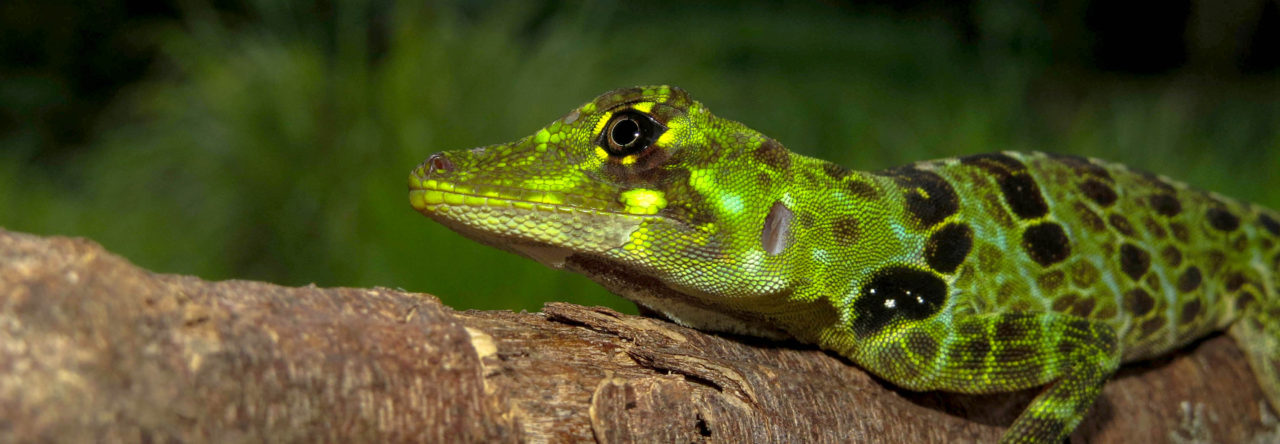

A brown anole emerging from the egg.
There is much talk these days about how human land use (e.g. urbanization) impacts wildlife. Although anoles have often taken center stage in this discussion (Winchell et al. 2016; Tyler et al. 2016; Chejanovski et al. 2017; Lapiedra et al. 2017; Winchell et al. 2018), most of this work has focused on measuring phenotypes of adult males. Very little work has been done to understand how massive habitat alteration impacts early life stages even though we know that these stages are extremely sensitive to environmental disturbance and have the potential to impact population dynamics (Carlo et al 2018). Embryos are particularly sensitive to changes in the environment because they lack the ability to respond to unfavorable conditions by adjusting their behavior (i.e., they can’t run away). Since the 1980’s, we’ve known that egg mortality can have massive effects on population densities and even determine how these densities cycle from year to year (Andrews 1982; Andrews 1988; Chalcraft and Andrews 1999). Still, comparatively little attention is given to embryo development and egg survival when considering how habitat alteration impacts species.
In a newly published paper (Hall & Warner 2018), we sought to understand how extreme ground temperatures in cities and suburbs (i.e., the urban heat island effect) influence patterns of embryo development. Due to a lack of canopy cover (i.e., trees) and an abundance of heat-absorbing surfaces (e.g., concrete), cities and suburbs tend to be much warmer than adjacent forested areas, and this means nest temperatures are higher in urban and suburban areas compared to adjacent forested sites (Tiatragul et al. 2017). Warm temperatures often have positive effects on embryo development; however, extremely warm temperatures can cause mortality and even slow developmental rates (Sanger et al. 2018).

Figure 1. An overview of our experimental design to understand how urban incubation regimes impact embryo development and survival. Eggs from both forest and city populations were factorially distributed into forest and city incubation treatments. At approximately a quarter of the way through development, some eggs were exposed to a spike in temperature measured from the field (either 39 or 43 °C peak). Eggs completed development at their assigned incubation profile (city vs. forest) and hatchling growth and survival were monitored in the lab for three months.


