SICB 2019: Ectoparasites and the Expression of Sexual Signals in a Tropical Lizard

Parasites are an ever-present threat to the organisms they interact with. Reptiles, like anoles, are often heavily infested with mites, an ectoparasite that drinks the lizard’s blood and are often visible on the surface of the skin. Despite the ubiquity of mite infestations on reptiles, the fitness costs of these infestations and the factors that cause mite load to vary among individuals within populations are surprisingly understudied.

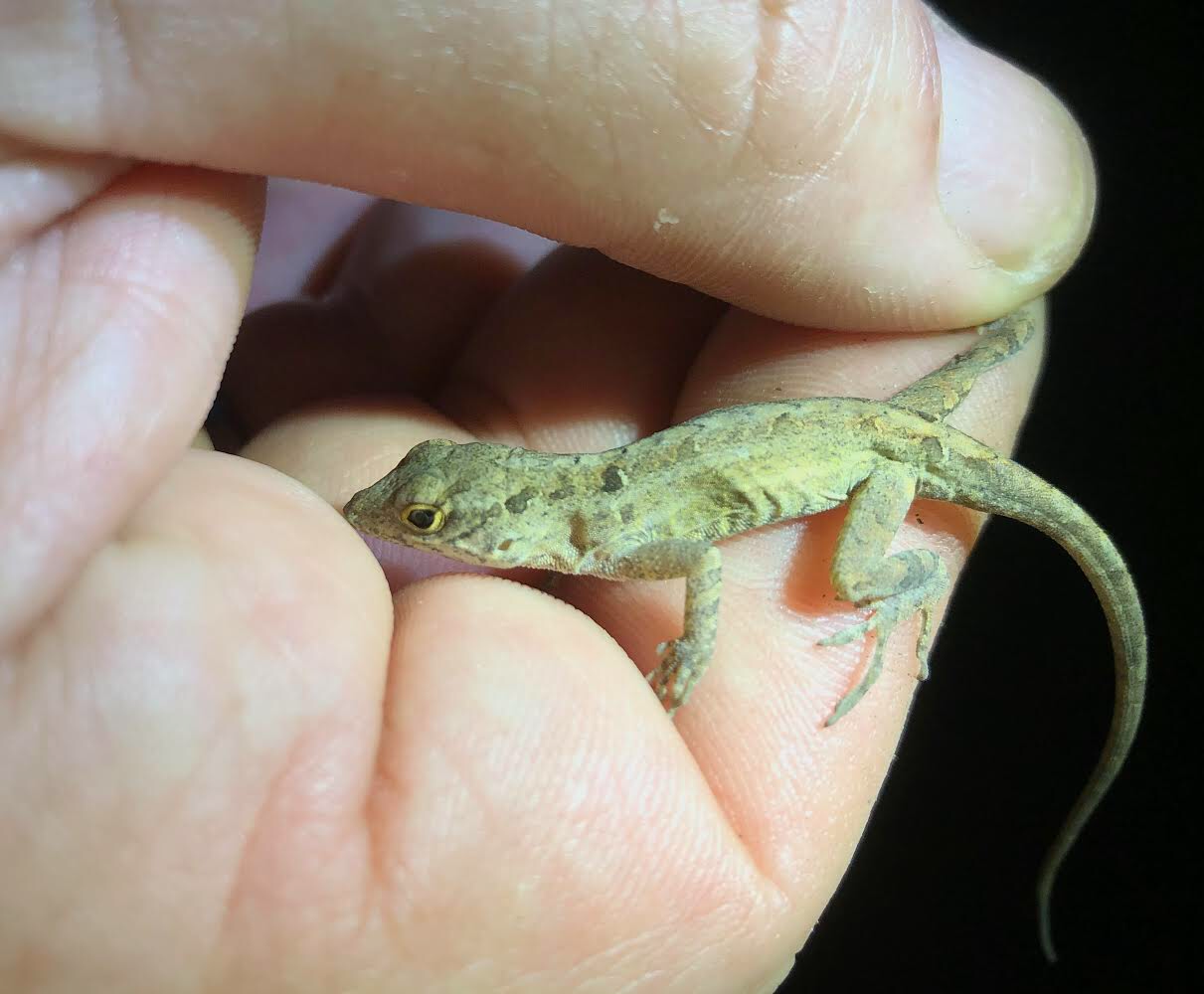
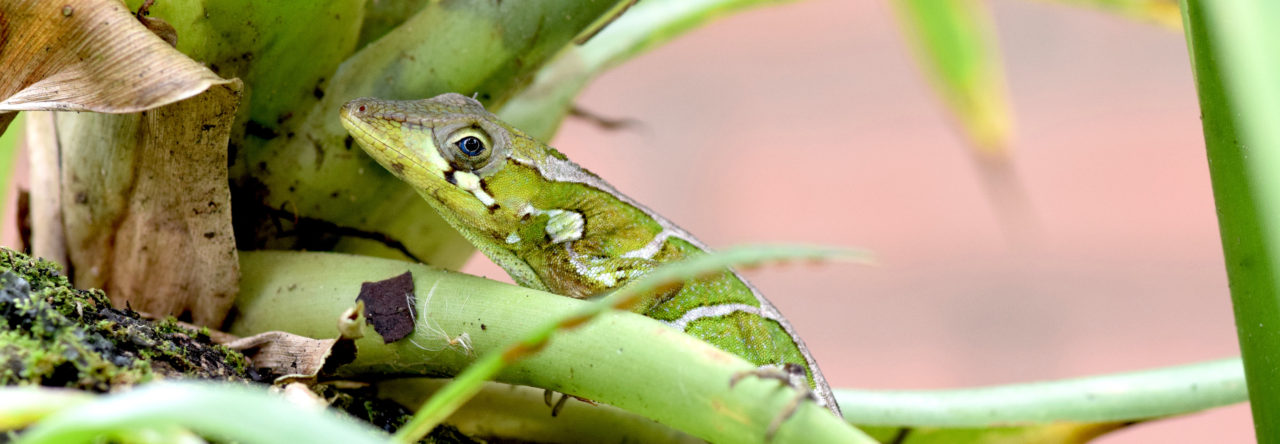
Adam Rosso, a masters student in Christian Cox’s lab at Georgia Southern University, studied the factors that drive variation in mite infestation among individuals in a population of slender anoles (Anolis apletophallus) in Panama. Slender anoles are sexually dimorphic; males have much larger dewlaps than females. Adam counted mite loads on hundreds of lizards and asked a series of questions, including: How does mite load differ between the sexes? Do the sexes differ in where they are being parasitized on their bodies? Can ecological factors such as habitat use and body temperature affect mite load?

First, Adam found that males have more mites than females, but this was due entirely to their larger dewlaps. In fact, females actually had more mites on other parts of their bodies (such as on their hind and forelimbs). But it gets even more interesting: Adam found that mite infestation increases with dewlap area in males but not in females, suggesting that mites prefer male dewlaps over female dewlaps. Neither field-active body temperature nor perch characteristics predicted mite loads in either sex, suggesting that dewlaps are the main factor influencing ectoparasitism in this population. Adam’s results suggest that there may be an important cost to producing a large dewlap in males. More generally, if parasite loads and dewlap sizes are seen as honest signals in anoles, the results of Adam’s work could have implications for understanding sexual selection and morphological evolution in this group of lizards.

SICB 2019: Jaw and Leg Muscle Performance in Anolis Lizards

Have you ever wondered which muscle is the strongest? Depending on a muscle’s function, it can have different levels of performance. Muscle performance can be quantified by measuring several different characteristics, such as time between muscle twitches, contraction velocities, and muscle curvature. Previous work in quantifying these values in jaw and leg muscles in three species of anoles led to questions about what gene functions these different functioning muscles regulate. Andrea Liebl with the University of South Dakota, along with colleagues at the University of Iowa and Brown University, addressed this question. She did this by working to identify candidate genes that may be involved in creating the functional differences seen between jaw muscles involved in biting and leg muscles involved in locomotion.

After using a PCoA Analysis that showed distinct clustering of different gene expression between the two muscles, they were able to find differences in specific genes and their expression in the two muscle types as well. Genes that differed in expression were classified and placed in groups based on function that may play a role in muscle performance. Genes that regulate energy for the cell such as those involved in ATP synthesis and mitochondria were found to differ in expression in the jaw and leg muscles, as well as genes involved in muscle structure, contraction, and activity. These findings allow for further work that is currently being done to address differences in gene expression among four species of anoles. This study along with further work gives great insight into what differences in muscle physiology leads to specific muscle performance as well as whole organism performance.

SICB 2019: Insulin-like Signaling across Life Stages in Brown Anoles

The somatropic axis regulates growth in vertebrates

Our growth during development is controlled by a complex brain-body axis called the somatotropic axis. Put simply as in the photo below, the hypothalamus in the brain signals the pituitary to release growth hormone into the body where it stimulates the liver to produce two forms of insulin-like growth facts (IGF1 and IGF2). Both growth hormone and IGF have different effects on growth of muscle and bone. While we rely on mouse models to study how IGF might impact human development, it turns out that the relative secretion of IGF1 and IGF2 over the course of life is quite different in the two species. In fact, we know little about IGF production and signaling in non-mammals.

Expanded view of the somatotropic axis to show receptors and binding proteins. From Yakar et al. (2018).

Abby Beatty, from Tonia Schwartz’s lab at Auburn University, set out to determine the developmental pattern of the somatotropic axis in brown anoles. Of course, the axis is much more complex than the diagram above, including receptors in various tissues, binding proteins that carry the signals around the body (see below), and proteins in cells that cause responses (IRSs). Abby studied expression of IGF1, IGF2, and five binding proteins during brown anole development, from embryo to hatchling to adult. She expected to find that IGF1 and 2 would be expressed differentially and that the expression patterns would differ across life stages. That’s exactly what she found. IGF1 and 2 were both low and similar in expression early in development, but at hatching IGF increased with IGF2 expressed more than IGF in adults. Surprisingly this is more like a human pattern than a mouse is!

As for the binding proteins, expression was similar for all of them in the brain, gonads, and liver, but BP3 was expressed less in the heart. It’s still unclear what these patterns in binding proteins mean for brown anole development, but they make for some excellent future research questions! Indeed, these results add to the already-long list of things that makes anoles good model systems.

Some Tricky ID’s for Us in Western Cuba

On a December 2018 trip to Cuba, we found several species we had difficulty identifying, but a few really have us stumped…  I’m hoping your community of experts can help!

For example, the faint lateral striping in this first pic is confusing us. Is this simply a young sagrei?

  1. Playa Jibacoa, just east of Santa Cruz del Norte
  2. Near Playa Larga
  3. Playa Jibacoa, just east of Santa Cruz del Norte
  4. Playa Jibacoa, just east of Santa Cruz del Norte
  5.  Playa Larga  – I know it’s not a lizard, but I’m hoping you can help pin down an ID \
  6. Playa Jibacoa, just east of Santa Cruz del NorteThe find of the trip (anole-wise) was A. allisoni – in Playa Larga

SICB 2019: Environmental Heterogeneity, Thermoregulatory Strategy, and the Effects of Climate Change on Ectotherms across Latitude

Predicting the responses of species to current environmental and climate change is one of the largest duties of current biologists. Ectothermic species (including lizards) are particularly vulnerable because they lack the ability to metabolically generate heat and rely on environmental sources of temperature to maintain their body temperatures. For species that live in the tropics, this task is much harder because tropical environments experience less temperature variation both within and across seasons. Tropical lizards traverse these landscapes to try and maintain optimal and preferred body temperatures, but are all thermal environments equal in the constraints they impose on lizards?

To address this question, Lauren Neel, a student of Mike Angilletta’s at Arizona State University, collected an astounding amount of data from two species of anole: Anolis sagrei from their native range on Great Exuma in the Bahamas, and A. apletophallus in Panama. She collected environmental temperature data using biophysical models, thermal performance data by racing anoles at several different body temperatures and measuring their sprint speed, and preferred body temperatures by placing lizards in a thermal gradient. Despite both lizards living in tropical climates, she found distinct differences between the environments (and anoles!). Anolis sagrei thermoregulated more,  was active for longer periods of time than A. apletophallus, and exhibited warmer preferred temperatures. Neel and colleagues also found that A. sagrei is not likely to suffer a drop in performance capacity as environments warm over time, whereas A. apletophallus is likely to experience a significant reduction in their speed performance which might be a physiological precursor to population collapse and a rise in local extinction events. Great stuff coming from Lauren Neel; stay tuned for more!

SICB 2019: The Effect of Testosterone on Male Aggressive Behavior in A. sagrei and A. cristatellus

Gianni Solis presents her work entitled “Effects of arginine Vasotocin and mesotocin on aggression in male Caribbean anoles.”

Male aggression in Anolis lizards is governed by the circulating sex hormone, testosterone. Two species of anoles, the brown anole (Anolis sagre) and the Caribbean anole (A. cristatellus), both exhibit high aggression. However, A. sagrei has low concentrations of testosterone in comparison to A. cristatellus. This suggests that there may be other underlying mechanisms governing male aggression rather than just testosterone.

Regulation of aggressive behaviors in male Anolis lizards was the focus of Gianni Solis’ poster presentation at the 2019 SICB conference. Solis is an undergraduate sophomore at University of St. Thomas under Dr. Jerry Husak, although one would think she is an established graduate student based on her knowledge and enthusiasm for this project. She predicted that there would be a difference in aggressive behaviors exhibited by A. sagrei and A. cristatellus and these behaviors would be influenced by Arginine Vasotocin (AVT) and Mesotocin (MT).

Solis examined aggressive behaviors towards a mirror in A. sagrei, a low-testosterone species, and A. cristatellus, a high-testosterone species. IP injections of non-steroid hormones AVT and MT were given along with Phosphate Buffered Saline (PBS) as a control. After a 15-minute acclimation period, aggressive behaviors were documented in 20-minute lengths. Latency, total number of bouts, average and total duration, and combination of displays were recorded. Aggression scores were calculated utilizing a PCA and a one-way ANOVA identified statistical significance.

While her results were non-significant, potentially due to small sample size, statistically close values suggest that there may have been an influence of AVT and MT on aggressive behaviors. MT-injected A. sagrei tended to be less aggressive than other treatments and MT-injected A. cristatellus tended to be more aggressive than other treatments. Other mechanisms by which these behavioral differences occur between both species, such as potential estrogenic influences, may also be the target for future studies. Anolis male aggressive responses and underlying processes remain in question, however, we are looking forward to hopefully seeing Solis again with more questions at SICB 2020.

SICB 2019: Large Immune Challenges Do Not Decrease Performance

Christine Rohlf from the University of St. Thomas presents her research on immune-performance tradeoffs.

Traveling to SICB is always exciting, but like any trip through crowded airports, hotels, and convention centers, you’re more likely to get sick during your travel if you’re not careful. As we all know, getting a travel cold (or worse) makes you feel terrible and certainly doesn’t make you want to run on a treadmill! The same is likely true in wild animals, including anoles. Mounting immune responses is energetically expensive, but so are other things that lizards have to do, like forage, escape predators, and process food. So, does an increasingly large immune challenge decrease a lizard’s ability to perform? Christine Rohlf, an undergraduate student in Jerry Husak’s lab at the University of St. Thomas, wanted to find out in green anoles.

Christine designed a laboratory experiment to determine whether two types of immune challenge, alone and in combination, decreased bite-force performance, sprint speed, or endurance capacity compared to controls. Some lizards received two sequential injections of lipopolysaccharide (LPS), some received a skin wound with a biopsy punch, and some received both. LPS is a signal on gram-negative bacteria that, when injected, tricks the body into thinking it is infected with bacteria. So, you get an immune response, but you don’t actually get an infection.

Surprisingly, none of the immune challenges affected sprint speed or endurance compared to controls. Although the lizards were not calorie-restricted, they were on a modest diet, meaning that energy was limited, but clearly not enough to make a difference. Apparently these two immune challenges aren’t as costly as we thought. The only effect that Christine found was that the second LPS injection significantly decreased bite force. Because bite force is likely the least energetically expensive trait of those measured (imagine running until you’re exhausted versus biting into a hard piece of French bread), Christine suspects that the decrease in bite force was due to a lack of motivation while feeling sick. Future work with calorie-restricted lizards should tell us if mounting an immune challenge is a significant cost to anoles.

SICB 2019: Tail Autotomy Happens More When the Tail Stores More Energy

Amy Payne of Trinity University presents her research on tail autotomy in 7 lizard species.

One of the most interesting features of many lizards, including anoles, is that they can willingly, and actively, lose their tails to escape predators. While it might seem counterintuitive to lose a large body part, it’s better than being eaten! Despite the obvious benefit of surviving another day, there are some costs associated with tail autotomy.

Amy Payne, a student in Michele Johnson’s lab at Trinity University of San Antonio, wanted to know whether the frequency of tail loss across seven species was associated with predatory and social use of the tail as well as energetic content of the tail. For those that are anole-inclined (which is why you’re here), Amy included A. cristatellus and A. carolinensis. She caught and measured hundreds of lizards, and made behavioral observations on them as well. She was then able to quantify how many lizards of each species had a lost/regenerated tail, as well as what proportion of each tail was lost.

Surprisingly, frequency of tail loss was not associated with using the tail in a social or predatory context. However, there was an association between these two functions of the tail: species that more often used their tail for predatory use also used their tail in social contexts more. There was no relationship between the frequency of tail loss and the proportion of the tail that was lost on average across species. But she did find some really cool results when looking at energetic content of the tail. Amy found that there was a significant positive relationship between frequency of tail loss and tail energy content. That is, the more energy that lizards have in their tails, the more frequently individuals in that species will have a lost/regenerated tail. While this seems opposite to what one might casually predict, Amy hypothesizes that the predator-distraction to survive function of tail autotomy is more likely to succeed if the tail is larger and more beneficial to the predator. In other words, if a lizard has a scrawny tail and drops it off for a predator, it is more advantageous for the predator to ignore the low-cal tail and just eat the lizard. This would put selection on species with low-energy content tails to be more prudent about when they drop their tails. These really interesting results open up some exciting areas for future research on the costs and benefits of tail autotomy!

SICB 2019: Crocodile Rocking (Different Snout Lengths) Is Something Shocking

Zachary Morris presents his research entitled “The role of craniofacial growth zones in shaping crocodylian snouts.”

Evolution of the crocodylian skull is driven by developmental changes. While embryos share many similarities, at some point within development they diverge into unique ecomorphs. Prior studies in American alligators (Alligator mississippiensis) showed that the snout is a source for early facial proliferation, wherein later stages lack growth plates that resemble post-hatching anole lizards. Snouts of crocodilians are described as moderate, blunt, and slender. Snout structure is related to dietary and ecological differences; for example, long, slender snouted crocodiles such as the Tomistoma (Tomistoma schlegelii) feed largely on fish. Heterochrony of slender-snouted crocodiles is responsible for continued elongation of the embryonic snout.

Zachary Morris of Harvard University following his great talk at SICB 2019.

To further understand forces behind these developmental changes, Zachary Morris, a current PhD student of Dr. Stephanie Pierce at Harvard University, began by asking the questions “When does this difference (in skulls) become apparent?” and “What are the cellular dynamics of snout elongation?” He presented his work on Saturday at the 2019 SICB conference and shared his experimental approach to answering such questions. To do this, he traveled to Imperial College London to work with Dr. Arkhat Abzhanov.

In answering his initial question, Morris incubated A. mississippiensis, dwarf crocodile (Osteolaemus tetraspis), and T. schlegelii embryos to developmental stages 14 and 17. These time-points were selected based on Ferguson staging. He could then examine snout/head length ratios to determine when skull differences, such as elongation, became apparent. At stage 14, no differences among blunt, moderate, or slender-snouted crocodilians were visible. However, at stage 17, he found that slender elongation began. To investigate his latter question, he followed the same procedure, but was able to calculate cell proliferation rate for tissue regions utilizing injection of EdU in ovo. He found that while elongation patterns such as facial shape were apparent during stage 17, early cell proliferation rate at the same stage was not apparent. His findings suggest that blunt species types (such as O. tetraspis) have decreased cell proliferation along the tip of the snout in comparison to slender species types (such as T. schlegelii).

In the future, Morris hopes to investigate whether cell proliferation at the tip of the snout is maintained in Tomistoma and if there is greater proliferation at lateral edges of facial structures in broader-snouted crocodilians. While these modern-day dinosaurs derived species-specific morphological differences from actual dinosaurs, the evolutionary processes by which these occurred remains the target of Zachary Morris’ interesting and exciting research.

SICB 2019: Is the Exercise Response Adaptive?

We tend to think of exercise as a human activity–training our bodies in specific way to accomplish tasks, maintain strength and endurance, and live a healthier lifestyle. Wild animals exercise just as often if not more than humans, but the benefits to animal exercise have been somewhat contentious in biology. The responses to organismal exercise are very conserved with respect to evolutionary change and speciation. Those responses include an increase in performance capacity (such as speed or endurance), but often times trades-off with some other physiological trait, such as immunocompetence. With this trade-off looming, one outstanding question remains: does the exercise response enhance reproductive success and survival? Can we call this response “adaptive”?

To test this idea, Jerry Husak from the University of St. Thomas and his co-author, Simon Lailvaux at the University of New Orleans, measured the exercise response in 90 green anoles (Anolis carolinensis). They had 30 control lizards, 30 lizards trained with speed trials, and 30 lizards trained with endurance trials. They found that overall, exercise enhanced performance for all lizards relative to the controls, but training decreased the ability of a lizard to fight off an infection. They found that lizards that had been trained did not exhibit increases in movement rates, and also found that over time, trained lizards exhibited decreased survival relative to the controls! Is exercise actually bad for lizards?! Green anoles were twice as likely to survive when they were not trained, and differences in lizard body condition might be intimately linked with their probability of survival. Husak and Lailvaux are going to continue to test the idea that the exercise response confers some benefit to lizards outside of performance. Stay tuned!

Page 60 of 304

Powered by WordPress & Theme by Anders Norén