New Research Project on Anolis pogus on St. Maarten

This just in from the Daily Herald, the self-proclaimed leading for St. Maarten and the northeastern Caribbean:

Research ongoing on status of endemic Bearded Anole Lizard


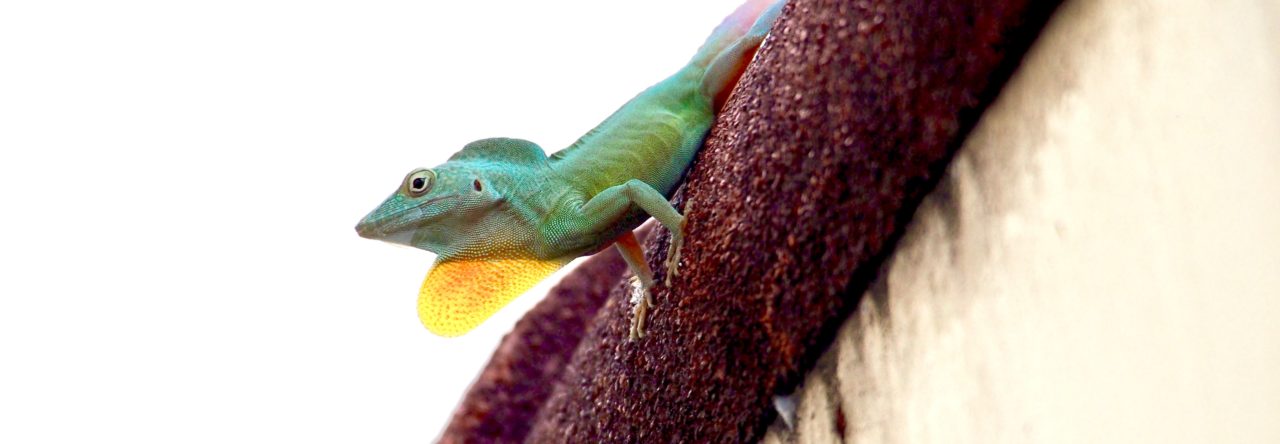
Bearded anole with a dorsal stripe, dark bands and a turquoise spot around the eyes foraging on St. Maarten. (Joost Merjenburgh photo)


COLE BAY–Nature Foundation, in collaboration with Reptile, Amphibian and Fish Conservation Netherlands RAVON, is researching the local status of the bearded anole (Anolis pogus) lizard, also known as the Anguilla Bank bush anole.

  This new research, executed by Aeres University student Joost Merjenburgh, will provide insight into the status of the vulnerable species and hopefully prevent its extinction.The bearded anole is an important endemic species to St. Maarten, which means that the species is native and can only be found here. In the past, the bearded anole occurred on Anguilla and possibly on Saint-Barthélemy, but has vanished on both islands for unknown reasons.

The research is aimed to better understand the current abundance, distribution and habitat preference of the bearded anole, as presently only little data is available. The data will provide insight about the population trend of the species and are needed for its International Union for Conservation of Nature (IUCN) red-list re-assessment. With this information measures can be made to conserve and protect the species.

Merjenburgh is investigating a total of 100 80-square-metre location plots each. All bearded anole are counted and measurements are taken of tree canopy cover and habitat type. Until now the bearded anole population seems to be well distributed on the island. The bearded anole seems to be quite abundant when searching in the right habitat and is mostly absent in residential areas.

Bearded anoles have a special appearance which can differ between individuals. Some individuals have a turquoise-coloured spot around the eye, others have a dorsal stripe or dark bands across the neck and body, and some have all characteristics. The reason there is so much difference in pattern and coloration is that they use their appearance for camouflage and communication purposes.

The bearded anole can also use the dewlap, a flap of skin that hangs beneath the lower jaw, to communicate. Although both genders have a dewlap, the one on the female is usually much smaller and less colourful than the one on the male. The male extends his dewlap mainly to attract females during mating season or to confront other males when they enter his territory, explained Merjenburgh.

Their diet, like other anoles, consists mainly of small arthropods – for example, cockroaches, crickets and spiders are their favourite foods – and occasionally flowers and fruits.

This species also falls prey to predators sometimes. One of those predators is the mongoose, which is an introduced species. The mongoose eats every native reptile species on the island and is probably the reason the only native snake, the leeward island racer, has probably become extinct on St. Maarten, said Merjenburgh.

Leptin Mediates Tradeoffs in Green Anoles

Leptin is made by fat cells and serves as a signal of available energy to lots of systems in the body. Diagram from healthjade.com

When you only have so much money to spend, you have to carefully consider what you’ll use it for. Do you go for instant gratification (dinner at your favorite, but expensive, restaurant!), or do you invest in something with a longer-term return (a needed kitchen appliance that will last years)? Free-living organisms have to make this choice throughout their lives. Of course they don’t cook in a kitchen, but their bodies have to ‘decide’ what to do with precious and limited energy. For our beloved anoles, in what do they invest that hard-earned energy from ingested bugs? Make more and bigger babies right away? Grow more? Invest in their immune system or locomotor performance to survive better?

Animal bodies don’t actually make ‘decisions’ about these things. Instead, hormonal and molecular mechanisms are arranged as networks in the body to make ‘decisions’ under different sets of conditions. In a new paper, Andrew Wang, a recent graduate from Jerry Husak’s lab, was curious how such decisions are made in green anoles. Previous work in the Husak lab showed that when calories are restricted, and lizards are forced to invest in athleticism via exercise training, both reproduction and immune function suffer. Why is that, and is it reversible?

The observation that trained and food-deprived lizards had little to no body fat (imagine elite marathon runners!) suggested that the hormone leptin, produced by fat cells, might be responsible. Leptin affects lots of systems in the body (see figure above), and less fat means less leptin. This means that leptin serves as a direct and convenient signal of energy stores: if you have enough energy, then you can direct organs to get to work. This fact has led to a huge literature on how leptin, as an energy signal, controls tradeoffs among traits. Hopefully you’re seeing a slight paradox here – if more leptin means more energy available, how could it mediate tradeoffs? How do you get more of one trait than another if leptin controls both in the same general direction?

Andrew conducted an experiment to find out. He replicated previous work, training and calorie restricting male and female green anoles to cause suppressed reproduction and immune function. He then gave half supplemental leptin and the other half saline, expecting leptin to ‘rescue’ reproduction, immunity, or both. The results were clear: immunity was ‘rescued,’ but reproduction was not. That is, both sexes were investing in survival-related traits to (hopefully) reproduce later instead of just reproducing right away. These results suggest that either there wasn’t enough energy for reproduction and the signal was moot, or the two traits have different sensitivities to leptin. Future work will help to disentangle these possibilities, but this work gives us more understanding of how anoles allocate energy when it’s limited.

Figure from Wang et al. (2019). Key: U=untrained, T=trained, H=high diet, R=restricted diet, L=leptin injected, S=saline injected. Note here that the swelling response to PHA injection was suppressed with training and caloriee restriction, but it was rescued with leptin (T-R-S vs T-R-L).

Paper: Wang AZ, Husak JF, Lovern M. 2019. Leptin ameliorates the immunity, but not reproduction, trade-off with endurance in lizards. J Comp Physiol B, in press. doi: 10.1007/s00360-019-01202-2

Anolis Newsletter VII is Now Published!

Following on from the last Anolis Symposium, held at the Fairchild Tropical Botanic Gardens, Miami FL, from 17-18 March 2018, we solicited submissions for the next issue of the Anolis Newsletter. We now finally have them all together! The newsletter represents an informal forum for the presentation of data and discussion of theory relevant to anoles. It serves three functions: to allow investigators to inform others of their current and future research; to provide an outlet for speculation and theoretical musings perhaps inappropriate for publication in more formal venues; and to give an opportunity to present data and ideas that otherwise might never be distributed. As with previous newsletters, there is a general request that nothing said herein be quoted without the authors’ express permission.

Spanning 333 pages, including 47 separate articles, I can now bring you the Anolis Newsletter VII!

Click this link here to access a PDF copy.

As always, you can also find links to PDF’s of all editions of the Anolis Newsletters (1972-2019) at the dedicated page on the Losos Lab website:
https://sites.wustl.edu/losos/home/anolis-newsletters-2/

Here’s a rundown of the articles included in Edition VII:

Yasel U. Alfonso and Dennis D. Ávila
Ectoparasite-host relationships: a case study of Anolis lizard ecomorphs on southeastern  Cuba

Yasel U. Alfonso, Javier Torre, and Daniel J. Paluh
The bizarre false-chameleons (clade Chamaeleolis, Anolis) from Cuba

Andrew C. Battles
How do anoles respond to urbanization? A summary of Ph.D. research on ecology and thermal biology in Anolis in Miami, FL

Winter A. Beckles
Variation in habitat lighting may mediate the persistence of dewlap color polymorphism
in South Florida bark anoles

Tom W. Brown
Conservation concerns for loyal lizards: Habitat specificity, site fidelity, a localised territory and in-situ growth rates for Anolis bicaorum (Squamata; Dactyloidae), endemic to Isla de Utila, Honduras

Stephanie L. Clements, Shantel Catania, and Christopher A. Searcy
Non-native species dominate herpetofaunal community patterns in both native and non-native habitat patches in urban Miami-Dade County

Rachel E. Cohen
Anole behavioral neuroendocrinology.

Jens De Meyer, Colin M. Donihue, Daniel Scantlebury, Julienne Ng, Rich E. Glor, Jonathan B. Losos, and Anthony J. Geneva
Protocol for setting up and rearing a successful lizard room

Colin M. Donihue and Anthony Herrel
A report on Anolis nubilus from the now rat-free island of Redonda

J. Sean Doody, Sean Sullivan, and Deby Cassill
Plasticity in hatching of anoles

Claire Dufour
Ongoing and future research on Anolis

A. C. Echternacht
Anolis research in the Echternacht Lab

Sean T. Giery and James T. Stroud
Geographic variation in trophic ecology of the Brown anole (Anolis sagrei): species-rich
communities are composed of more diverse populations

Joshua M. Hall, Timothy S. Mitchell, and Daniel A. Warner
The brown anole (Anolis sagrei) as a model for studying life-history adaptation to seasonality

Emma A. Higgins, Adam C. Algar, and Doreen S. Boyd
Revealing controls on abundance and microhabitat use of Anolis lizards in a changing
island landscape using airborne remote sensing

Michele A. Johnson
The potential for large-scale behavioral studies: A call to Anolis field biologists

Janson Jones
Beneath the Spanish moss: Growing up with Anolis in Florida. A photographic naturalist’s perspective

Masakado Kawata
Collaborative research projects on Anolis lizards in Cuba

Oriol Lapiedra
The ecological and evolutionary consequences of behavior in a changing Planet

Oliver Ljustina and James T. Stroud
Little evidence for size-structured habitat use in a diverse Anolis community

Michael L. Logan
Using transplant experiments to understand adaptation and speciation in anoles

Jonathan B. Losos
Anolis research in the Losos Lab

Inbar Maayan
A case study of character displacement and phylogeography of Jamaican anoles

D. Catalina Mantilla, Samuel D. Morales, Rafael Parra-Medina, and James T. Stroud
Histopathology of large epidermal cysts on the invasive Puerto Rican Crested Anole
(Anolis cristatellus) in Miami, Florida, USA

Gregory C. Mayer and Tony Gamble
Using archival DNA to elucidate anole phylogeny

Gregory C. Mayer and Jonathan B. Losos
Anoles not found

Walter E. Meshaka, Jr
The winds of stability: A south Florida residential Anolis assemblage over time

Walter E. Meshaka, Jr
What are the ecological costs and benefits to northern geographic expansion by a
successful anole?

Tim Mitchell
A call for more long-term studies of plasticity in anoles

Caitlin C. Mothes, James T. Stroud, Stephanie L. Clements, and Christopher A. Searcy
Predicting the invasion dynamics of anoles (and other lizards) using ecological niche
modeling

Julienne Ng, Daniel J. MacGuigan, Audrey L. Kelly, and Richard E. Glor
Do male-male interactions drive changes in dewlap size?

Stuart V. Nielsen, Aaron M. Bauer, and Tony Gamble
Natural History Note: Anolis sagrei foraging on a patch of obvious prey

Joanna Palade, Kenro Kusumi, Alan Rawls, and Jeanne Wilson-Rawls
Satellite cells demonstrate expanded musculoskeletal potential

Ivan Prates
Using mainland anole genomes to understand habitat shifts through time

Ashley M. Rasys, James D. Lauderdale, and Douglas B. Menke
Establishment of genome editing methods in Anolis sagrei

Liam J. Revell
Can we detect differences in the rate of discrete character evolution between clades of
anoles?

M. Christine Rose-Smyth
Role of a sweet-toothed anole (Anolis conspersus) in orchid pollination

James T. Stroud
Using introduced anoles as natural experiments in ecology and evolution

James T. Stroud
Thoughts on the ecology and evolution of anoles; insights from 5 years of meandering
strolls

Lindsey Swierk
Ongoing research on the ecology and behavior of Anolis aquaticus

Sarin (Putter) Tiatragul and Daniel A. Warner
Beating the Heat: nest characteristics of anoles across suburban and forest habitats in
South Miami

Javier Torres
Sterility in odd-looking Anolis mestrei (Dactyloidae) living in sympatry with trunkground
anoles

Nathan W. Turnbough
Are anole appetites altering ambient ant assemblages?

Kamau Walker, Andrew C. Battles, and James T. Stroud
Inter-specific predation bteween two eco-morphologically similar Anolis lizards

Kristin M. Winchell
Urban habitats: A natural experiment perfect for anoles

Amber N. Wright
Some thoughts on the use of experimental enclosures for studying anoles

Cindy Xu, Elizabeth D. Hutchins, Minami A. Tokuyama, Jason M. Newbern, and Kenro
Kusumi
Identifying molecular and cellular mechanisms of tail regeneration in anoles

Testis Size Evolves Faster than Sperm Size across Anoles

Sperm of Anolis sagrei. Picture by Ariel Kahrl.

Anyone who has worked with anoles in the field can tell you that during the breeding season, you can see these lizards mating pretty frequently. In fact, brown anoles are so promiscuous they have one of the highest rates of multiple paternity in vertebrates! In addition to this, females can store sperm for months at a time, which suggests that this group probably experiences a lot of sperm competition. We know from other groups that sperm competition can lead to the evolution of lots of interesting and diverse traits, but we know relatively little about how sperm competition targets these traits in anoles (though see Klaczko et al’s 2015 paper about the rate of genital evolution in anoles). 

Some of our previous work has shown that sperm size and sperm count are correlated with reproductive success in the lab, but it’s unclear how these important components of male reproductive success evolve. To explore this, we collected data on testis size (as a proxy for sperm production/sperm count), and sperm morphology (measuring the sperm head, midpiece and tail) for 26 species of anoles. We hypothesized that if testis size had a higher rate of evolution than sperm morphology, sperm competition likely targets sperm count over sperm size.

Rates of evolution of testis size, body size and sperm morphology next to an anole sperm.

In fact, we found that testis size evolves much faster than sperm morphology, confirming our hypothesis. We also found that within the sperm, the midpiece (which contains the mitochondria) evolves 2-3 times faster than the rest of the sperm cell. This is maybe unsurprising, considering that the midpiece size is correlated with reproductive success in brown anoles, and is often associated with sperm longevity and sperm velocity in other species.


You can read the pre-print from JEB below!

Kahrl, AF, Johnson, MA, and Cox, RM. 2019.Rapid evolution of testis size relative to sperm morphology suggests that postcopulatory selection targets sperm number in Anolis lizards. Journal of Evolutionary Biology.

https://onlinelibrary.wiley.com/doi/abs/10.1111/jeb.13414

New Book on Lizard Behavior Appears Next Month

Name that cover-gracing anole!

A new book on lizard behavior has an anole gracing the cover (who can guess the species?) and an all-star cast of contributors, including a number familiar to AA faithful (see Table of Contents below). The book is due out in a month, but you can go ahead and pre-order it. Sadly, it’s priced in the stratosphere: $159 for the 400 page volume. Let’s hope for a paperback edition!

Are Geckos the New Anoles? Come to World Gecko Conference and Decide for Yourself!

Sure, they mostly live on the other side(s) of the world, they use sounds rather than dewlaps, and you mostly see them at night.

But some anoles you could only spot at night!

And geckos are mostly tropical! And there are a lot of them! And they don’t like to lay many eggs at a time – heck, some of them even have dewlaps! And they have radiated like crazy (1860 species and counting).

Want to know more? Want to tell us more?

See you in Tel Aviv, Israel, at the end of May 2019 at Gekkota Mundi II: the second conference for gecko biologists from around the world

For more details write us:  gekkotamundi19@gmail.com

or see: https://gekkotamundi-ii.weebly.com/


Do Anoles Have the Largest Brains of All Squamates?

In a study hot off the press, Gilles de Meester and colleagues examine the phylogenetic distribution of brain size across squamates (lizards and snakes; you can find a reference and a link to the study at the bottom). In it, the authors explore the hypothesis that larger brains evolved to allow organisms to better manage environmental complexity, through enhanced cognition and behavioral flexibility. Despite years of hypothesis testing on the subject, there is no clear consensus about its validity. De Meester et al. join the quest and investigate the relationship of brain size in 171 squamate species (including 8 anoles!) to habitat type and degree of sociality. The punchline is that snakes are the pea-brains of the squamate world. Unexpectedly, there was a strong positive relationship between degree of sociality and brain size, such that solitary species had the largest brains. And, perhaps less supported but still a trend; arboreal species generally have the largest brains, while fossorial species (those that burrow and live in the leaf litter) have the smallest.

From De Meester et al.: Ancestral state reconstruction of relative brain size (residuals of the brain to body mass regression) along the nodes and branches of the phylogenetic tree of 171 species of Squamata. Sphenodon punctatus is included as an outgroup. Species with positive residuals (blue) have large brains relative to their body size, whereas species with negative residuals (yellow–red) have small brains relative to their body size. Results were visualized using the contMap function in R (package phytools; Revell, 2012) 

But, I hear you say, what of the anoles? Well, Neotropical species had the largest brains of any biogeographical region, and anoles specifically are exceptionally big brained. In fact, on delving into the supplementary material — in which De Meester et al. provide wonderful access into the brain size data that they accumulated — it reveals that Anolis stratulus, the Puerto Rican trunk-crown spotted anole, has the relatively largest brain size of any squamate!

Here is a crude figure I just whipped up from the De Meester et al. dataset. As it shows, anoles perform very well in the brain size department relative to both all squamates and within lizards specifically. Although the American green anole (A. carolinensis) does let the team down slightly…

You can read the study in full following the link below!

Gilles De Meester, Katleen Huyghe, Raoul Van Damme. 2019. Brain size, ecology and sociality: a reptilian perspective. Biological Journal of the Linnean Society, bly206.
https://doi.org/10.1093/biolinnean/bly206


AA Greatest Hits: A Highly Anecdotal Account of a Most Remarkable Anole

From the archives. One of the greatest <i>Anole Annals</i> posts of all times, because why not?

“You’ve gotta see this!” my fiancé Mark called to me one morning.  He was outside, which could mean only one thing: a wildlife encounter was underway.  Living in a semi-rural neighborhood in Florida, you never knew what you would see, from a mated pair of Sandhill Cranes walking down the street with their young, to Gopher Tortoises excavating burrows in the front yard.

I walked downstairs to the concrete area under our elevated house where Mark was staring at something on the ground.  I looked down to see a frog (Cuban Treefrog) with the tail of an A. carolinensis protruding from its gullet.

“I knew that lizard,” Mark said forlornly.

Communal Basking of Anoles

I wanted to share an observation of communal basking of the Green Anole (Anolis carolinensis) from the western Highland Rim of Tennessee. The locality is near the northern extent of their range in middle Tennessee. On a warm January day this winter, I observed six (6) individuals basking in close proximity along an exposed tree branch. The overwintering habitat was a south-facing road cut.

Has anyone else observed this type of “communal” basking of anoles, either in the Green Anole (Anolis carolinensis) or other species?


Evidence for Local Specialization in a Widespread Lizard

Figure 1 . (A) Widespread species may be comprised of populations (dashed lines) exhibiting traits generalized across all habitats or (B) capable of specializing to unique habitats throughout their range.

Widespread species are expected to be successful in natural environments because of their ability to generalize across a variety of habitats. Throughout their range, widespread species may experience a variety of habitat types and may subsequently exhibit similar patterns of morphology and performance capabilities. In this sense, widespread species could encounter a “jack-of-all trades but master of none” trade-off in that a population may not be optimally adapted to a certain environment (Figure 1A). By contrast, we hypothesized in a recent paper published in Evolution that local specialization could be driving the broad-scale success of a widespread species. By adapting to a specific habitat, natural selection could produce unique fitness surfaces and phenotypic variation between populations (Figure 1B).

In this study, my collaborators and I conducted this study on four distinct populations of Urosaurus ornatus, a widespread lizard found throughout the American southwest (Figure 2), to determine whether success is a result of ecological generalism or local specialization. Urosaurus ornatus is a small, polymorphic lizard that primarily occupies desert habitats. While the common name is the ornate tree lizard, this species can naturally be found on a wide variety of substrates, including tree limbs, tree trunks, boulders, shrubs, snags, canyon walls, and the ground. We focused on populations found in one of two microhabitat types, tree-dominated or boulder-dominated, to assess habitat-specific differences in natural selection.

Figure 2. Male (left) and female (right) Urosaurus ornatus on a natural perch.

Morphological characters and performance capacity are ideal traits for this experiment due to their sensitivity to ecological and environmental characteristics. Thus, our results show striking differences in selection on these traits by sex, supporting the notion of divergent ecological pressures within a shared environment. This, coupled with the heterogeneity in selection between habitat types, leads us to believe that local adaptation is driving the success of this widespread species. In the past, evidence for generalism at the species level has masked the underlying affects of the environment and local adaptation. Here we are able to tease apart some of these traits and determine how selection varies at the population level in order to extrapolate to the species level.

So what do tree lizards have to do with anoles? In short, the similarities between Urosaurus and Anolis are plentiful. While there may be significant differences in habitat, both genera contain species that are wonderful models for a plethora of different ecological, evolutionary, and genomic questions. The wide breadth of anole literature has influenced our findings in this study and contributed significantly to its impact and viability. For that, we thank the many anole researchers from around the world!

Page 58 of 304

Powered by WordPress & Theme by Anders Norén