Field Assistants Sought For Summer Anole Fieldwork in the Bahamas

Field Assistants (2-3) needed for field research on the behavior and ecology of the lizards Anolis sagrei and Leiocephalus carinatus on Great Abaco Island, Bahamas. The projects are part of a long-term study evaluating behavioral plasticity and its consequences on ecological and evolutionary processes. Assistants will be in charge of collecting focal observations and general ecological data. Duties include assisting in data collection, analyzing video recordings, habitat characterization, and data entry. Assistants must be flexible in their needs, comfortable living and working in close quarters, and able to work under hot and humid conditions. Assistants must enjoy watching and describing the behavior of animals for long periods of time, while working under relatively isolated conditions. Prior experience conducting fieldwork is desirable but not required. This can be a great opportunity for undergraduates with an interest in pursuing graduate studies in behavioral ecology or herpetology. An overview of the day-to-day activities related to this project can be found at

http://chipojolab.blogspot.com

Positions will run from 16 May to 13 June 2011. We offer a living stipend ($1,440/month), plus room & board and cost of transportation to the field-site. Field assistants will need to provide their own personal gear, including a backpack and life-jacket. Research will take place on relatively small islands, and short trips in a small boat are part of the daily activities. Email a cover letter, resume, and contact info for two (2) references to:

mleal@duke.edu

The review of applications will begin immediately.

Manuel Leal

Department of Biology

Duke University

Anoles Rule!

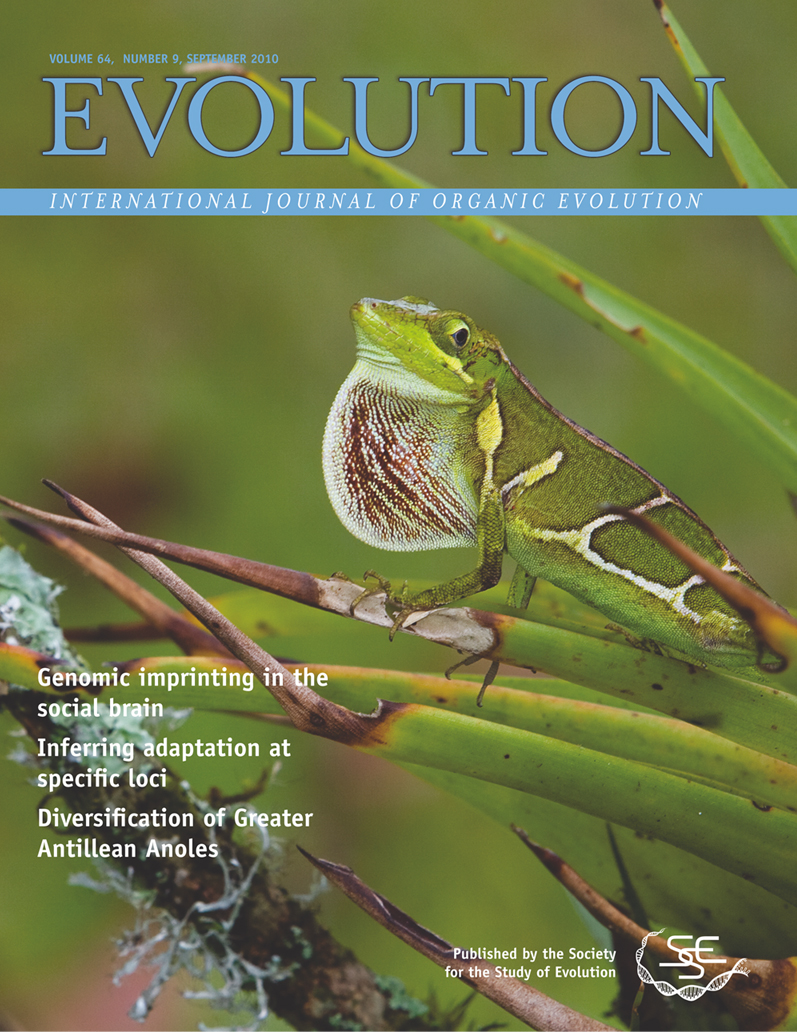
In an unprecedented display of organismal superiority, an anole graces the cover of a major scientific publication for the third time in six months (the others may be seen here and here [editor’s note: see comment]).  The photo advertises an article on environmental niche modelling and biogeographic boundaries in two Hispaniolan anole species, which will be the subject of a forthcoming post. Incidentally, not that anyone’s counting, this makes two cover shots for Richard Glor and one for Luke Mahler.

Anolis Photo Presentation

Photo from http://www.dpchallenge.com/image.php?IMAGE_ID=18556

Just back from a talk on primate color evolution. I was gratified to see that the opening slide of the talk included a picture of an anole—didn’t expect that in a monkey talk! However, the image used was the one above. Anole seminar aficionados know that this is a no-no—this image has been used in more talks than is humanly imaginable! The reason is simple: when you Google (or Google Image) Anolis, this image is one of the first couple that pop up. And it’s seemingly a nice picture, so people tend to use it. All the time. But look more closely. This guy is not the Adonnis of the anole world. Rather, his schnozz is very beat up. This fellow should not be the poster child for the anole world. I had always assumed that he was a captive animal, who had rubbed his snout raw against an aquarium wall, as often happens. However, the recent post on fighting A. carolinensis illustrates that perhaps this guy is a fighter, not a lover, and bears the scars of his battles. In any case, a word to the wise: use another anole photo in your presentations.

Green Anole Mayhem

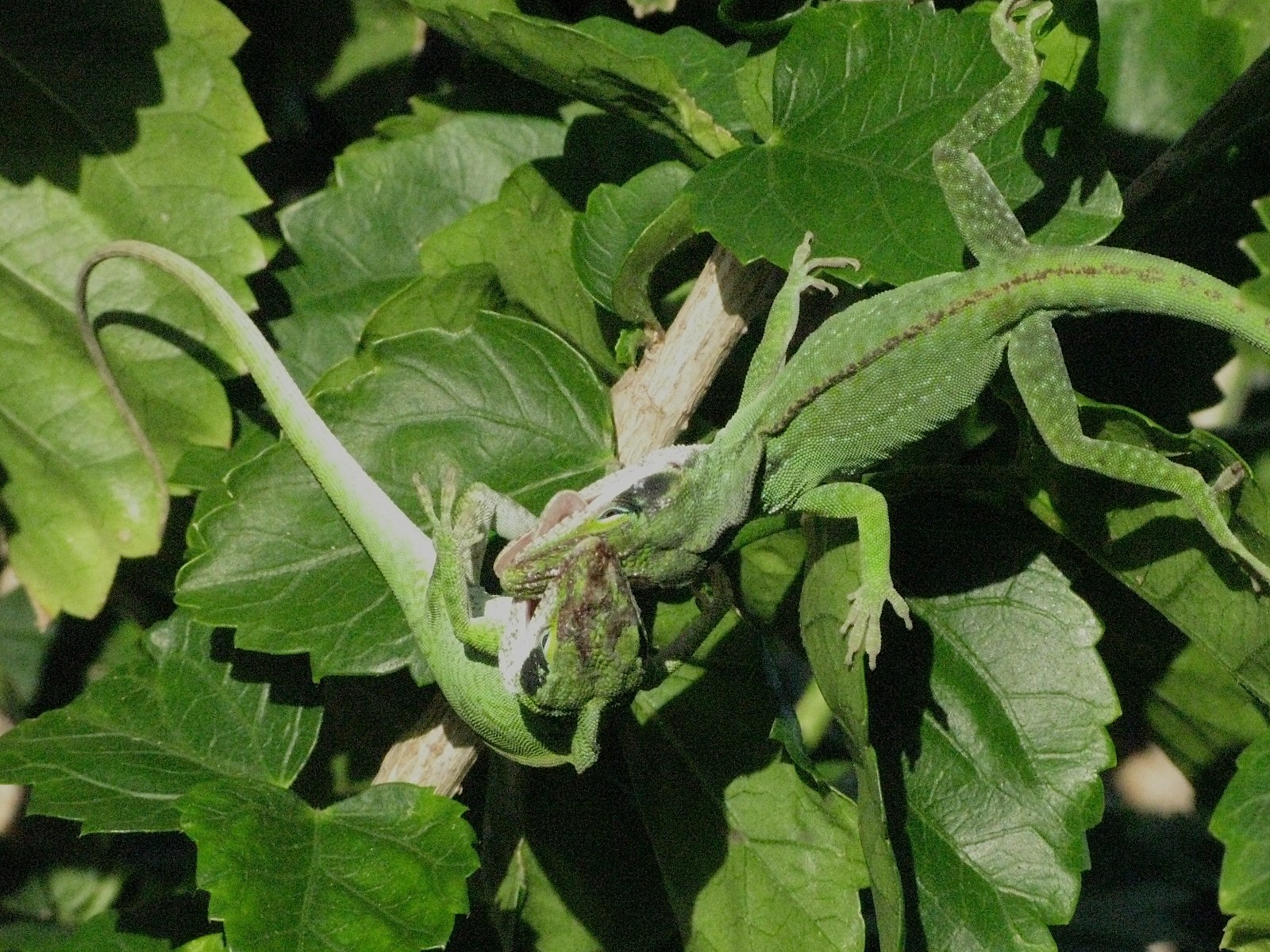
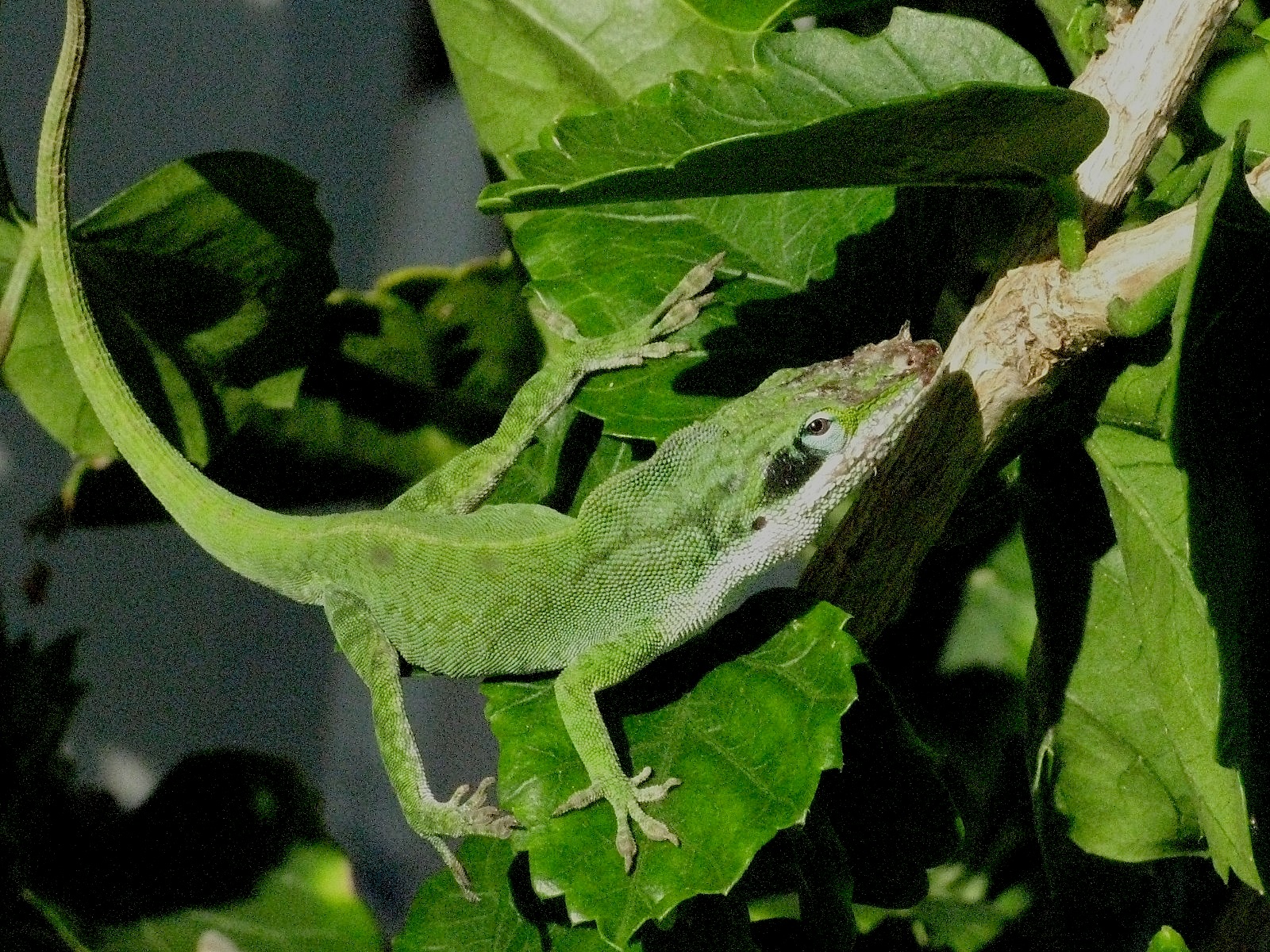
Florida green anoles appear so loving and peaceful. But perhaps the tranquility of Hawaii brings out the devil in them. Johanna Mercier was on vacation on Kauai with her husband and daughters when she snapped these photos on February 27th. She describes what happened: “These were taken in Kapa’a, Kauai at about 4:30pm.  They were on a hibiscus plant and I almost missed them, they blended in so well.  I watched them for almost half an hour and finally had to pull myself away to make dinner. NOT being sarcastic, they were fascinating!  They would flare out their dewlaps and bob at each other with their mouths open and then latch onto each other. They would stay in this lock for easily 5-10 minutes without moving. Then one would slip and fall; they’d climb back to each other and do it all again.”

More Mainland Bird Predation on Anoles

Photo @Alexa Class.

Pictured here is a nestling ocellated antbird with an anole of some sort (A. lemurinus? humilis?) stuffed down its throat (photo taken at La Selva Biological Station in Costa Rica; event described in Ornitologia Neotropical, vol. 20, 2009). Alexa Class and Johel Chaves-Campos several times observed these birds take anoles from army ants. Johel also reported he has “seen bare-necked umbrellabirds grabbing Norops capito anoles from tree trunks covered with mosses at middle elevations (about 1000 m, Caribbean Slope) in Costa Rica.  I was truly impressed by how far away the bird was when it detected the lizard; at least 30 feet away in front of me.  Actually, I was watching it with binoculars. The lizard was perhaps 7-10 feet away from me, on my side, and the bird flew directly towards where the lizard was and took it in front of my face.  By the way, the lizard was so well camouflaged that I couldn’t see it until the bird took it.  Great vision!”

Do you want to cuddle? It makes me feel safe.

Is this really worth it? I was asking myself while trying to balance my weight on the slanted old tree which I had climbed, the mountain stream beneath me gurgling around glistening rocks in the humid night. I stretched out my left arm as far as possible while clinging onto the tree with my right, to snap a probably completely out-of-focus and missing-the-object-of-focus picture with my trusty waterproof Pentax. While pushing the releaser button, I noticed some parts of the old tree I was holding on to slowly giving away. A flash, a thump, and I found myself suddenly clinging to another part of the tree, while the green power diode of my camera now flickered at me from the bottom of the stream. Great, I thought, you’ve ruined your camera for a picture that won’t even have anything on it and wasn’t that great to begin with either. This is why I want to make it worth it now, a posteriori: worth a blog post. Examining the SD card later on it turned out, that there was indeed a motif on that picture, and even the one I had hoped to catch: Two male Anolis etheridgei sleeping together on a leaf (more like waking up on a leaf due to my intrusion), facing away from each other. What made this observation picture-worthy for me is that these weren’t the only specimens I found like that that night. At least five other pairs of male A. etheridgei were sleeping in the same position, touching each other’s tails. When I approached them, the one that would wake up first would make a jerking movement, then both would simultaneously drop from their sleeping site into the leaf litter. They were way harder to catch than many other sleeping anoles I’ve stalked at night. Four eyes are better than two, as the saying goes, and those little anoles seemed to have realized just that.

Cuddling for safety

Rest in peace, my trusty Pentax Optio WP.

Anole Documentary Short

Anolis carolinensis - the green anole

Who’s your neighbor? Check out this short documentary by biologist Neil Losin about Anolis research in Miami. It’s cool research and contains some great video and still footage of anoles! After the video, explore the rest of Losin and Nathan Dappen’s Day’s Edge Productions website. Day’s Edge Productions is a new production company that uses video and multimedia to communicate science to the public.

In Defense of Herpetology

From http://xkcd.com/

New Species of Anole Described Based on Differences in…Well, This Is A Family Website


Guess what these are

Anolis polylepis is a small and very abundant anole that occurs in southwestern Costa Rica. Recently, Köhler and colleagues divided A. polylepis into two species based on the structure of the hemipenis illustrated above. The vast majority of A. polylepis retains the name, but populations of the lizard on the Osa Peninsula, where the famous Corcovado National Park is located (and hence from where many people know A. polylepis) are now to be known as A. osa.

The species may be distinguished by their man parts.  Anolis polylepis, whose hemi-tallywacker is on the top row above, has a bilobed organ, whereas that of A. osa, on the bottom row, is unilobed.  What appears to be a narrow hybrid zone occurs at the base of the Osa Peninsula, where lizards exhibit an intermediate hemipenial morphology.  Köhler et al. examined a number of other morphological characters, including dewlap color, and found that in all other respects, the two taxa could not be distinguished.

How Beer Advanced Anole Thermal Biology

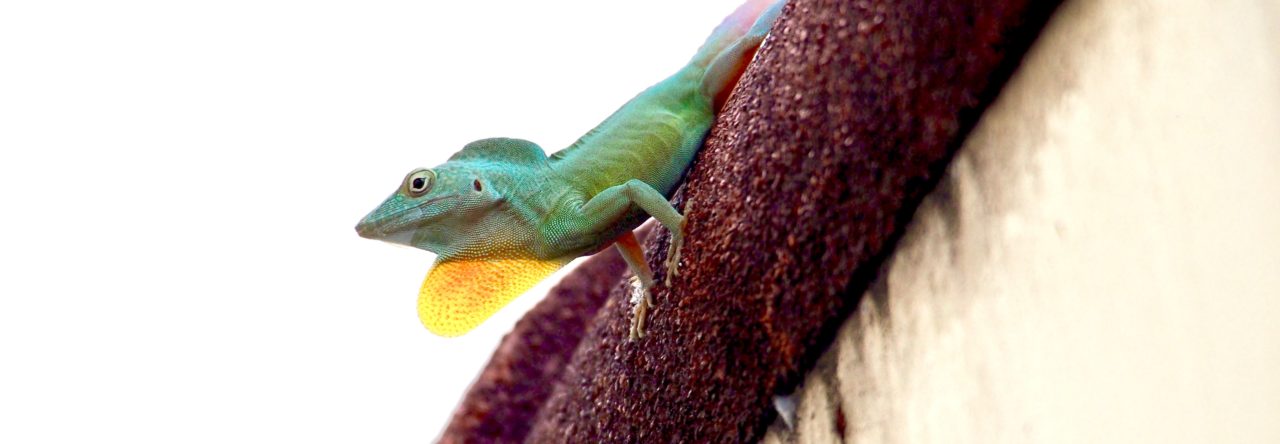
Anolis chlorocyanus basking on a clothesline in the Dominican Republic. Check out the parasites!

It was a long-standing paradigm in ecology that reptiles were consummate thermoconformers, essentially at the whim and mercy of environmental conditions. In 1944 this idea was challenged by seminal work by Cowles and Bogert who definitively demonstrated behavioral thermoregulation in lizards. This important paper sparked a series of new studies on the evolutionary ecology of thermoregulation. Researchers became interested in how lizards utilized different behavioral strategies under varying thermal regimes. They sought to explain and quantify the costs associated with thermoregulation in different environments, and understand how species richness on islands correlates with thermoregulatory strategy. The study by Cowles and Bogert was arguably one of the primary forces behind the “noose ’em and goose ’em” period of reptile biology.

Page 296 of 306

Powered by WordPress & Theme by Anders Norén