
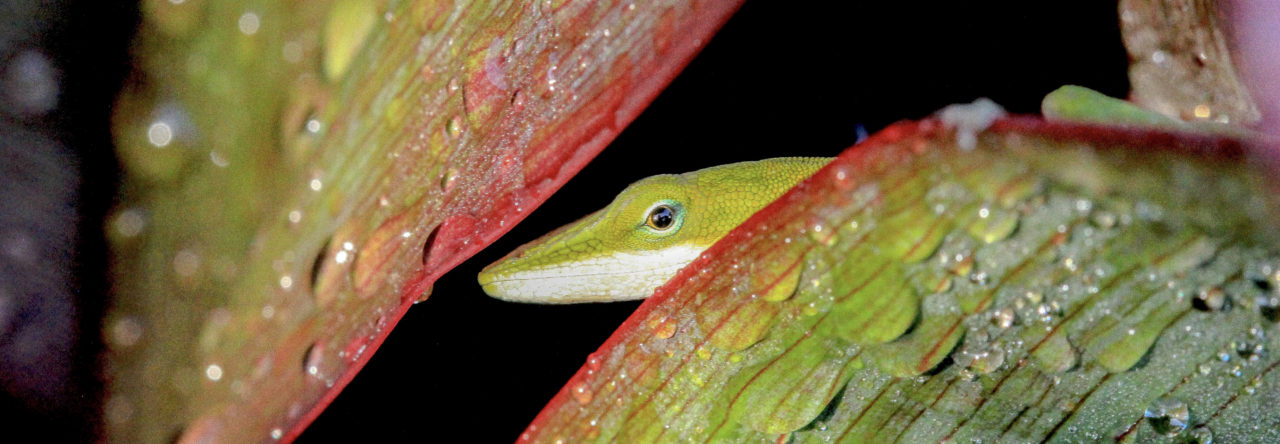
The website anolissen.nl has a collection of reasonably high quality anole videos, including one of Terry Ord’s behavior research, featured yesterday, as well as A. allisoni from Cuba fighting; many Cuban species displaying, including A. allogus (or was it A. ahli?) and A. mestrei; A. cuvieri displaying; A. punctatus displaying; a green anole (who can identify it?) eating a butterfly; and a bonus outgroup track of Polychrus acutirostris, as well as others.

The Puerto Rican grass-bush anole, A. pulchellus, displaying. Recent research indicates that this and some other, but not all, anole species time their displays to occur when the wind isn't blowing. Photo @ Rich Glor.
Successful communication requires that a message be detected by the intended receiver. One trick animals have when they communicate is to use signals that stand out against the background, so that they are more easily detected, such as waving light colored structures against a dark background, or making high-pitched calls when surrounded by low-pitched sounds. But what happens when the background isn’t constant? Just as we tend to talk when conversation partners are quiet, animals would be expected to signal at those times when their signals contrast to the greatest extent with the background and thus are most detectable. Reasonable as this hypothesis is, it has only been tested once, in a study which showed that lab monkeys vocalized in silent periods between bursts of machine generated white noise.
Anoles signal primarily in two ways, by moving their head and body up-and-down and by extending their dewlaps. With regard to the former, research has shown that headbobs are effective at catching the attention of other lizards because the rapid and jerky movements contrast strongly with motion in the background. However, this is only true when, in fact, the background—that is, the vegetation and other stuff behind the lizard—isn’t moving very much. When the wind is blowing and leaves and branches are swaying back and forth, headbobs should be more difficult to detect. Consequently, on a windy day, a savvy anole should time its headbobs to occur when the wind is not blowing.
And that’s just what they do—at least some of them.
About a week ago, an esteemed foreign colleague asked if I had a PDF of Ernest Williams’ famous 1983 Lizard Ecology book chapter on the evolution of the anole ecomorphs. I didn’t, nor did anyone else to my knowledge, so I scanned it today. In doing so I was able to renew my appreciation for just how LONG this gem is – nearly FIFTY PAGES including refs. I hope that no one ever has to scan it again!
To that end, readers may now find scans of this long-out-of-print work here. It comes in two flavors: slightly higher resolution or OCR text-searchable. Enjoy!!
PS. As a teaser, here’s Figure 2 – the ubiquitous ecomorph figure that’s found its way into countless anole presentations over the past quarter century.

Anolis chlorocyanus (photo @ Rich Glor). Anolis chlorocyanus occurs north of Mertens' Line, A. coelestinus to the south. Map on right (from Glor and Warren, 2011) illustrates that suitable conditions for both species occur in the range of the other species (the warmer the color, the more suitable the area).
Many sets of closely related species exhibit a geographic distribution in which species only come into contact at their range border, with one species replacing another across the geographic landscape. Such a “parapatric” distribution could be explained in many ways, such as:
1. The species are adapted to different environments, and their distributions reflect geographic differences in environmental conditions;
2. The environment does not change geographically, but the species are so ecologically similar that neither is able to displace the other from its current range;
3. The species are not reproductively isolated; when they come into contact, they interbreed, thus preventing coexistence;
4. The species are newly-arisen, and have not yet expanded their ranges into sympatry, or one species has not yet displaced the other completely.
A case in point are the large green anoles of Hispaniola, Anolis chlorocyanus and A. coelestinus. Except for their dewlap, these two trunk-crown species are nearly identical in morphology, and they also occupy similar structural habitats. Yet, A. coelestinus occurs only in the southern peninsula, whereas A. chlorocyanus occurs throughout the rest of the island.
Sequencing of the Anolis genome holds great promise for unlocking the genetic basis of anole phenotypic variation – such as dewlap coloration and limb length differences – and it also makes for a nifty way to discover new molecular markers, such as microsatellites. Wordley et al. report in a recent article on mining A. carolinensis expressed sequence tags (ESTs) for repeats and then blasting the EST-derived sequences against the genome to obtain the genomic sequence and its location on assembled chromosomes. From these sequences, they designed primers, tested them out in A. carolinensis, and, importantly, attempted to amplify them in multiple, phylogenetically diverse species. They identified 8-25 new variable markers for apletophallus, carolinensis, distichus, porcatus, and sagrei, which can be added to the existing resources designed for carolinensis, cristatellus, distichus, luciae, roquet, oculatus, and sagrei, which also work for some related species. Happy genotyping!
from Michele Johnson:
Two weeks ago, I had the opportunity to join one of my colleagues, mammalogist David Ribble, in the data collection for a vertebrate biodiversity survey he’s working on at Bamberger Ranch in Johnson City, Texas. (Incidentally, David is a grad school pal of Jonathan Losos – it’s always a small world.) We trapped rodents, checked pitfall traps, lifted cover boards, and jumped out of the truck when we saw snakes in the road. This was my first experience trapping mammals, and I was impressed by the many similarities, and the important differences, between field studies of rodents and anoles.
The similarities:
1. When you grab an animal, it pees on you.
2. If you don’t hold on tight, the animal gets away. (The perils of working with students…)
3. If you don’t hold on right, you get bitten.
4. When you catch males, you confirm the sex by everting the penes.
5. Tails can come off – oops!
6. We all pose our specimens in unnatural positions. (Mice get a “Superman flying” pose; anoles a “mid-jumping jack” pose.)
7. Field work is better with beer.
The differences:
1. You can lure mice into little traps using food. It would be awfully convenient if anoles fell for such a trick.
2. If an anole bites your finger, you can blow on its face until it lets go. If a mouse bites your finger, you bleed all over everything.
3. Male mice only have one penis, poor guys.
4. If takes way more work to make a mouse specimen than an anole specimen – you have to skin it, stuff it, and pin it. I prefer fixation with nasty chemicals.
Assuming my lists are exhaustive, it’s clear that the study of anoles has more similarities than differences with the study of their amniotic brethren. Still, I think I’ll stick with anoles.
PS – For those of you wondering, the rodents we trapped were Sigmodon hispidus (cotton rat) and Peromyscus pectoralis (white-ankled mouse), and the herps we caught were Sceloporus undulatus, Acris crepitans blanchardi, and Thamnophis proximus. It was very cold that weekend.
There have been a number of posts recently discussing various aspects of the sleeping biology of anoles (e.g., here, here, and here). Anoles spend 1/3 to 1/2 of their lives asleep, so it is not surprising that there is a small cottage industry of research papers describing where they sleep, in what position, and with whom. The most recent addition to this genre is a very nice paper on A. uniformis in Mexico, which reveals that this species is typical in sleeping on leaves with its body in line with the long axis of the leaf. The paper includes a brief, but thorough review of the literature on anole sleeping and thus is a good entrée to the literature.
A somewhat less brief review of the literature might go something like this

Evolution of species in a two-dimensional morphospace. Axes are from a principal components analysis of morphology; symbols represent different ecomorph classes.
Over on the Phytools blog, anole biologist and comparative methods guru Liam Revell provides a program to visualize the evolution of traits in multivariate space, termed a “phylomorphospace.” This method plots species’ values and connects the points to portray their phylogenetic relationships. Most imporantly, the example he uses is none other than Greater Antillean anole ecomorphs, using a figure developed by Luke Mahler and pictured above. The diagram above illustrates convergence of the ecomorphs by showing that members of the same ecomorph class occur in the same parts of morphological space, even though many members of each ecomorph are not closely related to each other. Each large dot represents an extant ecomorph and the color indicates ecomorph class; small dots are internal nodes of the phylogeny. Admittedly, these spaghetti-grams can be hard to follow for large phylogenies, but they do give a sense of how traits have evolved and the extent to which convergence occurs.


