New Reviews of Lizards In An Evolutionary Tree

More than two years post-publication, reviews of Lizards in an Evolutionary Tree continue to trickle in. The most recent appeared in Austral Ecology and Herpetological Review. See all 12 (of which we’re aware–know of others?) here.

A Non-Anole Grass-Bush Ecomorph?

I have long thought that the Asian lacertid lizard, Takydromus sexlineatus, is the best example of a non-anole species that corresponds to one of the anole ecomorphs. Extraordinarily long in tail, slender in body, light brown in color with a light-colored lateral stripe, this grass-dwelling lizard seems a dead ringer to a grass-bush ecomorph. This, of course, leads to many questions, not least of which is: if Takydromus somehow were juxtaposed with some ecomorphs, how would they interact?  Now we know the answer.

They’d ignore each other. Or at least, they’d do so within the confines of a small
Petsmart vivarium where they are commonly sold.

Anole Research Cleans Up on Awards at JMIH

A figure illustrating dewlap color variation in the distichus species group from Anthony Geneva's award winning poster.

Two posters on anole evolution presented at JMIH last weekend were honored with SSAR poster awards.  Anthony Geneva, a PhD student at the University of Rochester took home the prize in the Evolution, Genetics, & Systematics category for his poster on “A Multi-locus Molecular Phylogeny of Distichoid Anoles.”  Mingna Zhuang, an undergraduate researcher at UC Berkeley, won in the Ecology, Natural History, Distribution, & Behavior category for her poster on “Comparative Gliding Performance of Anolis carolinensis and Anolis sagrei.”  Although not on anoles, it also bears noting that Daniel Scantlebury’s study of adaptive radiation in Sphaerodactylus – which has been inspired partly by work on Anolis – won the SSAR’s Henri Seibert Award for best student talk on Evolution/Systematics.  Congrats to Anthony, Mingna, and Dan!

Is An Anole Smarter Than a Fifth Grader?

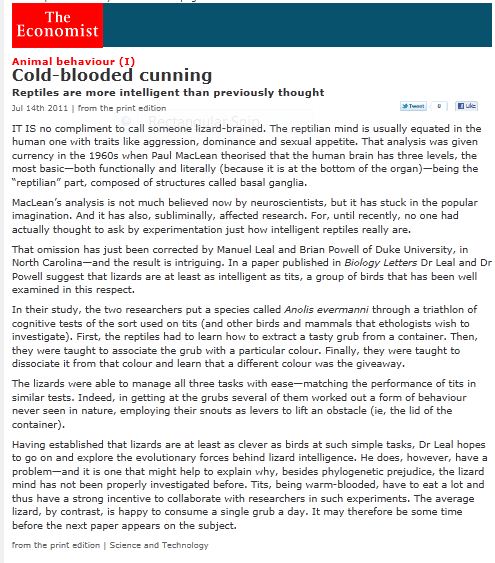
Manuel Leal and Brian Powell have just published a paper in Biology Letters demonstrating that lizards are smart. Before getting to the details, though—here’s the important point: check out the videos! They’re pretty amazing (here, scroll down and click on the videos).

Here’s the story: working with the Puerto Rican trunk-crown anole, A. evermanni, Leal and Powell presented lizards with an experimental apparatus in their home cages with two wells, in one of which was a dead phoenix worm (whatever that is). Next to the well with the worm was a little round disc similar to a poker chip. The lizards learned to go to the well and find and eat the worms. Then the experimenters placed the chip halfway over the well. Again, no problem.

Now comes the cool part. The experimenters completely covered the well containing the worm with a blue chip. Remember, these are Anolis lizards that usually find their prey by looking for movement—they don’t go digging around in the underbrush. Still, four out of the six lizards figured out how to get the mealworm: two of them bit the chip and removed it from covering the well, while two others figured out how to use their snouts as a lever to flip the chip off the well. This is pure problem-solving, and it uses novel behaviors, rather than simply transferring a natural behavior to a new context! And the two lizards that failed to get the worm came up with their own solution, hitting the center of the chip with their snout—but this was ineffective in dislodging the chip.

Once the lizards had learned to find the worm under the chip, the experimenters then conducted a discrimination trial, giving the choice of a blue chip and a yellow chip. Without error, the lizards always went to the blue chip; subsequently, they were presented a blue chip versus a blue-and-yellow chip, and they still had no problem.

Pretty amazing for a lizard, if you ask me, but it gets even better.

A Primer on Filming Anole Behavior – Part 1(b)

Back in my first post on this topic, I described some of the equipment I use to film anole behavior. I ended with a promise of a second entry replete with example videos to outline specific techniques I use to get useful footage. I also wrote that hi-definition videos are troublesome to play, let alone edit, on many computers. Well, the egg is partially on my face, because I’ve been having trouble finding a good way to edit standard definition videos. Playback, the important part for my research, is flawless, but iMovie doesn’t like to deal with the files.

Rather than balk at this challenge any longer, I decided to turn to the community (that’s you, Anole Annals reader) for help. So those of you out there who have done video editing, can you recommend a program to use (or to avoid)? Cost and ease of learning are prime considerations for me right now. Please leave comments, and thanks in advance for any input.

Unique dewlap?

I recently returned from a trip to eastern Cuba and as expected, made some interesting observations and gathered some new natural history information.
While poking around one evening with a flashlight (mainly looking for Eluth’s) I saw this “orange” sagrei sleeping on some veg. I photographed it to share here since there was some discussion on and off blog about this color phase. After I got it in hand to determine species (since homolechis and jubar were also very common in the area), I was surprised at the dewlap appearance. At first I thought it had a red mite infection because of the color and texture; but after scrutiny, just accepted that it had a bright red pigment that was scattered about the entire ventral anterior. Any ideas or similar observation?

JMIH 2011: More Anole Posters

The Sunday night poster session at JMIH 2011 had a few more anole offerings.  Melissa Moody from Iowa State reported on a laboratory experiment on the developmental and fitness consequences of varying Anolis sagrei egg incubation temperature and humidity.  Anolis sagrei eggs seem relatively robust to the variation experienced during this experiment.  Paul Cupp of Eastern Kentucky University asked whether ground skinks (Scincella lateralis) and green anoles (Anolis carolinensis) could detect chemical deposits from the Eastern Milk Snakes (Lampropeltis triangulum); he found evidence that the skinks could detect these deposits while the anoles could not.  Finally, Mingna Zhuang discussed comparative gliding performance of Anolis carolinensis and Anolis sagrei.  She found that A. carolinensis is a considerably better glider, perhaps due to the fact that it has a flatter gliding posture than A. sagrei.

The Anole Phylogeny at JMIH

In addition to a number of Anole posters yesterday, the Joint Meeting of Icthyologists and Herpetologists featured a talk by Rich Glor entitled “Phylogenetics and Diversification of Anolis Lizards.” In his 12 minutes Rich covered a lot of material. He described: the key components in diagnosing an adaptive radiation (speciation, adaptation and the more controversial extraordinary diversification), how the properties of adaptive radiations result in problems resolving their phylogenies (particularly when diversification rates are extraordinary), leveraging the anole genome project to generate and analyze new, informative loci for anole phylogenetics, the impact of incomplete data matrices on the ability to accurately infer phylogenies, and closed with a presentation of the latest, greatest genus-wide phylogeny of Anoles.

Anoles of the Florida Keys

Not an anole, but plays one on TV. Photo from Dust Tracks on the Web (http://dusttracks.com/)

Janson Jones is at it again. Having just driven about as cross-continent as you can get, from Alaska to the Florida Keys, he is now waxing eloquent on the lizards of that delightful island string. Today’s post is about introduced green iguanas, which apparently are everywhere and spreading, but yesterday he posted twice, on brown anoles (A. sagrei) and bark anoles (A. distichus) , with some keen observations on interactions between the two. Most notably, he’s noticed on multiple occasions that the larger browns chase off the the daintier barks.

postscript: Just as I hit the “post” button, Jones put up another of his own, with further observations on bark anoles and outlining what would make an excellent Ph.D. dissertation project. Plus, this intriguing observation:

“…the iPad of anoles in the Florida Keys. They’re right on the edge, living in the third space, transitory ground between the browns on the ground and the greens in the trees. They’re not iPhones, but they’re not desktops either. Right in the middle — and perhaps drawing business from both sides?”

Bark anole, A. distichus, from Dust Tracks on the Web

JMIH 2011: Posters, posters, posters!

Today’s JMIH poster session was an anole lover’s paradise!  Five posters featured molecular phylogenetic work on anoles, including studies of A. humilis (John Phillips from Central Michigan University), A. limifrons (Jenny Gubler from CMU), the pentaprion group (Julian Davis from the University of New Mexico), the distichus group (Anthony Geneva from the University of Rochester), and the ricordii group (Shea Lambert from the U of R).

Page 282 of 305

Powered by WordPress & Theme by Anders Norén