
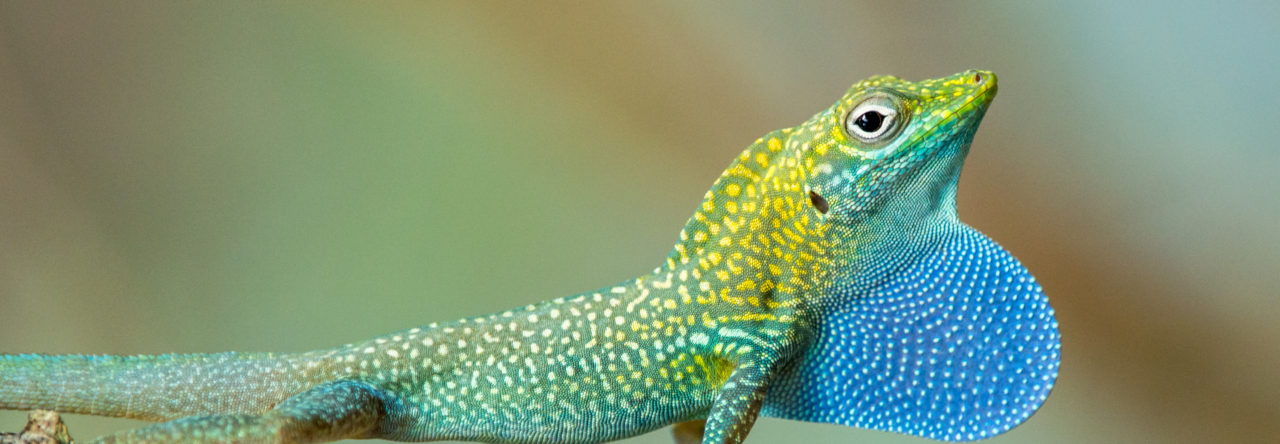
 The Invasive Species Specialist Group, a Species Survival Commission (SSC) of the International Union for the Conservation of Nature and Natural Resources (IUCN), recently gave the weekly top honor to our favorite greenie. We love ’em here in the U.S., but as we’ve documented many times, they can be a problem elsewhere. A pdf of the picture above is available at the ISSG site.
 AA contributor Dave Steinberg is in Costa Rica filming anoles. He’s posted his first report over on Chipojolab, featuring information on the diet of a juvenile A. capito he caught, with a surprising twist.

Male A. pogus fighting. Photo from http://www.lesfruitsdemer.org/wp-content/gallery/anolis-pogus-battle-03-01-2010/DSC_7573.jpg
Recently, our lab group was discussing what can be inferred from calculating tail loss rates in anole populations. It was pointed out that tail loss doesn’t necessarily result from predators and that, in fact, males may bite off the tails of other males in fights, and the victor or vanquished may even eat the tail. Someone pointed out that the older literature certainly pointed this out with examples*, but we haven’t seen much of this in more recent literature. So, we then asked, has anyone ever actually seen a tail lost in a fight? No one had. I then got online to look for photos. I could find plenty of males fighting, usually locking jaws or sometimes biting the body or a limb, but I found no photos of an anole biting another’s tail, much less biting off a tail. So, I ask you, fair AA reader, have you ever seen this? Can you provide a photo?
*By earlier literature, we were thinking 1960’s and 1970’s, but here’s a quote from the 1870’s, referring to A. cristatellus. Can you name the author? “During the spring and early part of the summer, two adult males rarely meet without a contest. On first seeing one another, they nod their heads up and down three or four times, and at the same time expanding the frill or pouch beneath the throat; their eyes glisten with rage, and after waving their tails from side to side for a few seconds, as if to gather energy, they dart at each other furiously, rolling over and over, and holding firmly with their teeth. The conflict generally ends in one of the combatants losing his tail, which is often devoured by the victor.”
Nicholson et al.’s proposed re-classification of anoles is now a few weeks old and we’ve already had numerous posts on the topic as well as some great discussion. Given the interest in this topic, we’ve decided to dedicate all of next week to discussion of this paper. We invite contributions from all members of the anole community. Because we have mostly heard people speaking out against, we are particularly interested in hearing those who support this new arrangement. Anole Annals is a community forum and we do not edit content of posts from our contributors, but we do expect all contributors and commenters to use their real names (like many blogs, we’ve found that anonymity leads to problems that we’d like to avoid).
Here are some of the topics and posts slated for next week. More are welcome!
Monday: Background Information
Historical Perspective on Fragmentation of Anoles into Multiple Genera – Glor
Does The Code Compel Us to Change Anole Classification? – Glor
Tuesday: Thoughts on the New Taxonomy
It is NOT Time for a New Classification of Anoles – Losos
A Rose is a Rose, but is an Anolis a Dactyloa? – Gorman
Wednesday: Calibration and Biogeography
Evaluating Support for the Hypothesis that Anoles are 90+ Million Years Old – Glor
Mitochondrial Estimates for the Age of Anole Radiations – Scantlebury
Thursday: Anole Ecomodes
Is It Time to Replace Ecomorphs with Ecomodes? – Losos
Friday: Loose Ends and Discussion
Last week, I wrote a post on how the new classification for anoles proposed by Nicholson et al. 2012 might affect long term taxonomic stability for this group. That post generated some discussion, including, most recently, commentary by Kirsten Nicholson herself, explaining some of the reasons her group decided it was time to split up the anoles. Because that conversation is quickly becoming buried in the depths of Anole Annals, I wanted to continue it here on the main page. Also, I wanted to write some more to expand on some of the thoughts that prompted me to post last week, and I hope folks will continue to weigh in (note, the rest of this post will make a lot more sense if you first read my previous post, and the ensuing commentary). I’d like to make several general points:
1 – I think we can all agree that taxonomies should reflect accurate phylogenetic knowledge (I don’t think anyone here would disagree with this – let’s take it as a given that Linnean taxa should not be paraphyletic or polyphyletic).
2 – Beyond accuracy, I’m pretty sure there aren’t any rules governing the type or level of phylogenetic information that “should” be included in a binomial classification. Whether binomial names should reflect deep phylogenetic knowledge or shallow phylogenetic knowledge is a matter of opinion – I’d propose it’s completely subjective.
3 – The amount of phylogenetic information you can communicate in a binomial classification is trivial. It’s hard enough to represent phylogenetic structure across the depths of the entire Linnean hierarchy, and there’s almost no such information in Genus+species epithets. The goal of communicating finely resolved phylogenetic information probably should not be our main concern when dealing with genus names (so long as they are not phylogenetically inaccurate).
4 – Given that no one’s to say who’s right about what the appropriate phylogenetic scale of a genus is, and that Latin binomials are ineffective at communicating much of anything about phylogenetic information anyway, issues of stability are comparatively very important. It’s no small thing to propose a change for 88.6% (n = 343) of the scientific names of a group of species studied by thousands of people.
Since I think we can all agree that Linnean names should be applied solely to monophyletic groups, I’ll start with my second point, which is that there’s no “right amount” of phylogenetic knowledge that should be expressed in binomial names. Kirsten suggested we might all agree that “our classifications should mirror our phylogenetic knowledge.” I certainly agree with this statement in general, but I suspect I might disagree on some of the details. What sort of classification, exactly, would mirror our knowledge best? Should we assign genera to the smallest phylogenetic units about which we can be reasonably certain of monophyly, and continue to split them up into additional genera as we work towards resolving the entire bifurcating history of anoles? If so, we’ll probably eventually end up with a taxonomy that’s as finely parsed as that of the non-avian dinosaurs, where the genus:species ratio is 1:2 (I’m not even kidding – check it out…)! At this point, we’d have all sorts of cool binomials, like Nicholsonolis annectans and Mahlerolis gorgonae, but the genera would be functionally equivalent to species names (as they are in dinosaurs). This sort of reasoning (taxonomy should reflect ever-improving phylogenetic knowledge) is implied in the very title of the Nicholson paper, which seems to suggest that periodically, when the progress of systematics has advanced enough, “it is time” to reclassify everything (I think this contradicts the founding purpose of Linnean classification, but that’s another point). Anyhow, if this isn’t what it means for a taxonomy to mirror phylogenetic knowledge, then what exactly does that mean? Why 8 genera, and not 60, 16, or 4?
My main point here is that it’s a matter of opinion what kind of phylogenetic knowledge should be in a Latin name. One person might think that a genus should apply to the MRCA and all descendants of any two species similar enough to be confused by an experienced herpetologist (e.g., Anolis fraseri and A. biporcatus; see Williams 1966 for details). Another person might maintain that a genus should have 20 species max, no exceptions. Both are entirely matters of opinion, and such opinions abound when it comes to systematics. But since there are no official guidelines on the matter, I don’t think that such opinions can suffice to justify a disruptive taxonomic change.
I next wanted to criticize the logic of amending genus names to reflect systematic developments. The reasons are that (a) there’s very little phylogenetic information in Latin binomials, and (b) any change in the names of genera will result in a gain of some phylogenetic information (shallower information) at the expense of other phylogenetic information (the deeper stuff).
Linnean binomials contain next to no phylogenetic information. When we look at a list of scientific names, all we know is that congeners are more closely related to one another than they are to members of other genera, and other than that, they don’t tell us anything about phylogeny. To illustrate this, I created “binomial phylogenetic trees” for the Iguanidae (or Iguania, depending on who you follow..). I included all species in “Iguania” from the Reptile Database. Here’s what the traditional classification looks like, with Anolis highlighted in red:

Binomial “phylogenetic tree” of iguanian genera, following the traditional classification.
That’s right, it says so right here!
 No surprise to us at AA, but greenies apparently provide yeoman service as garden pest control. And the wonderful folks at www.getmypestout. com provide all kinds of good advice about how to foster a healthy anole population in your garden. Good on ’em!
 If you were to cast lizards as characters in a remake of The Great Gatsby, anoles, of course, would have to be cast as protagonist Jay Gatsby. “
What Why Gatsby?” you might ask. Well, like Gatsby, anoles have gaudy, aggressive displays that show fitness and define territory. Also like Gatsby, (SPOILER ALERT) anoles cannot seem to escape their past (for the headbob part of their display, at least).
In a recently published paper, Terry Ord investigated whether past ancestry explains variation in Anolis diplays better than evolution by natural selection. To begin to ask this question, Terry compiled data on the average time of headbob and dewlap bouts for species for a Western Caribbean Anolis lineage (Jamaica, Cayman Islands, Cuba) and for an Eastern Caribbean lineage (Puerto Rico and Hispaniola). The data and phylogenetic relationships are shown in Figure 1.

In our comparison of mainland and island species turnover, we sampled mainland communities by randomly superimposing each of the Caribbean islands on the mainland five times. In each of these mainland island-shaped regions, we then tallied how many species were present and then measured turnover between regions.
Oceanic islands are famous for their high endemism. We all love Darwin’s finches, Hawaiian honeycreepers, Komodo Dragons, and all those weird things on Australia. These endemic wonders suggest that islands may be home to unique processes of diversification. However, there are many mainland regions that rival islands in their level of endemicity, especially in mountainous regions that have strong dispersal barriers and environmental gradients. Thus, you could ask, are islands truly special?

This NC green anole is on the ground, but mostly they apparently are up in the trees. Photo from http://www.wildherps.com/images/herps/standard/08041129PD_green_anole.jpg
We’ve had a lot of talk here on AA about how green anoles can be found low to the ground in places where A. sagrei has not invaded. But Manuel Leal says that’s not so in sagrei-less North Carolina, where all the ones he saw in the woods were high in the trees. What gives?


A recent photograph by Emma Sherratt. Amber tends to darken over time, which explains the deep orange color.
We’ve had previous posts on fossil anoles in amber. Emma Sherratt is currently studying them and has examined some three dozen specimens. All of these are from the Dominican Republic. Except the first one ever discovered, a Mexican piece described by Skip Lazell in 1965. Anolis electrum, as it was named, has had a pretty quiet scientific life. Now middle aged, the species has not been the subject of any subsequent research in the 47 years of its existence. But now it’s in the spotlight, as its phylogenetic position and dating may be pivotal for the recent calculation by Nicholson et al. that anoles originated more than 100 million years ago. In this post, I summarize what is known about A. electrum (examine the short original paper for yourself!). No doubt, we’ll be hearing more soon about the relevance of this species–specifically its phylogenetic placement and age–for dating anole diversification.
As you can see for yourself in the photo above, there are actually two pieces, a front half of a lizard and a back half a lizard. Since they were found together (or at least made it to the Paleontology Museum at UC-Berkeley together) and are matching in size, it seems like too much of a coincidence for them not to come from the same animal. Various aspects of the animal’s scalation are discernible, including some nicely visible toepads. Lazell stated that all that was left was skin, or the impression of skin, the bones having been eaten away, but Emma’s cat scanning has shown that this is not quite correct (see below).
Based on the specimen, what can be said about its phylogenetic placement? All anoles in Mexico today are from the Norops clade. Unfortunately, the primary character for identifying Norops is the shape of the caudal vertebrae, which cannot be discerned in this tailless specimen. Lazell compared the scalation of this specimen (a 26 mm juvenile) to various species, and found that the scalation was unlike most species. He concluded that electrum was most similar in scalation to A. fuscoauratus, A. maculiventris, and A. chloris, and among species found in Mexico, to A. limifrons (full quotations at the bottom of this post).
What should we make of all of this? It’s important to remember that this paper was published in 1965, prior to the description of many extant anole species and a year before Willi Hennig’s classic introduction to cladistic analysis was translated into English. This is a purely phenetic comparison of the amber baby lizard to known species, clearly non-phylogenetic and utilizing characters that now are recognized to generally have little higher level systematic utility in anoles. And the conclusion is that it is either a Norops clade anole (fuscoauratus, limifrons or maculiventris) or a Dactyloa species (chloris).
The other question one might have is: how old is this fossil? Dating amber is notoriously difficult. Solórzano Kraemer reviewed all of the data on Mexican amber bearing deposits in the 2010 volume Biodiversity of Fossils in Amber from the Major World Deposits and concluded: “In summary, it can be said that Mexican amber can be correlated with Dominican amber, with an age of approximately 15-20 million-years-old.” In other words, Mexican and Dominican amber anoles were contemporaneous.
Did anyone notice anything odd on the fossil of the lizard posterior (B, above)?