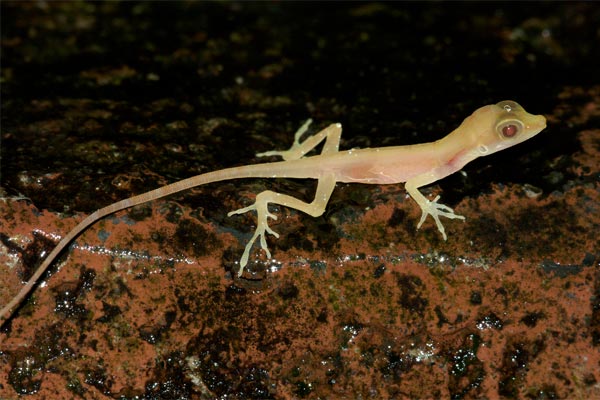
Anolis allisoni in the Grass

You thought I was kidding about the  Roatan allisoni doing their best grass anole imitation? See how many you find in this photo. There are at least five, but maybe I missed some.

Japanese Anole Toy

Anole Annals correspondent and skink biologist Matt Brandley recently sent me a padded envelope. When I pulled out its contents, above, I was bummed–crushed in transited. But I opened the bag and laid out the pieces.

Not crushed! Just disassembled.

The end result, perched on my computer monitor:

Note the purple dewlap, like some Anolis carolinensis from Hawaii.

Here’s the info from the company. Can anyone translate? There’s a whole zoo of different animals in their product line, but no other anoles.

Anolis Lionotus…Sleeping Posture

During a field survey in Muelas (21-08-2011; 21:07), buffer zone of the Santa Fe National Park in central Panama, an A. lionotus was captured in its sleeping posture on the river bank. Interestingly, they seem to “mimic” the dead tree branch, but being cryptic at night does not make much sense to me; even if the predator is capable of night vision, being perched on a tree without leaves does not seem to be an advantage.

Anolis lionotus


Research On The Hormonal Mechanisms Regulating Sexual Behavior In Green Anoles

Earlier this year, we mentioned a paper by Juli Wade reviewing research on the green anole, which has become a model organism for integrative studies of reproductive behavior in vertebrates. One example of such research is a paper recently published in her laboratory by Cohen and Wade in which levels of testosterone were experimentally manipulated to see the effect of this hormone on gene expression in different regions of the brain. The abstract gives the details better than I could:

“Aromatase and 5alpha-reductase (5-alpha-R) catalyze the synthesis of testosterone (T) metabolites: estradiol and 5-alpha-dihydrotestosterone, respectively. These enzymes are important in controlling sexual behaviors in male and female vertebrates. To investigate factors contributing to their regulation in reptiles, male and female green anole lizards were gonadectomized during the breeding and non-breeding seasons and treated with a T-filled or blank capsule. In situ hybridization was used to examine main effects of and interactions among sex, season, and T on expression of aromatase and one isozyme of 5-alpha-R (5-alpha-R2) in three brain regions that control reproductive behaviors: the preoptic area, ventromedial nucleus of the amygdala and ventromedial hypothalamus (VMH). Patterns of mRNA generally paralleled previous evaluations of intact animals. Although no main effects of T were detected, interactions were present in the VMH. Specifically, the density of 5-alpha-R2 expressing cells was greater in T-treated than control females in this region, regardless of season. Among breeding males, blank-treated males had a denser population of 5-alpha-R2 positive cells than T-treated males. Overall, T appears to have less of a role in the regulation of these enzymes than in other vertebrate groups, which is consistent with the primary role of T (rather than its metabolites) in regulation of reproductive behaviors in lizards. However, further investigation of protein and enzyme activity levels are needed before specific conclusions can be drawn.”

The Hatching Season is Upon Us

Here at the Glor Lab we’re in the second year of a major anole breeding experiment.  Specifically, PhD student Anthony Geneva is completing the second generation of an experimental study of reproductive isolation that was the subject of his poster at the Evolution meetings this past summer (see this previous post on Anole Annals for more on this poster).  I’m happy to report that egg production thus far has been steady and that the we’ve had hatchling emerging for a few weeks now.  In the photo above, you can see a baby just emerging from an egg in the foreground and other eggs individually incubating in vermiculite in the background.  We’ll have more to report on this experiment in the coming weeks.  We’re particularly interested in sharing information on how we’ve encouraged breeding this year by manipulating light and humidity, and in learning how others might have tried to do the same.

Anolis Maynardi Tail Display

Anolis maynardi confrontation. Photo by Pat Shipman

AA‘s correspondent in the Little Cayman bureau, Pat Shipman, reports:

We are in Little Cayman, greatly enjoying our anoles (maynardi & sagrei).  This morning we observed an interesting confrontation between two large, presumed male maynardi.  Not only were they head bobbing and flashing their dewlaps at each other, but they put their tails UP and pivoted their whole bodies forwards & back. The lower one in this snap is showing the tail up posture with dewlap.  Unfortunately it doesn’t show the rocking motion. We had not seen this rocking or pivoting posture before.

The second snap is a maynardi showing its ability to go dark.

Does anyone know how large a territory A. maynardihas? We see them quite regularly in the same places, day after day.

Dark A. maynardi. Photo by Pat Shipman

How Does One Decide Whether A Distinctive Population Is A Different Species?

Anolis sagrei nelsoni. Photo by Steve Busack.

Bob Powell raises an important point in a recent comment, concluding “So, at what point does a differentiated isolate cease to be a subspecies and become a species?” In other words, how do we decide whether to recognize a distinctive population as a different species? I’m not talking about the situation where somebody goes out and comprehensively samples a clade and then uses the latest fancy-pants statistical wizardry to decide how to “delimit” taxa into one or multiple species. Rather, I’m going old school, focusing simply on the situation in which one has a population that is distinctive from other populations. Should we recognize that population as a different species? What kind of evidence is sufficient?

The context is the population discussed last week, Anolis sagrei nelsoni, from the remote Swan Islands 90 miles off the coast of Honduras. This isolated population is morphologically distinctive in many ways from other sagrei. It’s larger, has more lamellae on its toes, and, at least in the photograph above, has a very dark dewlap. Very likely, when Randy McCranie is done examining their scalation, he’ll document  other peculiarities. Is this enough to decide to recognize Anolis nelsoni? Certainly, in recent years the same approach has been taken to recognize a number of other Central American anole populations as distinct species.

One problem with this approach is that nelsoni probably lies phylogenetically somewhere within what is currently recognized as A. sagrei (just my guess, but the only phylogeographic study on sagrei to date placed Belize populations in the middle of sagrei). Hence, raising nelsoni to species status would render the rest of sagrei paraphyletic, which bothers some people more than others.

Another option is to name the population (or in this case, retain the population) as a subspecies. I recently semi-seriously suggested to a collaborator that we name two subspecies for populations of a species found on two islands. He just laughed.

The answer, of course, is to conduct a detailed systematic study of the entire A. sagrei clade, using both molecular and morphological data. The problem is that this is a huge undertaking. Even Al Schwartz didn’t tackle variation in sagrei! So, it may be a while before this gets done. What do we do in the meantime? Is it A. sagrei nelsoni or A. nelsoni? Good question, Bob!

Update on Expedition to Swan Islands

While we’re on the topic of A. sagrei nelsoni,

Albert Schwartz’s Notebooks

Albert Schwartz, longtime professor of biology at Miami Dade Community College, was one of the most important figures in anole biology. Schwartz co-authored the authoritative account of West Indian reptiles and amphibians with Robert Henderson, described at least 8 anole species (in addition to many other reptile and amphibian species), authored dozens of reports on anole taxonomy and biogeography (see previous reviews on Anole Annals of his reports on Hispaniolan giant anoles and Hispaniolan trunk anoles for examples of this work), and amassed a collection that would ultimately include over 15,000 anole specimens. Most of Schwartz’s West Indian collection can now be found in the collections of the University of Kansas, including 15,511 anoles. When Schwartz completed his work on the vast collections he had accumulated over decades of intense field sampling, he reached an agreement with KU that would, in 1987, have Bill Duellman and Linda Trueb driving a 38′ U-Haul truck full of over 60,000 reptile and amphibian specimens of  from Florida to Kansas.  In addition to acquiring Schwartz’s preserved material, KU also acquired Schwartz’s original notebooks.

These notebooks are housed in KU Herpetology’s library and I had a chance to check them out during a recent visit. There are more than 40 notebooks in total, and they extend across Schwartz’s career in the West Indies. He kept his fieldnotes primarily in student composition books (some of which actually bear the title “SCHOOLTIME Compositions”). For the most part, Schwartz’s notebooks are simple catalogues of specimens that include a field series number, the species name, and the date and location of the collection. Although he provides color notes on most specimens, he rarely comments on natural history or other aspects of a particular specimen’s biology.

I’d like to get all of these notebooks digitized and transcribed so that the information they contain can be made available to anyone who’s interested.  I’ve been thinking that it might be fun to crowd source the transcription of these notebooks once they’re scanned.  For those who aren’t familiar with crowd-sourced transcription, this process permits large numbers of internet users to transcribe old texts that cannot easily be digitized via optical character recognition.  Today, this approach is widely used by folks interested in transcribing handwritten documents and numerous software applications have been developed to facilitate the process.  It’s already being used to transcribe some historical field notes, including an effort by The San Diego Natural History Museum to transcribe the field notebooks of the herpetologist Lawrence Klauber.

What do you think?  Are there readers of Anole Annals who would be interested in helping transcribe Schwartz’s notebooks?  Does anybody have past experience coordinating such efforts that they’d be willing to share?

The Anoles Of Saint Maarten

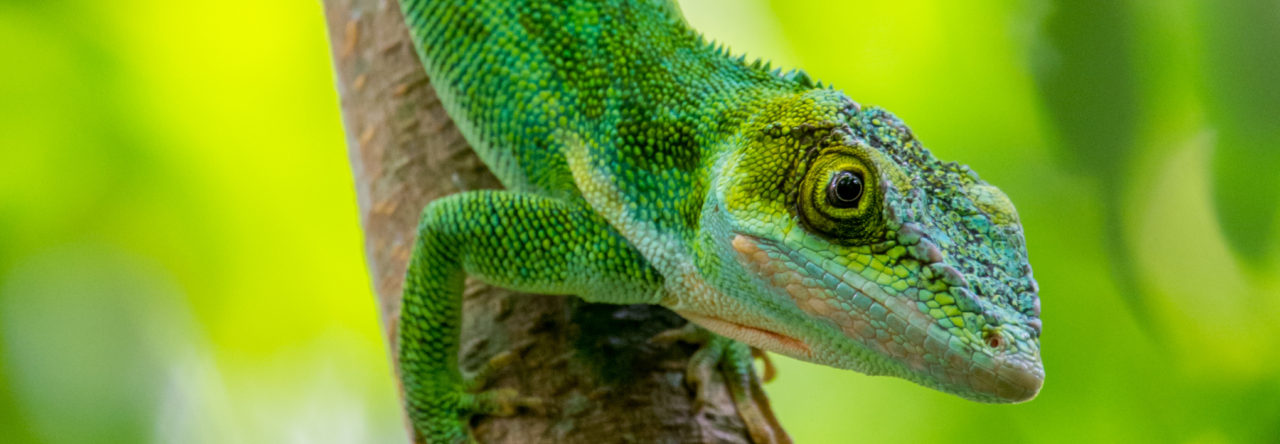
Anolis gingivinus. From http://wordpress.iworklab.com/dcna/bush-and-tree-anoles/

Read all about them in this post from the Dutch Caribbean Nature Alliance (whose logo features an anole!).


Anole Xmas Tree Ornament


Anole holiday shopping season is now officially open! What could be better than a Christmas tree festooned with ecomorphs?

Page 217 of 305

Powered by WordPress & Theme by Anders Norén