
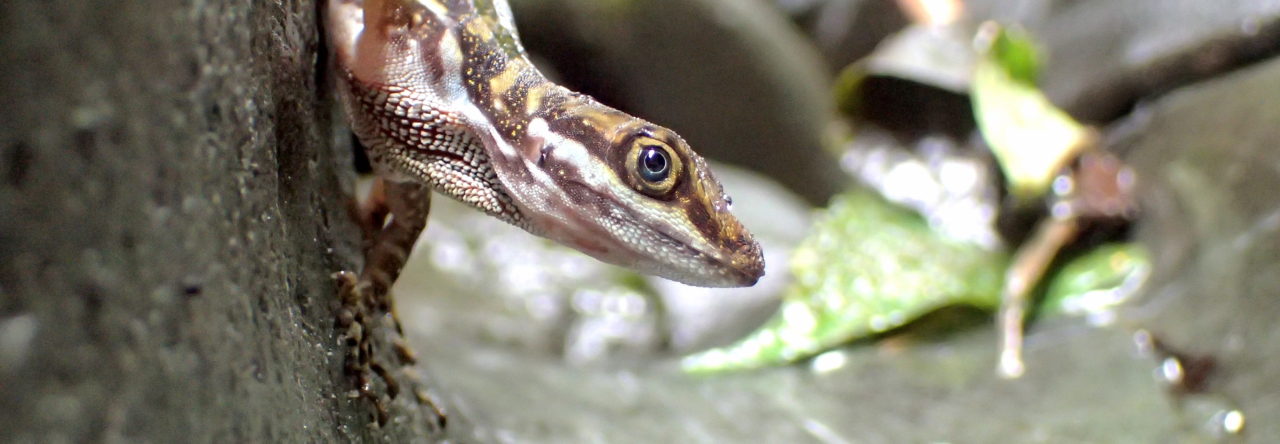
SICB 2015: How Do Anoles Get Big?

photo from;http://www.saumfinger.de/anolis_equestris.html photo by:Uwe Bartlet ?

One of the largest anoles, Anolis equestris (photo by Uwe Bartlett)

From the diminutive twig anole to the monstrous crown-griant anoles, Anolis lizards vary dramatically in their body size. Much research has focused on the patterns of body size variation among Caribbean species, how changes in body size are correlated with habitat differences among species, and rates of body size evolution upon invasion to new islands, yet an important question remains to be addressed in this body of literature, “how do anoles change body size?” S. Griffis and Dr. D. Jennings of Southern Illinois University at Edwardville are attempting to address this among Cuban anoles by searching for DNA sequence differences in known growth factories. But they are using what might be considered an unlikely model for lizard body size variation: dogs. Several years ago, Elaine Ostrander’s lab at the NIH uncovered that coding differences in the growth factors IGF were responsible for the body size variation in dogs. To a mechanist like myself, it was a surprise that this variation could be traced to coding differences in the genes, not to the levels of circulating growth factors. The authors of this poster are following Ostrander’s lead by looking for coding differences in genes involved with the IGF growth axis. But to keep their options open they are also collecting data on circulating hormone levels. When complete, if there are differences in the IGF growth axis contributing to differences in body size, Griffis and Jennings will find it.

SICB 2015: A Synthesis of Sexual Selection and Life History Perspectives

Anolis sagrei mating. Taken from the Cox lab website.

Anolis sagrei mating. Taken from the Cox lab website.

On the first day of SICB 2015 Robert Cox gave an interesting talk about reproductive investment and sexual selection in lizards. At the center of his talk was the striking notion that males and females are different biologically, yet should still be integrated into cohesive theories of sexual selection. According to Dr. Cox, past theory has generated mutually exclusive ideas about the costs of reproduction for each sex. Whereas theories about females have focused on life history and investment in the egg and offspring, theories about males have focused on mating investment. Cox stressed that this is overly simplified and doesn’t reflect biological reality,  as males and females also share many of the same costs of reproduction as well. Issues like growth, survivorship, energy storage, and parasite load are shared between the sexes. Dr. Cox is now trying to test how sex-specific reproductive mechanisms affect these shared reproductive constraints by surgically removing the gonads of each sex. Preliminary analyses show that parasite load appears to be a shared effect among the sexes regardless of the underlying mechanism (testosterone derived from testes versus estrogen derived from the ovaries). Studies directly comparing the underlying mechanisms of sexual dimorphic anatomy, physiology, and behavior are critical for the further development of sexual selection theory and for improving our understanding of anoles. Studies like Dr. Cox’s are an important step in that direction.


SICB 2015: Anoles in the Big City! Urban Environments and Predator Escape Behaviors

Screen Shot 2015-01-05 at 4.09.44 PM

Anolis cristatellus in Miami, Florida. Picture by Jason Kolbe.

Humans and wildlife are sharing the same spaces more and more frequently, but there’s still much that we do not know about how animal behavior is altered in urban environments. To address these questions, graduate student Kevin Avilés-Rodriguez (pictured below) and Dr. Jason Kolbe of the University of Rhode Island studied the responses of Anolis cristatellus to simulated predators in urban and natural environments in Puerto Rico. They found that lizards in an urban habitat had shorter flight initiation distances (the distance a simulated predator – in this case, Kevin – could approach before the lizard fled) than in a natural, forested site.  In addition, lizards’ predator-escape behaviors generally corresponded to the sizes of their perches and to their proximity to vegetation, but perch types differed between the urban and natural sites.  Whereas lizards in natural habitats tended to jump into nearby plants to escape, urban lizards tended to avoid capture by squirreling on larger, more isolated perches.  Kevin also reported that lizards perching on cement walls had adjusted their predator responses dramatically, as they generally did not jump or squirrel. In sum, this study suggests that habituation to humans and/or human-shaped habitats have altered the responses of these lizards to potential predators in important ways.

Kevin Aviles, stalking lizards in the field. Photo from Kolbe lab website.

Kevin Aviles, stalking lizards in the field. Photo from Kolbe lab website.

SICB 2015: What Causes Dorsal Crest Erections in Anoles?

We’ve all seen anole lizards extend their dewlaps, but the social displays of the many species of anoles also include the erection of a dorsal crest. But, what underlies the formation of these crests? Although many of us have talked about this, undergraduate John Ficklin, along with Morgan Gerace and Dr. Matthew Rand, all of Carleton College, aimed to find out and presented their work today at SICB. By injecting Anolis sagrei and A. carolinensis lizards with isoproterenol (a β-adrenergic agonist), they caused crest erection in males, but not in females. They then used histological techniques to examine the cellular morphology of the crest. What they discovered is that male anoles have a clearly-defined organ they dubbed the “crest capsule” (a structure female anoles lack), and when this capsule is filled with an edema from local blood vessels, the crest extends vertically. Collagen fibers appear to help maintain the crest’s vertical orientation during its display.  After inflation, the edema then drains into the subcutaneous space surrounding the capsule, causing the crest to deflate. They found no evidence of the involvement of muscles, cartilage, or vascular sinus in crest erection.

In sum, John Ficklin and his colleagues have solved one of the big questions of anole display!

SICB 2015: How Do Lizards Move in Nature?

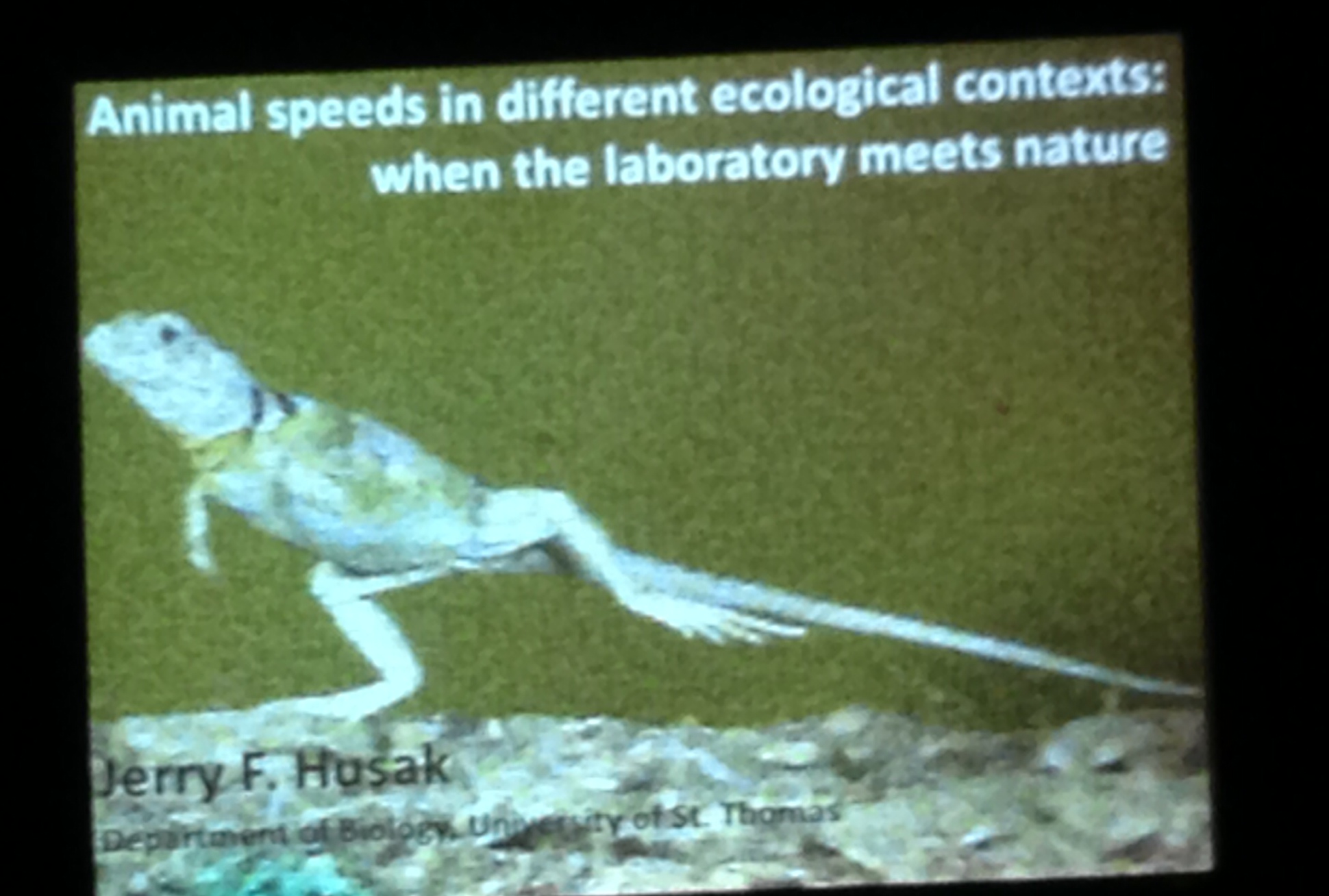
Jerry HusakHow do lizards move in nature? Note the added emphasis on “in nature.” For many years people have studied the mechanics and patterns of of lizard movement and anoles have played an important role in this research. But today Jerry Husak of the University of St. Thomas in St. Paul reminded us that most of this research has focused on characterizing maximum performance ability, despite the fact that  animals rarely achieve this level of activity in nature. For example, most of the time many lizards are merely scurrying about on the ground and not sprinting at their full ability. Hence, although measuring maximal spring speed in the lab is a common theme, this measurement may not actually reflect what animals do in nature. Dr. Husak also stressed to the audience that animal locomotion is context dependent. Specifically, a lizard’s speed depends on whether it is moving in grass or over rocks, and whether it is foraging or fleeing from a predator. During his enlightening discussion, which included a description of him trying to sprint on a frozen Minnesota sidewalk, Dr. Husak described a series of biotic and abiotic factors that should be incorporated into models of terrestrial lizard movement.  Finally, he concluded by challenging our obsession with maximum sprint speed once again by asking whether running at top speed can lead animals to make to costly mistakes. Based on a set of foraging data, he showed that this may be the case.  Dr. Husak’s talk highlighted the importance of understanding the natural habits of lizard behavior and performance. 

SICB 2015: Convergence in Body Shape among Squamates

P. Bergmann

Patterns of Convergence in the Body Shape of Squamate Reptiles

SICB 2015 is off and running and what better way to kick it of than with a lizard talk? Phillip Bergmann of Clark University filled the 8:15 time slot on day one with an intriguing evaluation of broad-scale body shape convergence among squamates. This is a perennial topic on Anole Annals due to the well-studied patterns of convergence among Anolis lizards and, indeed, Dr. Bergmann highlighted anoles early in his talk. He asked whether common functional (ecological) situations lead to body shape convergence at large scales. Rather than search for global patterns of convergence, Dr. Bermann used hypotheses specific to the transformations that occur when lineages transitioned into new habitats. As he pointed out, it is not surprising to find convergence in body shape occurring throughout squamate – after all, convergence is ubiquitous across the tree of life. He concluded his talk highlighting what he feels are some of the most pressing “Big Questions” regarding convergence which included the methods we use to detect convergence, the role of constraints in shaping convergence, and elucidating the mechanisms underlying convergence. Ultimately it was a thought-provoking talk both from the perspective of squamate organismal diversity and the topic of convergence more broadly.

Videos and Photos of Honduran Anolis allisoni

Anolis allisoni displaying. Photo by Pablo Bedrossian

Sister WordPress blog pablobedrossian has a nice post with photos and videos of A. allisoni from Los Cayos Cochinos in Honduras.

Let SICB 2015 Commence!

When I was a kid, the first week of January used to be such a bummer for me because it meant that the holidays were over. But now the first week of each year means that the annual meeting of the Society for Integrative and Comparative Biology (SICB) is underway! The meetings run from January 3rd until January 7th, and there are 30 talks/posters this year about anoles! I won’t be attending this year, as I’m currently based out of Australia (AKA land of no anoles), so I’ll be looking forward to the posts on this blog to hear what’s new and exciting in Anolis research. Stay tuned!
Two More New Anole Species

Introducing Anolis alocomyos.

Introducing Anolis alocomyos.

Gunther Köhler and colleagues have done it again!This time, they’ve taken Anolis tropidolepis  in Costa Rica and divided it into three species in the December 2014 issue of Mesoamerican Herpetology.

The back-story: the A. pachypus complex (as the authors refer to it, except using the generic name Norops) has in recent years been split in Panama into four species, but complex member A. tropidolepis remained intact in Costa Rica. These lizards are long-limbed, narrow-padded lizards found near the ground at high elevations.

Based on eight years of collecting, Köhler and colleagues now split the group in Costa Rica into three species that are somewhat genetically differentiated at the 16s mitochondrial gene and that differ in hemipenial morphology and to some extent in scalation.  One of the OTUs (operational taxonomic units), comprised of a single individual, has the mtDNA of one species and the hemipenis morphology of another and is interpreted as evidence of hybridization.

The paper includes interesting discussion of bar-coding and how one goes from degree of genetic differentiation to decisions on species delineation.

One highlight of the paper was the icon shown below, which occurred at the bottom of one of the pages at the end of the article without explanation. A quick look at the other two papers in the issue revealed that each has its own logo–nice!

icon

Eyelash Vipers Down Anoles

Photo by Christopher E. Smith

Photo by Christopher E. Smith

Christopher E. Smith recently tweeted this photo of an eyelash viper consuming an anole. The photo was taken in Tortuguero, Costa Rica in 2008 and the incident is recorded on HerpMapper. He provided additional photos which show the anole more fully. It appears to me to be an A. limifrons, though the regenerated tail means that the usual tail banding is not present.

limifrons eaten by eyelash christopher smith II


And two more, for good measure:

limifrons eaten by eyelash christopher smith III

And Down the Hatch!

Photo by Christopher E. Smith

Photo by Christopher E. Smith

In going back through the AA archives, I’ve discovered that we previously posted a link to these photos in April, 2011! But here they are again for your renewed viewing pleasure.

Consumption of A. limifrons by eyelash vipers has been previously reported, including a lovely photo by Harry Greene in Lizards in an Evoutionary Tree. A quick Google Image search yields a number of photos, although I suspect most are in captivity.

Here’s an interesting one:

This, in turn, led me to The Many Creatures of Costa Rica blog, which has a whole series of photos of this predation event from La Selva in Costa Rica. The anole seems to be A. humilis. Here’s another from the series:


Page 146 of 305

Powered by WordPress & Theme by Anders Norén