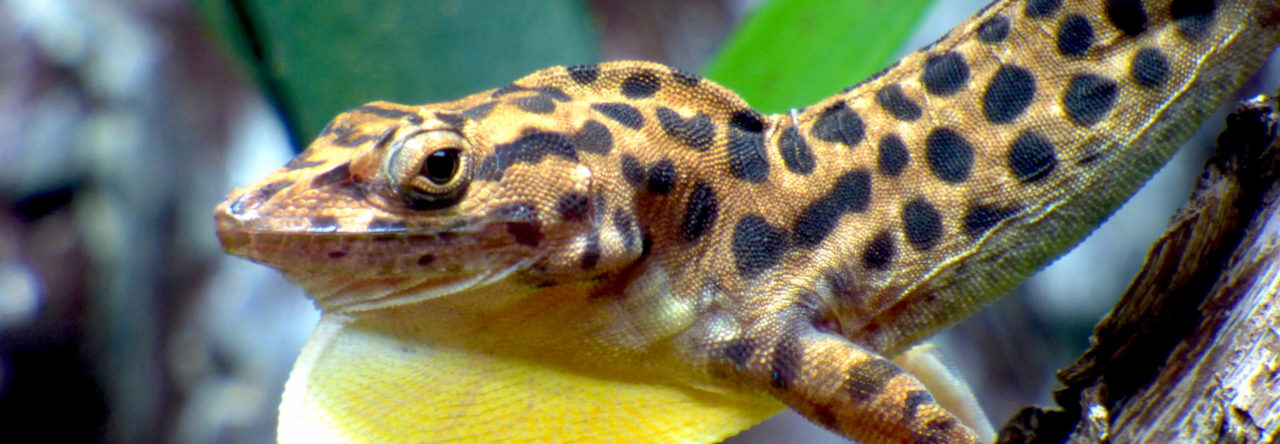
Get a Grip on It! Cling Force and Perch Diameter

An actual perch used by Anolis cristatellus - neither smooth nor flat! (photo by K. Winchell)

An actual perch used by Anolis cristatellus – neither smooth nor flat! (photo by K. Winchell)

In the real world, lizards cling to everything from smooth, flat concrete walls to rough,  rounded tree trunks. So why is it that most studies on cling force in anoles focus on clinging to smooth flat substrates? Does cling force differ if the substrate is rounded or rough? Jason Kolbe sought to answer this question in his recent publication, “Effects of Hind-Limb Length and Perch Diameter on Clinging Performance in Anolis Lizards from the British Virgin Islands” (Kolbe 2015).

We know that morphology impacts performance in anoles and that performance varies with environment. For example, sprint speed is correlated with limb length, but this relationship depends on the diameter of the substrate (e.g. Losos and Sinervo, 1989). We also know a little about clinging performance in anoles. Greater cling force is correlated with larger toepads and more lamellae on smooth flat surfaces (Irschick et al., 1996; Zani 2000; Elstrott and Irschick, 2004), but adhesion on rougher surfaces may be influenced by claw and toe morphology (Zani 2000).

There appears to be an unexplored interaction between substrate properties and clinging ability that involves more than just toepad characteristics. Specifically, Kolbe points out that claws can increase clinging ability by digging into the perch or simply by increasing friction on the surface. Limbs can also increase friction via the application of compression forces to the substrate. In other words, cling force can be increased, particularly on rough surfaces, by using muscular force to grasp rather than relying on van der Waals forces from the toepads, which are more effective on smooth flat surfaces.

Anole species used in this study: Anolis cristatellus (left) and Anolis stratulus (right). Photos by K. Winchell.

Kolbe investigated this further by looking at the interaction between limb length and clinging ability on perches of different diameters with Anolis cristatellus and Anolis stratulus from the British Virgin Islands. Specifically, he hypothesized that cling force should increase as the ability of a lizard to obtain a firm grasp on a substrate improves (i.e. when it can wrap its limbs around the substrate). This ability to form a secure grasp is dependent on both the diameter of the perch and on lizard limb length.

Urban Hibernacula

IMG_6548

Urban environments often create a diversity of novel habitats that differ from natural areas in thermal variance and spatial organization. Sometimes this results in a broader range of usable microhabitats for species able to thrive in human-disturbed areas. A few days ago I discovered such a microhabitat in an unlikely place. Last October, after getting mucked up seining for turtles in a slow moving Alabama stream, I quickly rinsed my muddy boots with a water hose and tossed them absentmindedly into a sunny spot to dry. There they remained until I went out a few days ago (January 30) with my daughter to look for green anoles coming out to enjoy a brief break in winter weather. Temperatures for the day were expected to reach the upper 60’s° F. Even in midwinter, green anoles (Anolis carolinensis) will sometimes emerge from their hibernacula to sun if the weather is right. As we walked outside, I noticed such an individual emerging from one of my steel-toe boots; he was covered in a dry layer of mud that most likely still lined the insole from my turtle trip last fall. He was quite sluggish so my daughter (3 ½) was able to inspect him for a moment before he got spooked and scurried off to a sunny brick wall some distance away. This was the only anole we found for several hours, so we called it quits and went looking for salamanders. Later that evening, once the sun was long down and temperatures had returned to a squamate-chilling 52° F, my skepticism got the best of me, and I returned to the boot for another look. After probing around a bit I found what I was looking for: a little green lizard had returned to bed down for the rest of the mild Alabama winter.

Are Anolis aeneus active at night?

Recently here in Trinidad, West Indies, I came across an Anolis aeneus. I observed the individual at 1930 h; sun had set at 1810 h. It was perched vertically on a wall, roughly 1 m off the ground facing down – as if in a foraging position. There was a bright light shining over it. I’m curious as to whether this type of behavior has been noted before; are these anoles also known to be active at night?

Anolis cuvieri, the Lizard Star in the New Amazon Prime Show, Mad Dogs

Anolis cuvieri - Mad DogsAnolis cuvieri - Mad Dogs 2I was watching the new Amazon Prime Show, Mad Dogs. Episode 6 is called “Leslie” named after an Anolis cuvieri, which is a central character in the episode. I grabbed a screen shot of the animal, and then another screen shot with a character holding it. The show is set in Belize ( using my Anolis Forensics Skills I deduced it was not filmed there). I did verify later it was filmed in Puerto Rico.

This may be the most Anolis “screen time” I have ever seen in a movie or show.  Anolis may be about to breakout into mainstream Pop Culture; keep an eye out for the Oscar – Best use of Anolis in a Major Motion Picture.

Yet Another Salad Anole

saladlizard

Green Fruit Loop, the salad anole of Princeton, NJ

We’ve previously reported on anoles finding their way into commercial produce, with happy and not so happy outcomes. Count this story from Princeton, New Jersey as one of the happy ones…

A kindergartener at Riverside Elementary found this juvenile Anolis carolinensis in a bundle of lettuce that had been stored in the family refrigerator for three days. Although initially listless, the animal recovered quickly and now seems to be doing just fine living with her reptile enthusiast science teacher. The new class pet was named Green Fruit Loop and will hopefully serve as an anole ambassador at Riverside for years to come.

The Anoles of Baton Rouge

Read–and hear–Chris Austin of LSU tell all about Red Stick’s Green Anoles. Plus, the photo gallery has a nifty photo of a kestrel with a green anole in its talons.

A First: Chamaeleolis Art

chamaeleolis print

Available as a print on Nadilyn Beato’s Etsy shop, along with lovely drawings of many other animals.

SICB 2016: Variation in Sperm Morphology of Native and Introduced Populations of Three Anolis Species


From left to right, Ariel Kahrl, Christian Cox, and Bob Cox.

Ariel Kahrl, Christian Cox, and Bob Cox.

Sperm morphology is highly variable across animals and is a great model for studying the evolution of sexually selected traits.

Ariel Kahrl, a Ph.D. student in Bob Cox’s lab at the University of Virginia, gave a talk on a study which she and coauthor Cox did just that. They sampled sperm from native and introduced populations of Anolis sagrei, A. distichus, and A. cristatellus to look at variation in morphology.

Variation in sperm morphology between native and introduced populations of three Anolis species.

Variation in sperm morphology between native and introduced populations of three Anolis species.

Interestingly, they found that introduced and native populations often varied in sperm morphology (i.e., head, midpiece, and tail lengths). Moreover, these effects were consistent between the three species tested!

Kahrl also pointed out that the variation observed in sperm morphology between males of a single species was often as large as that observed between different species. This study suggests that sperm morphology is highly plastic and/or is capable of rapid evolution in response to environmental change. Further work is needed to elucidate what selective pressures are driving the variation observed between introduced and native populations of these three species.

Knight Anole (Anolis equestris) Subspecies Question

KnightAnoleIMG_0856I photographed this knight anole 9 November 2015 at Criadero de Cocodrilos, Matanzas, Cuba. I tentatively assigned this one to Anolis equestris juraguensis based on the range map on page 257 in “Amphibians and Reptiles of the West Indies” by Schwartz and Henderson (1991).  However after reviewing the detailed descriptions in Schwartz & Garrido (1972), I believe this individual is a better match for nominate A. e. equestris. I base this primarily on the yellowish occipital patch and contrasting blue color on its head.  The range map in Schwartz & Garrido does not include this particular locality, but nominate is geographically close.   Confirmation or corrections are welcome.

Anole Calendars Now 30% Off. Watches, Too!

anole calendar 1 front

Your frugality has paid off! Through Wednesday, zazzle.com is having a 30% sale. That’s $15 per calendar. Stop missing appointments and get your calendar today. Code: SEMIYEARSALE

anole calendar 2

While you’re shopping on zazzle, check out the Anole Annals store there. All custom items are on sale for 30% off, including the ecomorph line of watches, ties, playing cards and more.

watches

Page 119 of 305

Powered by WordPress & Theme by Anders Norén