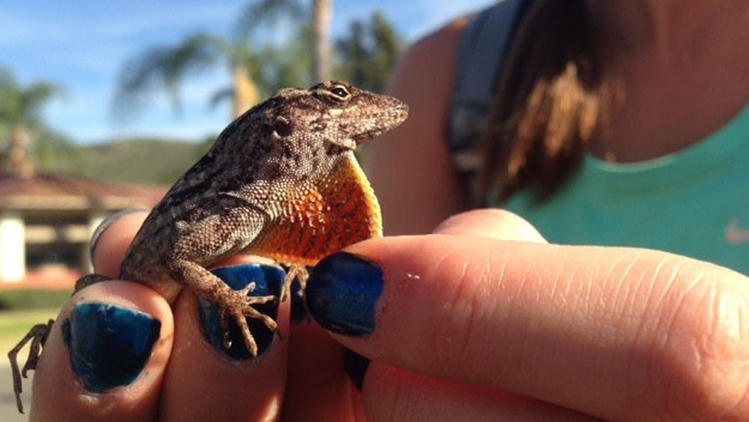
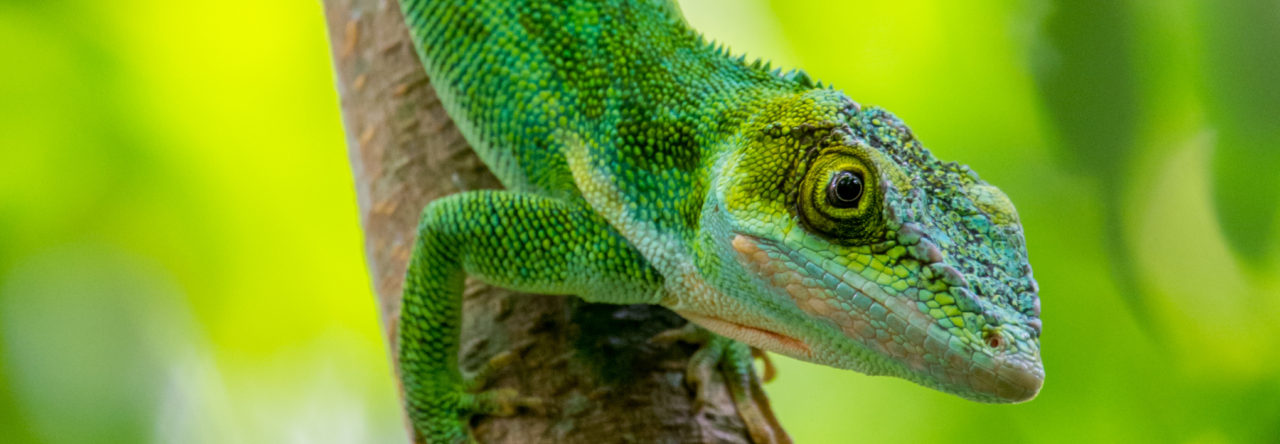
Dear experts, I will be very grateful if anyone could help me identify these three species I found in Roatán, Honduras.

As reward, I offer this beautiful Allison’s anole (Anolis allisoni) photo. Cheers!
Any observant individual has noticed and possibly even been astonished by the incredible densities that some insular anole populations (i.e. A. sagrei) can achieve. Islands necessarily create a unique combination of environmental factors, several of which have traditionally been suggested as reasons that insular species are capable of attaining such densities. Species richness tends to be quite low on islands and so the diversity of predators remains low and there are fewer other species with which to compete for resources. A lack of predation pressure and competition can allow a species to more broadly utilize a traditionally occupied niche or even evolve to fill new regions of adaptive space, further utilizing resources in ways that increase population growth. A newly published meta-analysis of lizard densities across the globe confirms some of what we already knew about island biogeography, but also challenges some traditional thinking on the subject.
Seasonal fluctuations in the environment frequently lead to important modifications in the distribution of all kinds of resources in all sorts of ecosystems. Consequently, environmental seasonality has long been known to determine the biology, ecology and behavior of animals. Less known, however, is whether and how seasonality differentially affects populations of the same species inhabiting mainland and island areas.
By conducting field observations on Anolis nebulosus from a mainland and a nearby island population in the Jalisco coast (Western Mexico), Siliceo-Cantero & Garcia (2015) investigated i) if anoles from these populations experienced similar degrees of seasonality and ii) whether they responded similarly to these seasonal changes. At each of the study sites, the authors conducted a series of transects at three different time blocks of the day within the normal activity range of the species. They collected information on each of the observed anoles including sex, perch height, temperature and humidity. Behavioral information was obtained for males by conducting focal observations in which researchers quantified movement rates, perch height and width, as well as the type of movements (i.e. dedicated to thermoregulation, socialization, and feeding).
Results showed several differences in substrate use and behavior between sexes, sites, and seasons. Overall, females perched lower than males (see Figure below), which could be a strategy of females to minimize competition with males. Interestingly, both sexes tended to perch lower on the mainland site. The authors suggest this could be a way of decreasing niche overlap with the larger lizard Sceloporus melanorhinus, a species that is not present on the island site. The reason why females perched lower during the rainy season whereas males did not remains unclear.
In general, males showed higher movement rates and covered longer distances on the San Agustin island site, maybe due to reduced environmental fluctuation on the island. The explanation for this is that, on the mainland, lizards may have to spend more energy to keep an appropriate body temperature so the costs of being active are higher that the potential benefits. Daily patterns of activity seem to be mainly determined by seasonal fluctuations in temperature and relative humidity (see Figure). The bimodal daily pattern of activity found during the dry season is possibly the consequence of an increased risk of overheating by direct solar irradiation, since the trees have lost their leaves during this time of the year. The lack of such bimodal pattern of activity on the island is compatible with possibility that this environment has less harsh weather conditions (e.g. lower temperatures due to regular wind currents), allowing anoles to be active with a lower risk of overheating.
Perch height differed among sexes, seasons and sites (means and 95% CI shown). Box shows significant differences among groups. Males (M), females (H), from island (I) and continent (C) during dry (S) and rainy (LI) seasons. (Figure 2 from Siliceo-Cantero & Garcia 2015)
In summary, the behavior of anoles is affected by seasonal fluctuations in their environment, but these effects seem to be the consequence of a complex interaction between several geographic and biotic factors. For instance, an increased seasonality in the environmental conditions of mainland may cause anoles to show a bimodal pattern of activity that does not exist on islands. In addition, the presence of a larger lizard is suggested to influence perch height in mainland anoles. Finally, increased intraspecific competition on islands could explain both increased activity of males (e.g. to defend their territories) as well as increased resource partition on perch height between males and females.
As I mentioned in a previous post (1), community ecology is a confusing field, confounded by the interchangeable use of many fundamental terms.
A group of graduate students and I discussed this paradigm and thought we would see what people’s own interpretations were, as an update and extension of a previous exercise conducted by Fauth et al. (1996). We created an online poll asking contributors to describe which factors are most important in defining the following key terms in community ecology: ‘community,’ ‘assemblage,’ ‘guild’ and ‘ensemble.’
There was certainly a lot of variation! We decided it was interesting enough to draft the results up into a manuscript, and it has eventually found some light in Ecology and Evolution. Specifically, we discussed the interpretation of each term from the perspective of undergraduate, graduate, non-academic, and professor perspectives, and conducted a thorough review of many ecology and evolution textbooks to investigate similarities in use. The abstract is detailed below, and you can find a link to the original paper here. Many thanks to all of you who contributed to the survey, your input it very much appreciated!
Abstract:
Community ecology is an inherently complicated field, confounded by the conflicting use of fundamental terms. Nearly two decades ago, Fauth et al. (1996) demonstrated that imprecise language led to the virtual synonymy of important terms and so attempted to clearly define four keywords in community ecology; “community,” “assemblage,” “guild,” and “ensemble”. We revisit Fauth et al.’s conclusion and discuss how the use of these terms has changed over time since their review. An updated analysis of term definition from a selection of popular ecological textbooks suggests that definitions have drifted away from those encountered pre-1996, and slightly disagreed with results from a survey of 100 ecology professionals (comprising of academic professors, nonacademic PhDs, graduate and undergraduate biology students). Results suggest that confusion about these terms is still widespread in ecology. We conclude with clear suggestions for definitions of each term to be adopted hereafter to provide greater cohesion among research groups.

Figure 1. Relative interest in community ecology terms from 1977 to 2013, as reflected by respective citation histories (trends are overlayed, not stacked). The publication date of Fauth et al. is indicated by a vertical dashed line. Terms were searched for in the“ecology” category of ISI Web of Science (accessed 20 February 14).
Although one tragedy did occur – we were a month too late to get into the issue sporting a beautiful green anole as the cover photo! Credit goes to Simon Lailvaux and colleagues for getting yet another anole front page.
While out watching lizards last week with my undergraduate research assistant extraordinaire, Oliver Ljustina, and fellow SoFlo anole Ph.D. student Winter Beckles, we happened upon a pair of male crested anoles (Anolis cristatellus) ready to rumble! This is quite early – but not unheard of – in the season for the commencement of territorial disputes, so it was a surprise to see them locking horns so aggressively. This couple were battling fairly high in the tree, at approximately 3m.
Anyway, here are the pictures!

Surely green anoles would love it here
Bob Henderson writes to ask:
“Can anyone tell me the source of the record of Anolis carolinensis/porcatus on Canouan in the St. Vincent Grenadines?
It is listed as a waif in the Lesser Antilles island list by Henderson & Breuil (pp. 148–159 in Powell & Henderson, 2012. Island lists of West Indian amphibians and reptiles. Florida Mus. Nat Hist. Bull. 51: 85–166).”
Help, anyone?

Anolis gundlachi from The Reptile Database
Plasticity is the ability of one genotype to produce multiple phenotypes under different environmental conditions. Once considered a hindrance to the study of evolution, plasticity is now thought to be one basic way organisms may persist in novel habitats long enough for adaptation to occur. Because of its propensity for rapid change, behavioral plasticity is considered one of the most effective ways that organisms can adjust to new surroundings. In some circumstances, behavioral changes can even be immediate. In example, some populations of birds can alter their vocalizations when singing against the backdrop of city noise pollution (Potvin and Mulder, 2013). This ability to instantaneously respond to external stimuli is known as contextual plasticity, and it may be a powerful tool by which organisms adapt to novel conditions.
A new paper by Ord et. al., explores the potential use of contextual plasticity in social communication using species of Puerto Rican Anoles. Anoles use visual signals (head bobbing, pushups, and dewlapping) to communicate with one another, and previous research has noted that these signals are in competition with background visual noise (i.e. presence/movement of leaves and visual obstructions) and their reception is more challenging under low light conditions (Ord et.al., 2007). Anoles must adjust their signaling behavior in order to compete with distractions in their environment. The point of visual signaling is to be seen, so a positive relationship exists between mean visual noise and signaling speed and a negative relationship between mean display duration and mean light levels. See the decibel chart which is used to measure the intensity of a sound.
From Yesterday’s Jeopardy round. Thanks to Joel McGlothlin for the videography, and Ian McGlothlin for the soundtrack. Note also Alex Trebek’s pronunciation of anole. And further note that Jeopardy has an understandable thing for anoles, having featured another anole question two years ago.

Scott Trageser posted this photo on Herpnation of Anolis leachii eating a gecko in Codrington, Barbuda. Here’s a few more details he sent while travelling in Madagascar: “The story was, I was photographing the gecko for a distribution note and the A. leachii came down and grabbed before I could even pull the shot off! The leachi would stay high in the trees so despite being large, we seldom saw them.”

Liolaemus lemniscatus. Photo from Thomas Kramer’s flickr account.
Based on thermal constraints, as deduced from the effects of global warming on key aspects of thermal biology (e.g. field and laboratory temperatures, and thermoregulation indices; after Hertz et al., 1993), Dr. Piantoni and Dr. Navas from the University of São Paulo, Brazil, and Dr. Ibargüengoytía from the University of Comahue, Argentina, assessed the vulnerability of a sample of populations from the genera Anolis, Liolaemus, Sceloporus, and Tropidurus from a broad range of ecological settings such as the deserts of Yucatan, the Brazilian Cerrado, the lowlands of southern Patagonia steppe, the rainforests of Puerto Rico and the Nothofagus forests in Tierra del Fuego. The combined data on the four iguanian lineages, reported in a just-published paper in Animal Conservation, corroborate the hypotheses of increased susceptibility to warming in species from lower latitude and lowlands, and contributes to debate climate-related risk of extinction in lizards.
Thermoregulatory behavior increases with latitude and altitude and tropical and lowland environments are mainly occupied by thermoconforming lizards. In most of the cold and temperate environments (e.g. inhabited by Liolaemus and Anolis), warming could be neutral or beneficial and vulnerability to climate warming is not only linked to the efficiency of thermoregulation, but also to the high geographic and seasonal variation in the thermal biology of these species. Near the equator, susceptibility to climate change is associated with the tendency to physiological specialization as a result of the thermal stability of the forested environment and of the high proportions of operative temperatures exceeding the critical thermal maximum of most lizards of the open environments. The substrate temperatures at these localities will further increase with warming and eventually achieve overheating values. Whereas thermal shelters may assist lizards in the short-term, the compromise between sheltering and activity time may affect fitness in the long-term.
Overheating become a concrete risk in these environments, both as a direct driver of death or as a limiting factor for activity. Although a recent study on A. sagrei confirmed that some tropical populations might be capable of adapting to warmer and thermally variable environments (Logan et al., 2014), adaptive trends are unlikely to outrun global warming. Besides, habitat fragmentation and transformation may constrain the possibilities to disperse to cooler environments accelerating the extinctions, particularly in montane populations that would also face the upward progress of lowland species.
Finally, it should be noted that the studied populations are potentially challenged by additional disturbances. Tropical populations, especially the ones inhabiting open and low elevation sites, are also vulnerable to the increasing fragmentation of the landscapes. For example, in Puerto Rico, species like A. cooki, which used to inhabit the dry forests, have been slowly displaced to areas in sympatry with A. cristatellus (Genet, 2002). The Brazilian savanna is gradually being replaced by soy fields and cattle ranches which may raise the soil temperature well above the predicted values and confine populations, such as Tropidurus torquatus‘ in Tocantins, to gallery forests. Paradoxically, the species with the highest vulnerability seem to inhabit the least protected areas, which emphasizes the urgent need of mitigation measures as the increase in conservation units to protect their underestimated biodiversity.
Powered by WordPress & Theme by Anders Norén