
Category: Notes from the Field Page 11 of 22

Roatan Lizard Report

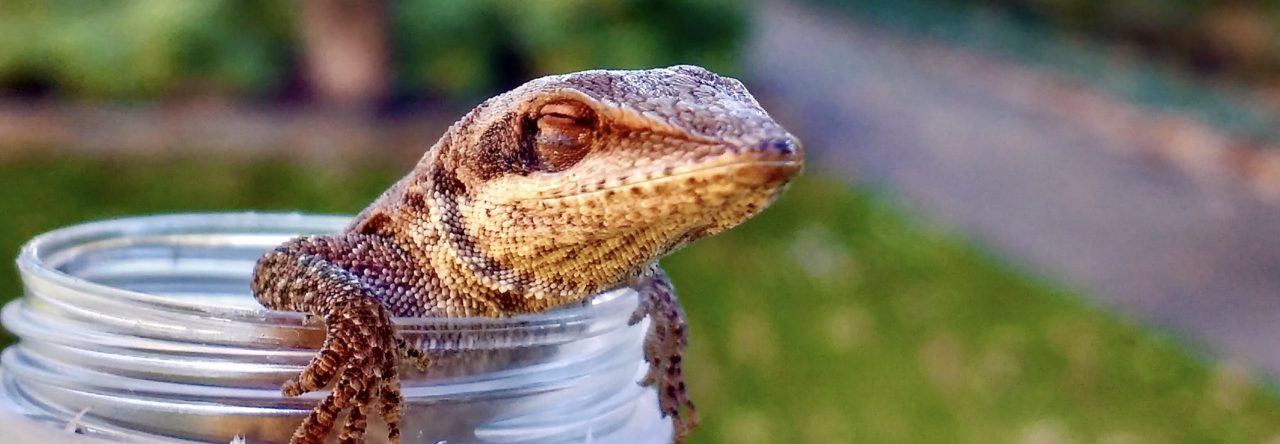
A female Anolis allisoni, no worse for the wear, from Roatan, Honduras

In advance of our trip out to Swan Island, I’ve come to Roatan, one of the Bay Islands just off the coast of Honduras, to check out its anole fauna. Of particular interest is the mixture of island and mainland faunas: A. allisoni¸ a trunk-crown member of the carolinensis group, somehow found its way here from Cuba, whereas A. roatensis (nee lemurinus) represents the mainlanders. And, as a bonus, A. sagrei is here, too, apparently introduced. I’m looking forward to seeing how they mix it up.

Things didn’t get off to a good start yesterday when I arrived mid-afternoon. It was very overcast and drizzly, and the temperature probably barely topped 70. Brrr! With more of the same forecast for today, I was not optimistic.

But although it looked like it was on the verge of raining all day, it held off until after dark. The sun was in and out, and so were the lizards. My expectation was that the balance of color would be like it is in other places where carolinensis and sagrei group anoles co-occur: lots of brown anoles on the ground and low on trees, bushes and buildings, and a small to moderate number of greens at eye level up to the treetops.

I couldn’t have been more mistaken. Green anoles were seemingly everywhere—as thick as anywhere I’ve ever been. And the browns? I saw three. The greens were on the buildings, on the fences, in the bushes up the trees, even doing their best grass-bush anole imitation along the roadside. They were everywhere, except one place: the ground. And therein lies the explanation for this green:brown inversion. There were brown lizards in great abundance—at least in open sunny localities—but although they skittered about and occupied the same place, they weren’t anoles. Rather, they were these fellows.

Brown basilisk on Roatan

Brown basilisks, Basiliscus vittatus. Many of them were sagrei-sized, and if you weren’t paying attention, their abundance might have convinced you they were anoles. But then there were the bigger fellows, not as abundant, but plenty of them. My hunch is that they’re why brown anoles haven’t gotten much of a foothold. The little guys compete with the sagrei, and the bigger ones eat ‘em. I speculated earlier this year about interactions between basilisks and introduced A. cristatellus in Costa Rica—there, they seemed to coexist and cristatellus was doing fine. Here, I think the story is different. Of course, brown basilisks have also been introduced to Miami, where they coexist with sagrei, so maybe I’m barking up the wrong tree, but the great abundance of basilisks, living exactly where you’d expect to see the sagrei, seems too much of a coincidence to me.

The proverbial lizard in the grass

Whatever the cause, the absence of sagrei seems to have given allisoni the green light to go crazy. They’re enormously abundant and use many off-the-ground habitats—fences, buildings, etc.—where you’d expect to see sagrei. At least in open places, like hotels, they are very common from 1-2 meters in height, or even lower. In more forested areas (and remember, this is based on one day’s observations, and the forested areas were visited in the afternoon), they  seem mostly high up, generally in sunny spots. I was particularly struck that they were very common in the thick grass, while at the same time as high up in the tree as I could see them. Those of you who live with green anoles in other places (I’m thinking of certain Georgians and Little Caymanians), I’d appreciate your thoughts. Does this seem different from your abundant greens?

Now, as for the other native anole, A. roatensis, today I was shut out. They’re supposed to be in forested areas, and I have a hot lead for a spot tomorrow, so hopefully will have more to report then.

Recollections Of The Swan Islands

Anolis sagrei nelsoni from Little Swan Island. Photo by Steve Busack.

Yesterday I wrote about our upcoming trip to look for the giant brown anole, A. sagrei nelsoni (and other reptiles), in the Swan Islands of Honduras. To give a little flavor of what we have in store, here are two mini-reports from trips here in the 1970’s.

First, Steve Busack’s reminiscences from a Smithsonian sponsored expedition 40 years ago:

“Wow!  It was so long ago, and my memory—aside from some pretty interesting aquatic (diving) iguanas at the dock around dusk—doesn’t recall very much.  And I’m afraid that my experience with Anolis in the field is less than bountiful.  I could help much more if it were Podarcis on Swan Island.

If I were given an opportunity to return, I’d have to think twice. BUT there is one issue I’ve always wanted to address if I had the opportunity.  Great Swan was—at that time—”loaded” with worm snakes (Leptotyphlops if I recall correctly).  One evening we took a handful (probably about  20 or so) and placed them in a chest type freezer available at the NOAA main building.  After we had dinner, we returned to the dormitory and removed the specimens from the freezer.  They were all frozen.  We placed them on a bed in the dormitory while we worked with other specimens — allowing them to thaw before we preserved them.  Several specimens actually thawed out and begain crawling off the bed.  I was amazed!!  A tropical snake with the ability to become frozen to the point that it is quite stiff—truly a surprising result.  Because the island was accessible only by flying over from San Jose on a NOAA “supply flight,” and at the time I had no access to anything physiological, I dropped the idea of pursuing it further—thinking others I mentioned this to would have better access.  To my knowledge, nobody has investigated survival of these snakes after freezing, or—more interesting—the physiological pathway they have available allowing such resistance.

One hint:  if you decide to go, and wish to visit Little Swan as well, bear in mind that Little Swan is uninhabited and it’s basically a rock in the water with no fresh water.  We had a tent with us, and air mattresses, but finding a place to sleep wasn’t easy.  Also the island is full of the mites that infect sea birds—and people.  I am not generally allergic to insect bites, but these mites sent me to an ocean bath one morning.  I can’t remember if DEET was available back then, but I’d highly recommend it now.  As I recall we stayed only one night on the island (radio contact and transport with the main island thanks to NOAA personnel).”

And Brad Lister, whose work I summarized yesterday, recollects:

“I do remember Swan Island and the giant sagrei very well (or is it nelsoni now?). Of all the places I’ve been, Swan seemed the most remote and enchanted.

It was the summer of 1972 and I was on the last leg of a trip to Jamaica and  the Cayman Islands. NOAA had a weather station on the island and they flew me in and out. The CIA had used Swan as a staging area for the Bay of Pigs and had created a landing strip that destroyed maybe 1/4 of  the forest. Apparently the island was also used for a coconut plantation at one time.  At least the time I was there, the remaining forest was fairly open with a low (<10m) canopy, mainly small (10-20cm trunk diam) trees, with lots of small palms in the understory. The sagrei were fairly abundant, but not really dense. Not sure what predators might have been on the island back then, but I did see a several feral cats.   I did not see any other reptiles except the big iguanas, though as I’m sure you know, Aristelliger nelsoni is listed as a resident.

Qualitatively, the anoles certainly looked like your average, every day sagrei scaled up to a larger size. Nothing striking morphologically that would distinguish them from the basic sagrei body plan.  I remember being somewhat disappointed that they hadn’t evolved a more exotic look given how isolated the island is, and having just left Little Cayman and being so impressed  by the really cool A. maynardi.  Then again, I just measured SVLs &  head size, counted lamellae, and did some other basic scale counts. In retrospect, it would certainly be interesting to get an estimate of how long the population has been on Swan and to look for the the adaptations that have been identified in solitary anoles that are utilizing a broader range of perch sites. My guess is that the large size is primarily due to competition for females, and would expect the males to spend the lion’s share of their time  courting and defending their territories.  Little Swan island intrigued me, but there were no small boats so I was never able to land and explore. Amazingly enough it had a species of hutia that went extinct sometime in the 1930s(?).”

The endemic and extinct hutia of Little Swan. Photo from http://www.redorbit.com/media/uploads/2004/10/42_8cf650ddccd939f96fdf01fb8572efa0.jpg

Expedition To Swan Island: In Quest Of The Giant Brown Anole

Great Swan Island. Image from http://4.bp.blogspot.com/-r2giIJn_MqU/TinmSdNEWgI/AAAAAAAAHYU/m4CSy8_7NU8/s640/An+aerial+view+of+the+eastern-end+of+Swan+Island+..jpg

The Swan Islands are a tiny specklesome trio stuck in the middle of the Gulf of Mexico. Great Swan, picture above, is scarcely two square males in area; Little Swan to its east is smaller yet and Booby Cay barely deserves mention.

The islands have an interesting history. Christopher Columbus is said to have stopped there to collect wood, for which reason Honduras, as the last vestige of the Spanish Empire in the New World, claimed it as its own. However, the U.S. also claimed the islands based on a visit there by a sailor in the mid-19th Century. In the middle of the last century, the U.S. operated a weather station there, and in 1960, a radio transmitter was put into place to beam Spanish language propaganda into Cuba; Radio Swan gained attention as it operated before and during the Bay of Pigs invasion. At that time, there were 28 inhabitants of Great Swan, possibly an all-time high. The radio station was removed in the late 1960’s, and in 1972, the U.S. relinquished control to Honduras, and now the island is home to a small Honduran naval garrison. In 1988, Hurricane Mitch devastated the island.

From photographs, the island seems pretty typical of many in the Caribbean; scrubby and somewhat xeric, with some palm trees. One curiosity is that almost the entire length of the island is bisected by an airstrip, presumably put in by the US during the halcyon days of the 60’s and 70’s. Little Swan island has a much different aspect, with karst rock formations and covered with cacti.

So, who cares?

Anolis Pogus Observations

Anolis pogus male on pandanus root in hotel garden surveying his territory (J.Burgess)

It has been widely published that Anolis pogus is only found in high elevation on the island of St Martin. While it is true, it is very common and in high densities at these higher elevations and more mesic environments, however I observed this species at lower elevations and even only meters from the beach. I came across this species several times (by accident) while making my way around the island, even in downtown Phillipsburg. Mongoose certainly take their toll on this ground, bush, and trunk “generalist” and there were many areas on the island where neither A. pogus nor A. gingivinus are easily observed. I do not agree with the assumption that this species is excluded by competition by the larger species as both species were observed in great numbers in these areas where both are present. This species certainly deserves another look at its ecology.

Observations On Two Colombian Endemic Anoles

Juan Salvador Mendoza

Fundación Kamajorú para la conservación y educación ambiental  Barranquilla, Colombia.

Detail of Anolis concolor, San Andres Islas, Colombia; Juan Salvador Mendoza, July 2012.

Anoles (genus Anolis sensu old taxonomy) are one of the most diverse neo-tropical vertebrate groups with more than 200 species. In continental Colombia more than 60 anole species have been registered, including 30 which are endemic (Sanchez et al. 1995).  Three more endemic species are known from the insular portion of San Andres and Providencia in the Atlantic Ocean and Malpelo in the Pacific (Sanchez et al. 1995).  One of this insular species is A. concolor (Cope, 1836) a relatively medium-sized anole (60-80 mm SVL) that inhabits mangroves and dry forests in the islands of San Andres and Providencia; on the latter island, this species is sympatric with a A. pinchoti which is endemic only to the island of Providencia. In the Pacific, the representative species is A. agassizi from Malpelo Island.

A.concolor. Male, Jardin Botanico, Universidad Nacional, sede Caribe;

A.concolor. Male, Jardin Botanico, Universidad Nacional, sede Caribe; San Andres Islas, Colombia. Juan Salvador Mendoza 2012

Anolis concolor is a very agile lizard that may use the ground, tree trunks and branches to forage and display courtship and territorial behavior. I observed and photographed several individuals in the “Jardin Botanico, Universidad Nacional de Colombia;” this garden holds more than two hectares of the natural vegetation of the island, tropical dry forest.  This lizard can be found in the borders of roads on top of secondary vegetation and can be also found in conserved remnants of mangroves and dry forest. In San Andres this species shares its habitat with a gecko species (Aristelliger georgensis) that may be also found even during the day time in the tree trunks. This is the only anole species in San Andres Island and can be very abundant; I counted 35 individuals in a 1 km forest trail.

Help Identify Dactyloa From Departamento Del Atlantico, Colombian Caribbean

Photographs from Jaime Palacio Sierra. We are currently reviewing reptiles from our home department and have doubts on two specimens captured by Jaime. can anyone help us confirm their taxonomic identities?

Colombian caribbean Anolis

Anolis Cuvieri Adventure

For many of us, the academic summer has finished or is ending imminently. In Boston, the temperature is falling, and most in the Boston area woke up to temperatures in the low 50s this morning. At this point, I thought the timing would be good to revisit (with some nostalgia) the manner in which I started the summer – with a three week field trip to Puerto Rico.

In June I was in Puerto Rico primarily to help my first Ph.D. student, Kristin, start her thesis project on urban ecology and adaptation in anoles. The focal species of Kristin’s research is the ubiquitous Anolis cristatellus, which, as anyone who has visited Puerto Rico will know, is equally common (if not more abundant) in heavily urbanized habitats as it is in natural forests. One species that is not found in urban areas, and, in fact, is fairly difficult to find in most habitats, is the Puerto Rican crown giant anole, Anolis cuvieri. We were lucky enough to see a few of these anyway, including one that I happen upon entirely by accident on the 60 acre finca where we stayed in a rental cottage for a little more than a week.

At night I was searching for invasive boa constrictors which are known from this part of the island, so as dusk approached I thought I’d try and take some photos of the sunset over the island’s western coast. Always on the lookout for A. cuvieri, I nonetheless somehow missed this individual in this pre-dusk shot (highlighted here by the red arrow). A perfect “find the anole” photo, but one in which I had initially “missed the anole” in spite of seeing it in person!

I initially missed this Puerto Rican crown giant, perched 20+ feet up a palm tree.

When I did spot him, he was far too high to capture with my meager 14 foot noose pole, so we just kept an eye on him. As the sun continued to set he did something interesting – he started to descend the trunk.

When The “New World” Meets The “Old World”: Interactions Of Introduced Anoles and Native Agamids In Taiwan

The observations made on the 14th of July, 2002. A – the adult male Japalura swinhonis attempts to prey upon the crickets it can see through the plastic container; B – the Japalura swinhonis moves aside, and an adult male Anolis sagrei takes his place at the plastic container; and C – as the Anolis sagrei attempts to prey on the crickets, which it can see through the plastic, the Japalura swinhonis moves up the trunk of the betel nut palm.

On the 14th of July, 2002, I wanted to test the possibility of using a modified funnel-trap to collect Anolis sagrei. The first lizard to respond to my trap, though, was an adult male of the agamid, Japalura swinhonis, that was attracted by the movements of the crickets in the trap. The J. swinhonis attempted to prey on the prey items for about 30 seconds. When an adult male A. sagrei approached, the J. swinhonis moved up the trunk of the betelnut palm onto which the trap was secured. No further observations were made after the A. sagrei lost interest after about one minute and moved off.

This was to date the only instance I observed in which a J. swinhonis gave way to an A. sagrei, and I am quite convinced that the J. swinhonis actually just lost interest in the possible prey in the trap, and as it moved away the A. sagrei thought he could try his luck. And this is my point concerning A. sagrei in Taiwan.

In my study area in Santzepu, Chiayi County, southwestern Taiwan, J. swinhonis males (mean ± SD = 70.5 ± 8.4 mm) and females (mean ± SD = 58.2 ± 13.9 mm) are substantially larger than A. sagrei (males; mean ± SD = 46.2 ± 9.1 mm; females; mean ± SD = 38.2 ± 5.5 mm). In most other aspects, both species are quite similar; both are diurnal trunk-ground ambush foragers and are very territorial. In a paper I am currently preparing, I compared the diet of these species and found that A. sagrei has a much wider dietary niche breadth than J. swinhonis, and that in areas where J. swinhonis and A. sagrei are sympatric, there is a substantial dietary niche overlap, and competition for prey is very likely.

Although both species are human commensals, J. swinhonis is more shade tolerant, while A. sagrei reaches higher densities in open disturbed habitats. So, my view of A. sagrei in Taiwan is that this species is here to stay, and we have to accept that it is becoming part of local ecosystems.

Diet Study with Gastric Lavage

Rings and syringes for gastric lavage.

With only two weeks left in El Yunque, Puerto Rico, the two projects that Travis Ingram and I are doing will soon come to a close. Travis has already written about one project, the enclosure experiment. The second is a diet survey of six species (Anolis evermanni, A. stratulus, A. cristatellus, A. gundlachi, A. pulchellus, and A. krugi) that are sympatric in the area around where we are staying. The goal is to quantify diet overlap between these species. To obtain the stomach contents, we use a nonlethal method known as gastric lavage. I chose this method unsure of how it would turn out because, before this trip, Travis and I had had very little practice performing gastric lavage. My hope was that we could take this technique that we had read about and practiced a few times in the lab and become good enough at it to do it potentially hundreds of times in the field.

Field Work in Puerto Rico and a First Lizard Bite

Anolis evermanni in Bosque San Patricio, San Juan.

I’m presently in the field in Puerto Rico working with my (first, brave) doctoral student, Kristin Winchell, along with two undergraduate assistants (Zack & Sofia). Although Kristin has been with me to Puerto Rico once previously (in January), this expedition is the first trip of Kristin’s doctoral research, which will focus on urban ecology and adaptation in anoles. In this trip she is collecting phenotypic, habitat use, and activity temperature (ambient and internal) data for Anolis cristatellus in urban and forested sites in the three major municipalities of Puerto Rico: San Juan, Mayagüez, and Ponce. For example, our forested field locality in San Juan is the diminutive but verdant state forest Bosque San Patricio. San Patricio is a small forest of no more than about 70 acres nestled well within the sprawling San Juan metropolitan area. In spite of this status as an island of green amidst concrete, at least three species of anoles can be found there (including Anolis evermanni, pictured above), along with Ameiva, the Puerto Rican racer (I found two), and (according to accounts) the endangered Puerto Rican boa.

My role in this expedition is mostly in a supporting capacity. In addition, I am visiting colleagues, scouting sites, looking for boas, and preparing for the tropical biology field course that I will be co-instructing with herpetologist Alberto Puente here in January. In fact, while Kristin & her crew finish up in San Juan, I have proceeded ahead to Mayagüez with my wife, Emily, and our two year old daughter, Cecilia, both of whom joined us on the island a couple of days ago. This leads me to the the second part of my post title. No doubt Zack & Sofia, who have never worked on anoles before, suffered their first anole bites (and perhaps inumerable additional bites) on this trip. It’s part of the job! However, it was to my considerable surprise when Cecilia suffered her first Anolis bite as well. Before you call Child & Family Services, this was a total accident, not some cruel rite of passage.

What happened was as follows.

Page 11 of 22

Powered by WordPress & Theme by Anders Norén