Category: New Research Page 55 of 67

New Study on Color Change In Green Anoles

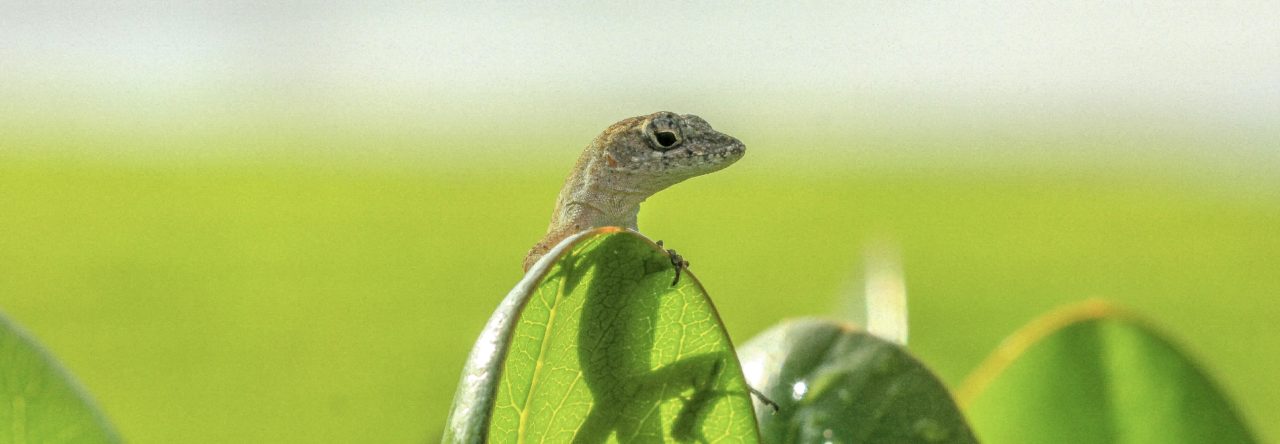
Green anoles can change from green to brown. Occasionally, they do it only part way. Photo from http://www.floridagardener.com/img/critters/Greenanole.jpg

Widely, if inaccurately, known as the American chameleon, Anolis carolinensis is renowned for its ability to change color from a sparkling emerald to a deep brown. Surprisingly, we don’t really know what factors determine whether a particular lizard chooses to be green or brown at a particular time.

Here’s what I had to say about it in Lizards in an Evolutionary Tree (pp. 279-281; I’ve omitted most references here):

“In theory, we might expect green anoles to match their background, turning green when in vegetation and brown when against a woody surface. Although widely believed, this idea is not strongly supported (reviewed in Jenssen et al., Herp. Monographs, 1995).

Anoles and the IUCN

Anoles are well-known for a lot of reasons, but conservation is not one of them.  Possibly because of the abundance, hardiness, and visibility of the more common anole species, the group as a whole is often regarded as one that’s doing just fine.  To date, very few specific efforts have been made to assess the conservation status of anole species.*

Anole species vary, of course, in how they’re doing.  Although species such as Anolis cristatellus, cybotes, and limifrons seem to occur on every perch across broad distributions, species like A. fowleri and A. megalopithecus have only been located a handful of times in the wild despite some considerable efforts. Dozens more species are known from just a single locality, where they may or may not be locally abundant.  While a lot of rare or little-known anoles may simply be secretive or geographically restricted, some are very clearly endangered.

Science Is More Interesting When You Discover You Were Wrong: The Backstory on the Anole Founder Effect Experiment

They thought it was only a three hour tour.

In my career, I have found that the most exciting research is when the results are exactly the opposite of what I had expected. Certainly, it’s nice to show that what you thought was correct, but you really learn something when the opposite occurs–it makes you look at questions in a new way and often leads to new insights. This has happened to me several times, most recently in our experimental study of founder effects in Bahamian anoles (paper downloadable here).

One of the tiny islands on which the founder effect experiment was conducted. Note the scraggly vegetation. Photo by Jason Kolbe.

Here’s the story: we have been conducting studies on anoles in the Bahamas for quite some time, using tiny islands as experimental test tubes. We had seen island populations wiped out by hurricanes, and we had documented anoles colonizing these islands, so we knew that populations often must be founded by overwater dispersal, probably by one or very few individuals. Given the long-running controversy over the evolutionary significance of founder effects, we had long discussed whether we could create an experimental founder effect, in replicate, to see what would happen. But we never started such an experiment, for a simple reason: suitable islands for our various ecological and evolutionary experiments were in short supply, and this experiment wasn’t a high priority.

Enter Hurricanes Frances and Jeanne in short succession in the late summer of 2004.

Anolis Research Stirs Up Evolution-Creationism Controversy

On Sunday, the Washington Post published a nice news article covering the recent study on island colonization and adaptation in anoles (pdf now available here). Very quickly, back-and-forth exchanges appeared in the paper’s online comments section, but most of them were debates about evolution vs. creationism/intelligent design, as well as invectives, insults, and ad hominem attacks. The same thing happened when I posted a story on the anole genome and its utility for the study of evolution on a National Geographic news website. Who knew that anole research was so pivotal to the evolution/creationism controversy? Or that it could bring out the worst in so many?

Appended below are the 77 comments that had appeared in the Washington Post by mid-afternoon on Monday.

Your Comments On:

Castaway lizards put evolution to the test

By , Published: February 4

77

Comments

lynnecatlover
12:52 AM EST
Please hope that the little beasts survived and flourished with shorter hind legs, of course !
akuperma1
2/5/2012 4:48 PM EST
So the key to evolution is a superior being manipulating things. From a lizard’s perspective, what’s the difference between a biologist and a diety?

Castaway Lizards: Experimental Studies of Lizard Colonization and Founder Effects

httpv://www.youtube.com/watch?v=fAgxpB9fn50

Duke University Press Release. Check out the cool video!

In 2004, Hurricane Francis wiped out all Caribbean lizards found on the keys near the Bahamas.

Seeing an opportunity to study evolution, Duke biologist Manuel Leal and his colleagues took lizards from a larger, nearby island, paired them up and then put the couples on seven of the small keys.

The scientists came back year after year to check on their experiment.

They observed the lizards’ legs getting shorter over time. But, the lizards’ legs did not all shorten to the same size, a hint of the founder effect, where traits from a founding species persist after years of adaptation. It is one of the rare times scientists have seen this phenomenon in nature.

The first results of the experiment were published in a Feb. 2 Science Express article.

You can read more about the study here. And how’s this for a newspaper article title: “Lowly lizards settle ‘founder effect’ theory“?

Citation: “Founder Effects Persist Despite Adaptive Differentiation: A Field Experiment with Lizards.” J.J. Kolbe, J.B. Losos, M. Leal, T.W. Schoener and D.A. Spiller. Science Express. Feb. 2012.

Why Don’t Lizards Jump Off Branches Like People Jump Off Diving Boards?

Many arboreal animals get from one place to another by jumping. But there’s a problem: branches, particularly narrow ones, aren’t stiff. As a result, as the animal starts to jump by pushing against the branch, the branch gives way and bends. As a result, some of the force that could be used to push off is dissipated in pushing the branch away. One potential solution would be to avoid bend-y branches; another would to make like an Olympic high diver and wait for the branch to spring back, and then use the recoil to help launch the animal forward. Do animals use any of these tricks? Or is their jumping compromised on pliable surfaces?

Turns out that there hasn’t been much work on this, but the research that has been conducted, on birds and primates, has showed that jumping performance is, indeed, reduced on flexible surfaces and that there is no evidence for animals powering off a branch’s recoil. No work has been conducted on small animals, so Casey Gilman set out to remedy this shortcoming by examining the jump biology of the Florida green anole. You can read here about the background to her study and see some photos of the study site.

The main findings of the study can be summarized easily: 1. In the wild, green anoles frequently use very compliant (bend-y) surfaces such as narrow branches and leaves; 2. In the lab, when anoles jump, they do not use the recoil of the support to increase their jump distance; and 3. The more flexible the support, the great the reduction in jump distance.

The most exciting finding of the study, however, was something completely unexpected. The reason that lizard jumps were short from very flexible supports was not just that the support’s give wasted some of the lizard’s push. Rather, what happened was that as the support recoiled, it smacked into the underside of the tail of the launching lizard. This in turn pushes the back end of the lizard up and the front end down, and instead of sailing through the air with the greatest of ease, the lizard does an ungainly face plant, as the video above illustrates. Apparently, this happened frequently when lizards jump off of very pliant surfaces.

Who knew? It certainly makes sense, but I have to say, I’ve never seen a lizard gobsmacked by a branch as it jumps. Maybe it happens too fast to actually recognize what’s happened, but I don’t recall seeing lizards jump in such a klutzy manner. Has anyone noticed something like this in the wild?

More generally, an obvious next step is to not only measure the pliancy of the perches on which lizards can be found, but to observe their movements and see if they choose to jump from particularly stiff surfaces, relative to the ones they use more generally. Word on the street is that Gilman has already conducted just such a study, with fascinating results. Stay tuned!


Anole Visual Ecology, Sans Vision

A riddle: What has four legs, eagle eyes, and can change colors?

Anoles are extremely visual animals, with vision being the primary sensory mechanism through which they perceive their surroundings. Accordingly, their vision is excellent, at least during the daytime. (“Eagle eyes” might be a bit misleading. A more accurate phrase might be “bifoveate retinae conferring excellent visual acuity and depth perception”). The amount of daytime light available for vision depends largely on the vegetative structure in the microhabitat. Indeed, many Anolis species occupy a distinct “photic habitat” due to sun/shade preferences. Variation in photic habitat provides a treasure trove of testable hypotheses for the visual ecologist. Is anole vision adapted to particular light environments? Is dewlap color selected for detectability in a given light environment? And so on.

Two very different photic habitats. (Photographed at approximately the same time of day, same cloud cover).

I totally dig visual ecology, but I’m using it as bait to draw your attention to a closely related (but under-studied) relationship between the light habitat and physiology/behavior. Anoles, like all other animals, use light in ways that do not require visual images at all. These so-called “non-visual” responses to light are used for things like the dilation and constriction of the pupils, the control of circadian rhythms, and seasonal responses to daylength. Non-visual photoreception is processed in the brain through different pathways than those involved in the formation of images, so these responses to light can occur even if the animal is visually blind.

Interesting stuff, but here’s where habitat enters the picture. Non-visual responses to light are irradiance-dependent, meaning that whether or not there is a response, and what the response entails, depends on how much light there is. Bright light, for example, is a wake-up signal to the sleeping lizard, whereas dim light (e.g., moonlight) is less effective in eliciting arousal. However, “bright” and “dim” are relative measures, thus one might expect that the sensitivity of non-visual photoreception would be “tuned” to the overall light levels in the microhabitat. After all, light that seems dim in an open, unshaded habitat might correspond to the brightest midday light available in closed canopy forest. A mismatch between non-visual photosensitivity and habitat irradiance would impair non-visual photoreceptive “performance,” and could even lead to the misinterpretation of photic cues.

In a recent paper published in Journal of Comparative Physiology A, we showed that a non-visual behavioral response to light (the photic induction of locomotor activity) is correlated with habitat irradiance using four species of Puerto Rican anoles (A. cristatellus, A. gundlachi, A. pulchellus, A. krugi). Most diurnal animals respond to light by increasing their activity level. The best way to demonstrate this is to give light when the animal is inactive, i.e., at night. We developed a special device to continuously detect and record anole locomotor activity (walking, running, jumping, etc.) for weeks on end.

Transparent enclosures with a very sensitive movement detector were used to continuously record locomotor behavior.

We quantified baseline activity levels during the day and night, then measured the increase in activity in response to light given at night. Species occupying relatively more shaded habitats were more sensitive to the effects of light (light induced more locomotor activity) as compared to closely related, ecomorphologically identical species occupying more brightly illuminated habitats. The differences were most pronounced at irradiance levels similar to natural twilight levels. This jives well with the notion that dawn is nature’s alarm clock, and that photosensitivity should be tuned to take advantage of morning light, whatever irradiance that may be in a given environment.

Still, there are a few gaps that need to be filled in to complete the story. (You’ll have to read the paper to find out what they are). Non-visual photoecology is still in its infancy, and the main challenge is to develop approaches to explore the links between the environment, non-visual photoreception, and fitness. If anyone’s interested in pursuing variations on this theme, I know a good post-doc for hire.

Species Richness Patterns in Caribbean (and Mainland) Anolis IV

This is the last post (for a while, anyways) about species richness patterns in anoles. Unlike the previous papers and discussions (found here, here, and here), Algar and Losos (2010) zoom out from the Caribbean and take aim at the entire Anolis radiation. 

Islands are often species depauperate relative to mainland settings, likely because their small size makes them difficult to colonize and those species that do make it are more susceptible to extinction. Yet, islands also house many iconic evolutionary examples of adaptive radiation. Algar and Losos (2010) point out that this discrepancy stems mainly from the role that in situ evolutionary diversification plays in these two scenarios. In their paper, Algar and Losos, using anoles of course, explore how in situ diversification on islands affects the relationship between island and mainland species richness.

Anoles Are Off To A Great Start At SICB!

Greetings, Anole Annals readers, from lovely Charleston. It may not be balmy here, but it’s warmer than my usual habitat of Cambridge, Massachusetts, which is currently experiencing an “Arctic front,” which is fancy speak for blistering cold wind. For those of you who couldn’t be here, this morning held some great Anolis talks at SICB, and I was able to attend three. The first was by Maureen Stimola, a senior undergraduate student at Columbia University who did her senior thesis with me in the Dominican Republic this past summer. Maureen’s research project addressed how thermal tolerance (CTmin and CTmax) changes with elevation in the cybotoids (A. cybotes and related trunk-grounds) from the Dominican Republic.

Posthumous Co-Authorship: What Are the Rules?

In a recent AA exchange, it was noted that Ernest Williams’ last publication appeared 11 years after his death. Anthony Geneva wondered “how far one could take posthumous co-authorship. What’s stopping me from including Darwin as a co-author on my next manuscript?”

Indeed, just what are the rules? Are you comfortable with the idea that a paper may be published in the future and the deceased you listed as a co-author, without the opportunity to agree to be a coauthor, much less comment on or contribute to its content? What’s to keep someone just from tacking on the names of prominent figures in a bid to make a paper more publishable or to gain more attention?

In this case, the paper, Poe et al. (2009), made clear their rationale:

Page 55 of 67

Powered by WordPress & Theme by Anders Norén