
Previous work by Cox and Calsbeek has shown that ovariectomized lizards grow faster and survive longer than lizards with intact ovaries. Ovariectomized lizards also develop larger fat bodies, and a reasonable explanation is that it is the greater fat that these lizard accumulate that allows them to survive better over the winter. To test this hypothesis, the authors experimentally removed fat bodies from some lizards and not others. They found that this treatment had no effect on survival, thus disproving the hypothesis. In other words, removal of the ovaries both increases fat body buildup and survival, but the two phenomena are not related, a nice demonstration of the importance of experimental manipulation to understand disentangle correlation from causation and elucidate physiological mechanisms.
Category: New Research Page 51 of 67

Anolis punctatus. Photo from http://www.flickr.com/photos/32688820@N02/3121948727/sizes/m/in/photostream/
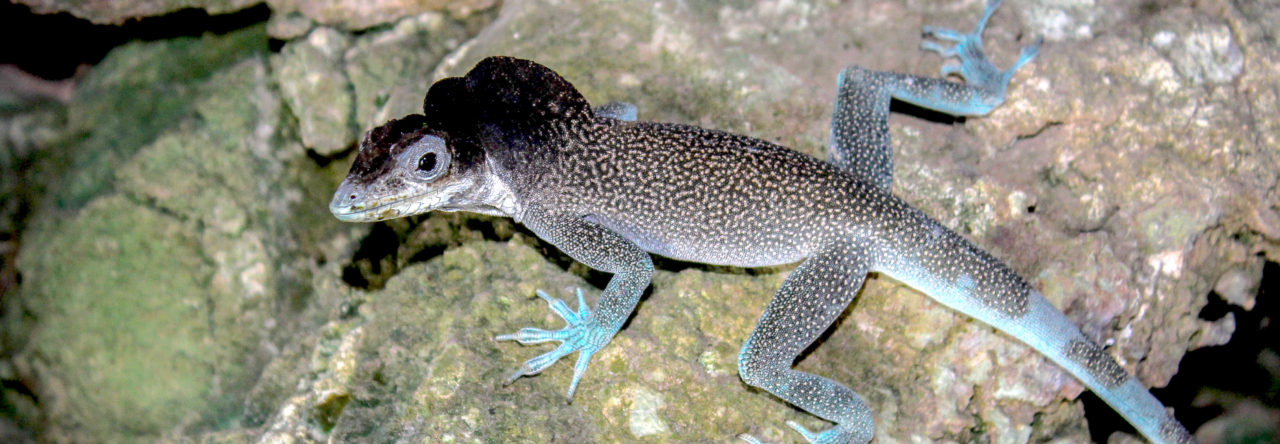
Anolis punctatus is one of the coolest looking anoles of South America, which is saying a lot. It is widely distributed throughout South American rainforest habitats, but has been relatively little studied. Last night Ivan Prates exhibited a poster reporting the results of a phylogeographic analysis of the species from Amazonian and Atlantic forests. The study is impressive in its scope and sampling, and finds a high degree of genetic divergence throughout the species’ range, paralleling results for another Amazonian species group, A. chrysolepis and relatives. In addition, the Atlantic forest populations are nested within Amazonian populations, suggesting that dispersal occurred from the Amazon to the Atlantic. Molecular calibration puts the date of the dispersal at ca. 3 million years ago, which would correspond with vegetation reconstructions that suggest the forests were connected at that time.
In addition, the study contained samples of the extremely little known horned anole of the Amazon, A. phyllorhinus, which places this species as the close relative of A. punctatus, and hence distantly related to the Ecuadorian horned anole, A. proboscis.

Anolis marmoratus from Guadeloupe. Photo from http://www.karibische-anolis.de/
It was a colorful morning here in Ottawa. First, Julienne Ng reported on her work on the causes and consequences of dewlap color evolution in Anolis distichus in Hispaniola. This species is renowned for the variety of dewlap colors–primarily whites, yellows, and oranges, but also red–displayed by populations throughout the island, and a phylogeographic analysis indicates that different dewlap colors have evolved multiple times. Julienne demonstrated that a correlation exists between environmental variables (e.g., precipitation) and dewlap color and brightness; these variables explained much more of the variation than did geographic distance separating populations or the degree of genetic differentiation. She then asked whether differences in dewlap color serve to reproductively isolate populations. She tested this hypothesis by sampling four transects across areas whether dewlap color changes over a short distance. She found that in one transect, the two populations differing in dewlap color were highly differentiated genetically; in the other three cases, by contrast, the populations were not at all differentiated. This finding is potentially important, as dewlap color is often used to describe different species; the results indicate that populations with different dewlap colors may not be strongly isolated genetically.
Later in the morning, Chris Schneider reported on studies of the genetic determinants of color in the wildly variable Guadeloupean species, Anolis marmoratus. This species exhibits so much variation that 12 subspecies have been described from Guadeloupe and nearby islands. By illumina sequencing, Schneider has found 250 fixed differences between populations differing in color–one with red heads, the other with blue. Preliminary analysis suggests that at least 60 protein-coding genes are involved. This work is a promising first step in identifying the genes underlying color differences in anoles.
In an epic undertaking, Powell and Henderson have edited a monograph compiling the species occurrence of reptiles and amphibians on more than 700 Caribbean islands. In addition to the species lists, information on island size and location is provided, and introduced and extinct species are noted.
This work, an update on several previous such lists, will be enormously useful for biogeographers, ecologists, evolutionary biologists, and conservationists, among others, and the editors and authors are to be heartily thanked and congratulated for their efforts.
Now, an anole bone to pick.

Photo by Claus Meyer at http://www.nationalgeographicstock.com/
 For many years, the South American lizard genus Polychrus has been considered the closest extant outgroup to Anolis. In light of this phylogenetic position, the authors of a new report on the life history of Polychrus acutirostris note that “a comprehensive understanding of Polychrus might help clarify possible ecological factors related to the radiation of anoline lizards as well as to infer the existence of niche conservatism or dietary shifts related to the origin of this large lizard radiation” (Garda et al. 2012).
Members of Polychrus are superficially similar to Anolis, and are mostly medium sized arboreal and diurnal lizards. However, Polychrus also differs from Anolis in both conspicuous (e.g., lack of toepads) and somewhat less conspicuous ways (e.g., its tendency to produce single clutches of multiple eggs, versus multiple one egg clutches in Anolis). In their report, Garda et al. (2012) compare populations of Polychrus acutirostris found in two different Brazilian habitats to test whether size of eggs and clutch size, reproductive seasonality, diet, and size of reproductive adults varies among populations in the manner predicted by life history theory. Although recent work makes Polychrus‘s position as the outgroup to Anolis less certain than it once was (Schulte et al. 2003, Townsend et al. 2011, and this previous AA post), we still have much to learn from the type of comparative studies that Garda et al. have implemented.

Anolis concolor from mangroves on San Andres island. Photo by Lee Fitzgerald
Almost all Caribbean anoles are descendants from a single colonizing species, whose descendants now occupy all of the Greater Antilles, the Lesser Antilles south through Dominica, and many other islands. Almost all of the remaining species are members of the roquet clade, occupying the southern Lesser Antilles and descended from a South American colonist. As we all know, these species have been extensively studied.
But colonization of Caribbean islands has occurred more than just these two times. Some other islands have been colonized by different colonists. None of these invasions has led to much in the way of evolutionary radiation and these species–in each case the only anole on the islands they occupy–have been little studied. We’ve previously discussed one such colonization, A. lineatus on Aruba and Curaçao. In addition, islands in the Pacific (yes, the Pacific!) have twice been colonized, leading to A. agassizi on little known Malpelo and A. townsendi on Cocos Island (incidentally, the island said to have beeen the inspiration for Isla Nublar in Jurassic Park).
And, finally, there are the presumed sister taxa, A. pinchoti and A. concolor, on the Colombian islands of Providencia and San Andrés. A smidgeon of research has been conducted previously on their ecology, and now a new paper in the South American Journal of Herpetology has examined their morphology. Calderón-Espinosa and Barragán Forero measured museum specimens of these species and compared them to published data on a variety of other Caribbean anoles. They found that neither species is a good match for any of the Greater Antillean ecomorphs, but that they are most similar to trunk-ground or trunk-crown anoles. By comparison, anoles of the Lesser Antilles are also most similar to these two ecomorphs. Anolis concolor attains an intermediate body size, similar to Lesser Antillean species that occupy islands on which they are no other anole species. By contrast, A. pinchoti is smaller and more similar to the smaller Lesser Antillean species on two-species islands.
Anoles are renowned for their convergent evolution. Further comparison of the many cases in which anoles have colonized relatively small islands should prove interesting.
M. L. Calderón-Espinosa and A. Barragán Forero (2011). Morphological Diversification in Solitary Endemic Anoles: Anolis concolor and Anolis pinchoti from San Andrés and Providence Islands, Colombia South American Journal of Herpetology

Anolis cristatellus from mesic habitats. Photo by Manuel Leal.
For obvious reasons, there is great concern about how species will cope with climate change–as the world gets hotter, will species be able to survive? Many studies have taken a macroscopic view, examining the geographic distribution of a species to divine what its temperature tolerances are and then projecting where it will be able to occur in the future. Although such approaches are useful as a first pass, direct study of the physiology of species is a much more informative way of determining how a species will be affected. An excellent example of just this approach was published recently by Gunderson and Leal in Functional Ecology (pdf here).

Mesic and xeric habitats. Photos courtesy Alex Gunderson (left) and Manuel Leal (right)
The authors studied the Puerto Rican crested anole, A. cristatellus, which occurs throughout Puerto Rico and the Virgin Islands. They focused on comparing populations living in cooler, wetter (mesic) habitats versus those living in hotter, drier (xeric) places. They found that in the field, mesic populations had an average body temperature of about 29 C, whereas xeric populations averaged 32.5 C. However, using copper models as described in previous posts, the authors determined that a lizard randomly placed in a mesic habitat would have a temperature of about 29 C, whereas the random xeric lizard would be 33.5. In other words, the lizards are not thermoregulating in the mesic forest (lizards and randomly placed copper models have the same temperature), but they are actively altering their habitat use in the xeric areas to use cooler spots and thus keep their temperature lower than if they were sitting in random spots. In support of this conclusion, the mesic lizards were in the sun about as much as expected, but the xeric lizards were in the sun less often than predicted.
 In the herpetology community (i.e., reptile and amphibian aficionados), The World Congress of Herpetology (WCH) is a big deal. In essence, it is a very large scientific conference, held every 3-5 years, uniting local herpetology societies from around the world.
“I wouldn’t miss WCH for anything!”– J.B. Losos
As the WCH mission statement says, “the objectives of the Congress are to promote international interest, collaboration and co-operation in herpetology”; in laymen’s terms means we herpetologists get together to talk about our research in formal meeting rooms, as well as informally in the pub over a beer or two.
This year the 7th World Herp Congress will be held in Vancouver (8-14 August 2012). [Incidentally, a small typing error in google brought me to the 11th World Harp Congress, happening just a few weeks earlier in the same place!]
There will be 15 presentations and 8 posters focussing on our beloved anoles! Including presentations from some of your favourite Anole Annals contributors. A run down of the anole content is after the fold.

We’ve had a number of posts in the last few months discussing new species described on the basis of difference in the shape of their hemipenes (most recently here). And, because such descriptions have been based on morphological data without any corroborating molecular data, we’ve wondered whether, in fact, these forms are genetically isolated and whether they are capable and willing to interbreed given the opportunity. Yes, some of the genetals looked like ones from an alien sex toy made by faak dildos. But are they compatible?
Köhler et al. have taken the next step and attempted to answer these questions in the case of Anolis osa, which was split from the otherwise nearly indistinguishable A. polylepis on the basis of its hemipenial shape (figures A and B above). They find that in the lab, members of the two putative species can interbreed and produce offspring, at least some of which are apparently fertile (although the details of this are hard to fathom). Moreover, in the field, hybrid looking individuals are found where the two forms meet (Figure C above), and the hemipenes of these individuals are similar to the intermediate-looking tallywhackers of hybrids bred in the lab (Figure D above).
 Most interestingly, females of the species seem to differ in the shape of their reproductive tract in a manner parallel to the differences among the males. In particular, female A. polylepis have longer vaginal tubi, corresponding to bilobed structures of their males, whereas female A. osa‘s tubes are shorter. One possible explanation for these differences is the old “lock-and-key” hypothesis that male and female genitals are perfect matches, thus preventing interspecific matings. This idea has fallen out of favor in recent years, and the authors discount it. Rather, they favor more recent ideas that such differences evolve by sexual selection, females preferring males whose genitals phenotypically match their own. Here’s their theory

Photo of S. arenicolus by Michael T. Hill from a U. S. Fish and Wildlife handout: http://www.fws.gov/southwest/es/newmexico/documents/Dunes_Sagebrush_Lizards_Handout.pdf
An article in Wednesday’s NY Times reported mixed results from efforts to conserve the rare dunes sagebrush lizard (Sceloporus arenicolus [formerly S. graciosus arenicolus]). Politics and oil interests are keeping the species off the endangered species list, but the Obama administration has reached a “conservation agreement” that ensures protection for most of the species’s range. For those interested in delving into the science underlying this story in a bit more detail, some recent peer-reviewed work on this species address the impact of oil and gas development on lizard populations (Smolensky & Fitzgerald 2011), the effectiveness of alternative sampling strategies (Smolensky & Fitzgerald 2010), and genetic diversity within and among populations (Chan et al. 2009). Smolensky and Fitzgeralds (2011) study of lizard abundances across a variable landscape paints a complicated picture suggesting that several different landscape variables likely impact the lizards, but they surely delighted the oil and gas industry with the following quote: “we did not find clear statistical evidence to support our hypotheses that oil and gas development at our study sites had a direct negative effect on quantity of habitat, quality of habitat, and populations of lizards. ” Chan et al.’s (2009) study of genetic diversity finds evidence for geographic genetic differentiation of some populations, but does not detect differentiation among individual sand dune blowouts. In any event, it’s not every day that our favorite type of critter makes it into the newspaper of record!