
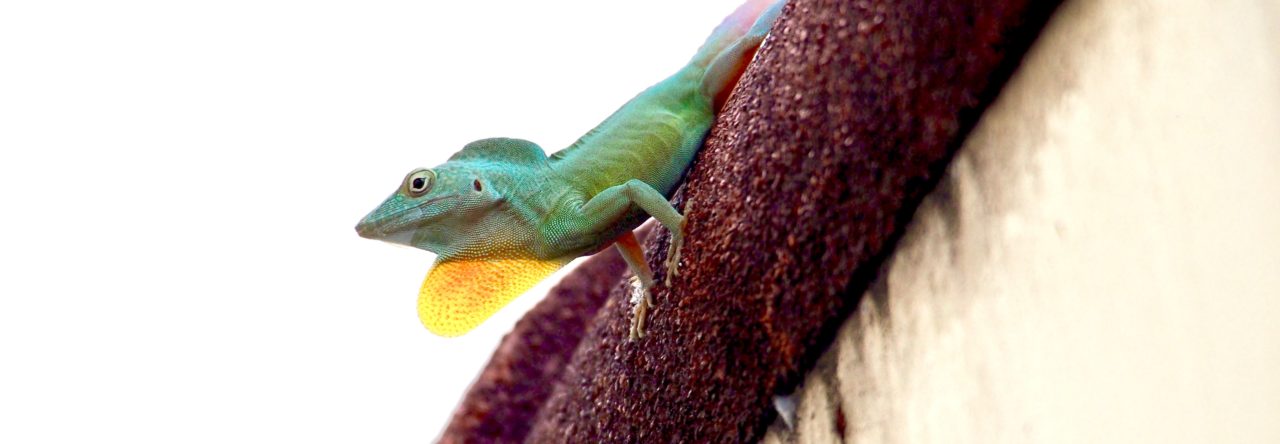
When AA contributors attend scientific conferences, we try our best to post about as many talks and posters as we can visit, but inevitably we simply can’t visit them all. I will be attending the annual meeting for the Society for Integrative and Comparative Biology this upcoming January. This will be the third consecutive year in which I blog about SICB and I want to try a different approach this time. Rather than choosing the talks and posters myself, I want to get your input on what types of research most interest you. If you like to read about new research presented at conferences, then please take the survey provided below. Choose up to three different subject matters and I’ll decide my schedule based on the results. You can access a list of anole-related presentations here. Most presentations can fit into more than one category, but I just want a general idea of what most interests the readers. Now go vote!
Category: New Research Page 34 of 67
I’m a little embarrassed to be writing this post, but I’m still unable to figure out some of the proposed changes to anole binomials in Nicholson et al.’s (2012) taxonomic revision of Anolis. I’m a real novice with implementation of “The Code” and the rules of the International Commission on Zoological Nomenclature, so I’m looking for a bit of help from AA readers who are more expert than I.
I understand that some of Nicholson et al.’s proposed changes to specific epithets are necessitated by the fact that their taxonomic revision would change the gender of generic epithets (e.g., Anolis chlorocyanus would be Deiroptyx chlorocyana due to the fact that Anolis is masculine and Deiroptyx is feminine). These types of changes are demanded by The Code’s article 31.2. However, I am struggling to understand Nicholson et al.’s proposed changes to twelve binomials that – to my novice eyes – do not appear to be due strictly to changes in the gender of generic epithets (see table below). Because the authors of this paper include leading authorities on taxonomy and nomenclature, I trust that these changes are not simply the result of typographical errors.
In most cases cited in my table, Nicholson et al. add or change vowels in the correct original spellings of species epithets, where the “correct original spelling” is defined under The Code as “the spelling used in the work in which the name was established.” Based on my amateur reading of The Code, changes to correct original spellings are not permitted unless it can be shown that the original spelling was inadvertently incorrect due to a printer’s error or related mistakes unrelated to the authors lack of familiarity with Latin (ICZN, Article 32). Can somebody enlighten me about which articles in the code govern the changes in the table below?
In this table, I provide the genus to which Nicholson et al. assign each species, the gender of this genus, the exact spelling for the specific epithet used in their manuscript, the spelling of the specific epithet from the Reptile Database, the spelling of the specific epithet from the original publication (NAs indicate that I have yet to check the original citation4), the type of change that Nicholson et al. have proposed, and the citation of the original description. Below the table, I provide some additional details about three specific cases. Thanks in advance for your help.
| Genus | Gender | Nicholson et al. | Reptile Database | Original Spelling | Change | Description Citation |
| Anolis | Masculine | anfilioquioi | anfiloquioi | anfiloquioi | o to io | Garrido 1980 |
| Anolis | Masculine | maclientus | macilentus | macilentus | e to ie | Garrido and Hedges 1992 |
| Anolis | Masculine | pumilis | pumilus | pumilus4 | u to i | Garrido 1988 |
| Ctenonotus | Masculine | monoensis | monensis | monensis4 | e to oe | Stejneger 1904 |
| Ctenonotus | Masculine | nubilis | nubilus | nubilus4 | u to i | Garman 1887 |
| Dactyloa | Feminine | anatolorus | anatoloros | anatoloros | o to u | Ugueto et al. 2007 |
| Dactyloa | Feminine | euskalerrari | euskalerriari | euskalerriari | ia to a | Barros et al. 1996 |
| Deiroptyx | Feminine | domincanus [see comments for correction and clarification] | dominicanus | dominicanus | delete i | Rieppel 1980 [Note: the original version of this post incorrectly referenced de Quieroz et al. 1998] |
| Norops1 | Masculine | forbesi | forbesorum | forbesi | si to sorum | Smith & Van Gelder 1955 |
| Norops | Masculine | schiedei [see comments] | schiedii | schiedii4 | ei to ii | Wiegmann 1834 |
| Norops2 | Masculine | williamsi | williamsii | williamsii | ii to i | Bocourt 1870 |
| Norpos3 | ? | parvicirculatus | parvicirculata | parvicirculata4 | rops to rpos and a to us | Alvarex del Toro & Smith 1956 |
I have a bit more information about three cases in this table.
1. Anolis forbesi is the original spelling in Smith and Van Gelder (1955), but Michels and Bauer (2004) corrected this name to Anolis forbesorum due to the fact that this species is named after more than one person. Michels and Bauer (2004) suggest that this change is a “justified emendation” under Articles 31.1.2-3 and 33.2.2 of The Code. We know that at least one author of Nicholson et al. (2012) was aware of this report because Michels and Bauer thank Jay Savage for having provided thoughtful comments on their manuscript. I’m not sure why Nicholson et al. (2012) reject this proposed change by using forbesi.
2. Nicholson et al. (2012) delete the final ‘i’ from a species originally named Anolis williamsii, in spite of the fact that article 33.4 of the ICZN states that “[t]he use of the genitive ending -i in a subsequent spelling of a species-group name that is a genitive based upon a personal name in which the correct original spelling ends with -ii, or vice versa, is deemed to be an incorrect subsequent spelling, even if the change in spelling is deliberate.” Which part of this rule or related rules in The Code permits changes from ‘ii’ to ‘i’ under some conditions?
3. Nicholson et al. (2012) change both the generic and specific epithets of Anolis parvicirculata when they refer to this species throughout their manuscript as Norpos parvicirculatus (see pages 91 and 96). Although I have included this change in my table for completeness, it is the one change that I think we must attribute to a typo, even though the misspelling of Norops as Norpos appears at least twice. The change from parvicirculatus seems likely due to the fact that this species originally, and incorrectly, had a feminine rather than a masculine specific epithet.
4. This post was revised to include original spellings confirmed by Peter Uetz, thus no more NAs in the table. Thanks Peter!
With all my preparations for Thanksgiving underway, I had almost forgotten that the highlight of the holiday season is upon us. I am referring, of course, to the annual meeting for the Society for Integrative and Comparative Biology (SICB). Unlike most scientific conferences, which tend to host their meetings during the summer, SICB bucks the trend and meets during the first week of January. To me what is most exciting about SICB is the diversity of work that is presented there. SICB draws biomechanists, ecologists, physiologists, and geneticists, among many others, under the same roof. Thus, for those of us who are interested in anoles, SICB is a one-stop shop for learning about what’s new and exciting in Anolis lizards. In recent years, anoles have had a very strong presence at SICB. At the 2012 meeting in Charleston, South Carolina, there were 26 anole-related talks and posters. Last year’s meeting in San Francisco saw a bit of a lull, as there were only 18 talks and posters focusing on anoles. The program for the 2014 meeting has just been released, and a few quick searches using the terms “Anolis” and “anole” turn up 22 talks and posters. I hope this means that the Anolis presence at SICB is back on the rise. I will be posting about as many talks and posters as I can visit, so stay tuned. The talks and posters are given in alphabetical order by author below.

Anolis talks and posters at SICB 2014.
Today’s post is only tangentially related to anoles, but it’s about a new paper that seems to have received relatively little attention, so I thought it worth writing about. The idea of founder effect speciation goes back to the writings of Ernst Mayr and historically has been very important in the development of ideas about how new species originate. However, in recent years FE speciation has fallen on hard times. Theorists have claimed it to be highly unlikely, lab experiments have failed to find much support for it. More than a few evolutionary biologists have declared the idea dead and buried.
As an aside, why talk about FE speciation in these pages? The answer is simple—at least a few anoles (e.g., the green anole, A. carolinensis, and the festive anole, A. sagrei) have routinely colonized islands in the Caribbean, and very likely many of these colonizations involve the arrival of a single, impregnated, female. If the FE speciation occurs, these Caribbean anoles might be a good place to look for it. Moreover, a recent experimental study on A. sagrei (of which I was an author) reported that founder effects could have persistent effects on morphology, at least over the several-year span of the study.
And that leads us to the study in question, by Daniel Matute of the University of Chicago (and soon to be faculty at the University of North Carolina). In a truly gargantuan experiment on laboratory fruitflies just published in the Journal of Evolutionary Biology, Matute showed that reproductive isolation can, in fact, evolve as a result of extreme and persistent founder effects. The extent of this study is truly mind-boggling. A founder effect was induced by taking a single male and female fruit fly and putting them in a vial. Then, from their eggs, a single male and female were randomly chosen to form the second generation. This was continued for 30 generations. Sounds like a lot of work, right? Well, catch this: Matute started this experiment with not a single vial containing two flies, but with 1000 vials in which he replicated the experiment–I’ve never heard of such a massive experiment (though some Drosophila-savvy friends say I need to read the literature more). Now, admittedly many of the populations went extinct very quickly because of the intense inbreeding—80% were gone by generation 5 and only 12% lasted the full 30 generations. But, still that’s a lot of Drosophila TLC.

Degree of reproductive isolation (as measured from mate choice trials). The red histogram is the distribution of reproductive isolation between founder effect populations and the parental population; blue is between individuals from parental populations. Approximately 100 out of 123 surviving founder effect populations had reproductive isolation values greater than zero.
Of the 123 surviving lines, 100 of the lines showed some degree or reproductive isolation (i.e., flies preferred to mate with members of their own population rather than with members of the parental population), and in 3 of the lines, in which 80% of the matings were with their own kind, this degree of evolution of reproductive isolation was found to be statistically significant. Note, too, that even though the degree of reproductive isolation (RI) was only statistically significant in those three lines, the mean degree of reproductive isolation of all FE lines from the parental (red line in figure to right) was greater than the degree of isolation in almost all parental x parental crosses. Or, looked at another way, a substantial number of FE lines evolved greater RI than seen in any of the parental crosses.
A number of perspectives can be taken on these findings. A conservative interpretation is that, at least very occasionally (0.3% out of 1000 initial founder events; 2.4% of 123 surviving populations), founder effects followed by very small population sizes for 30 generations can lead to the evolution of significant amounts of reproductive isolation. Given that the primary architects of FE speciation theory (Mayr, Templeton, others) have always said that FE speciation is a rare event, this result will be seen by many as supporting their position. Ardent proponents of founder effect speciation will go a step further and argue that the experiment provides at least suggestive evidence that founder effects can not infrequently lead to the evolution of enhanced reproductive isolation, given the relatively large number of populations with high degree of RI (see figure above). On the other hand, detractors will no doubt argue that the extremely stringent conditions imposed in the experiment, especially the maintenance of a population size of two for 30 generations, is both unrealistic of conditions likely to occur in nature and doesn’t closely model the theoretical ideas put forward by Mayr, Templeton, and others.
Although no doubt various camps will view these results in different ways, if nothing else, this is the first glimmer of support for FE speciation in a long time; it will be interesting to see whether the paper succeeds in putting founder effects back on the speciation playing field.

Various anole species have been observed feeding on fruit (e.g., Herrel et al. 2004) and nectar (e.g., Colón Archilla 2010). On March 08, 2013 a brown anole (Anolis sagrei) male in my study area joined the growing list of lizards that have been observed feeding on plant sap. In our natural history note we not only describe how he fed on the sap of a banana plant (Musa sapientum), but also provided some notes on its display behavior.
Natural history notes like this usually describe single observations and may seem of minor significance. However, such observations contribute to our understanding of the natural history of the species in question, and can be an inspiration for study areas. And for that reason I encourage everyone to describe observations not only in Internet blogs, but also in journals such as Herpetology Notes and Herpetological Review. That way the information can be shared with a greater readership, and a record is left for generations to come.
NOTE: For those of you who are curious. I also wanted to know what the sap tasted like, so after touching some of it, I licked the tip of my finger. The sap had a very mild bitter taste, not something I would try to market as a soft drink.

A cobra in the Caribbean? No, the Hispaniolan brown racer, Haitiophis anomalus. As AA contributor Miguel Landestoy reports in the September issue of IRCF Amphibians & Reptiles, more than half of all prey consumed by these snakes were anoles (Miguel: which species?). The article is a comprehensive overview of the natural history of this little known species, including much data newly collected by the author.
 Apparently they can, as they graph above indicates: Captive brown anoles tilt their heads more when the call of a kestrel or hawk is played compared to their response to calls from a variety of more benign feathers. These results come from a study on 32 captive brown anoles conducted by Cantwell and Forrest and published recently in the Journal of Herpetology. We’ve had a bit of discussion on the hearing ability of anoles–we tend to focus on anole visual capability, but its clear that they can hear and thus the role of auditory capabilities in the lives of anoles deserves more study (as do their vocalizations).

I’ve just finished reading The Symbol, the spectacular new book by Dappen, Losin, and Pérez-Mellado on the Ibiza wall Lizard, Podarcis pityusensis. We’ve already discussed in these pages the exploits of the first two authors, Ph.D.’s-turned-filmmakers who have already produced some exceptional science documentaries, most with a lizard focus. And we helped advertise their ultimately successful effort to crowd-source funding for their trip to the Pityusic Archipelago to produce the book. As a result, we saw the spectacular photos and videos they posted along the way, as the project was in progress. For all of these reasons, we had high expectations for the ensuing volume.
 And now The Symbol has arrived, and our expectations have been vastly exceeded. In a word, the book is fabulous, or should we say “fabuloso, fabelhaft, favoloso” because the book is simultaneously written in English, Spanish, German and Italian? At first pass, what grabs attention are the photographs, which are amazing. Of course, with a resplendent species like Podarcis pityusensis to work with, the Day’s Edge team had good material with which to work, but they’ve made the most of it. The photos are lustrous, exquisite, sharp and beautifully framed.
But what was so unexpected is the fascinating evolutionary pageant put on by these lizards. We had no idea that they were so extraordinarily diverse, exhibiting dramatically different colors manifest over small geographic distances.


Check out the geographic distribution of the different color forms, 23 of which are recognized as distinct subspecies. Truly extraordinary.

The authors comprehensively review the natural history and evolutionary diversity of these lizards, explaining in a way that will be captivating to a general audience. Ibiza is a world-renowned tourist destination, and the Ibizans love their local lizards, so this book will no doubt be of great value to locals and tourists alike, and doubtless will educate a wide audience.
Yet, the book also holds value to the seasoned herpetologist. The discussion of the biology of this species is thorough and first-rate, and the photos capture in unusually vivid detail many important aspects of their ecology and behavior.


Anole biologists, the challenge has been thrown down. Dappen and colleagues have shown what a fabulous book looks like. Our lizards are equally enticing and photogenic–let’s see a book on a Caribbean anole!
 A conference on the fauna and flora of the “Petite Antilles” was held in Martinique in 2010 and the resulting conference volume has just appeared and is downloadable. The papers are many and varied, covering all manner of organism and topics spanning a wide range of topics. I’d give a full report on the papers, but…most are in French. Of most interest to our audience is a paper from Roger Thorpe’s reporting further studies on contact zones between divergent A. roquet lineages on Martinique (we previously discussed what was formerly their most recent study). In addition, the Bobs Powell and Henderson, along with Gad Perry and others, have a paper on introduced species of the Lesser Ants, Michel Breuil has one on sphaeros, and there are a number of others of interest. The full Table of Contents is below.


The egg-laying biology of anoles is surprisingly little studied. Where do they lay their eggs? How often? Inquiring minds needs to know. And now a team of Japanese scientists led by Mitsuhido Toda has taken a small step to answer these questions.
Working with green anoles introduced to islands near Japan, the researchers brought ten females into the lab, amply fed and watered them, and saw where and how often they laid eggs. The lizards were brought into the lab in April and the first egg was laid in late May. Egg production increased until a peak in mid-August and ended in late October. Over the course of the season, females laid an average of 13.7 eggs. At the peak in August, females were averaging almost an egg a week.
Perhaps the most interesting part of the study was the cage in which the females were kept, which had a variety of available sites, including a potted fern and pots with wet and dry soil all at ground level, and another set of pots at a meter. Females strongly preferred the low-down pots to the high ones, and the pots with the ferns to those without. Among eggs laid in fern-less pots, all were in the wet soil and none in the dry soil. In the pots with ferns, eggs were often laid in the cup-shaped part of the plant in the center of the pot or between the eggs; eggs laid in the soil were from 0-50 mm below the surface, averaging 17 mm deep.
This research is part of a greater effort to learn the natural history of the green anole so as to eradicate it from the Japanese islands, where it is apparently having a devastating effect on the endemic insect fauna [1,2]. The researchers suggest that eradication efforts may be most useful in April, before the egg-laying season begins, and also suggest the development of artificial egg-laying sites, from which eggs can be harvested before they hatch.