
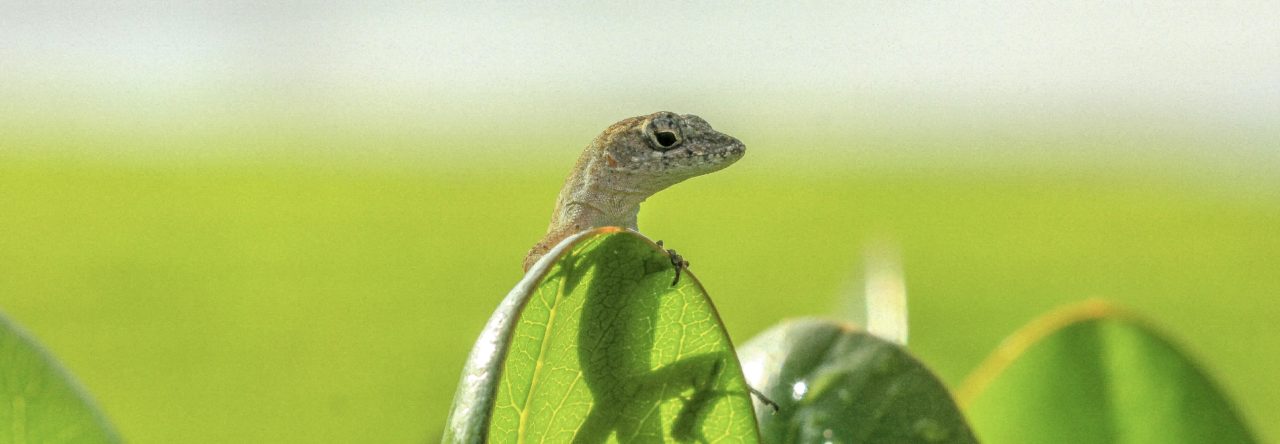

Yesterday at JMIH, Phillip Pearson reported results from work conducted with his thesis adviser at the University of Alabama, Birmingham Daniel Warner. Pearson investigated the impact of incubation environment on the brown anole (Anolis sagrei), and the effects of incubation in shaded versus open habitat and early versus late season in particular. Pearson reported several significant differences between the eggs (and resulting hatchlings) incubated under these two conditions. He specifically reported longer incubation intervals under early season and shaded conditions, smaller hatchling size under shaded conditions and better performance of hatchlings at 1 and 3 weeks for the eggs incubated under the late season regime. Performance of hatchlings was quantified as their speed and the number of times they stopped during a performance trial. This work is the latest in a string of interesting studies from the Warner Lab on the impact of incubation conditions on anoles. I was going to provide links to previous posts on Anole Annals about the Warner Lab‘s work, but there are so many that I’ll just suggest that you type “Warner” into the search box at the top of the page and enjoy for yourself.
Category: New Research Page 30 of 67
 I caught my first anole talk at this year’s Joint Meeting of Ichthyologists and Herpetologists in Chattanooga, Tennessee. James Stroud presented the results of work with Ken Feeley on modeling the niche of the brown anole (Anolis sagrei). Using data acquired from GBIF, Stroud showed that the environmental conditions experienced by brown anoles in their introduced range are outside of the environmental conditions experienced by brown anoles on Cuba. Stroud discussed how these data from the invasive range of the brown anole might be used to develop a more accurate model of this species’ fundamental niche. This is a work in progress.
There is considerable variation in phallus morphology among the major groups of amniotes (phallus used herein to be inclusive of both the penis and clitoris). Just for starters, while most clades – including mammals, birds, turtles, and crocodilians – have a single midline phallus, squamates have paired hemiphalluses. Although herpetologists have long appreciated morphological variation in the hemipenis for its systematic value, understanding the nuances of anatomical homology, homoplasy, and novelty at this larger scale has not been as widely addressed. Recently, the Cohn lab of the University of Florida (of which I am now a member) undertook this challenge from a developmental perspective, studying development of external genitalia in representatives of each reptilian clade: the ball python (Python regius), the pond slider (Trachemys scripta), three duck species, the American alligator (Alligator mississippiensis), and who else, but the green anole (Anolis carolinensis). A synthetic review of the complete series will have to wait for another post, but reprints of each paper are available on the lab’s website to hold over the most curious. But because of the growing interest in anole nether regions, I will briefly highlight the recent findings regarding hemiphallus development in the green anole.

Fig. 2 of Gredler et al. illustrating the development of paired genital and cloacal swellings.
The Wade lab has previously shown that both male and female green anoles develop similar hemiphalluses during the early stages of genital morphogenesis, which then later differentiate into sex-specific reproductive structures. Building upon this observation, Gredler et al. described the embryology of the green anole hemiphallus from the earliest stages of morphogenesis through sexual differentiation. Hemiphallus development begins around the time of oviposition when three sets of paired swellings appear between the cloaca and the developing hindlimb bud, reminiscent of what is observed in other amniote clades. These swellings expand and meet at the midline to form the external lips of the cloaca or remain lateral to the cloaca and mature into the hemiphalluses. Following morphogenesis, the male hemipenis continues to elongate as it forms its distinctive lobes and sulcus spermaticus while the female hemiclitores gradually regress into the cloaca. Further details of the developmental anatomy of internal reproductive structures and gene expression patterns of several key molecules associated with genital morphogenesis are described in the paper.

Fig. 4 of Gredler et al. illustrating sexual differentiation of the hemiphalluses. Red arrow highlights the formation of the sulcus spermaticus.
Although there is some variation among squamates in the relative timing of the emergence and fusion of the paired swellings associated with hemiphallus development, these results are largely consistent with classical embryological descriptions of squamate genitalia (summarized by Raynaud and Pieu in Biology of the Reptila volume 15). But the revival of this body of literature in a comparative and molecular context brings new research questions to our collective table. As discussed by Gredler et al., the seemingly modular relationship between the genital swellings, cloaca, and limb buds may be particularly interesting in the context of repeated body elongation and limb loss among squamates. Better understanding of the relationship between cloacal and phallus development may also shed new light on the mechanisms of reproductive isolation, the coevolution of male and female reproductive organs, and evolving patterns of sexual conflict. Furthermore, there remain open many mechanistic questions regarding the molecular patterning of the hemiphalluses and which processes are hormone dependent that can now be more thoroughly addressed using the newly available sex-specific molecular markers. Considering the growing literature on hemipenis variation and expanding access to genomic resources in Anolis, these may be particularly fruitful areas for future investigation.
 Robert Cox, from the University of Virginia, presented his work examining the relationship between fitness and body condition in Anolis sagrei from the Bahamas. Many evolutionary biologists want to understand selection in wild populations. But in order to do that we need to measure fitness. Finding out who survives to maturity, who finds more mates, and who produces the most viable offspring, however, is quite difficult. For this reason, many researchers use body condition, or the ratio of body mass to body size, as a proxy for fitness.
One of the issues with using body condition as a proxy, however, is that it varies a lot, even within the same individual! When resources are plentiful, even less fit individuals can fatten up. And, when the going gets tough, even vigorous individuals fare poorly. For his study, Bob wanted to know whether body condition was actually a good proxy for fitness. He did this by actually measuring fitness in the wild by tracking survivorship in A. sagrei from the Bahamas. Most studies examining survivorship are performed over a single season or a few seasons, but Bob managed to gather data for 41 estimates of selection over 10 years of work. The numbers are impressive: He tracked survivorship over the summer, which is the height of the reproductive season, for 4,608 adults from 7 populations.
What he found was surprising – it turns out that, in these populations of A. sagrei, fatter is not fitter. He found no evidence for selection favoring better body condition in males or in females. He did find, however, strong selection for body size, rather than body condition. He also found correlational selection on body condition and body size – Specifically, he found that body condition did matter, but only in really large males. But this effect only explained a small proportion of the residual variance. The selection on body size, he found, was much stronger.
Bob’s work emphasizes that we, as a community, need to be wary of the traits that we use as proxies for fitness. In the case of A. sagrei, it didn’t matter what condition the lizards were in, except in the case of larger lizards. However, survival is only one piece of the fitness puzzle. To know how body condition influences fitness, we would ideally also want to know whether fatter individuals gain more access to mates and produce more viable offspring (i.e., more fecund). Together, Bob’s work highlights the importance of body size in survivorship and provides new evidence that fitness proxies need to be experimentally verified before being widely applied.

Mean CTmin for invasive (gray) and native range (green) populations of Anolis sagrei.
Most anole enthusiasts are familiar with the brown anole, Anolis sagrei, because it is a highly successful invader. Although it can be found as far away from its native Cuba (and nearby islands) as Hawaii and Taiwan, most of what we know about invasive populations of this species come from work conducted in Florida. A recent study by Jason Kolbe and colleagues demonstrated that physiological traits vary with latitude in A. sagrei from Florida. Specifically, cold tolerance (CTmin) and desiccation resistance were lowest at higher latitudes in Florida. Tamara Fetters, a graduate student in Joel McGlothlin’s lab at Virginia Tech, supplemented this work by adding data from a native population of A. sagrei found on the island of San Salvador in the Bahamas.

Box plots showing rates of evaporative water loss in invasive (gray) and native range (green) populations of Anolis sagrei.
Tamara found that mean CTmin for A. sagrei from the Bahamas was close to 12°C, which was significantly higher than in Tifton, the most northerly population from Jason Kolbe’s study, but not significantly different from the lower latitude populations in Orlando and Miami. Similarly, she found that desiccation tolerance in native range A. sagrei was significantly higher than in lizards from Tifton, a result that she attributes to the lower relative humidity found at higher latitudes in Florida. Tamara’s future goals include measuring more physiological traits, such as oxygen consumption and heat tolerance (CTmax), along with morphological traits associated with desiccation resistance (scale number and scale area), for various invasive and native populations of Anolis sagrei.

Hanna Wegener talks about Anolis scales at Evolution 2014.
Talks are underway at Evolution 2014 and anoles are already off to a strong start! Early this morning, Hanna Wegener, a Ph.D. student at the University of Rhode Island, discussed some of her work on the diversity in scale size in Anolis lizards. The work she presented was conducted in collaboration with Gabe Gartner and Jonathan Losos from Harvard University. Hanna started by discussing the adaptive radiation of anoles in the Caribbean. As a community, she said, we know quite a bit about how certain morphological traits, namely skeletal dimensions and lamella counts (i.e., number of toe pad scales) differ among ecomorphs and among different climatic habitats. Scale number, however, remains comparatively unexplored in anoles. For her study, Hanna examined ventral and dorsal scale counts in anoles. Her sampling strategy was impressive – by mining the collections in the Museum of Comparative Zoology at Harvard University, she was able to get scale counts for well over 100 anole species, and Caribbean anoles were particularly well represented in her dataset.
She first sought to examine the relationship between scale number and climate. There are prevailing ideas regarding how scale size and number should relate to climate. Specifically, Michael Soulé and Charles Kerfoot have posited that larger scales are advantageous in hot environments because their greater surface area increases radiative efficiency. Larger scales are also thought to reduce water loss in dry environments. Thus, lizards in hot, dry environments should have fewer, larger scales than lizards in cool, wet environments. Hanna found a positive relationship between scale number (both dorsal and ventral) and precipitation, but she did not find a significant relationship between scale number and temperature.

Hanna showing the variation in scale number and size among anoles. The top two rows show dorsal scales, whereas the bottom two rows show ventral scales.
Hanna then asked whether scale number relates to structural microhabitat use. Here the study became much more exploratory and exciting because, if there is little known about the relationship between climate and scale number, there is even less known about the relationship between scale number and microhabitat use. Hanna found significant differences among ecomorphs in scale number. She found that higher perching ecomorphs, such as crown-giants and trunk anoles, tended to have more, smaller scales. Lizards that perched lower and used broad surfaces, such as trunk-ground species, tended to have fewer, larger scales. Although the precise mechanism underlying this relationship remains unknown, Hanna posited that aspects of microclimate, such as temperature, might vary with structural habitat, which may in turn drive scale number patterns. She also suggested that the observed patterns of scale number variation might represent correlated evolution, such that scale number covaries with a trait that relates to differences in structural microhabitat use. Hopefully Hanna’s study leads to more research on the significance of scale number in anoles and other lizards.
 The annual meeting of the Society for Molecular Biology and Evolution meetings start this weekend in San Juan, PR and there are a number of talks and posters to appeal to the squamatophile.
There are three presentations from AA contributors (Marc Tollis and Tony Gamble) using anole genomic data, as well as posters and talks on phylogeography of Puerto Rican Sphaerodactylus, and genome-scale studies of Sceloporus, skinks, and snakes. You can see the full list after the jump.

I may have given the Evolution 2014 logo an Anolis upgrade.
It’s that time of year again! The annual Evolution meeting is upon us. In just under a month, scientists from around the world will converge on Raleigh, North Carolina to learn about new and emerging trends in evolutionary biology. As with the Society for Integrative and Comparative Biology meetings, anoles have had a strong presence at Evolution. It appears that this year will be no different. A quick search for talks including the terms “anole” or “Anolis” yielded seven presentations, and so this meeting should be quite fruitful for those of us interested in what’s new and exciting in Anolis. You can view the list of scheduled presentations here – simply put Anolis into the keyword search at the bottom and all seven presentations will be displayed. Or just look below. As in previous years, we’ll be blogging live from the conference, so stay tuned.


As a senior in college I wanted to study courtship behaviors, and the brown anole (Anolis sagrei) piqued my interest. In going through the literature, I noticed that some studies reported finding evidence for the presence of female choice in brown anoles and others reported that female choice didn’t occur in the species. So I decided to see if females exhibited a preference for males based on two different characteristics: male physiology and male territory quality, each of which would provide females with different benefits. I expected that females would choose males based on territory quality, because females usually mate with the males whose territories overlap theirs in the wild.
I tested for female preference in two different choice experiments using anoles that I ordered and had sent to my college, Colby College, in Maine. I was given access to a small storage closet (which I cleaned out) in the basement of Colby’s biology building in which I kept my crickets and anoles. To test for differences between males with different physiological traits, I tested male endurance by placing them on a treadmill and running them until they couldn’t run any longer. This was perhaps one of the most stressful parts of the experiment for me, since the lizards really didn’t like being put on the treadmill, so during this part of the experiment I got to chase many lizards around the room.

A brown anole running on a lizard treadmill
I then paired similarly-sized males with very different running times to see if females spent more time with one male over the other. For the preference tests, the males were tethered to posts in a mate choice box originally constructed for zebrafinches, and the females were able to run freely through the box.
In the territory tests, rather than pairing males with different endurance scores, I randomly placed males on the side of the box with many plants and twigs, or on the side without. In both tests, I recorded the amount of time females spent on either side as well as the behaviors of the males and females (I watched many hours of video to score behaviors).

Mate choice arena for the territory quality experiment
My results were somewhat surprising; I found that in both experiments the more active male was the most preferred one. This was contrary to my prediction, especially since our measure of activity included all male behaviors, not just courtship behaviors. This is not surprising in the broader scheme of mate choice, since active mates are often preferred, and it’s interesting to see how anoles fit into the bigger picture of mate choice and sexual selection in general. This study is now published, so check it out if you’re interested in the details! Please feel free to contact me if you have any questions or would like a copy of the pdf.

The Anolis literature is replete with examples of lizards altering the properties of movement-based displays in response to fluctuations in environmental conditions. Anoles modulate head-bob amplitude based on social context (Fleishman 1988) and social spacing (Stamps and Barlow 1973, Steinberg & Leal 2013), and head-bob speed based on background vegetation motion (Ord et al. 2007) and many other habitat variables (e.g., Ord et al. 2010). Our recent paper adds predation pressure to this growing list of factors that might affect the signal properties of anoles.