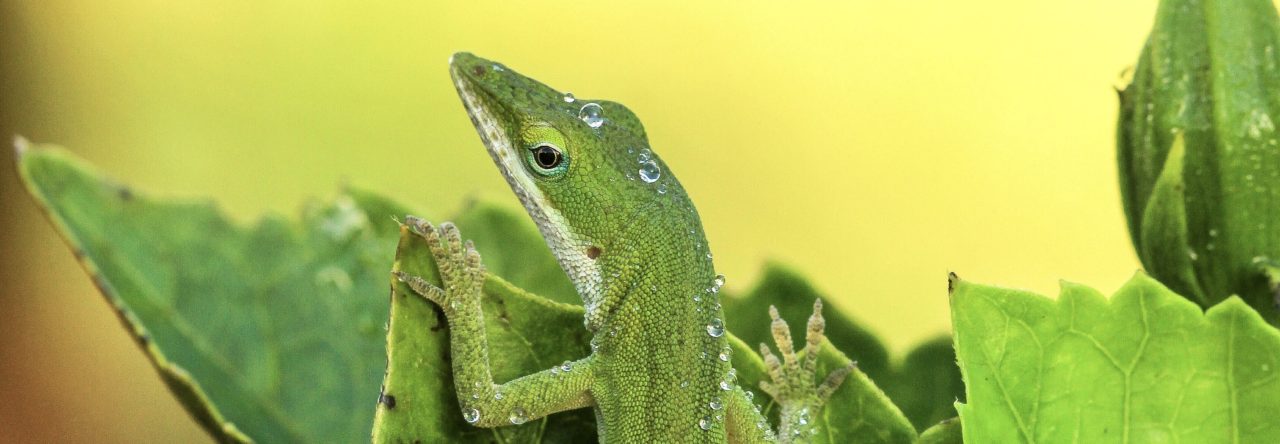
Greetings from Eildon, Australia, where the 2015 meeting for the Australian Society of Herpetology (ASH) is currently underway. Today is the first full day of talks and posters and I’m excited to learn what’s new and exciting in herpetology. Although the focus is predominantly on Australian amphibians and reptiles, there are several presentations on non-Australian herpetofauna, as well. Anoles are also represented as I will be giving a talk on my work on Hispaniolan anoles and Emma Sherratt will be speaking about her work on fossil anoles. If you would like to see what’s going at ASH, feel free to follow the conference on Twitter using #ASH15.
Category: New Research Page 25 of 67
Muscle fiber size can vary based on the frequency of use, or due to the fusion of multiple mononucleated myoblasts during development to form multinucleated fibers. To test if variation in muscle fiber size was due to frequent use or due to differences in development between species, Jacob Stercula of the Johnson lab examined the fiber size and number of nuclei for the ceratohyoid and the retractor penis magnus (RPM) of nine species of anoles. Most species exhibit a positive relationship between fiber size and the number of nuclei in both muscle types. Among species, this positive relationship between fiber size and the number of nuclei exists in the RPM muscle when accounting for phylogeny using independent contrasts, whereas the ceratohyoid shows a positive trend, though the relationship was not significant. This suggests that for the RPM, muscle fiber size is evolutionarily conserved and is due to differences in development among species rather than differences in the amount of use. The size of the ceratohyoid muscle however, maybe be influenced by both the frequency of use and the fusion of myoblasts during development.
Birds are lovely animals. Our avian friends swoop through the air, defecate on field equipment, and consume lizards. What’s not to like?! Well, their shoulder region, for example. Lost interclavicle, reverted muscle pathways, and so many other anatomical adaptations that appear crucial for the modern avian life style, but that are hard to explain in a gradual-evolutionary context. Reconstructing the structural evolution of the avian shoulder remains a challenging task to students of biomechanics and kinematics. When I left my European homestead to enter the Canadian realm of biological sciences, I was hoping to solve the evolutionary mystery of the avian shoulder, at least in part. Alas, the discovery of anoles sent me on a much more convoluted journey.
Here is the first tale that resulted from that endeavour (Tinius & Russell 2014).

Michelle Oberndorf of the Johnson Lab (Photo courtesy of the Johnson Lab website)
Anolis visual display can come in two flavors: static and dynamic. Static displays are those that are involve permanent morphological structures, whereas dynamic displays involve movement of physical structures. Michelle Oberndorf of the Johnson lab asked if structures involved in both static display (tail crest) and dynamic display (dewlap size), were related to body condition or fighting ability (head size) in males and females of two species of anoles. She collected SVL, mass, head morphology, tail crest size, and dewlap size data from 50 males and 50 females of A. cristatellus and A. gundlachi. She found that in males, tail crest area was correlated with body condition in A. cristatellus. In male A. gundlachi, tail crest area was correlated with head size, and dewlap size, while dewlap size was correlated with body condition and head size. She found no relationships between any of the traits in females of either species. These results suggest that both the dewlap and the tail crest may communicate information about male quality and potential fighting ability.
When you tell someone that you study anoles, often one of the first questions they’ll ask is why these lizards change color. While it’s a complicated phenomenon, we do know that anole color can indicate both social dominance and stress. In a poster presented on Tuesday at SICB, Spencer Hudson, an undergraduate working with Travis Wilcoxen at Millikin University in Decatur, Illinois, considered whether habituation in green anoles can mediate the effects of social and handling stress (measured via fecal corticosterone, or CORT), and how stress is associated with color. Spencer found that in comparison to a control group, male lizards that experienced human handling and social interactions with other males had higher CORT levels, and they were more likely to turn brown during experimental trials. However, he did not find evidence that habituation lowered CORT or influenced lizard color. Spencer and his colleagues suggest that acute stress (experienced during human handling) and chronic stress (experienced over the course of the three-week experiment) may have different effects on lizard color.
Impressively, Spencer designed and conducted this experiment all within a one-semester undergraduate Animal Behavior class at Millikin!
We perviously learned about new research on the mechanisms of dorsal crest erection in the brown anole, Anolis sagrei, being done by the Rand Lab at Carleton College. This is a interesting new research area with relevance to our understanding of anole signaling and anatomy that is being carried out by Rand and a team of impressive undergraduate students. Rand Lab student, Morgan Gerace, presented a second Rand Lab poster on this topic at SICB 2015. Following up on the first poster, in which the authors found no evidence of the involvement of muscles, cartilage, or vascular sinus in crest erection, Morgan tested whether crest erection is due to an inflammatory response. By injecting male anoles with the an adernegenic receptor antagonist, interfering with the lizard’s fight-or-flight response, Morgan determined that crest erection may be the result of an inflammatory-like response. Conversely, injection of with epinephrine, essentially supercharging the fight-or-flight response, facilitated a crest erection response. This exciting work by this set of motivated undergraduates draws new attention to the physiological control mechanisms of this under-studied display mechanism.
The ability to move through complex arboreal habitats is critical to anoles, yet we know very little about the physiological mechanisms that underlie arboreal locomotion. Kathleen Foster, a graduate student in Tim Higham’s lab at UC-Riverside, presented an outstanding talk at SICB this week on the kinematics of locomotion in Anolis equestris. (Yep, Kathleen gave both a poster and a talk at this meeting!)
The relationship between the force a muscle can produce and the length of that muscle determines how force is generated at different positions of a limb – at different joint angles, the muscle will have a different length. But, this is extremely difficult to study in anoles, as standard surgical techniques aren’t possible in such small muscles. Kathleen is focusing on the muscles of the hindlimb, and she first determined that tendon strain did not contribute to the force-length relationship in these muscles. This result indicated that in vivo measures of muscle length should provide relevant information on limb kinematics. Next, she addressed how muscle function changes as lizards move on different substrates, using the gastrocnemius (a muscle in the “calf” of the hindlimb). Her preliminary data showed that this muscle is more active on a broad, flat perch than a small, narrow perch, that the active length of the gastrocnemius is more optimal on a flat perch, and that the maximum force generated by the gastrocnemius is greater on a flat perch. Together, these results indicate that the gastrocnemius contributes more to locomotor propulsion on a flat perch than a small perch.
And, because Kathleen has shown that tendon strain doesn’t significantly contribute to differences in muscle length in lizards, she can now study smaller species. This will allow her to examine the physiological differences underlying locomotor adaptations among ecomorphs!

The immune system can be costly, even for anoles. However, despite a large amount of work on natural populations examining when and why animals use their immune system, as well as what it energetically costs, it remains poorly understood whether a larger (more costly) immune response to pathogens offers more protection. In other words, is a major immune response worth all the cost? This is what Amber Brace, a graduate student in Marty Martin’s lab at the University of South Florida has been trying to test. Amber used experimental malaria infections in introduced brown anoles in Florida to determine whether the high costs of an immune response would result in better protection from the disease. Although malaria naturally occurs in Floridian brown anoles, Amber first had to develop an experimental protocol to successfully infect lizards. She gave one group a low dose of malaria, and another group a high dose. Interestingly, only the high-dose group became infected. Once this was worked out, she could then test how experimental infection would affect individuals.
Since malaria ultimately results in the bursting of red blood cells, she predicted that a higher malaria burden would be positively related to the change in number of immature red blood cells (from pre- to post-infection), and this is exactly what she found. This shows that individuals with greater malarial infections are compensating for lost red blood cells by producing more. Perhaps most importantly, she found a negative relationship between malaria burden and the change in number of white blood cells. This suggests that individuals greatly increasing one group of immune cells (white blood cells) are able to decrease their malaria burden. Thus, it appears that an enhanced immune response does, in fact, offer added protection, and the high costs of an activated immune system are worth the investment.
Anoles are no strangers to urban environments. In fact, many anole species seem to do just fine in cities. However, they do face a number of different challenges not present in their native environments. One example is the perches on which anoles move. Andrew Battles, a graduate student in Jason Kolbe’s lab at the University of Rhode island, was interested in exploring how the perch use of two anole species differed between natural populations and urban populations, and what that habitat use might do to their running performance. Andrew studied Anolis cristatellus and A. stratulus on Guana Island in the British Virgin Islands to measure perch smoothness/roughness, perch use, and sprinting performance on various perch types.
Lizards were found most often on artificial perches, instead of natural perches, in urban environments. This is interesting, because such artificial substrates tend to be vertically oriented and significantly smoother compared to natural perches like tree branches and trunks. As predicted, lizards ran more slowly on substrates that are smooth and more vertical, and this was most pronounced in the larger male A. cristatellus compared to the smaller female A. cristatellus and both sexes of A. stratulus. Thus, while optimal substrate use might be inclined, rough, natural perches, these anoles are using smoother, more vertical, artificial perches in urban environments. This fits into a theme present at this year’s SICB meeting that animals often move in ways that seem counter-intuitive at first. How such perch decisions might influence fitness remains an open question. Future work will investigate how availability of perches and alternative escape strategies influence perch selection.
Activity is where the rubber meets the road in the interaction between organisms and their physical and social environments: in order to acquire energy, attract mates, and produce offspring you have to get up and move around. But what dictates how much activity an individual will engage in? We know a fair amount about what causes organisms to be more or less active, with temperature a particularly important one for ectotherms like anoles. Nonetheless, the physiological mechanisms that underlie activity variation are less well understood. Jamal Murray, an undergraduate in Michele Johnson’s lab, presented a poster at SICB that begins to address this question with the Puerto Rican Anolis stratulus. He put lizards into an enclosure with grids marked on all sides, and measured activity rates as the number of times individuals moved from one grid to another. Afterward, he measured blood glucose levels and found that individuals with higher glucose levels were more active. This suggests a proximate physiological mechanism driving differences in activity rates among individuals and, potentially, populations and species.