
Category: Natural History Observations Page 26 of 34

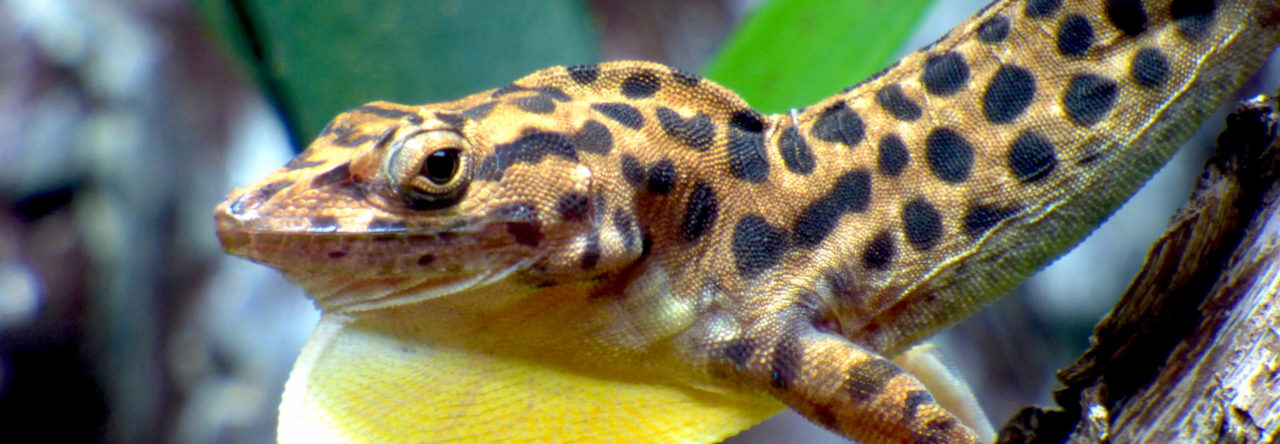
Asymmetrical dewlap color in Anolis lineatus on Curaçao

In September, 2011, Alex Dornburg (Yale), Andy Jones (Yale), Teresa Iglesias (UC Davis), Dan Warren (UT Austin) and I made our yearly pilgrimage to study the marine and herpetological fauna of Curaçao. On the advice of J. Losos, one of our missions this year was to document the dewlap color asymmetry in Anolis lineatus.

In 1967, Stan and Patricia Rand published a paper on the natural history of A. lineatus and noted that:

“The dewlap is large in the male; extended it has a wide border with bright orange skin around a block central spot. The spot is crossed by several widely separated rows of white scales. The border on one side is closely set with yellow or whitish scales, on the other side, the scales are rudimentary and colored like the skin. About half the males have the scales well developed on the right side of the dewlap, about half on the left… one side of the dewlap appears to have a bright orange border, the other side a yellow orange border. The females have a much smaller dewlap, but colored like the males’ and also asymmetrical, though less conspicuously so.”

We braved multiple attacks of push-ups and head bobs and managed to collect and photograph multiple individuals.

Note the large, white scales in the orange field of the dewlaps:

versus the other side of the dewlap which lacks the large, white scales:

The orange vs. yellow-orange difference is a bit subtle and not easily visible in these photos, but it’s there.  Like Rand and Rand, we found a roughly equal distribution of individuals with the white scales on the left, and those on the right.

What explains this asymmetry?   Are they using the different colors to warn males and attract females?

We are thinking of hypotheses to test during our 2012 trip to the island and we’d appreciate hearing other ideas from other researchers.

Illustrations by A. Seago


Species-Specific Feeding Behaviors!

As an evolutionary biomechanist that is half in the Losos lab, I naturally dabbled in studying anoles during my first semester. I never presented my research, and have since moved on to other animals, but I thought you might like to see what I found.

Thom’s work on head shape shows a great amount of variation in the jaw length and width among anoles, and we wondered if the shape had an effect on jaw function. I was looking for differences in feeding behavior between the short-snouted Anolis sagrei and the pointy-snouted Anolis carolinensis. I placed a cricket on a leash, put it on a wooden perch inside a plexiglas container, put the lizard on the perch at the other end, and filmed the result.

Here are some videos of one sagrei attack:
sagrei- Front view

sagrei- Side view

And here is a video of a carolinensis:
carolinensis- Side view

Based on my limited dataset, it looks like the sagrei keep their heads low on the perch while they make an attack-dash consisting of 1 chomp. They hold the prey in their mouths for a while before they begin chewing. Carolinensis get very close to the prey, pause, raise their heads up, and stab their jaws downwards without moving their hind legs.

By the way, if you need ideas on how to study anole biomechanics, I’d love to chat!

Hungry Hungry Anole

Here’s another highlight from the collection of videos that the Glor Lab recorded during an expedition in the summer of 2010 (see our previously posted videos of a fight, color change, and mating).  This video is an interaction between a male Anolis distichus and a caterpillar.  This interaction left one of the participants with a good meal and the other, well, let’s just say he’s a part of the circle of life.

Chameleons Eating Anoles on YouTube (Not for the Faint of Heart)


We’re certainly not shy about posting on our favorite lizards being eaten by other organisms (see this post and links therein).  Heck, we’ve even posted on anoles being eaten by plants and insects.  However, I can’t help but be a bit disturbed by videos posted online that show anoles being used as food for captive chameleons (1, 2, 3, and many others).  Although many of the videos start with the anole already in the much large chameleons mouth, at least one of these videos shows a large veiled chameleon using its tongue to catch the anole (1, 2).  A giant sticky tongue is not likely something anoles have evolved any defenses against.

Day Time Ruminations on Knight Anoles

Check out what Janson Jones has to say about the largest anole, as well as a cool video, here.

Anolis hendersoni in the Dominican Republic

Here’s a close up of the Anolis hendersoni I found sleeping one fateful night inside the Dominican Republic.

Anolis hendersoni - male

Anolis hendersoni - male

Prior to finding this species, I had spent the evening looking for Sphaerodactylus armstrongi and S. streptophorus on the northern slopes of the Sierra de Bahoruco NW of Puerto Escondido.  Upon entering a patch of closed-canopy, broad-leafed forest with a dense, bushy understory, I remarked to myself, “I bet there will be Anolis bahorucoensis here.”  Anolis bahorucoensis is a bush anole that is common across the Sierra de Bahoruco, and often found alongside S. armstrongi.  I was not expecting to see A. hendersoni – another dolichocephalic bush dwelling species that is closely related to A. bahorucoensis – because it is generally considered a Haitian endemic whose range doesn’t cross the border into the Dominican Republic. When the sun set and I switched over to night hunting, I was happy to find out my intuition was, for once in my life, a close approximation of reality.


The Dating World of Anoles (WARNING: Contains Mature Content!)

In the summer of 2010, one of the Glor Lab field teams gathered video of Anolis distichus displays as part of a project to quantify display diversity across the Dominican Republic.  A video of a fight from this expedition was posted on Anole Annals and some great color changes from the same trip were posted on the Glor Lab’s blog a few months back.  Another exciting action that was caught on video a few times throughout the trip was a little bit of the hanky panky.  Generally, the male performed a set of pushups after which he chased and contacted the female.  The two then performed some pushups together, followed by a few minutes of copulation in a leg-wrap.  Copulation was followed by more pushups from the male.  The video above shows an example of this typical sequence of events.  Viewer discretion is advised.

Can You Spot the Sleeping Anole?

Somewhere in this photo is a sleeping anole. The species is one that has only been reported from the Dominican Republic a few times.

Somewhere in this photo is a sleeping anole. The species is one that has only been reported from the Dominican Republic a few times.

If you can find the sleeping anole in those photo, you will have contributed to cataloging the anole fauna of the Dominican Republic.  Points if you can identify the species.  Hint – the photo was taken on the northern slopes of the Sierra de Bahorucco approx. 12km east of the Haitian border.

One Night in Antigua – Photos from a Layover with the Colossus Anolis leachii

Early morning sighting of a female Anolis leachii on a leaf covered in raindrops.

Sometimes, they say, it’s about the journey, not the destination. This makes me think of exciting layovers I’ve had in Anolis country. At any place where the layover is long enough to permit stepping outside of the airport, I like to pop out and see what kind of anoles I can find lurking around the terminals. On a few occasions, travel requires an overnight stay in an exciting place. One of the benefits of working in remote Lesser Antillean islands is that infrequent (and unpredictable) airline schedules typically mean spending a night or two in tiny islands to and from the actual destination. For years I’ve been working in Montserrat, a small island with an active volcano, where I try to follow the flighty bugger Anolis lividus as close to the volcano as I can get. On our way home from Montserrat, we usually spend a night in Antigua, where the charming giant, Anolis leachii can be found.

View of a raincloud and rainbow as we descended into Antigua in January 2009.

Like most anoles from the Lesser Antilles, this species is abundant. However, few species from the Lesser Antilles are as large as A. leachii. It is a member of the bimaculatus clade of large anoles from the Northern Lesser Antilles. According to Scwhartz and Henderson (1991), it can reach a snout-vent length of 123 mm. For anyone who works with crown-giants, this may not seem so large, but for an aficionado of the Lesser Antillean anoles, Anolis leachii is a relative behemoth! Its body ranges from yellow to blue and green, and it’s covered in a purplish vermiculation. The large eyering ranges from a sulfurous yellow to a deep orange. Hands down, this is one of the world’s most beautiful anoles. Imagine my excitement when I got to spend a night chasing these lizards through the wilds of Antigua Village, a cushy beach resort teeming with Anolis leachii and the smaller congener, A. wattsii. Here I offer some photos of this dazzling species, and a bit of its taxonomic history.

White Nose Fungus? Or Just Shed Skin?

Anolis carolinensis hatchling in our animal facility.

I’ve noticed that many of the anoles in my breeding colony occasionally have white protuberances emerging from their nostrils, like the two-month old hatchling to the left. I haven’t been able to determine whether these protuberances are the remnants of an old shed or whether the lizards have a fungus growing in their nostrils. By the time I catch an afflicted individual in its cage the protuberances are gone, seemingly because the lizard blew them out while moving to evade my hand. Has anyone experienced this phenomenon?

Page 26 of 34

Powered by WordPress & Theme by Anders Norén