
Category: Natural History Observations Page 25 of 34

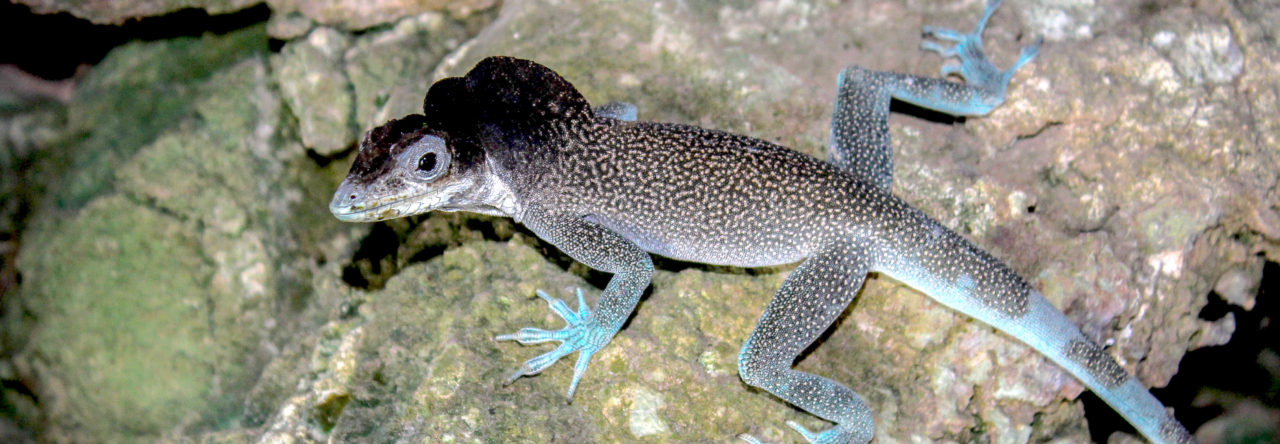
Information on Anolis Maynardi (AKA The Little Cayman Green Anolis)

My husband and I are retired professors living part-time on Little Cayman, so we have come to know both A. sagrei and A. maynardi fairly well. Due to the dearth of information on the latter, we’re posting whatever we’ve got in hopes it helps someone or inspires someone. We have one, a large male, who sleeps most night on a ledge on the inside of our screen porch (he comes in a gap under the door). He goes to bed about 5:30-6 and wakes up around 8 am.

the daily cycle

Anolis who sleeps on top of screen door frame

He is very regular in his habits & quite territorial — we watched him chase a smaller green anolis out of his sleeping ledge with much head bobbing and charges and this morning he smacked into another large male who had the affrontery to be sitting on his deck outside the screen porch! The other male either jumped off the deck or moved quickly to be underneath the deck.

We attach a few photos of two maynardi mating yesterday. Total encounter time was about 6 minutes.

Another view of anole sex


Both maynardi & sagrei drink from our bird bath regularly & follow me when I water the garden to drink off wet decks or leaves.

It’s Only the Beginning of February, and The Green Anoles Are Already Out and About in Georgia

Read all about what they’re up to here.

Working Hard for a Meal

httpv://www.youtube.com/watch?v=u0bkDhKeeQ4

Thanks to the former student, who sent me the link.

A Yellow Knight Anole

Photo courtesy Paul Richards

Paul Richards and Kirsten Nicholson found this unusual knight anole while conducting their radio-tracking study on this magnificent species. Richards recalls: “I think we found him on the west edge of the “microbiome” of the Gifford Arboretum. I recall showing it to a well known herpetologist who claimed it was a temporary color change, so we held it overnight. It looked identical in the morning and we released it. I honestly can not remember if we bead tagged it or not (that would be stupid but…). We never saw that individual again, but I also cannot recall how far into the study we were, so our regular searches could have ended soon after. Local lizard fanciers have told me they have seen these color morphs before, so it is apparently somewhat common.”

The Contrary Anole of Bonaire

Non-alphabetically arranged, the ABC islands lie in a row 20-50 miles north of Venezuela with Curaçao sitting in between Aruba 50 miles to the west and Bonaire 30 to the east. Like many small Caribbean islands, each of the islands harbors but a single species of anole. Previous posts have discussed the inhabitant of Aruba and Curaçao, Anolis lineatus. Bonaire’s anole, however, is a beast of an entirely different stripe.

Anolis bonairensis. Photo by Jonathan Losos

What is curious is not the fact that a small island, not too far from other islands, has its own endemic species. Such anole species occur routinely in the Caribbean, such as A. lividus on Montserrat, A. nubilus on redonda, and A. sabanus on Saba. Rather, the oddity of A. bonairensis is its evolutionary heritage.

How Big Are Hatchling Crown Giant Anoles?

Young knight anole. Photo from http://www.repticzone.com/forums/Anoles/messages/2236899.html

There’s not a lot in the literature on the size of hatchling anoles, especially the giants, and such toddlers are not well-represented in museum collections. The photos here, easily gleaned from the web, indicate that newborn knight anoles are substantially larger than hatchlings of smaller species. What about other anoles? Does anyone out there know how the size of hatchlings of other large anole species? And how big are the eggs? Pictures, anyone?

Fresh out of the egg. Photo from http://media.photobucket.com/image/recent/RandeMchance/Anolisequestris1dayold.jpg

Asymmetrical Dewlaps Redux: the Anoles of Aruba

Anolis lineatus from Curaçao

Several previous posts have discussed the odd case of Anolis lineatus on Curaçao, whose dewlap differs from one side to the other. Rand and Rand reported this in 1967, but the observation was pretty much forgotten until earlier this year, when Matt Brandley and compatriots confirmed the Rands’ claim. Shortly thereafter, Melissa Losos and I travelled to Curaçao as well and observed the same phenomenon, allaying concerns that the Brandley team was covering for the Rands.

But since these posts, many AA readers have no doubt been sleepless at night, pondering the obvious question: what about A. lineatus on Aruba? Do they, too, have mismatched throat fans? Indeed, one could imagine a scenario in which they might not. Asymmetry is a common result of low levels of genetic variation (although there is a lot of quibbling about this in the literature). Curaçao is downstream in an ocean current sense from Aruba. Thus, it could be that the Curaçao population of A. lineatus was founded by one or few Arubians, and thus the resulting founder effect gave rise to the dewlap discordance.

An exciting hypothesis that I am pleased to immediately quash:

Battle of the Sexes: When Dewlaps Differ

Anolis insignis above, Anolis transversalis below. Males on left, females on right. Photos appeared in Lizards in an Evolutionary Tree, photographed by Steve Poe (insignis), Arthur Georges (male transversalis) and Alexis Harrison (female transversalis).

Sexual dimorphism–differences between the sexes–have been greatly studied in anoles, and so has dewlap color and patterning. But little research has been directed to the phenomenon of sexual differences in dewlap color or pattern. Such differences are relatively rare in Caribbean islands, but much more common in mainland species. Why does this occur? Nobody knows. In fact, what female anoles use their dewlaps for has been little studied (another phenomenon, fodder for a future post, is differences in the size of the dewlap between the sexes, which can be quite substantial).

In any case, here’s a sampling of dimorphic dewlaps.

Anolis fitchi (female and male), and Anolis orcesi (female and male)

Photos courtesy Melissa Woolley.

Winter Anoles: Thermoregulating in the Cold

Braving the elements in Charleson.

We all think of anoles as warm weather, tropical beasties, but of course, that’s not entirely the case. Many live at quite high elevations and are active at cool temperatures. For example, this past summer we saw A. orcesi active (as active as it gets) when temperatures were 20 C and below.

In addition, anoles get relatively far north into temperate areas of the United States. One might think that they’d just go to sleep in the winter and not come back out til the spring warmth, but that’s not the case. Faithful contributor Marc Tollis discusses one recent observation over on his own blog, Anolis Tollis.

Vacation in Vieques, Complete with Anoles

Frigid temperatures in Boston are making me long for the warm waters of Vieques, PR and the time I was there in October.  Truth be told, I work for Jonathan Losos in a mostly administrative role, but even that has turned me into an avid lizard hunter when on vacation in the tropics.  I even set a goal for myself – to find and photograph all three species of anoles on the island – except for the one no one has seen in almost 100 years.  I trusted that if several professionals have not been able to find A. roosevelti, than my chances were slim (although, I did keep my eyes out for large lizards falling out of trees, just in case).  To my absolute delight, the other three species,  A. cristatellus, A. pulchellus, and A. stratulus could all be seen running around the manicured garden that surrounded the house I was staying in.   We named one “King” and watched him move from palm tree to palm tree, displaying to the other anoles in the vicinity.  (I’ve observed many anoles in Ecuador, but had never seen an anole move its tail back and forth before as a display – adorable!)

I watched a spirited courtship between a male and female A. pulchellus in ferns, and spent far too much time trying to get a shot of A. stratulus – particularly one that could always be seen on the wall of the pool house, but would promptly run through the door when I pulled out my camera.

There was even an A. stratulus running around without a front hand.  He seemed to move about just fine, though, both through the house and around the vegetation outside.  I was proud of my non-biologist friend that worried about him missing “so many sticky toes”.    Also entertaining was a fight between two juveniles – unfortunately shot with my cheap telephoto lens, so the quality is poor, but it’s still entertaining: video

Looking forward to a week in the Bahamas in May – another vacation, but I’m sure it too will be filled with anoles.

Page 25 of 34

Powered by WordPress & Theme by Anders Norén