
Category: Natural History Observations Page 2 of 34

Color Change In the Andean “Chameleon”

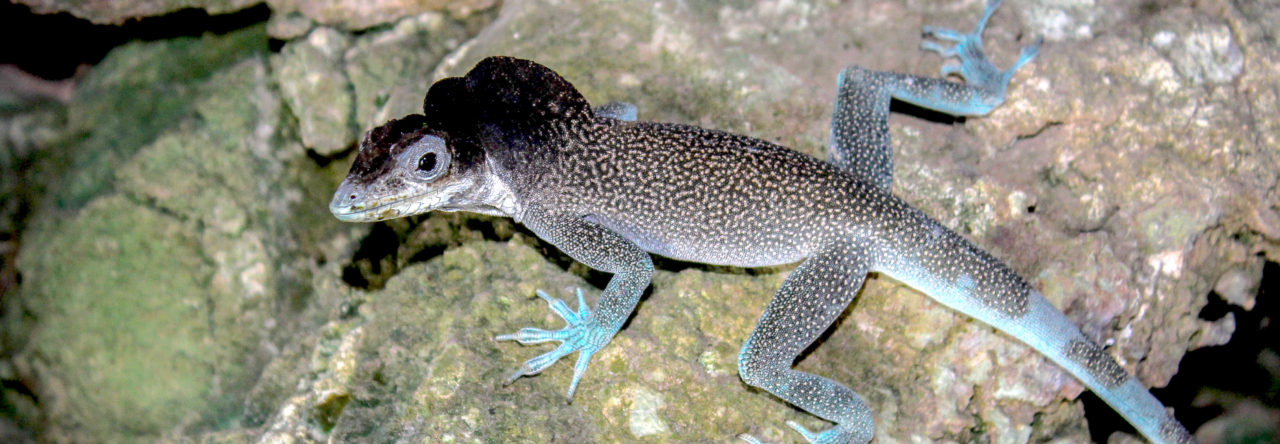
Anoles are well known for the sharp differences in dewlap colour and size between females and males. However, this is not true for all the species of the genus. Anolis heterodermus is a large arboreal lizard that inhabits shrubs and small trees in the cloudy Andean forests in Colombia and northern Ecuador. Although males are slightly bigger than females, this species has no apparent sexual dimorphism in dewlap size or colouration. Anolis heterodermus is a slow-moving lizard that relies mainly on its body colour pattern to camouflage from predators, thus its common name Andean “chameleon.” Moreover, these lizards have a long prehensile tail which is very useful when moving through thin branches. Interestingly, males curl and swing their tail to their opponents during aggressive encounters.

The body colour pattern is incredibly variable in this species, but all animals have a small patch of bluish scales in the base of the tail. After keeping some of these lizards in captivity, I noticed that the colouration and size of this patch changed dramatically between animals, and even within the same animal over the course of the day. Every time I arrived at the lab in the morning, the patch was small and reddish (Fig. 1A) but after midday, it seemed bigger and with an intense blue colouration (Fig. 1B).

Figure 1: Colour and size variation in the tail patch of Anolis heterodermus. The same male has A) a reddish patch at 06:40 h and B) a bluish patch at 14:47 h.

I thought that the colour and/or size of this tail patch were somehow related to a male’s quality and that could be the reason why males display their tail in the combats. If my hypothesis was correct, males (but not females) would have a larger variation in patch colour and size that is dependant on the time of the day. With the help of some colleagues, I collected males and females of A. heterodermus across the Eastern Cordillera of Colombia. I housed the lizards separately and took photographs (Fig. 1) from each animal every hour between 6:30 to 18:00 h. On each photo, I measured the colour and size of the tail patch. Colour was scored as the ratio of blue vs. red intensities (Blue:Red score), where a larger score indicates bluer scales.

I found that the tail patch of Anolis heterodermus changed from red to blue throughout the day and was generally bluer in males. However, contrary to my hypothesis, the colour change was similar between females and males (Fig. 2). In addition, the coloured patch remained the same size throughout the day in both males and females but was bigger in males.

Figure 2. Diurnal colour change in the tail patch of males and females of Anolis heterodermus. Larger values of the Blue:Red score indicate bluer scales.

Active colour change in lizards often occurs in the context of intraspecific communication (e.g. territorial and courtship behaviour). However, my animals were kept isolated from each other; thus is unlikely that the change in colouration per se is conveying social information. Intriguingly, the highest values of blue colouration for both males and females were reached around midday, which corresponds to the natural peak of activity of the species and possibly to higher body temperatures. In this case, the colour change might be an indicator of animal activity or arousal. This could also explain why the blue colouration disappears at night (personal observation).

Finally, the fact that the patch was significantly bigger and bluer in males compared to females supports the hypothesis that the patch can be relevant in male interactions. It would be interesting to test if the colouration and size of the patch are related to male performance or overall quality.

These are just some of the many questions that still need to be answered about the colour change in the Andean “chameleon,” and this study highlights the importance of observations in the laboratory to identify traits that might be important but difficult to observe in nature.

Original article: Iván Beltrán (2019) Diurnal colour change in a sexually dimorphic trait in the Andean lizard Anolis heterodermus (Squamata: Dactyloidae), Journal of Natural History, 53:1-2, 45-55. DOI: 10.1080/00222933.2019.1572245

Underwater Breathing by a Tropical Lizard


Adult water anole (Anolis aquaticus) from Coto Brus, Costa Rica, with an exhaled – and recycled – air bubble. Photo by Lindsey Swierk.

Over the past few years, I’ve been accumulating evidence that the water anole (Anolis aquaticus) might be a tiny scuba diver in the streams of its home in southern Costa Rica. Anolis aquaticus takes to the water as refuge from predators, swimming and often diving underwater for long periods of time – the record at my study site is currently 16 minutes! To enable these crazy-long dives, it’s possible that anoles may have come up with a scuba-tank method of sorts to “breathe” underwater.  I’ve compiled a video of what appears to be underwater respiration of a recycled air bubble that clings to the anole’s head. (A few more details about these observations will be in the upcoming March issue of Herpetological Review.) For now, enjoy the video!

Amazing Video of Nest Site Selection in Anolis equestris


Here is an outstanding video of — what looks like — an adult female Cuban knight anole (A. equestris) testing out a potential nest site for egg laying. However, around the 3 minute mark in the video it seems to get spooked and possibly abandons the operation!

What do Anole Annals readers think the lizard is trying to measure when gently prodding the soil with her snout? Substrate firmness? Avenues of easy digging? And when she appears to be licking the substrate? Moisture? Fascinating!

Special thanks to Florida resident Janie Barbato for recording and posting this wonderful video as an addition to her iNaturalist observation of this female.

What Colombian Anole Species Could These Two Be?

I found these two specimens in my farm located in the municipality of Santa Sofia, department of Boyacá, Colombia. The living specimen was found near a stream in a wet area, while the dead specimen was found in the house of the farm. The farm is located in an Andean forest at about 2300 meters above sea level where plants such as oaks and eucalyptus trees predominate, among others.

Out of Puerto Rico?: A Puerto Rican Anole Hatchling in Need of an ID

The nursery trade is a known vector for many invasive species including anoles. Anoles have quite the affinity for laying eggs in the moist soil of potted plants, which may then be transported to various locations. Indeed, the nursery trade is the suspected vector for introductions to Hawaii and California of A. carolinensis and A. sagrei and likely accelerated their spread within those states. In fact, citizen scientists on iNaturalist document a reasonable number of brown anoles well outside their normal range. These observations have a distribution that suspiciously coincides with locations of Home Depots and Lowes. However, while the nursery trade is a suspected vector for other species of anoles, verified instances of long-distance transport via the trade are fewer and farther between.

An (as yet) unidentified anole hatchling transported from Puerto Rico to Virginia. From user kimjy3 on iNaturalist.org

One recent observation on iNaturalist documented a hatchling anole that popped out of a potted plant shipped from Puerto Rico as the user unwrapped it…in Alexandria, Virginia. Can anyone on Anole Annals having experience with Puerto Rican anoles and their hatchlings help ID this little one? The user reports that the anole does not have blue eyes; instead they are brown or black.

Feel free to add IDs/comments on the iNaturalist observation as well!

Perch Use by Anolis polylepis Peters, 1874 (Polychrotidae) in a Tropical Humid Forest at the Piro Biological Station, Costa Rica

Morazán Fernández, F., Gutiérrez Sanabria D. R., Coello-Toro H. L., Arévalo-Huezo, E. Ioli, A. G., Díaz Gutiérrez, N., Guerra, L. F, Burbano, D., Guevara, C., Lobos, L., Rico-Urones, A., Cortés-Suárez, J. E, Jiménez, R., Reinke, H., Narváez, V., Aranda, J.M. 2013. Relación entre la fauna silvestre y las plantaciones de palma africana (elaeis guineensis) y su efecto en la producción de pequeños y medianos productores en la península de osa, Costa Rica. Instituto Internacional de Conservación y Manejo de Vida Silvestre, Universidad Nacional, Costa Rica. Pp 104.

This image was taken as part of the integrated course developed by the XXIII promotion of the Masters in Conservation and Wildlife Management of the National University of Costa Rica.

Individuals of a species use habitats on different ways for refuge, feeding, reproduction, or perching. We studied the variation on perch use between sex and age classes of Anolis polylepis at the Piro Biological Station, Costa Rica. Our results point to a similar perch use pattern between sex, but different between age classes, considering only the lowest and
highest perches. Adult females and males use herbaceous and shrubby vegetation and avoid leaf litter. Juveniles use herbaceous vegetation and leaf litter, but avoid shrubby vegetation. We suggest that adult males use higher perches to defend territory.
Conversely, juveniles use lower perches to avoid predators and foraging. Adult females use middle and high perches. This result is in contrast with previous studies on this species.

Cortés-Suárez, J. E. and N. Díaz-Gutiérrez. 2013. Perch use by Anolis polylepis Peters, 1874 (Polychrotidae) in a tropical humid forest at the Piro Biological Station, Costa Rica. Herpetology Notes 6: 219–222.

‘Whoops’! Anolis bicaorum Falls during Dewlap Display!

While performing population research of Anolis (Norops) bicaorum at Kanahau Utila Research & Conservation Facility, we stumbled upon two males in close proximity initiating a territorial dispute. With the intention of documenting this behavior, we began to record the interaction.

In all honesty, the confrontation was a little shorter than any of us expected…  It may well be one of my funniest fieldwork memories to date (despite watching it on repeat, I still can’t help but chuckle at this anole’s misfortune!) . To detail, upon the first exchange of dewlap extensions, the responding male slipped and fell clumsily from the trunk; meanwhile, his contender (who was in the process of displaying) looked on, apparently baffled at the sudden disappearance of his rival.

It appears the falling males mistake arose owing to a combination of two factors. The simple explanation is that this male lost his footing on the steep vertical trunk (which formed the battleground on this occasion), but indeed it’s rare to see an anole make such an error of judgement;  the lamellae on their feet afford them excellent grip on many substrates.   The second explanation owes to the fact males are completely intolerant of one another.  We noted that when engaging in territorial disputes, males of A. bicaorum become entirely absorbed in their confrontation, possessed by their territorial natures and relentless in their efforts to dissuade and expel contenders from their patch.  Often, competing individuals become so preoccupied that hey no longer perceive apparent dangers (e.g., the closely observing biologists).  Perhaps the haphazard approach of males in territorial engagement leaves them prone to the occasional miscalculation.

If you are curious to learn more about Anolis (Norops) bicaorum (a threatened species endemic to Isla de Utila, Honduras),  the most recent research by Brown et al. (2017) at Kanahau URCF resulted in published records on their geographic distribution, natural history, ecology and interactions with sympatric anoles. 

Three in The Bed: a Curious Case of a Shared Sleeping Perch in a Neotropical Anole

Opposite views of a communal sleeping event (1 male, 2 females) of Anolis cusuco at Parque Nacional Cusuco, Departamento Cortes, Honduras (Brown & Arrivillaga, 2018)

Let’s be honest: anoles are fascinating! These charismatic and well-adapted lizards are always a pleasure to watch and document. Better yet, no matter how well you think you know a species, they’re still always full of surprises.

The sleeping behavior of anoline lizards is a fascinating aspect of their natural history, and a growing amount of literature has detailed species-specific sleeping activities.  Typically, anoles are considered solitary sleepers owing to their territorial nature,  but ‘behind closed doors,’ this may not always be the case!

For those curious,  a recent  ‘behavioral oddity’ published in Mesoamerican Herpetology  by Brown & Arrivillaga (2018), reported an example of three individual Anolis (Norops) cusuco sleeping together on a perch! The individuals were so close that portions of their bodies overlapped! Strange, indeed; this observation contrasts the typical view of anole sleeping ecology, territoriality and indeed that what is known for this species (Clause & Brown, 2017).  In over 5 years of visiting Cusuco NP (observing countless solitary sleeping A. cusuco), imagine the surprise in finding these anoles having a sneaky snuggle!!

As we wrote: “Although a conclusive explanation is not available, we suggest that because the sleeping group consisted of one male and two females, that the shared perch might have been breeding-related. This situation might be associated with the overlap of male and female territories, or by the anoles awakening close to necessary resources. Conceivably, however, courtship might have been interrupted by nightfall, and the orientation of the sleeping male ensured that courting would continue the following morning.”


Anole Annals World Cup: Round One

It’s June. It’s orchid flowering season in Grand Cayman. And with nods to #Anole March Madness and  #MammalMadness it’s the opening round of the 2018 ANOLE WORLD CUP. #ANOLEGOOAAAAALLLL!!!!

Home Team – Anolis conspersus  – against –  Away Team – Anolis sagrei

And in less than 90 seconds it’s all over.


The teams are on the pitch


The Away Team


The Home Team heads to mid-field


The Striker takes aim


Home Team – 1, Away – nil


Sometimes Knights Eat Dragons (Dragonflies, That Is!)

One of the loudest anole meals I’ve witnessed.

During one recent afternoon’s field work, I heard an unusual noise in the botanical garden I was working in: a sound like someone crunching and crinkling a foil potato chip bag. Tracing the sound from about 20 feet away, I did not find a snacking plant enthusiast, but rather a young Knight Anole (Anolis equestris) in survey posture who had apparently just snagged a large dragonfly out of mid-air. The anole chowed down on its prey while keeping a weather eye on me and conducting a few half-hearted displays to let me know it was aware of my presence. As the anole continued to masticate its rather large afternoon meal, it moved to a higher perch away from the prying eyes of this anolologist.

The dragonfly, a Regal Darner (Coryphaeschna ingens), is a common species in the southeastern United States and an accomplished aerial predator. It was also more than a mouthful for this young knight, which had to chew with its mouth open for over four minutes (and still wasn’t finished when it escaped my view); quite the prey handling time! And yet more evidence that this largest of anole species is willing to take a chance on any prey item that might fit into its maw even if it takes a little work.

An impressive snag for such a young anole.

Page 2 of 34

Powered by WordPress & Theme by Anders Norén