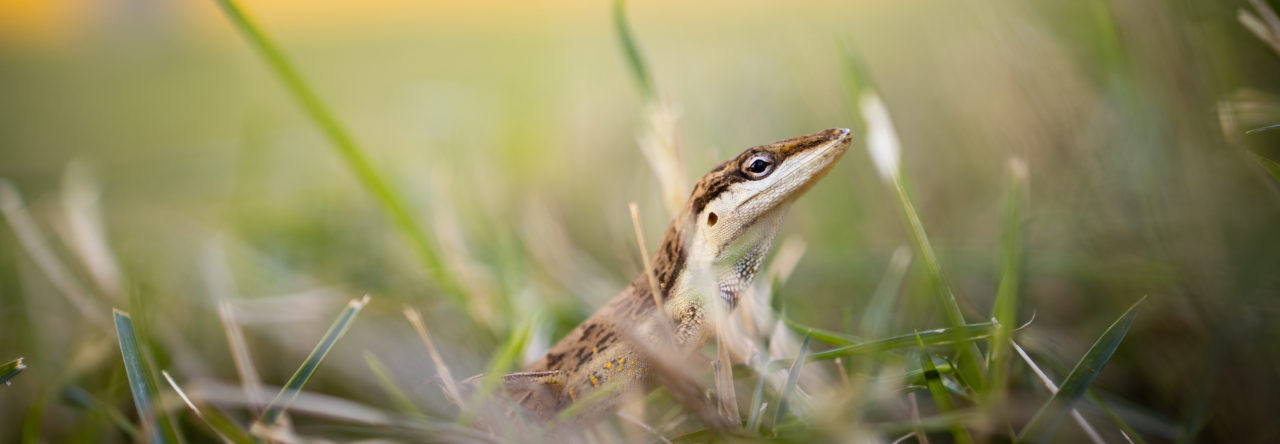
 Don McLeish has photo-documented an amazing battle between two green anoles in his backyard. The fight went on for at least an hour, and when he checked in on the lizards at night, one was still breathing hard hours later. Check out the photos!
Category: Natural History Observations Page 16 of 34
Currently in Guadeloupe to investigate in collaboration with the National Park the distribution of sub-species of anoles with a colleague of the University of Toulouse (France), we saw an extraordinary scene of predation of a female anole (Anolis marmoratus speciosus) by Scolopendra gigantea. In Guadeloupe, the predation pressure is essentially due by cats, dogs, blackbirds and thrushes. At our knowledge, the scolopendre have never been reported before …

Anolis sagrei nelsoni from Little Swan Island. Photo by Alexis Harrison

Where the Swans meet.
My first two posts [1,2] reported on how we got to the Swan Islands and what we found on Great Swan, especially the anoles. But after five days on the island, we had given up hope of crossing the strait to Little Swan Island. The navy on the island had no boat. The channel between the islands, while narrow, was deep and carried a substantial current. From the air, it appeared that there were no sandy beaches on which to land, only jagged rocks beyond the jagged reef.
That afternoon, we were surprised to hear the sound of a motor. From the top of the dilapidated radio tower, someone spotted a small boat headed for the island. It turned out to be a lobster boat, headed back to the mainland of Honduras after several weeks collecting lobsters offshore. They were stopping at Swan Island to replenish their supply of plantains and rainwater. With a little haggling, we were able to persuade the captain to ferry us over to Little Swan the next day and pick us up again several hours later!

Heading to the lobster boat
We arranged to leave the next morning at 6 a.m. The morning came and we packed our gear and went to wait at the dock. Two men headed from the boat to the shore in rickety-looking fiberglass canoes and we piled in: three in one canoe and two in the other. Randy and I were sitting in the canoe with three and I was a little nervous. The lip of the canoe seemed awfully close to the water line and the surf was high enough to bounce us around. But the sailor paddling us back seemed unconcerned, so away we went.
We made it about halfway to the boat before a wave came up to the lip of the canoe and poured in. Within moments the canoe had disappeared beneath us and we were bobbing in the water a couple hundred feet from shore. My first thought was that my camera was going to get wet – the second thought was that it is hard to tread water in hiking boots. I tried to hold my backpack over the water while we waited for the second canoe to come over. I was able to toss my bag into the canoe, then we held on to the side of the canoe and were towed back to the shore. The other canoe and Randy’s rake stayed on the bottom of the ocean.
Our next attempt to reach the boat was successful. This time, we used three canoes. The captain of the boat was also able to find three life jackets to send along, just in case.

Anolis sagrei nelsoni from Great Swan Island. Photo by Alexis Harrison.
In a previous post, I detailed the trip to Swan Island and our initial impressions. But now for the important stuff. The most abundant animals on the island were the anoles. They could be found on the beach, in the forest, on the buildings, on the hammock where we napped in the hottest part of the afternoon. This abundance was not immediately apparent, as the anoles seemed rather shy and tended to hide when I approached. Yet, if I sat still for a few minutes, anoles would start descending from the treetops and soon there seemed to be an anole on every branch.

Dewlap of A. sagrei nelsoni from Great Swan Island. Photo by Alexis Harrison.
My immediate impression was that these anoles did not “feel” like typical A. sagrei. They were light in coloration when calm, more like A. cristatellus than A. sagrei. Their eyes were marked like A. sagrei, but they were larger and darker. Females seemed similar in size to A. sagrei that I have seen elsewhere, but the males were (much) larger. This pronounced sexual dimorphism is consistent with the pattern in the anoles of the Lesser Antilles, where sexual dimorphism is exaggerated on single-species islands. Finally, the dewlap of the anoles on swan island were much darker than what I think of as typical A. sagrei dewlaps, and did not have the typical two distinctive colors, red and yellow, but graded from a lighter margin to a darker center gradually.
 The anoles on Swan Island were also different from “typical” A. sagrei in their behavior. My general impression was that they were more shy of people. When threatened, they nearly always ran up into the canopy, rather than towards the ground or around their perch. Males displayed their dewlaps relatively infrequently. Finally, I observed them using a broad range of perches. Males especially used broad horizontal perches in the canopy of trees in addition to lower vertical perches.
Next Up: Big Surprises on Little Swan!

Photo by Alan Templeton.

Couldn’t resist including this
Last June, we had a discussion of tail regeneration (that was continued just last week), as part of which I stated that three-tailedness is known in lizards. And sure enough, here’s an example of it, albeit an agamid (at least it starts with “a”). Alan Templeton, of fruit fly and collared lizard fame, is the photographer, and the shot was taken in Kiryat Yam in northern Israel, close to the Mediterranean.
Species, anyone? And, if I’m not mistaken, agamids don’t have tail fracture planes, which explains the lousy looking regenerated tails. But why the triple? Anyone got a photo of an anole doing that? A quick Google failed to find any, but did come up with this.

Anolis sagrei in All-America Park in South Miami. Photo by Janson Jones.

Last month, we had a trio of papers [1,2,3] on the awesome anolifauna of a tiny park in Miami, which currently hosts five anoles, four introduced from Cuba, Hispaniola and Jamaica, and with a fifth, from Puerto Rico, only blocks a way. Now Janson Jones has joined the chorus, adding his observations from a visit in 2011. Check out his fascinating observations on A. sagrei and the gang on dust tracks on the web.

Photo by Karen Cusick.
They say redheads have more fun, but is that true in the brown anole world? We’ve had a lot of discussion of A. sagrei that are overall orangey in color, but less about the coppertop look that seems to pop up in populations far and wide. We certainly see it on some of small Bahamian islands, but not others. The photo above is from Florida, courtesy of Karen Cusick’s Daffodil’s Photo Blog. Who else has seen the redheads, and where? And any idea of their significance?


Before. Photo of A. maynardi by Pat Shipman.

After.
Pat Shipman, AA‘s correspondent in the Little Cayman bureau, reports: “We are very familiar with the individuals of A, maynardi that count our house in Little Cayman as their territory. The individual shown here regularly sleeps on our screen porch in the gap at the top of the door. He is shown in May 2011 in the photo on the left. Judging from the landmarks in the photo, his total length was about 23 cm at that time. Early in Dec. 2012, we saw him again and noticed he had lost his tail. By early February–roughly 2 months–he had regenerated about half of his tail (see photo on right). Judging from reported rates of tail regeneration in A. carolinensis, this is rather fast growth. Of course, warm temperatures accelerate growth and the average temperature here year-round is about 85 degrees (Editor’s note: sure, rub it in). We’re trying to get the photos scaled exactly so we can estimate size & growth better, but this seems remarkable.”
I expect that rates of tail regeneration have been reported in anoles, but I don’t know where off-hand. Anybody know of relevant research? Some googling tells us that tail regeneration was a hot topic in the late 60’s and early 70’s and, in fact, there was a paper entitled “Factors influencing rates of tail regeneration in the lizard Anolis carolinensis” by Maderson and Licht (Experientia Volume 24, Issue 10, pp 1083-1086). Am I too lazy to dig out of the internet? Heck no, but apparently it’s not to be found digitally. Sorry! But wait–it is, only you have to look under the journal’s new name, Cellular and Molecular Life Sciences. In any case, here’s the abstract…oops. There is no abstract. But here’s a section from the beginning of the Discussion: “Our results indicate that temperature may influence at least 3 different aspects of the regenerative process…Comparison of results obtained between 21 and 32 °C indicate that the higher temperature accelerates both rates of blastema formation and subsequent regeneration rates. However, the latter process is seen to be considerably more temperature dependent than the former when Q10 values are compared. Finally, temperature influences the final form of the regenerated tail, a smaller proportion being replaced at the lower temperature.”
And, for Pat, here’s the key figure on tail regrowth:

From Maderson and Licht (1968)

Anolis cybotes. Photo by Miguel Landestoy
A while back, we had a post that featured a photo of a male brown anole sticking its leg off the ground and out to the side in an odd manner. Readers speculated that this was to get the body and leg off the hot surface of the ground. AA contributor Miguel Landestoy has sent in a photo of A. cybotes doing more-or-less the same thing, although less awkwardly, and Miguel, too, speculates that this is for thermoregulatory purposes: “the guy may be avoiding the heat on the very reflective surface on the banana/plantain leaf (see that also fingers are also lifted).” This is, of course, reminiscent of the famous dancing behavior of the African lacertid lizard Aporasaura anchietae, which lives in the Kalahari desert and stands on two legs, rhythmically alternating which feet are in contact with the hot sand (check out the remarkable BBC video).
Maybe so, but I’m not convinced. I’ve seen behavior like this many times, and it didn’t necessarily seem to occur in ultra-hot conditions, though maybe I just wasn’t paying enough attention. Thoughts, anyone?
httpv://www.youtube.com/watch?v=sVn-JWEcHAg&feature=player_embedded
We talk a lot about how green anoles and brown anoles interact with each other, and the supposition usually is they are competing for space and/or food. But they can interact in another way, by eating each other! And here’s graphic proof that it happens!
The footage is from the classroom science project run by Aaron Reedy, Dan Warner and Tim Mitchell. We featured their recent paper a few months ago, and you can read all about the project on their website.