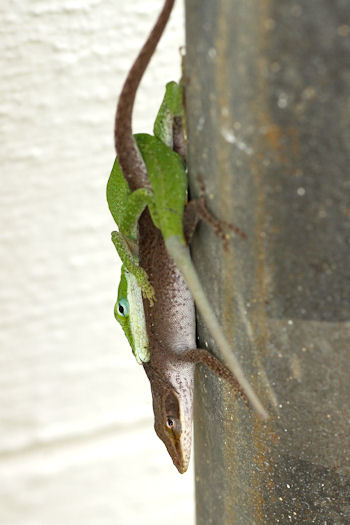
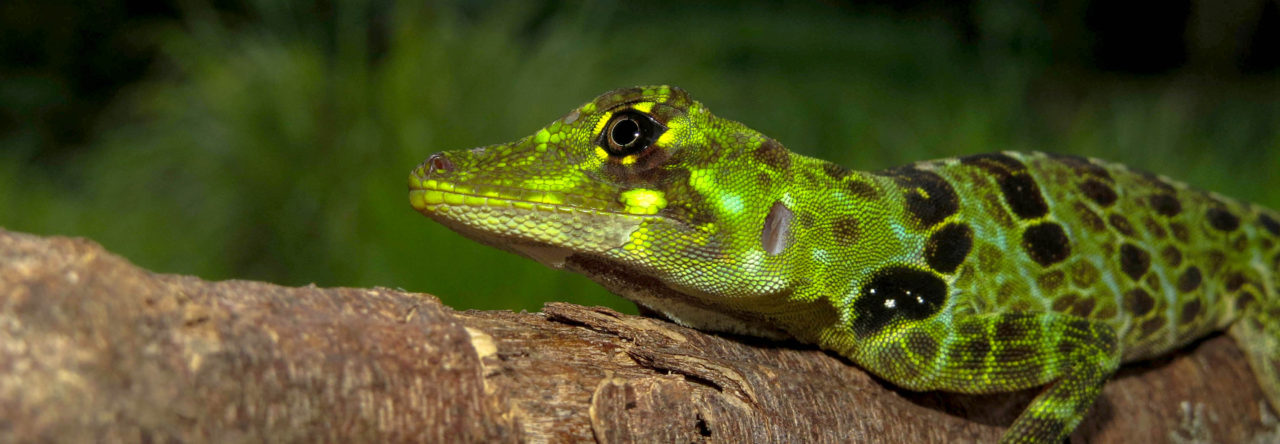

Two Anolis marmoratus males fighting on Basse Terre, Guadeloupe
When it comes to territorial behavior male anoles tend to get all the attention. I suppose it makes sense – nothing catches the eye like a brightly colored male doing a few dewlap extensions or engaging in a dramatic battle. It would be a bit of an understatement to say that we like to talk about male-male territoriality and aggressive encounters on this blog (1, 2, 3, 4, 5, 6, and the list goes on!). In fact, we’ve even had photo contests to document the best fights, which tend to feature large, colorful males.
Perhaps it’s no surprise, but females can be just as aggressive as males. At SICB this past January, I learned about Jessica Edward’s research on aggressive encounters between Anolis carolinensis and A. sagrei. It turns out that the victor of female-female staged encounters was nearly always A. sagrei. There are plenty of interesting papers on the topic, for those that are interested (1, 2, among others).

Figure 1. The author waiting for the sun (and the lizards) to come out.
Regardless, I was completely caught off guard during my field expedition last summer to the Dominican Republic when a female A. armouri engaged in a territorial display against a male intruder. Along with Ellee Cook, an undergraduate at Trinity, I was catching A. armouri near Loma de Toro high in the Sierra de Baoruco, the mountain chain that runs between Haiti and the Dominican Republic in the southwest of the island. It’s frequently rainy and overcast at these high elevations and we spent most of our time languishing in the drizzle and waiting for the lizards emerge, as evidenced in Figure 1 and Figure 2.