Category: Natural History Observations Page 10 of 34

The Anole Community Of Los Tuxtlas, Mexico

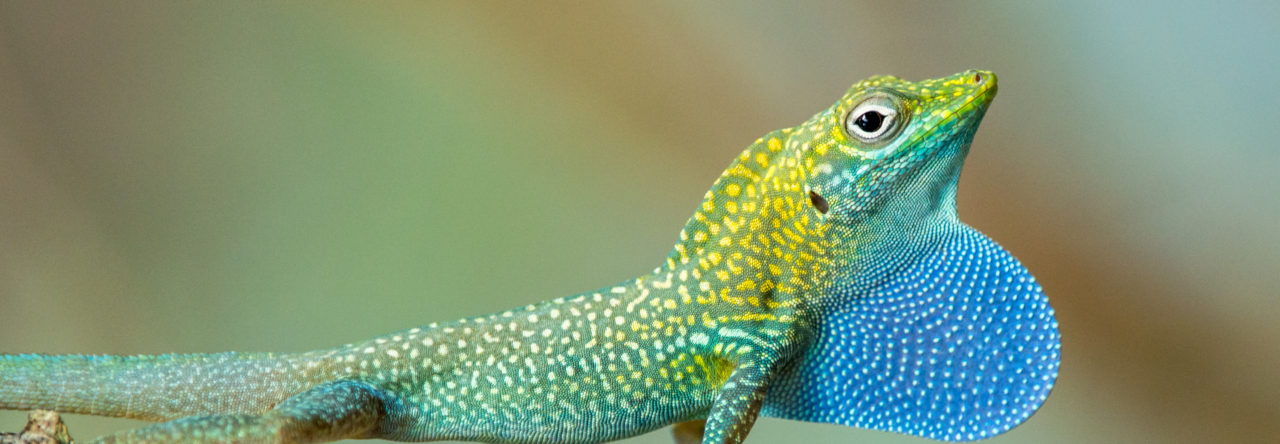
Anolis barkeri. Photo by J. Losos

Anolis barkeri. Photo by J. Losos

As part of its ongoing studies of Central and South American anoles, Team Mainland—fresh off successful field work in Colombia and Venezuela earlier this year, traveled to the Veracruz, Mexico to sample that state’s anole fauna. Joined by Anne-Claire Fabre, Victor Jiménez, and Ramón Martínez, Team Mainland worked at the fabled Estación de Biología Tropical Los Tuxtlas, home to eight or nine (depending on which paper you read) species of anoles. The goal of the trip was to characterize the ecology, behavior, and morphology of the species residing at the station. Although all anoles are interesting in their own right, as we know, not all anoles are created equal. And, indeed, there was one special species we had our heart set on seeing: the large aquatic anole, Anolis barkeri.

Anolis barkeri. Photo by J. Losos

Anolis barkeri. Photo by J. Losos

Anolis barkeri. Photo by

Anolis barkeri. Photo by Victor Jimenez.

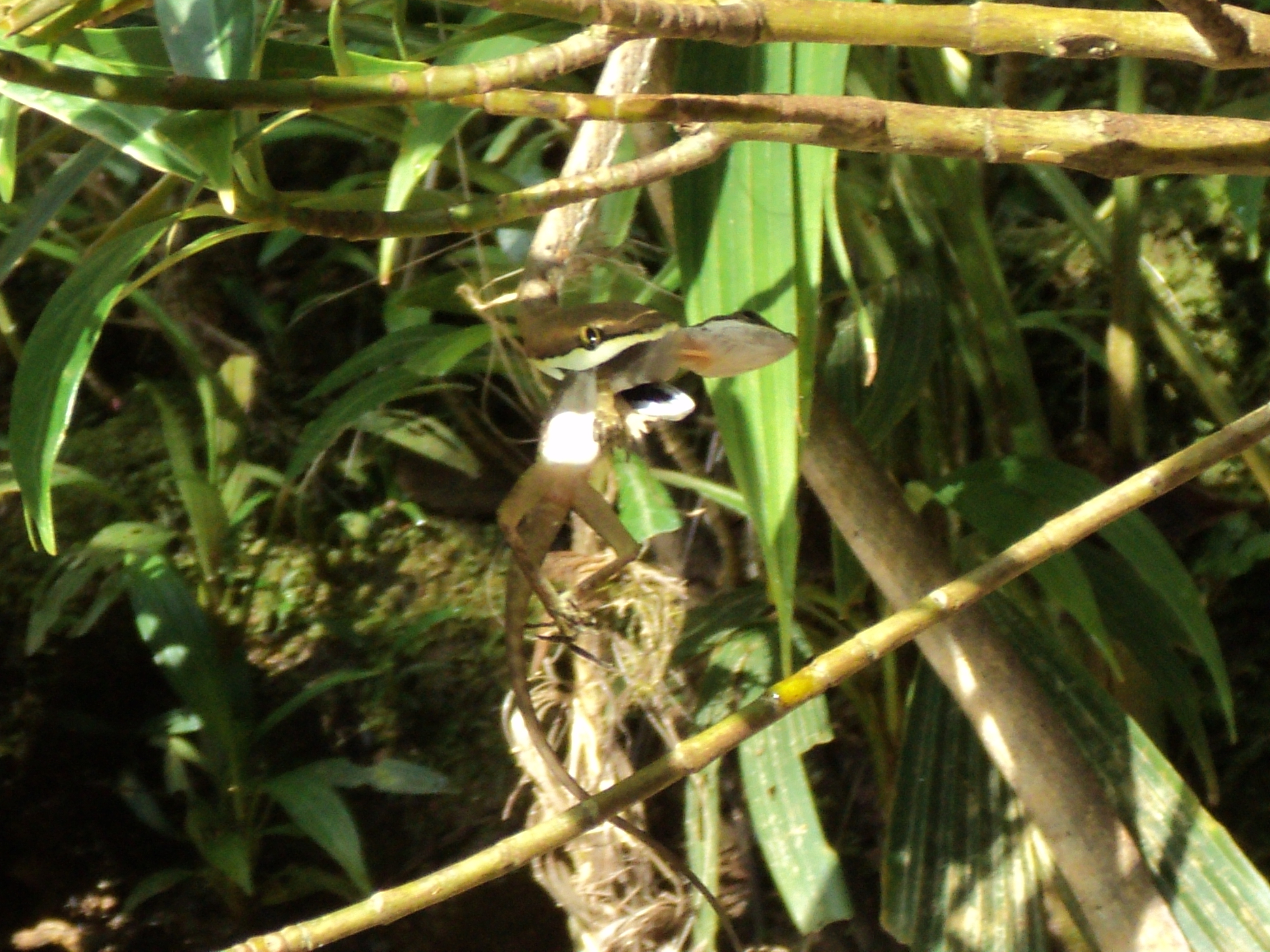
And lo and behold, we saw them! Aided by Bob Powell’s advice to visit his old field site, a lovely stream located several kilometers from the station, we spent several days observing the antics of these gorgeous anoles, the largest of the mainland aquatics. And by antics, I mean primarily sitting around doing nothing, though they did flash their gorgeous red dewlaps occasionally (alas, not caught by camera, but several times on video—stay tuned once they get processed). Actually, they were sometimes quite active, running rapidly from one place to another. Like other mainland aquatics, these guys hang out right next to streams, and when threatened will sometimes jump in. They don’t go swimming away, though, at least not in our observations (which agree with others); rather, they immediately go to the nearest water-land interface and hang out, hoping they have not been detected.

Our trip occurred in early August, at the end of both the reproductive and dry seasons. We were told that it had been a particularly dry dry season, which may explain some of the observations. For example, A lemurins is supposed to be very common, but we didn’t see a one. Also, males of two other common species, A. sericeus and A. rodriguezi, were few and far between. This was surprising, but perhaps these—like many mainland species—are primarily annual, that is, with a lifespan averaging less than a year.  Perhaps the males, spent by their exertion, are all dead, explaining why we saw so few of them. That was a classic hypothesis borne of field observations, but the Malice of Nature did not intervene to refute it. A number of people suggested that A. barkeri is only found in shaded streams; in the open, it is pushed out by basilisks. “Find a basilisk,” we were told, “and you won’t find A. barkeri.” For the record, we did find several small basilisks along the stream, though only in open, sunny spots in the otherwise well-shaded watercourse. The A. barkeri were found on logs and rocks, always near the water. They didn’t impress me as brilliant swimmers, but could immediately climb onto rocks—very good graspers, with long arms and sharp claws.

I was particularly curious to learn more about A. sericeus.

Another Observation Of Nectivory In Anolis

Following previous threads documenting nectivory in various Anolis (1, 2, 3), here is another account recently observed in south Florida, from Florida International University’s palm botanist Scott Zona in Miami:

This American green anole was methodically going along an inflorescence of one of the palms (Ptychosperma macarthurii) in my back yard licking the nectar droplet from the tip of each pistillode. This palm is an exotic ornamental from New Guinea and northern Australia but is widely cultivated around the world. It is monoecious (male and female flowers on the same inflorescence) but strongly dichogamous (separation in time). The male flowers open first. The lizard was lapping up a droplet of nectar that is excreted by the long, slender pistillode (sterile pistil) in each male flower. I watched him for several minutes (and have lots more photos). The lizard was very methodical about going to every flower, climbing to another branch, and then exhibiting the same feeding behavior. It is unlikely that the lizard would be a pollinator, because of the strong dichogamy; however, female flowers also secrete nectar, so if the same anole were to find another inflorescence in the female phase, it could affect pollination.

American green anole (Anolis carolinensis) feeding on the nectar of a palm inflorescence in south Florida

American green anole (Anolis carolinensis) feeding on the nectar of a palm inflorescence in south Florida

Nectivory in anoles has been well summarised in a previous post, in which Ambika Kamath noted that they had observed a a female licking palm flowers in south Florida but regrettably never got a picture – well it may have been a year and 3 months, but here’s one!

With the wealth of introduced anoles in south Florida, I wonder if this feeding behaviour has been observed in other species but not yet documented – the ecologically similar A. porcatus and A. chlorocyanus seem likely candidates…

If anyone would like more information on this, or has a keen interest in palms, please feel free to email Scott directly.

Rapid Color Change In Anoles

Anolis gundlachi. Photo by  Alejandro Sanchez.

Anolis gundlachi. Photo by Alejandro Sanchez.

Anolis gundlachi 10 seconds later. Photo by Alejandro Sanchez.

Anolis gundlachi 10 seconds later. Photo by Alejandro Sanchez.

West Indian photographer and natural historian extraordinaire Father Alejandro Sanchez sent in these photos, commenting “I took these two pics less than 10 seconds apart from each other – the time it took for me to modify the flash’s settings. Yet the lizard noticeably changed color patters in such a short time, surely for being scared by my proximity. Anolis gundlachi is one of my favorites.”

And note those blue eyes!

Thorny-Headed Worm Parasites In Anoles: Host Manipulation, Complex Life Cycle, And Recent Expansion

These termites might infect anoles with a thorny-headed worm parasite.

Broken Caribbean termite nest.  These termites may infect anoles with a thorny-headed worm parasite, Oncicola venezualensis.

Among the many anole parasites are the acanthocephalans, or thorny-headed worms, which in anoles are typically found as encysted larvae in the body cavity, muscle, or under the skin. One of these acanthocephalans – Oncicola venezualensis – is relatively common in anoles on the Puerto Rican Bank, and is the main character in one of my favorite anole-parasite stories. The story has three parts: 1) how the parasite gets into anoles, 2) how it continues its life cycle beyond anoles, and 3) the mystery of when it all began.

In addition to anoles, O. venezualensis larvae occur in the Caribbean termites Nasutitermes acajutlae on the Puerto Rican Bank, which is a partially submerged landmass comprised of Puerto Rico and all the Spanish, U.S., and British Virgin Islands except St. Croix. These termites construct protective nests and foraging tubes in which they live (see photo), and each individual termite belongs to a morphologically distinct caste. Most are in either the soldier or worker caste, and soldiers are larger than workers, aggressive, and armed with big mandibles. These two castes also have slight color differences – worker termites have yellow heads, whereas soldier termites have dark yellow heads.

Anoles eat termites, and O. venezualensis manipulates both the behavior and appearance of its termite hosts in order to increase the likelihood that the parasitized individuals will be preyed on by anoles (Fuller et al. 2003). Infected termites behave carelessly when compared to their uninfected peers. When a foraging tube is broken, for example, the parasitized workers arrive quickly and then linger, a behavior that makes them more susceptible to predation by anoles. Infected termites also look different, as the head color of infected workers changes to a pale yellow. This increases the difference in appearance between the parasitized workers and the aggressive soldiers, and anoles presumably try to avoid eating soldiers (remember that anoles are smart decision-makers!). The color-changing strategy is effective – in feeding trials with Anolis cristatellus where the lizards were presented with petri dishes containing both parasitized and parasite-free workers, the lizards consistently preferred the light-colored parasitized termites.

After the anole ingests a termite infected with O. venezualensis, the parasite encysts (i.e., forms a cytacanth) somewhere outside of the host’s gastrointestinal tract. In anoles it remains in its larval form, unable to complete its life cycle, and waits for the lizard to be ingested by its definitive host where it will mature into an adult and undergo sexual reproduction. The identity of O. venezualensis‘s definitive host remained elusive for some time. Two primary suspects were mongooses and the pearly-eyed thrashers, since both eat anoles and are common on the Puerto Rican Bank. But, O. venezualensis remains in its larval form in both of these hosts (Nickol et al. 2006). The mystery was solved a couple of years ago – it’s cats! Fuller and Nickol (2011) necropsied a feral cat on St. John and found 87 adult worms. The life cycle for O. venezualensis is now understood to be termite → lizard or bird → cat, then begins again when termites ingest parasite eggs in cat feces. The mongooses aren’t eaten by cats, and so are dead-end hosts for the parasites.

For me, learning that the cat is the definitive host was a head-scratcher. We know that cats eat anoles, and feral cats are abundant on the Virgin Islands, particularly St. Thomas. But, it’s hard to imagine how a parasite with a complex life cycle of at least three hosts (termites, anoles/birds, cats) became invasive across so many islands. It’s also possible that a different, native anole-eater also serves as the definitive host. Bats are the only extant native mammal species on the Virgin Islands, and we know that some bat species eat anoles. Perhaps bats are the original definitive hosts? In any case, the populations of O. venezualensis have likely increased in recent times due to the introduction of cats on those islands, and whether that’s had any effect on the anole populations is unknown.

Weird Urban Perches

There is quite a bit of evidence that anoles like to display from relatively high perches (e.g. references in this paper), a tendency that seems to cross over to their Old World counterparts, the agamids (e.g. Sitana ponticeriana, as outlined here). The hypothesized reason for this choice is that displaying from high perches enables lizards to be maximally visible to conspecifics, ensuring that broadcast displays are heeded by the neighbours. This summer, my field assistant Divyaraj Shah spotted a Calotes versicolor in Kutch, India, displaying from the most exposed perch I’ve ever seen a lizard on. See if you can spot it below:

Spot the displaying Calotes versicolor

Spot the displaying Calotes versicolor


Anole Eats Morpho Butterfly

Photo by David Herasimtschuk

Photo by David Herasimtschuk

David Herasimtschuk took this striking photo along the Rio Carbon near the town of Bribri in Costa Rica. Here’s what happened: “The story of how I photographed this image was very bizarre. I was working my way up a stream with the intent to film poison frogs along the bank, and I saw the blue morpho floating down the stream. It was fluttering and still alive, but was being harassed by a school of very hungry fish. Feeling sorry for the animal and curious to see a blue morpho up close I pulled it out of the water. At that point it wasn’t doing to well, but I felt bad throwing it back in the stream, so I placed it on a branch thinking if it might be able to rest and dry off. I then left to film frogs, and came back about a half an hour later. When I returned the butterfly was gone.  Initially I thought it had survived and flew off, but then I saw a bright blue shape in the mouth of stream anole a couple feet from where I had placed it. It was a strange set of events, and it definitely reinforced my belief that when you live in a tropical forest everything wants to eat you.”

Lizards, Tree Resin And How Amber Fossils Are Formed

The best anole fossils have been found in amber [e.g. 1,2]. Amber is, of course, fossilized tree resin, and I have often wondered how likely it would be that a lizard would manage to get itself stuck in tree resin. After all, as we know from catching them, small lizards are nothing if not agile.

Sitana ponticeriana is a small agamid lizard found in dry habitats across South Asia. Though most commonly found in disturbed, open habitats, they also occur in the rapidly dwindling stands of thorn scrub forest found across India.These forests are dominated by resin-producing Acacias, and are being invaded by the resin-producing Prosopis juliflora.

Acacia forest

Acacia forest in Kutch, India

This sort of forest is exactly where you might expect to find lizards interacting with resin, and here is an example. This female Sitana ponticeriana, caught in the forest shown above, had a finger on her front foot completely stuck in a little ball of resin. It is easy to imagine how a slightly smaller lizard or a slightly larger piece of resin could result in an inextricable lizard and, in several thousand years, a very cool fossil!

IMG_2611

Female Sitana ponticeriana with resin stuck to her toe


A. Lionotus Male Paid The Price: Snake Predation By Oxybelis

Oxybelis aeneus prey upon A. lionotusFemale A. lionotus observing[June 12 2012; 8:35 a.m.]. During a placid morning, a team from Herbios Group Panama observed an impressive image. We witnessed an Oxybelis aeneus (147 cm, 55 g) with an Anolis lionotus male (22.9 g) caught in her jaws. He was the breakfast meanwhile, his fellow female just observed the scene.

We were so happy to witness such an event, thinking about what was the male doing while the predator took the chance. Perhaps He was displaying to attract the cryptic female, or just was distracted while feeding! In any case the snake had the morning meal and the male paid the price.

Avoiding Surface Heat In Agamids And Anoles

Avid readers of this blog might have noticed that Jonathan Losos likes trying to get readers to confuse the white-fanned variant of the South Asian agamid lizard Sitana ponticeriana with the only toepad-less anole, Anolis onca. Indeed, the two lizards look quite similar:

Sitana ponticeriana, white-fanned variant, in Saswad, India

DSC_0010x

Anolis onca in Maracaibo, Venezuela. Photo by Jonathan Losos

Posts [1, 2, 3] detailing the habits and habitats of these two lizards point to a number of similarities between the species. Both occur in incredibly hot and windy environments. Both are primarily terrestrial, where they are very well-camouflaged, but are also observed perching on vegetation. The causes for the loss of A. onca’s toepads remain a mystery, and here I lay out some observations of S. ponticeriana’s behaviour that lead to a hypothesis for why A. onca might have lost it’s toepads.

Perch use in S. ponticeriana follows a predictable temporal pattern from about 8:00 a.m., when the lizards first emerge, to about 12:00 noon, the hottest part of the morning. Lizards perch primarily on rocks, if available, in the early morning while basking. During the middle of the morning, male lizards are found perching on and displaying from a variety of perches, including the ground, mud piles, rocks, twigs, and shrubs. By noon, however, lizards are often found resting in shrubs. Here are a couple of lizards resting:

IMG_0152

Male Sitana ponticeriana, white-fanned variant, resting in the shrubs. Saswad, India.

IMG_2515 (800x600)

Female Sitana ponticeriana, white-fanned variant, resting in the shrubs. Kutch, India.

But what happens when you chase lizards out of the shrubs in the heat of the day? Peak air temperatures at the site I was at this summer hovered around 40 degrees Celsius, and soil or rock surface temperatures were likely higher (they certainly felt so). Lizards that we chased out of shrubs onto the sand would run rapidly as usual, but when they paused, were often observed lifting the toes of their hind feet off the ground. Here are two photos–compare the toe positions on the hind foot to get a sense of the behaviour I’m referring to:

IMG_0136 IMG_0137

If the highest risk of heat exposure comes from the ground, any adaptation that reduces the transfer of heat from the ground to the lizard will be favoured. Such adaptation would explain S. ponticeriana’s behaviour of resting in vegetation during the hottest part of the day and lifting toes off the ground when forced onto hot terrestrial perches. Like most agamids, Sitana have very skinny toes, leaving a small surface area for transfer of heat from the ground. But what about A. onca? If the ancestral A. onca had typically anole-like toepads on moving to the beaches, they might have been at high risk of heat transfer from the sand when forced onto terrestrial perches in the heat of the day. This would lead to the evolution of reduced toepads to avoid such heat transfer. A temporal pattern of perch use in A. onca, similar to that of S. ponticeriana, would be the first piece of evidence useful for establishing what might be an exciting example of trans-continental convergence.

Brown Anoles Will Display At Inanimate Objects

If I were a brown anole, I’d take offense at a flag like this, too!

Pat Shipman from the AA Little Cayman Bureau checks in:

The observation that anoles nod at inanimate objects (or possibly at anoles the observer hasn’t spotted) is not new.

A few days ago, I watched an adult male sagrei repeatedly unfurling his dewlap and displaying… at an orange landscaping flag that marks the location of a large septic pipe underground.  What was most interesting is that the flag was fluttering in the breeze and that it was a shade of orange almost exactly the same as the sagrei’s dewlap. Alas, I did not have a camera handy to record this event.

Has anyone else noticed sagreis paying special attention to orange objects?

Page 10 of 34

Powered by WordPress & Theme by Anders Norén