
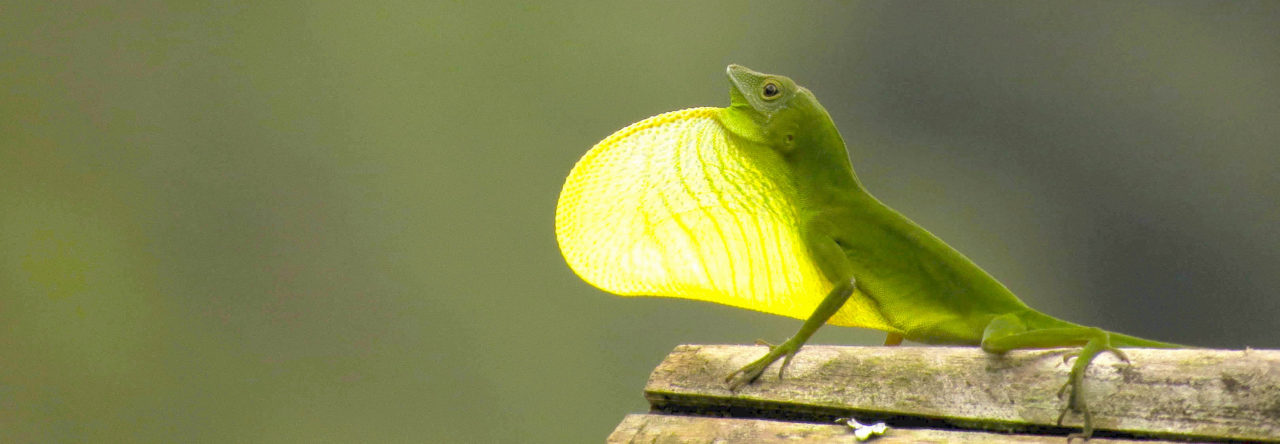

 I’ve enjoyed this type of post and figured I would contribute myself. On a trip to Costa Rica in early 2010, I had the pleasure of wandering around catching all the anoles I could see. Although most of my photos have unfortunately been lost in a massive computer/hard drive failure, I have recovered a few shots from the field. Here are photos (of two species) that always get me thinking about dewlap coloration, and maybe they will get you thinking more about that too. So what are the species, everyone?
Category: Ask the Experts
I recently received an email from UC Davis undergraduate and lizard enthusiast, Kirk Sato. On a recent trip to Belize, Kirk snapped a great photograph of this anole and he wants to know what species it is. What are your ideas, folks?

Unidentified anole from Belize
 José Ernesto Pérez Villota, a Colombian student, is looking for information on the population structure of A. aequatorialis, or of any other Colombian anole. He is particularly interested if some populations have sex ratios deviating from 1:1. If you have any such information, contact him at jeperezv@gmail.com.

This photograph was taken by a colleague visiting some of Belize’s offshore islands. I’m pretty sure I recognize this species from my time in mainland Belize, but I thought I’d open it up to the community for additional opinions. What species do you think this is?
My name is John Phillips. I am an undergraduate in Kirsten Nicholson’s lab at Central Michigan. Kirsten and I were discussing some interesting behavior I observed by A. laeviventris and A. cupreus during our Nicaragua trip last summer. Multiple individuals upon capture appeared to ‘play dead’ until I stopped holding them securely, whence they suddenly sprang to life and escaped. Kirsten thought you may know of any related instances of such behavior in anoles, and she has encouraged me to write this observation up in Herp Review so I was wondering if anyone knew of related instances in other anoles. If so, could you email me at: phill1jg@cmich.edu?
My name is Frederik Sachser and I am studying Biology at the Heinrich-Heine-University of Düsseldorf, Germany and at the moment I am about to start writing my Bachelor thesis. I want to study the influences of the eyespots of Caligo on Anoles at “Un poco del Choco” in Ecuador next March. I heard that there is a wet season at this time and I am wondering if the anoles are showing less activity because of this. Can anyone advise me? My email is Frederik.Sachser@uni-duesseldorf.de.