Category: All Posts Page 93 of 154

Should the Use of Subspecies Be Revived?

The last week has seen a spirited discussion of the pros and cons of splitting recognized genera into multiple, smaller genera. We’ve had 34 comments already. Check it out! And if you’re an advocate of splitting genera, that viewpoint has been getting the short end of the stick and could use more support.

As a tangent, the topic of subspecies has come up, and David Hillis has strongly argued for reviving its use. Here’s what he has to say:

First, I don’t think either species or subspecies are “clades.” Species are lineages (the branches on the tree of life). Sexual recombination among individuals results in tokogenetic relationships within species. Clades, on the other hand, are monophyletic groups of lineages on the tree of life. Rather than being defined by tokogenetic relationships, they are defined by phylogenetic relationships.

Traditionally, subspecies are geographical races of species. In other words, they are geographically distinct populations that nonetheless meet and interbreed at contact zones. Sometimes, these contact zones are very broad, as with broad-banded versus southern copperheads. If the contact zones are very narrow, and there is strong evidence that the contact zone is a genetic sink (there is no gene flow across the zone, because of strong selection against hybrids), then I agree that the two entities can be considered separate lineages, and hence species. But in many recent cases, as with the copperhead example, there is abundant evidence that the contact zone is NOT a sink, and that there is NO selection against hybrids. In this case, I disagree strongly with the authors who proposed to split these subspecies into distinct species. That is inconsistent with any lineage species concept…there is a huge area where these two forms intergrade, with no evidence of any loss of fitness. Thus, the two forms are geographical, intergrading races, or subspecies.

I think we will soon see a backlash against the splitting off of geographic races as species as well. Frank Burbrink (who was an author on the copperhead example I mentioned above) and I plan to write a pro/con article about this together, each arguing our respective points of view. Hopefully, this will re-kindle the conversation about subspecies.

Subspecies are unpopular right now because they were long abused in several ways. Inappropriate uses include (1) to describe non-geographic “varieties”; (2) to arbitrarily break up clines; and (3) to describe distinct, isolated lineages that clearly are species. But used in proper context to designate a geographically distinct race, they are certainly reasonable and often useful. They are rarely used in some groups, for several reasons: Groups like freshwater fishes have discrete ranges, so taxa don’t interbreed over broad areas. And many groups are too poorly studied to understand geographic variation. But in well-studied terrestrial groups (like herps), subspecies are perfectly reasonable and useful taxa to designate intergrading geographic races.

Taxonomic Splitting Revisited: When Should Genera Be Subdivided?

Over the last several years, ever since Nicholson et al. proposed dividing Anolis into eight genera, the topic of taxonomic splitting has periodically been discussed in these pages (for example, this post, its comments, and links to other posts).

The general question of when to split taxa recently has been revisited in several comments in AA. A week ago, David Hillis wrote:

Anolis is a valid name for a monophyletic group on the Tree of Life. It is “special” as a genus only in that the genus name is used as part of a binomial for particular species. It doesn’t make sense to change the scope and application of generic names unless the names are actually misleading about phylogeny (e.g., if Anolis were polyphyletic, then that problem should be fixed). But splitting a valid, monophyletic genus into a bunch of smaller genera, and thereby needlessly changing the names of many species, without fixing any phylogenetic problems with the existing taxon names, is not science. It is just playing around with names. If someone wants to name the groups within genera, then do so…but there is no reason to change the meaning of a existing name (or the names of the all the affected species) in doing so. That is the kind of silliness that gives taxonomists such a deservedly bad reputation among biologists.”

Elswhere, David posted a flowchart on his recommended decision-making process about whether and how to divide recognized genera:

Hillis flow chart

Ivan Prates, in line with comments he made in a recent paper on A. punctatus, then remarked:

“This seems more like a sociological matter.

During the ‘taxonomic revolution’ of the amphibians, about 10 years ago, the (perhaps?) most influential (or faster?) group was the splitter one, and their taxonomic scheme prevailed. Currently, nobody is upset about which species were once named as Bufo, Hyla or Rana. A few do care about Dendrobates – like Anolis, a sexy group with a body of dedicated investigators.

It seems that a single genus makes sense for the community that investigates dactyloid lizards more closely. On the other hand, those who deal with overwhelming levels of herpetological diversity in the tropics (waaaay beyond lizards) see benefit in more partitioned schemes, which correlate more closely to morphology and geography.

So, when we discuss names, it may be healthy not to forget about our diversity as investigators as well. About science, splitting Anolis is not science, but well, not splitting Anolis isn’t science either.”

On the Origin and Diversification of the (Hemi)Penis: Anolis Takes Center Stage

Over the last decade the term “model species” has taken on new meaning. Species that were once the building blocks for distinct disciplines have taken on new importance in comparative evolutionary studies that integrate perspectives across biological disciplines. Nowhere is this better illustrated than with Anolis lizards. For decades anoles were a workhorse of ecologists and evolutionary biologists, but have, more recently, been embraced by developmental biologists, genomicists, physiologists, and neurobiologists among others. This disciplinary expansion is perhaps most evident with the rapid increase of penis/hemipenis research that has been published using anoles within the year.

For many herpetologists, including those focused on anoles, the hemipenis is ripe with taxonomic characters, easily allowing for the identification of new species. Julia Klaczko and colleagues recently demonstrated that features of the hemipenis are some of the most rapidly evolving characters among anoles, a group already well known for its rapid anatomical evolution. Independent from these taxon-specific interests, developmental biologists became interested in the anole hemipenis because of its unique anatomy compared to other amniotes. Marissa Gredler and members of the Cohn Lab used anoles as one of their reptilian models of external genital development in what is arguably the broadest embryological survey of reptilian phallus development to date. In parallel, Patrick Tschopp and colleagues probed the cellular and molecular regulation of early phallus development among anoles, snakes, chickens and mice, demonstrating that the hemiphalluses (hemipenes and hemiclitores) and hindlimbs of squamates utilize similar molecular networks at the earliest embryonic stages of morphogenesis. Now, just within the last month, two more papers have used anoles in studies of phallus evolution and development, one using cutting-edge molecular techniques to better understand the relationship between limbs and external genitalia and the other addressing the fundamental question of external genital homology using museum specimens that are more than 100 years old.

Before getting into the findings of this new research, lets lay out some of the dirty details of penis evolution. First and foremost, the penises of amniotes are extremely diverse. Squamates have paired lateral phalluses while other clades have a single midline phallus. Each of the amniote lineages uses hydrostatic pressure to achieve an erection, yet accomplish this using different bodily fluids (lymph or blood). In mammals sperm is transferred to the female through a closed urethral tube, but other groups utilize an open channel. Most birds (97%) and the tuatara, have absent or highly reduced phalluses and reproduce with the famed “cloacal kiss.” These large differences in anatomy should not overshadow the spines, bulges, corkscrews, and dramatic differences in size that give species their distinctive features. But with such striking variation, we are forced to wonder how many times the penis evolved. Perhaps the amniote ancestor possessed an intromittent phallus capable to transferring sperm to the female that later diversified in each lineage independently. Or, perhaps the last common amniote ancestor used cloacal apposition to foster internal fertilization and unique phallus morphologies evolved independently at the origin of each lineage. Because adult anatomy provides few clues to phallus homology, Thom Sanger (me), Marissa Gredler, and Marty Cohn looked towards the embryo for help.

Table 1 from Sanger et al. 2015 summarizing phallus variation in amniotes

Table 1 from Sanger et al. 2015 summarizing phallus variation in amniotes

The tuatara, a species lacking an adult phallus, has presented a problem in attempts to reconstruct the last common ancestor of amniotes because it raises the distinct possibility that reproduction through cloacal apposition was the ancestral condition.

A Few Meters Matter–Landscale Thermal Heterogeneity and Reproductive Output in a Puerto Rican Anole

Anolis cristatellus. Photo by Janson Jones.

If you ever come to Puerto Rico, the first thing you’ll probably notice is the warmth. Yet, for an anole, things are not that simple. Different habitats can have different thermal regimes that potentially influence the lizard’s biology and natural history in different ways. What might be a hot and humid urban park for us can be a heterogeneous thermal landscape for a small lizard.

This is the case for Anolis cristatellus, a lizard common in most parts of Puerto Rico. Back in the early70’s, Ray Huey (1974) studied how habitat influenced this anole’s thermal biology. He found that in open and sunny habitats, this lizard actively thermoregulates and has relatively high and stable body temperatures, but that in shaded forests it is a thermoconformer and has relatively low and variable body temperatures.

Also back in the early ’70s, George Gorman and Paul Licht (1974) found that altitudinal and seasonal variation in temperature had major effects on reproductive cycles of Puerto Rican anoles. So, do reproductive cycles differ between lizards living in thermally distinct — but contiguous — habitats? Ray Huey, George Gorman and I teamed up to find out, and you can find the answer in our recent paper just published in The American Naturalist.

We studied seasonal reproductive cycles of this lizard in two localities in lowland Puerto Rico. Both localities have contiguous but thermally distinctive habitats: open parks and forests, separated by only a few meters. We caught female lizards every month for more than two years and palpated their bellies to establish reproductive condition. At both localities, lizards living in open habitats were more often gravid than were those in the forest. This difference was especially marked during winter months (of course… in a tropical sense). During these cooler months, more than 20% of open lizards were gravid, while essentially none of the forests ones were.

Large-scale geographic variation in reproductive cycles has been described in many taxa, but this is one of the few examples on a micro-geographic scale. Very likely these difference will have significant effects on the population ecology of the species, and these will be reported on soon. But in the meantime, we can say that at least for the reproductive output of Anolis cristatellus, a few meters matter!


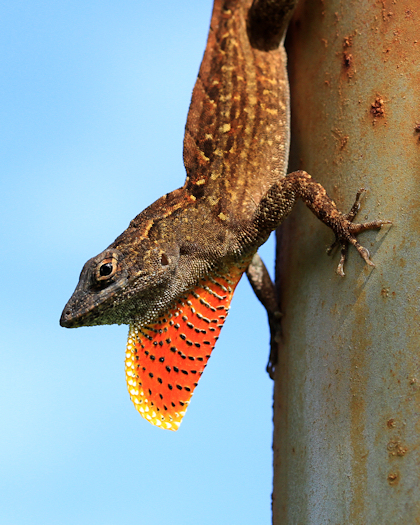
Brown Anole with a Busted Dewlap

Photo by Karen Cusick

From Daffodill’s Photo Blog.

You’re Never Going to Guess Who’s a Big Anole Lover

Untitled

Rush Limbaugh, that’s who! To wit: “But I love those little lizards.  They’re anoles, actually.  I love ’em.  They’re our buddies. They eat insects and all that.”

And it turns out that Jeb Bush is just like a cat chasing an anole. Read all about it here (or listen to it here), skipping to paragraph four if you want to get to the important, mostly non-political stuff.

Redundancy in Communication Signals: Work on Anoles Anticipated Current Research Decades Ago

eew and asrIn anticipation of its sesquicentennial in 2017, The American Naturalist has solicited essays commenting on overlooked or underappreciated articles published in the journal during the past 150 years. In this month’s issue, Manuel Leal and I comment on a 1970 paper by Stan Rand and Ernest Williams on how differences among anole species in their dewlap and display behavior contain multiple signals for species-recognition. Several decades later, the importance of redundancy in communication signals has become an important area of research, but years before, Rand and Williams sketched out the important issues, as well as identifying some still-unresolved questions.

Here’s the introduction to our essay:

“Why are animal signals so complex? This question continues to attract the interest of behavioral and evolutionary ecologists. In this Countdown article, we revisit a littlea ppreciated article in The American Naturalist published in 1970: “ An Estimation of Redundancy and Information Content of Anole Dewlaps” by A. Stanley Rand and Ernest E. Williams. As part of this piece, Rand and Williams argued that signal complexity can be explained by redundancy, a mechanism by which multiple components of the signals have evolved to increase the probability of eliciting a response from an intended receiver. We highlight this work because it presents one of the earliest demonstrations of the potential benefits of applying information theory to animal communication. In addition, the study demonstrates the insights that can be gained by evaluating signal evolution at the level of the community. Even today, when both theoretical and empirical studies evaluating the potential forces leading to signal diversity have fl ourished, evaluations at the community level are extremely rare.

More generally, in the spirit of the American Society of Naturalists, we wish to emphasize that the perspicacity of Rand and Williams resulted from the fact that their ideas were ultimately derived from a deep understanding of the natural history of their study organism. In particular, Stan Rand spent substantial time in the fi eld observing lizards, including 10 months studying the ecology and social dynamics of the Jamaican lizard Anolis lineatopus. This study reported detailed observations of many aspects of behavior, including detailed descriptions of the signaling displays used during intra- and interspecific interactions (A. S. Rand, 1967, “ Ecology and Social Organization in the Iguanid Lizard Anolis lineatopus,” Proceedings of the United States National Museum 122:1– 79). It was this familiarity with what animals actually do in nature—when and where they do it, interacting in which ways with what other individuals—that formed the basis of the theoretical constructs put forth in Rand and Williams’ s article. At its core, Rand and Williams (1970) is an elegant illustration of the art of being a naturalist, demonstrating how an intimate knowledge of the organism can serve as the building blocks for the formulation of new conceptual approaches (see H. W. Greene, 2005, “ Organisms in Nature as a Central Focus for Biology,” Trends in Ecology and Evolution 20:23– 27, and references therein).”

You’ll have to read the essay to get the full details, but here’s the conclusion:

“By detailed field study of the morphology and behavior of sympatric lizards, Rand and Williams (1970) were able to outline the applicability of information theory to lizard signaling behavior and species recognition two decades before those ideas became widely accepted. Moreover, they proposed important hypotheses yet to be investigated. This article demonstrates the key role that natural history plays, and will continue to play, in the conceptual development of animal behavior, evolutionary biology, and many other fields. Although the tools available for technological advancement in these fields are unparalleled, Rand and Williams’ s work demonstrates that observing animals in the wild and developing an intimate knowledge of their ecology serves as the raw material for the development of new and exciting areas of research. Thus, as we move into new frontiers, the appreciation of natural history must be an integral component of our approach and should be encouraged to a new generation of behavioral and evolutionary ecologists.”

Where Did the Dewlap Come From?

DSC_2227

There’s been no shortage of enthusiasm when it comes to thinking about the anoline dewlap. From the recent findings that dewlaps are highly functional in low light environments to large scale characterization of dewlap diversity, these charismatic ornaments are captivating to biologists from many fields. However, they are also proving to be amazingly dynamic and difficult to functionally characterize universally. What we know definitively is that dewlaps in anoles are used during territorial and mating interactions. There is some evidence to support a correlation between dewlap morphology and a lizard’s physiological characteristics  or body condition. Dewlaps are highly diverse in both size and color; some species having enormous dewlaps that extend from snout to vent and some having virtually no extendable dewlap at all. Dewlaps also differ between the sexes. In most, but not all, species, males have a larger dewlap than females, but the degree of sexual dimorphism is highly variable across the genus. Strikingly, dewlaps are not unique to anoles! Within iguanid lizards, dewlaps have evolved at least twice, in anoles and Polychrus. Ambika Kamath has done extensive work on the Indian lizard genus Sitana, a dewlap sporting agamid genus. Going a step further, lizards such as Pogona, bearded dragons, and Chlamydosaurus, the frilled lizards, also have elaborate throat ornamentation that develops from similar throat structures as the dewlap (the hyoid apparatus).

While the ecology and diversity of the “dewlap” have been studied in a variety of contexts, the evolution of its underlying skeletal structure is a black box. Questions ranging from, “How many times has the dewlap evolved among lizards?”, “Do the same skeletal structures support an extensible throat in different groups?”, to “What selective forces are driving dewlap diversification?” have yet to be answered systematically. Recently, Ord et al. examined the factors influencing throat morphology diversification and systematically describe throat morphology evolution across iguanid and agamid lizards. They conducted a comparative phylogenetic study, first asking if the diversity in elaborate throat ornamentation across lizards can be explained either by the influence of male-male competition or by the need to signal in visually complex environments. They found that there are more species with colorful dewlaps or throat appendages in forested environments, suggesting selection for conspicuousness in visually complex environments.

Looking at the evolution of colorful and elaborate throat morphologies more broadly, the authors found a single origin of a colorful throat ≥ 110 MYA for agamid lizard. From there, throat morphologies took one of two evolutionary routes, either being modified to include a large appendage or reverting to a non-ornamented/non-colorful state. Following from their previous result, they hypothesize that the loss of a throat ornamentation is due to historical transitions into more open habitats where displays are less constrained.

Anolis is characterized by their large moving dewlaps because the skeletal elements that support the dewlap are highly specialized for rapid extension. However, both iguanids and agamids have a hyoid apparatus, and distinct skeletal elements support the extensible throat skin in each group. The dewlap of anoles is supported by the second ceratobranchial cartilage in the hyoid apparatus and is extended by the contraction of muscles attached to the front end of the hyoid system, causing the second ceratobranchials to rotate downward from the throat of the lizard. Most iguanid lizards exhibit a similar, conserved hyoid morphology, but typically with a smaller second ceratobranchials and no dewlap compared to anoles. Alternatively, across agamids, the authors found amazing diversity in hyoid morphology. While some agamids have a strikingly iguanid-like hyoid, others demonstrate extreme reduction in the length of the second ceratobranchials and extension of other elements of the hyoid system. For example, the beard of a bearded dragon results from the loss of second ceratobranchials altogether coupled with an extension of the first ceratobranchials to support the charismatic lateral frills. When mapped on a phylogeny, hyoid morphological diversity supports a single origin of a movable dewlap with extended second ceratobranchials in iguanid lizards (in Anolis) and two independent origins of a moveable dewlap with extended second ceratobranchials in agamids. Including throat fans that are supported by alternative hyoid modifications, as seen in the bearded dragon, there are another two origins of moveable throat morphologies in agamids (see Figure 3 from Ord et al below).Screen Shot 2015-10-13 at 5.44.22 PM

There is much more work to be done to further understand the specific environmental factors influencing the evolution of elaborate throat morphologies in lizards. However, this study strongly suggests that there are many factors at play. Also, the extensive characterization of hyoid morphology across agamid and iguanid lizards in this study sets up many questions about the physiological processes driving the diversification. What processes cause hyoid morphology to vary so dramatically across a group of closely related groups?

Is It Possible to Distinguish A. carolinensis from A. porcatus

Name that lizard (this one from Miami, not Grand Cayman). Photo by J. Losos

Tennessee lizard guru Sandy Echternacht writes in to AA about the green anoles that have shown up on Grand Cayman, in response to a post from several years ago:

I also think that it is difficult or impossible to distinguish U.S. Anolis carolinensis from U.S. A. porcatus in the field since you typically don’t have live, known A. porcatus for comparison. I think that Wes Chun is correct. Fully adult male A. porcatus are bulkier than A. carolinensis and I’ve seen some with what appear to be large bilateral calcium (?) deposits between the jaw and the neck that give them a bit of the look of a bulldog. I haven’t a clue how, for these two species, to distinguish subadult males and females in general. That shoulder bar (black; often with turquoise blue spots around the edges) is present in many populations of A. carolinensis in the Florida and further north and west, so it can’t be a reliable indicator of A. porcatus.

In addition, most of the relevant research on these issues today concentrates on spectral analyses of skin and dewlap colors, sometimes comparing these to spectral characteristics of the habitat which the lizards occupy. It’s time for a little old school field work. We need detailed narrative descriptions of color AND pattern of live A. carolinensis obtained under controlled conditions of light and temperature and in the maximum green and maximum dark color phases, and of patterning in both color phases, and these data need to be representative of populations across the entire mainland range of the species. If done by multiple investigators, these studies need to employ the same methods and standards. Geographic variation is obvious. Most A. carolinensis have pink to reddish dewlaps but those in southwestern Florida are grayish or greenish, I found a small population between Corkscrew Swamp Sanctuary and Immokalee, FL with pale orange dewlaps, and some males on Oahu, HI have lilac-colored dewlaps. As noted above, the shoulder patch can be entirely absent in a population or present but in frequencies that differ among populations. In East Tennessee, animals in the maximal dark phase are very dark brown to nearly black with no patterning (except a pale venter) whereas those near Gainesville, FL are a gray with a filigree pattern that is whitish in color. The frequency of females with pale middorsal stripes varies among populations. In a part of Withlacoochee State Forest, FL and in the green phase, the color is “chalky” green, along the coast near Ft. Myers it is a beautiful emerald green, further north, as far as Tennessee, it is more of a leafy green. As important as they are, spectral studies usually don’t mention pattern at all, and are carried out only in the green phase. Further, spectral values are of little value to someone working in the field not well versed in visualizing what they mean in the context of the lizard they are holding. I say all of this despite having a friend who is heavily invested in spectral studies. With all of this variation, and without having comparable data for A. porcatus, I’m not sure that we will ever be able to identify in the field with 100% certainty whether a green anole in South Florida (or the Cayman Islands) is A. carolinensis or A. porcatus with the possible exception of a large male A. porcatus with “calcium” deposits.

But I guess I could be wrong.

Video of Anolis proboscis Walking


Page 93 of 154

Powered by WordPress & Theme by Anders Norén