
Category: All Posts Page 65 of 154

Updates on the Development of Anolis as a “Model Clade” of Integrative Analyses of Anatomical Evolution

Staging series page 1

The first plate from the Sanger et al. (2008) Anolis staging series.

Long time readers of this blog will likely remember the many posts I’ve made trumpeting the utility of anoles for integrative analysis of anatomical diversity, studies that gain perspective from disparate biological fields. The community has come a long way since we published the first staging series of anole embryology only nine years ago. To some this may be old news, but I still find this pace exciting and personally motivating. Decades of ecological and evolutionary studies have created a strong foundation upon which to build new insights about the molecular and developmental underpinnings of anatomical diversity. My lab’s questions boil down to trying to shed light on the developmental origins of adaptive anatomical variation. Otherwise stated, where did the requisite phenotypic variation arise from during the adaptive radiation of anoles. The inherently comparative nature of these studies led me to use anoles as a “model clade,” a group of species that provides the capacity to obtain evolutionary insights the way that “model species” have provided pure developmental biologists and geneticists the power to deduce insights in their areas.

One of the highest hurdles to the progression of Anolis as a model system has been long-term access to living embryos. Although comparative biology is a powerful approach for evolutionary studies, one of the hallmark lessons of modern Evo-devo is the need to experimentally validate the candidate molecular changes associated with anatomical evolution. If I hypothesize that Gene X underlies some phenotypic difference between two species, I must 1) show that it is expressed at the time when the difference arises and 2) somehow tweak the expression of Gene X at that time and in that tissue to show that the changes parallel those observed in nature. To do this you must have access to an embryo in culture, unencumbered from its opaque shell.

Over the past several years several people have been working on ways to gain access to lizard embryos. The first report of a culturing method was by Tschopp et al., who used lentivirus to trace cell migration into the genitalia and limbs. I have not personally been able to consistently replicate those conditions, especially for later embryos. Bonnie Kircher and I, however, recently published two relatively “simple” culturing protocols as part of a new book, Avian and Reptilian Developmental Biology. One of the challenges of earlier culturing attempts was bacterial and fungal growth. As a first step to combatting these invaders, we developed a protocol to sterilize the eggs, soaking the eggs in a weak bleach solution (yes, a literal bleach solution). From there we were off and running.

The first method we describe, following from advice from Raul Diaz, has worked on eggs a few days old to those that are nearly half way through their incubation period. Using a fine pair of scissors, we separate the outer opaque lays of the shell from the inner membranes that surround the embryo and yolk. This bag-of-embryo is then transferred to a small culture dish with a nutrient rich media and drugs to further combat bacterial and fungal contamination. This culturing system has worked well for up to ten days, roughly from the time the limbs are developing digits to the time that the limbs have visible scales on them. (Check out the video!) In principle, this method will allow better access to the embryo for viral injection or the application of small molecule inhibitors that disrupt particular signaling pathways.

Be warned, the second method is a little more Frankensteinian. Because the membranes cover the embryo, visualizing development remains difficult. To circumvent this problem, we developed a protocol where we explant a piece of anole tissue, such as the developing

A developing A. sagrei foot explanting onto a chicken embryo

A developing A. sagrei foot explanting onto a chicken embryo

limb, to a chicken embryo. Both anole and chicken seem to fare well at 33 degrees Celsius, below the standard incubation conditions of the chicken and above that of our anoles. Development appears to proceed normally in the explanted tissue, just as it does would in an embryo within its own shell. These experiments still have a relatively low success rate, but when the explant takes, it works well. To better visualize the tissue for imaging we also stained the tissue with a vital fluorescent dye before the transfer, giving the tissue a wonderful Halloween feel.

The work is far from over. These culturing protocols are just the first step and will not work for all applications. More technically challenging steps especially await those that want to manipulate the anole genome or target distinct patterns of gene expression. This is only the start of what’s to come. For more details about these protocols you can download the chapter here.

Knight Anoles Introduced to Another Island: Abaco, Bahamas

Photo by Joel Sartore

The knight anole is really getting around these days: Turks & Caicos, Grand Bahama, Grand Cayman and many other islands. Now they’ve  made it to Abaco, Bahamas, where one individual was captured and possibly two others seen (see article in IRCF Reptiles and Amphibians)Abaco Scientist has an insightful discussion of introduced reptiles and amphibians on Abaco.

Female Green Anole with Sand on Her Head–Been Egg-Laying?

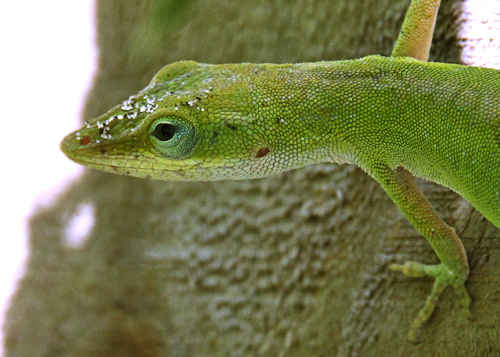
Photo-chronicler of Floridian natural history Karen Cusick has done it again. We’ve been captivated by her backyard photos before, but here’s photo of a female green anole with sand on its snout. Been digging holes to bury her eggs, maybe? And while Karen observed the little lady lizard, it suddenly darted into the bushed and emerged with a meal!


Festive Anole Invades British Columbia!

The plant in question

Well, at least one A. sagrei did. Gavin Hanke’s, Curator of Vertebrate Zoology at the Royal BC Museum in Victoria, BC, reported on the arrival of one stowing away in a tropical plant. Anoles do seem to have a knack of getting around in plants, fruit and other contrivances.

Anolis Lizards Have Their Own Homing Device

Carolina Anole

Lizards are active creatures, often running around in new territories to explore and find food. Sometimes they encounter challenges that keep them from running too far. When they wander away from home, how do they get back? It’s a question that’s led researchers to study this topic.

After watching the daily routines of Anolis lizards by using tracking devices placed on their backs, researcher Manuel Leal learned that they return to the same home again and again. This established the next question which was to find out how the lizards knew how to get back. Birds have a similar ability to find their way home. Although the exact method has not been discovered, it’s possible that lizards have similar abilities and functioning as birds in finding their own again.

They Claim Their Homes

Anolis lizards, especially males, claim trees as home territories, fighting to keep any newcomers off their bit of land. They’ve proven that they remember exactly where they stake out their claim, and like all animals, they like structure in their environment, including the location of where they spend their days and nights. Some studies prove that after disorienting the lizards and placing them a far distance from their home, they can still find their way back within 24 hours.

Then They Listen

U.S.  Geological Society geologist John Hagstrum proposed that in order to get back home, pigeons use sounds wave; extensive studies on pigeons show that they use low-frequency sound waves to create an acoustic map of where they are. This way, they can identify predators and safe spaces to land. Some have wondered whether  Anolis lizards might have similar capabilities that are advantageous for homing.

It’s hard to argue that lizards use any other method to get where they came from. Tests have proven shown results that indicate that lizards don’t have the ability to use any magnetic senses or distinguish polarizing light. Still, they manage to baffle scientists who wonder at their complex societies and developed capabilities.

If you want to learn a little more on the topic of how Anolis lizards find their way home, you can see a short film done by Days Edge Productions that follows Leal as he conducts his study.

Anole Ecomorph Watches 50%–Today Only!

Note: the watch on the bottom right is not one of ours!

Note: the watch on the bottom right is not one of ours!

It’s that time again. For one day only, Zazzle.com is offering 50% off the Ecomorph line of watches. Sale Code:

COOLZAZSTYLE

And we’re open to suggestions for new species to feature on a lovely wrist fob. Suggest away!

Arthropod Predators of Anoles

Orange-legged wandering spider (Cupiennius coccineus) consuming house gecko (Hemidactylus frenatus) at Sirena Biological Station, Corcovado, Costa Rica

Red-legged wandering spider (Cupiennius coccineus) consuming a house gecko (Hemidactylus frenatus) at Sirena Biological Station, Corcovado, Costa Rica

When someone first asked me about the major predators of anoles, my first thought was to talk about curly-tailed lizards (Leiocephalus carinatus) in the Caribbean, vine snakes (Oxybelis spp.) in the neotropics [see my previous post on anole predation by O. aeneus at La Selva], and birds. I think that as herpetologists, we tend to fall into the trap of thinking of invertebrates as “lesser” taxa to be preyed upon by small vertebrates like lizards, and in turn for small vertebrates to be eaten by larger vertebrates.

I, too, when thinking about how selective pressures shape morphological variation in mainland and island habitats turned to fellow herps and birds as the primary predation pressure for mainland anoles. However, it wasn’t until I arrived in Costa Rica that I discovered the high prevalence of voracious arthropods, and I realized that our beloved lizards had much more to fear!

Orange wandering spider (Cupiennius getazi) with egg sac at La Selva Biological Station, Costa Rica

Orange wandering spider (Cupiennius getazi) with egg sac at La Selva Biological Station, Costa Rica

Red-legged wandering spider (Cupiennius coccineus) eating a pink katydid (Tettigoniidae: Phaneropterinae) at La Selva Biological Station, Costa Rica

Red-legged wandering spider (Cupiennius coccineus) eating a pink katydid (Tettigoniidae: Phaneropterinae) at La Selva Biological Station, Costa Rica

A large adult female mantis (Phasmomantis championi) at La Selva Biological Station, Costa Rica

A large adult female mantis (Phasmomantis championi) at La Selva Biological Station, Costa Rica

Conehead katydid (Tettigoniidae: Conocephalinae: Vestria sp.) at La Tarde, Osa Peninsula, Costa Rica

Conehead katydid (Tettigoniidae: Conocephalinae: Vestria sp.) at La Tarde, Osa Peninsula, Costa Rica

In a single night at La Selva, I could easily find dozens of large wandering spiders (Ctenidae), and if I pointed my headlamp higher in the trees I could see eyeshine from hundreds of spiders. Given the high density of large ctenids at La Selva, it is not unlikely that anoles and small tree frogs constitute a major portion of their diet. In fact, I wouldn’t be surprised if large arthropods are one of the most common predators of mainland anoles in some regions.

The same might be the case for giant mantids of the genera Macromantis and Phasmomantis, and conocephaline katydids sporting fearsome mandibles (e.g. Copiphora spp.). Since the invasive Chinese mantids (Tenodera sinensis) in North America are well documented to prey on hummingbirds almost equal in size to the mantids [see Nyffeler et al. 2017], surely larger and bulkier species in the neotropics can take lizards much smaller than themselves. Even though wandering spiders and conehead katydids are primarily nocturnal hunters, I have heard many stories of these arthropods being implicated in anole and tree frog predation. Research looking into how ctenids and nocturnal katydids forage would help determine if they can actually detect sleeping anoles or if predation events occur from the arthropods simply running in to the anoles while on the move.

If anyone here on Anole Annals has any anecdotal or photographic records, please comment below.

To throw a twist on this discussion, is it possible for a spider to prey on a lizard two and a half times its size? A new paper about a vertebrate-eating jumping spider (Salticidae) describes just that! Considering arthropods as possible major players in anole predation could shed light on behavioral and ecological studies of mainland anoles.

Figure 1 from Nyfeller et al. 2017, showing female jumping spiders (Phidippus regius) consuming Carolina anoles (Anolis carolinensis) and Cuban tree frogs (Osteopilus septentrionalis)

Figure 1 from Nyfeller et al. 2017, showing female jumping spiders (Phidippus regius) consuming Carolina anoles (Anolis carolinensis) and Cuban tree frogs (Osteopilus septentrionalis)

Here are a few more spider photos to wrap up this blog post.

Jumping spider (Salticidae: Phiale cf. guttata) eating an assassin bug (Reduviidae)

Jumping spider (Salticidae: Phiale cf. guttata) eating an assassin bug (Reduviidae)

Red-legged wandering spider (Cupiennius coccineus) consuming house gecko (Hemidactylus frenatus) at Sirena Biological Station, Corcovado, Costa Rica

Another angle of a red-legged wandering spider (Cupiennius coccineus) consuming a house gecko (Hemidactylus frenatus) at Sirena Biological Station, Corcovado, Costa Rica

Threat display of a Brazilian wandering spider (Phoneutria boliviensis) from Tárcoles, Costa Rica. A ctenid with medically significant venom.

Threat display of a Brazilian wandering spider (Phoneutria boliviensis) from Tárcoles, Costa Rica. A ctenid with medically significant venom.

Help Identify Costa Rican Anoles

I recently saw these four anoles on a trip to Costa Rica. All four were sighted in La Fortuna in the province of Alajuela. They were sighted on July 18th and 19th, all within a few meters of a forested stream. I have some ideas about their ID’s, but am not completely sure. Can anyone help me with their identification?

20170717_182454

20170719_061318 20170719_061414

This first anole was found on a tree trunk near the stream at night, while the second one was found on a pole in the morning. Both Anolis lionotus?

IMGP2047

This third one was found on a low shrub in the morning. Anolis limifrons?

20170718_184326 20170718_184358

The fourth anole was found on a low-growing shrub at night. Anolis lemurinus?

Thank you in advance for your help.

Shades of Bumpus: Polar Vortex-Induced Natural Selection on Cold Tolerance in the Green Anole

Shane Campbell-Staton had fortuitously measured the thermal physiology of a number of populations of the green anole, Anolis carolinensis, the summer before 2014’s Polar Vortex. So, he went back and examined the survivors. And sure enough, in the most southerly populations, those most strongly affected by the cold snap, natural selection had occurred. Shane tells Scientific American all about it in this podcast. The nifty figure above comes from the University of Illinois’ press release.


More Information on the Knight Anole Invasion of the Turks and Caicos

We reported recently that knight anoles (Anolis equestris) have shown up in the T&C. Here’s more on the story from B Naqqi Manco, the Terrestrial Ecologist at the Department of Environment and Maritime Affairs, Turks and Caicos Islands Government:

Cuban knight anoles are currently known from two sites on Providenciales: Vicinity of Beaches Resort in The Bight and Amanyara Resort on Northwest Point. Both populations showed up after the importation of large trees for landscaping from Miami. The properties are both irrigated pretty heavily to keep the bigger trees going. The tree imports were brought in before the Department of Agriculture was fully operative, so unfortunately things got in at that time that probably shouldn’t have made it through.

I don’t have confirmation of the knight anoles breeding, but I know The Bight population has been spreading with individuals having been found on adjacent properties and in a nearby residential neighbourhood. I would be very surprised if they’re not breeding on either site. Unfortunately we don’t have the capacity to monitor them well but this is something we want to keep a closer eye on and it would make a worthwhile research project for a student or intern. 

Thus far, they have not been reported from any other island or cay. 

Page 65 of 154

Powered by WordPress & Theme by Anders Norén