
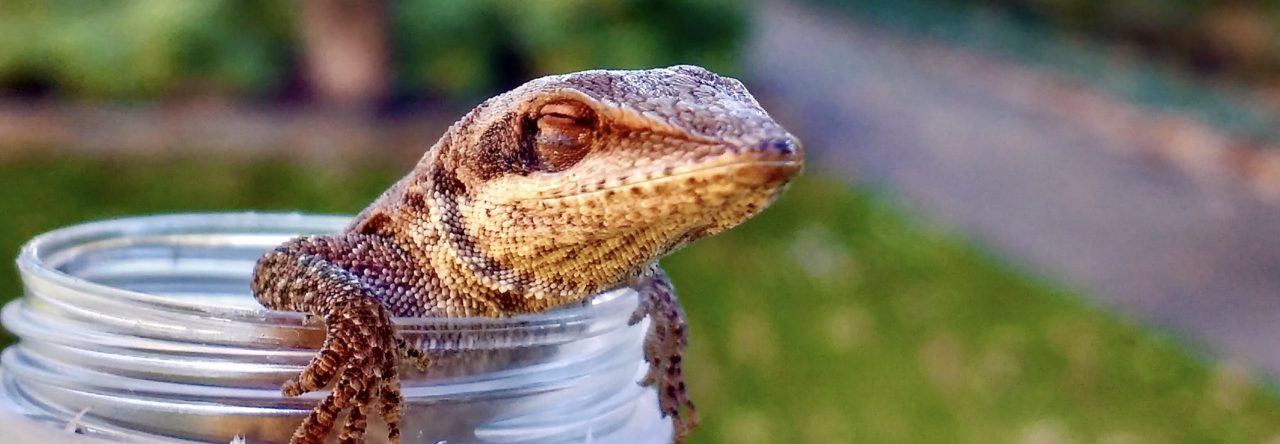
Greg Pauly, the world’s authority on the anoles of California [1,2], kindly passed this information along to AA:
Category: All Posts Page 53 of 153
Evolution 2018 may have been a week and a half ago, but the fun doesn’t have to stop just yet. Shane Campbell-Staton reports on the talk by Guin Wogan:
As we all know by now, contemporary climate change is expected to cause problems for species across the globe. Understanding the mechanisms that will allow species to cope with these changes, through acclimation and/or adaptation, is one of the most pressing issues of contemporary biology. Reptiles, and lizards in particular, have been a model for studying the effects of climate on extinction, gene flow, performance, and adaptation. Yet, only recently have we really begun to understand the genetic mechanisms associated with survival and persistence in the face of changing environments. In this year’s Epigenetics and Adaptation session of the Evolution Meeting, Guinevere Wogan – a postdoctoral researcher in Ian Wang’s Lab at UC Berkeley – presented a first look at how variation in the epigenome correlates with climate variation with and between anole species.
Wogan et al. used reduced representation bisulphite sequencing to search for epigenomic associations with environment in two wide ranging species – Anolis cristatellus on Puerto Rico and Anolis cybotes on Hispaniola – both species that occur in a wide variety of habitats from cool, wet forests to dry, arid scrubland. They found some indication of convergent methylation profiles under similar climates within species, suggesting epigenetic signals may be important for acclimation and/or adaptation to local climate. However, this association was not perfect potentially due to habitat use differences between populations. Additionally, they found that variation in climate between populations explains a large degree of variation in methylation profiles between popualtions within each species (75.6% in A. cristatellus and 39.1% in A. cybotes), again suggesting an important role of epigenetic modification in contributing to survival in local environments. However, local climate isn’t the only factor effecting variation in epigenetic modification; they also found strong species level differences in methylation, even when populations occurred in similar environments.
As they continue to work on this study, it will be very exciting to see what further patterns emerge. As we collectively seek to better understand the mechanisms involved in environmental adaptation and acclimation, Wogan et al. are exploring an extremely understudied aspect of Anolis biology that is bound to shed valuable light on the subject. I’ll certainly be on the lookout for this manuscript in the near future.
I kept Anolis onca, as a hobbyist, in the late 90s; they were available via European breeders who had obtained them on Isla Margarita, Venezuela. I had some breeding success with them at that time, and have always found them fascinating. I assumed their range was specific to Margarita Island, but only later via Anole Annals saw a photo from Manaure and realized that they were also found in Colombia. I travel frequently to Colombia and know that area of the northeast where the photos were taken, so when I was in the area, I would look for them.
I first saw them about 4 years ago, during a day trip near Rioacha, the Departmental Capital of La Guajira. The first ones I saw were very small juveniles which were sunning themselves in very thick piles of discarded branches, and so were difficult to catch, handle and photograph. In a subsequent trip in 2017, I enlisted the help of some of the local Wayuu (the indigenous group that is predominant in that area of the country). They called them the “lizard that doesn’t move,” which is a very apt description of their habits.
The habitat in the region is characterized as being dry Chaparral (though with very few trees), and is very windy. While looking for Anolis onca, we would find nests of the local dove species, which choose to nest on the ground versus in the low lying trees probably due to the wind. The main shrub is a species of Milkweed, and animals were found within yards of the Ocean.
I am no newbie to looking for Anolis, but A. onca really is very different in its behavior compared to many of the anoles I had previously observed in the wild. While you often find them on the ground in the midst of thickets of vegetation on the beach, they are very slow and deliberate in their movements and as you approach them. They only seldom move when approached, even when you are very close to them. They are almost twig anole-like in their behavior and obviously rely on camouflage as their first line of defense.
Despite the sparse nature of vegetation in their habitat, ground dwelling habitats and relatively large size for an anole (about 4-5 inches SVL and 6-7 inches in TL), they are a challenge to find. I would estimate that we saw only one animal every 1.5 hours of searching (there were three of us actively looking). We probably saw nine over about 12 hours of searching.
I would be very curious to hear from others who have observed them in the wild, and if Anolis annectens, which is closely related, is similar in its habits.
Cities were hot at this year’s Evolution meeting because they provide valuable petri dishes for asking myriad evolutionary questions. For example, cityscapes tend to create and retain heat–the so-called urban heat island effect–resulting in significantly elevated temperatures in urban areas relative to nearby undeveloped landscapes. Hot cities thus provide scientists an opportunity for asking questions about how plants and animals adapt to tolerate high temperatures. These questions are especially relevant as the built landscape continues to creep into less-developed surroundings and the globe as a whole experiences year after year of record temperatures.
Dr. Shane Campbell-Staton and colleagues used steep thermal differences between cities and nearby forests in four municipalities in Puerto Rico to determine whether, and to what extent, lizards may have adapted to warmer temperatures in the city. First, they found that operative temperature does change: lizards in cities use warmer perches and they operate at higher body temperatures than their forest counterparts. When brought back to the lab, however, those city lizards did not continue to function better at higher temperatures than their forest counterparts.
So what might be underlying this thermal plasticity?
Campbell-Staton and his collaborators then brought lizards back to the U.S., bred them, and raised the offspring in common conditions. Surprisingly, they found that the differences they observed in the wild populations disappeared in the next generation, an indication that this thermal ability is a plastic response to the thermal environment.
This thermal plasticity observation generated another question: Is thermal plasticity the target of natural selection in urban heat islands? To investigate this, Campbell-Staton isolated and analyzed transcriptomes of skeletal muscles in lizards from the hot city and cool(er) forests. Indeed, after the lizards were subjected to controlled heat treatments in the lab, they found a suite of candidate genes that were expressed at different levels between the populations. More genomic wizardry is planned for the very near future.
The work is ongoing and a very exciting paper is coming together. Keep your eyes peeled because it will certainly make a splash. Additionally, if you’re interested in this kind of work, Campbell-Staton has just started a lab at UCLA and is actively recruiting new lab members. Shoot him an email here.
The anole dewlap is a powerful visual signal to attract sexual partners and repel rivals and predators. The diversity of dewlap color has fascinated researchers for decades, environmental lighting and species competition being among the potential drivers of its evolution. At the Evolution meeting in Montpellier, Winter Beckles, PhD student at the University of Miami, presented his great study on the bark anole. Anolis distichus invaded Miami through multiple introductions events. Intriguingly, these little lizards occupy a range of habitats and present polymorphisms in their dewlap color within populations.
For his PhD, Winter and his colleagues measured the reflectance spectrum of the habitat and of the dewlap of 20 to 25 males per population. They found a strong positive correlation between the relative abundance of habitat UV light and the UV light reflected by the dewlaps. But that was before Hurricane Irma hit Miami in September 2017. And what a destruction it was: the trees, the canopy, the plants and by consequence the habitat lighting, were affected by this catastrophic event.
Despite the obvious negative consequences of the hurricane, this event gave a great opportunity to test the effect of extreme habitat change in the variability of dewlap color in the bark anole. Thus, after Irma, Winter and his colleagues immediately returned to each field site to collect reflectance data of the habitats and dewlaps: Irma altered the light profiles across sites and the correlation between dewlap and ambient light disappeared. In order to track how the relationship between dewlap color and habitat lighting develops over time, Winter plans to collect data in 2018: maybe the correlation will be back. Looking forward to seeing the paper.
How do new species form? At ESEB 2018, Colin Donihue uses Anolis lizards to answer this fundamental question in evolutionary biology.
Anoles are known for their adaptive radiation in the Carribean and the corresponding diversification into distinct “ecomorph” categories. Each ecomorph is associated with distinct morphologies and behaviors that allow it to live easily in a different habitat. This pattern is repeated across the Greater Antillean islands, but what we see is the end result of an adaptive radiation – each ecomorph corresponds to a separate species.
Donihue and his co-authors embarked on an ambitious project to capture the beginning of an adaptive radiation. To do so, they turned to the ubiquitous brown anole, Anolis sagrei. As Anolis sagrei is found across the Bahamas in a variety of different habitats, you might expect to see them adapting to those different habitats through changes in morphology; in other words, looking at the early adaptation of Anolis sagrei populations in different habitats is a natural experiment reflecting the early stages of ecomorph development. And since Anolis sagrei is on islands across the Bahamas, there isn’t just one experiment, but several replicated ones. Donihue et al. could therefore also question the role of contingency vs deterministic evolution though their study.
The authors captured 20 individuals from coastal scrub, mangrove, and primary coppice forest habitat across 11 islands in the Bahamas, and measured a suite of morphological traits for all individuals; these traits include the “usual culprits” of ecomorph differentiation, such as forelimb length, hindlimb length, and lamella count. This effort resulted in an enormous data set that the authors could use to test whether brown anoles had adapted to the different habitats across all the islands.
So are the Bahamian brown anoles adapting along early ecomorph lines? Well…sort of. On any given island, lizards living in different habitats have different morphological characteristics. But, looking across islands, Donihue et al. observe different patterns of morphological specialization on each island. This suggests that contingency, in this case represented by the island of origin, is playing a large role in how the lizards adapt to the three different habitats.
In an interesting twist to the project, Donihue et al. used supervised machine learning to test whether lizards could be assigned to the correct habitat categories based on morphology. They found that this algorithm could assign lizards to their habitat correctly based on the input of their morphological measurements across islands. This result implies that determinism is playing a role in the specialization of these brown anoles, but may only be detectable when looking at a lizard’s holistic phenotype rather than any individual trait measurement. Looking forward to seeing the paper on these results!
Disturbance events can be important drivers of population dynamics for many different species. Puerto Rico, an island in the Caribbean, experienced two major disturbances over the course of a few years – a drought in 2015 and a hurricane in 2017 – that caused stress to the herpetofauna living in the region. The yellow-chinned anole, Anolis gundlachi, is particularly susceptible to disturbance events because it is a thermoconformer and vulnerable to dehydration. Johann Crespo-Zapata and his team wanted to track the population of yellow-chinned anoles in the tropical mountain forest of Sierra de Cayey during and after these disturbance events to determine how the population would change.
Johann and his collaborators counted A. gundlachi along four 30-meter transects to determine population size. The crew split its groups into adults (> 45 snout to vent length, SVL), large juveniles (20-45 SVL) and juveniles (<20 SVL). The team also collected precipitation levels using a local weather station to determine if each month had less rain than average, which is called a rain deficit. Following the population subsets over the last four years allowed Johann to understand how the population responded to hydric stress. He recorded a decrease in juvenile abundance as rain deficit increased (r = -0.352, p < 0.0482, n = 32), which suggests a decrease in recruitment. There was no overall trend for large juveniles in response to the drought. Adults displayed a similar pattern to that of juveniles, as they experienced a decrease in abundance with increased deficit. After a time lag, adults experienced an increase in abundance when the drought lifted (r = 0.4469, p <0.0024, n = 44) that could be attributed to increased mortality during the drought events.
Following this study period, hurricane Maria struck Puerto Rico, causing structural changes to the forest canopy and decreases in humidity. Immediately following the hurricane, Johann saw the anole abundance decrease to its lowest point. Johann plans to continue to follow this population for the foreseeable future to observe population dynamics in A. gundlachi populations following major hurricane disturbances. Understanding the population dynamics of these anoles is critical to comprehending how this species and others like it will cope with increased disturbance events that will become more frequent according to current climate change projections.

With Evolution 2018 kicking off this Saturday in Montpellier, we are putting out a last minute call for bloggers to help us cover the 9 anole talks/posters! Will you be attending? Want to contribute to the blog? Send me a message at kmwinchell@wustl.edu! We are happy to have you join the team whether or not you have blogged for us before!
For those of you following along at home, here’s a sneak peek of the action:
Kicking off the anole posters during the first poster session on Sunday will be Winter Beckles (“Habitat partitioning and signal divergence among non-native bark anoles in South Florida”), Colin Donihue (“How does an adaptive radiation begin? Contingency and determinism in Anolis sagrei ecological specialization”), and Timothy Thurman (“Phenotypic change in response to introduced predators and competitors: a field experiment with Anolis lizards”).
Monday starts off bright and early with a talk by Guin Wogan (“Replicated landscape level epigenomics and genomics of two Greater Antillean trunk-ground Anolis lizards”), followed by an afternoon talk by Carlos Infante (“Regulatory evolution, development, and convergence among Anolis lizards”). There is also a talk slated for Monday afternoon by Tony Gamble on “Sex chromosome evolution in lizards and snakes,” which I hear may feature some anoles, but will focus more generally on squamates.
All the rest of the anole action happens on Tuesday, starting with a talk by Shane Campbell-Staton (“Selection on thermal plasticity facilitates adaptation of city lizards to urban heat islands”), and ending with 3 posters during the evening poster session by Claire Dufour (“Evolution of the agonistic behavior as a first response to the recent interspecific competition between the invasive species –Anolis cristatellus– and the native–Anolis oculatus– in Dominica”), Kristin Winchell (“Urban Evolution Mid-Stride: Morphology and Performance of Urban Lizards”), and Yann Bourgeois (“Population genomics of green anole (Anolis carolinensis) reveals evolutionary forces shaping diversity in a reptile”).
Check back during the meeting as we rev up our blogging machine to cover all of this exciting new research! Also, make sure to follow along on Twitter by following Anole Annals (@AnoleAnnals) and the Evolution 2018 hashtag (#Evol2018)!
David Polly, vertebrate paleontologist extraordinaire, keeps an eye out for living organisms as well, but turns out his specialty really is the dead ones. Here’s the story: “Ironically I was trying to photograph a live anole on the University of Florida campus [in Gainesville] who was annoyingly reclusive while trying to avoid a swarm of ants. The Anolis escaped so I turned attention to the ants, who turned out to be engaged in Anolis reanimation.”
Check the new episode of the series “Chris & Z’Andy, the 2 anoles in Dominica ” published in PeerJ (Dufour, Herrel & Losos 2018)!
See also episode 1


