
Behavior Is a Motor and a Brake for Evolution

Tyson Research Center Seminar Series
Thursday, July 23
4 pm Central Time
Tune in to the Seminar live here; or come back later and watch the archived version.
Behavior Is a Motor and a Brake for Evolution
Tyson Research Center Seminar Series
Thursday, July 23
4 pm Central Time
Tune in to the Seminar live here; or come back later and watch the archived version.

Photo by: Jake Scott
Howdy y’all!
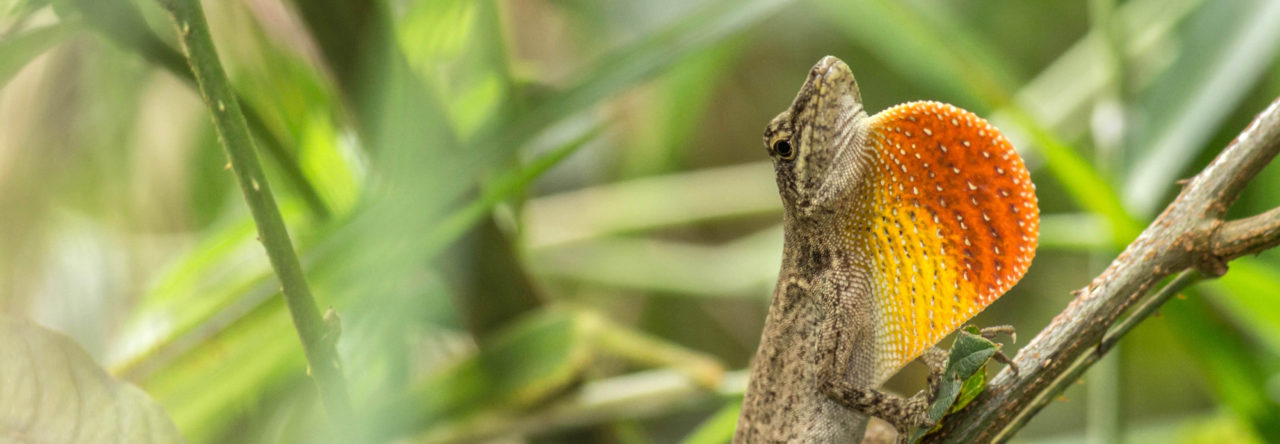
This week we’re going green again with probably one of the best anole names ever (next to apletophallus maybe). It is the trunk-crown anole, Anolis smaragdinus, the Bahamian Green anole.
Quick side note: It appears that some of the authors on this site (Jonathan), disagree about how awesome the name is.
Now it’s name translates to “emerald” from Latin, which is entirely fitting because it is a gorgeous green anole, with a GREEN (sometimes yellow-green) belly. Please forgive me for the gratuitous pictures of smaragdinus. I love a good green anole.

Photo by: Cleo Falvey

Like all its cousins it can change that green to drab brown, but it’s face is a bit more pointy and it has a red-orange or deep peach colored dewlap.

Photo by: Emily Powell
And as the name implies, this lizard is from and is endemic to The Bahamas.
There are two recognised subspecies, A. s. smaragdinus and A. s. lerneri. The main differences between them being an axillary (“armpit”) spot that A. s. smaragdinus has, and occasional chin spotting, and then their size. Anolis s. lerneri males are larger, with an SVL of up to 64mm and have a pointier head.

Photo by: Cleo Falvey
The Bahamian Green anole was observed in a study by Dr. Losos and colleagues where they were introduced to a small uninhabited islet that is occasionally (due to the tide) connected to a larger one by a strip of rock. These trunk-crown anoles are rarely found on the ground, but when Dr. Losos and his colleagues returned to the islet, the lizards had dispersed to and colonised the larger islet. This is a really interesting note because arboreal anoles aren’t often, if at all, observed going to ground and traveling to colonise such vegetation.
Bonus! Here’s a very yellow smaragdinus found by James T. Stroud and some more posts about this anole!


If you missed it in the theater (so to speak), you can now watch Anthony Geneva’s fabulous talk on anole genomics any time!
Here’s what it’s about:
Adaptation and speciation are largely responsible for the origin and maintenance of biological diversity but despite this central role in evolution, many fundamental questions about these interrelated processes remain. The adaptive radiation of Anolis lizards (anoles) is ideally suited for testing hypotheses about speciation and adaptation because they represent a replicated natural experiment. Anole species on the Greater Antilles that occupy similar ecological niches have independently evolved strikingly similar morphologies and behaviors. These ecomorphs have been the focus of decades of detailed analyses which strongly support the adaptive nature of this convergence. Nevertheless, we lack a clear understanding of how morphological adaptation contributes to speciation and we know virtually nothing about the genetic basis of these convergent traits.
In this webinar, Dr. Geneva presents ongoing research in his lab using anole genomes to investigate the processes of adaptation and speciation. He will detail the development of genomic resources for anoles including nine highly complete and contiguous reference genome assemblies and discuss NSF-funded plans to understand the genetic basis of morphological convergence in this group.

Back when this was originally posted in 2012, some viewers claimed to have seen a sixth anole. I can’t find it, but maybe you can!

Photo by Humberto Bahena Basave
Hey guys! As an international student and considering what’s happened recently, it’s been tough. But having happy things is really important right now and anoles are exceedingly wonderful lizards, I’m sure we all agree here. So I’m still going to do #DidYouAnole this week because I love doing it.
And we are continuing with the A. carolinensis series.
There are 13 species in this proposed group of anoles and they are all morphologically similar, so we’ve got a few more pointy headed anoles coming up. This week is Anolis allisoni, one of my favourites and it’s because of the blue mostly if I’m being completely honest. Look at it! Most of them look like they’ve been dipped in paint!
(Please don’t dip lizards in paint!)

Photo by Christopher Hampson
Anolis allisoni, also called Allison’s anole or the Blue-Headed anole, is found in Cuba where all anoles in this series are thought to originate from. It’s also found on the Bay Islands and Cayos Cochinos (Honduras), and Half Moon Caye (Belize). And guess where else they’ve been spotted now. I feel like I actually will go to Florida when the world is OK because it seems like 300 of the 436 recognised anole species live there now.
Anolis allisoni is capable of changing from green and blue to brown like A. carolinensis, and pretty quickly too. Only the males have this blue colouring and pink dewlaps, and the amount of blue varies by individual, as well as by population it seems, with those in Honduras having less blue than other locations. Like A. carolinensis, the females have smaller, more proportional heads, but they don’t have the white dorsal stripe that Green anole females tend to. Males typically have an SVL (snout-to-vent length) of 10cm, while the females are about 7-8cm.

Look at that little bit of pale blue on this A. allisoni compared to the intense blue on the first! (Photo by Christian Grenier)

And then this individual has his blue like racing stripes! (Photo by Shea Lambert)
Most female anoles lay their eggs in the dirt, and West Indian anoles follow a reproductive cycle where a period of inactivity aligns just about with colder months (October – February). Anolis allisoni however is one of the six species in Cuba that we know of to have communal nests, where all the females lay their eggs together! How cool is that!
They are also really good at pretending to be grass apparently. Check this older post and see how many you can find. I think I found the 5 Dr. Losos says there should be. For those of you that follow #FindThatLizard, I know Earyn didn’t have a challenge on this Wednesday, so maybe this can help!
Thanks for reading!

Photo by Víctor Vásquez-Cruz
Read all about it in this new paper, available online: Víctor Vásquez-Cruz. 2020. New prey records for the Atlantic Central American Milksnake Lampropeltis polyzona (Serpentes: Colubridae). Phyllomedusa 19(1):107–111.

The hatchling Brown Anole as discovered.
Animals spanning a wide taxonomic breadth often serendipitously appear in households and greenhouses after hitching rides in potted plants being transported (e.g., Perry et al., 2006). In Anolis lizards, this pattern is well-documented, especially in the notoriously successful invader, the Brown Anole (Anolis sagrei). Indeed, A. sagrei populations have been established outside of their native range widely across the globe, from Taiwan (Norval et al., 2002) to Bermuda (Stroud et al., 2017) to Angola (Ceríaco and Bauer, 2020).

The hatchling after plucked out of the pot!
In the northeastern United States, Anolis encounters are less common, but are occasionally reported. For example, most recently in January, a Green Anole (Anolis carolinensis) was reported from Cape Cod. On Monday, I was alerted to a hatchling Anolis sagrei in Anne Arundel County, Maryland that took a ride home from a Lowe’s in a mother-in-law’s tongue (Dracaena trifasciata). Where this individual originated from is unknown, but as Graham Reynolds (University of North Carolina Asheville) previously writes, do lizards in potted plants constitute range extensions? Echoing the sentiment of Graham, established populations in the states that ring the Gulf of Mexico are presumably assisting in leapfrogging expansions of anoles throughout the United States, further propelling the Brown Anole invasion. Where will A. sagrei turn up next?
Ceríaco, L. and Bauer, A. 2020. Geographic Distribution: Anolis sagrei (Brown Anole) in Angola, Africa. Herpetological Review. 51. 271.
Norval, G., Mao, J. J., Chu, H. P., and Chen, L. C. 2002. A new record of an introduced species, the brown anole (Anolis sagrei) (Duméril & Bibron, 1837), in Taiwan. Zoological Studies, 41(3), 332–335
Perry, G., Powell, R., & Watson, H. 2006. Keeping invasive species off Guana Island, British Virgin Islands. Iguana: Conservation Natural History, and Husbandry of Reptiles, 13, 273-277.
Stroud, J. T., Giery, S. T., and Outerbridge, M. E. 2017. Establishment of Anolis sagrei on Bermuda represents a novel ecological threat to Critically Endangered Bermuda skinks (Plestiodon longirostris). Biological Invasions, 19(6), 1723-1731.

Photo by Janson Jones
Hey there!
Welcome to #DidYouAnole on Anole Annals for the first time!
I talk about a new anole every week on Twitter (with really good GIFs) and now here too!
This week’s #DidYouAnole is in collaboration with #GuessThatSkull, so if you want a 3D look at an A. carolinensis skull, check it out!
Last week I talked about Anolis porcatus and that A. carolinensis wasn’t a distinct species, but that’s not its fault and it’s still worthwhile to talk about. Since A. carolinensis was described first, that would mean A. porcatus should become carolinensis. So they’re all A. carolinensis!
The American Green Anole or simply, the Green Anole, gets its name from its colour. As most of us know it’s usually green, but it can change to brown, olive shades, grey and can even be blue!

Green anoles display sexual dimorphism, which is when animals have different features based on their sex. Like peacocks and peahens! Females tend to be smaller and have more proportional heads, have a white stripe down their backs and may have a dewlap that is much smaller than a male’s.
(Juvenile males may also have this dorsal stripe though!)

Photo by Vicki DeLoach
A lot of people have remarked that their native populations of the Green anole have been disappearing due to the introduction of the Brown anole. While it is entirely possible that its population can be affected by A.sagrei, it’s also very likely that these anoles are just partitioning by habitat. That means that Green anoles (trunk-crown ecomorphs) used to roam freely, but now with another anole around, they’ve moved and further adapted to the trees and the Brown anoles (trunk-ground) stayed on the ground where they prefer and are very visible.
Brown anoles are totally jerks though.
Green anoles have a range of dewlap colours. Most commonly bright red to pink, but some populations in southwestern FL have grey dewlaps and are a subspecies, A. c. seminolus, and some in HI have lilac dewlaps. This has been noted a few times by observers and authors on Anole Annals.
Speaking of which, I’m super excited/scared to bring this to you here on Anole Annals. I love this website. I’ve been in articles on here before and now I get to share my anole fan-girling on here myself!
And speaking of the dewlap colours! I draw anole stickers and my carolinensis sticker is now available in grey, and lilac. And there’s a new anole friend waiting there for you too!
Thanks for reading!!

Bananaquit feeding from a cactus fruit opened by a brown-throated parakeet on the island of Bonaire in the Netherlands Antilles.
Call for contributors to a Caribbean-wide investigation of psittacine-vertebrate commensal relationships!
We are seeking ecologists who have observed vertebrates (here Anoles) feeding on items (fruits, cacti and other stem-sap, or flowers) that some wild native Caribbean psittacine (Macaw, Parrot, or Parakeet) has opened and/or discarded. By opening and/or discarding food items, some psittacines may routinely provide access to resources that might otherwise be out of reach or at least more costly to acquire.

Bananaquit feeding from a parrot-opened orange on the island of Dominica, eastern Caribbean.
We anticipate that the majority of our contributions will be anecdotal and opportunistic field observations. Our deadline to collect all submitted observations is December 1, 2020. All contributors in this project will be listed as co-authors on a manuscript tentatively titled: Caribbean psittacines as indirect controllers of ecosystem dynamics through commensal feeding associations. Here is a template that outlines the types of information that we are hoping to receive from contributors.
Above and to the left are two photos, as examples, of how psittacines provide opportunities for birds to find food (sugary juice, pulp, and even insects) by opening fruit in both an agro-ecosystem and a natural dry forest system.
Please contact Leo Douglas at lrd2107@columbia.edu or leo.douglas@nyu.edu with any questions or for further information. Looking forward to hearing from you!
Powered by WordPress & Theme by Anders Norén
